
Key Takeaways
- Written notice at least 14 days before surveillance commences is mandatory under the Workplace Surveillance Act 2005 (NSW).
- Cameras must never record inside toilets, change rooms or lactation rooms — there are no exceptions for any employer.
- Covert cameras require a magistrate-issued covert surveillance authority and are limited to suspected unlawful activity.
- Breaching the Act is a criminal offence carrying fines up to $22,000 for corporations and potential imprisonment.
- Signage, secure footage storage and Privacy Act 1988 handling practices strengthen your compliance position.
What Is the Workplace Surveillance Act 2005 (NSW) and Who Does It Apply To?
The short answer is that lawful workplace CCTV in New South Wales depends on the Workplace Surveillance Act 2005 (NSW), which requires employers to give every affected employee written notice at least 14 days before camera surveillance begins. Cameras must never record in toilets, change rooms or lactation rooms, and covert monitoring is banned without a court-issued authority. For businesses in Newcastle, Adelaide and across Australia, following this checklist keeps your security coverage legal and your staff informed.
This guide explains exactly what the Act requires before a single cable is run: who must be notified, what the notice must contain, where cameras can legally point, when hidden cameras are ever permitted, how recorded footage must be handled, and what happens if you get it wrong. Whether you run a retail store in Parramatta, a warehouse in Wetherill Park or an office in the Sydney CBD, these rules apply to your installation.
Do You Need Written Notice Before Installing Workplace Cameras in NSW?
The [[workplace-cctv-in-nsw-vs-victoria-comparing-surveillance-laws-for-employers|Workplace]] Surveillance Act 2005 (NSW) is the principal piece of legislation regulating employee monitoring in New South Wales. It covers three forms of surveillance: camera surveillance, computer surveillance (including email and internet use) and tracking surveillance such as GPS devices fitted to company vehicles.
The Act applies wherever employees perform work for an employer based in NSW. That includes offices, retail shops, warehouses and distribution centres, construction sites, hospitality venues, commercial kitchens, medical practices and factories. It applies to full-time, part-time and casual workers alike — if a person performs work at your premises, they are generally covered by the notification requirements.
It is worth understanding why the legislation exists. Employers have a legitimate interest in protecting stock, cash, equipment, staff and customers. Employees, however, retain a reasonable expectation of privacy while at work. The Act draws the line between those two interests by demanding transparency: surveillance is permitted, but only when it is openly declared, properly targeted and used for legitimate purposes.
One important caveat for multi-state businesses: every Australian state and territory has its own surveillance laws, and they differ in detail. Victoria's Surveillance Devices Act 1999, Queensland's approach and the ACT's Workplace Privacy Act all operate differently. If you operate across borders, take advice for each jurisdiction. This article concentrates on NSW.
How Does the 14-Day Written Notice Rule Work for Employers?
The cornerstone of [[the-complete-cctv-compliance-checklist-for-australian-homes-and-businesses|compliance]] is written notice. Before any camera surveillance commences, the employer must notify each employee who will be affected, in writing, at least 14 days in advance. For new hires, the notice must be given before they commence work — you cannot rely on a probation period to delay it.
Critically, the notice cannot be vague. It must set out:
– The kind of surveillance to be carried out (camera, computer or tracking);- How the surveillance will be carried out;- When it will commence;- Whether it will be continuous or intermittent; and- Whether it will operate for a stated limited period or on an ongoing basis.
A one-line statement buried in an employment contract — 'the Company reserves the right to monitor the workplace' — does not satisfy the Act. Nor does a group email sent two days before go-live. The safest practice is to issue a standalone surveillance notice document, tailored to your actual camera plan, have each employee sign an acknowledgement of receipt, and file the signed copies with your HR records.
Remember that the obligation continues after the initial rollout. If you later add new cameras, reposition existing ones into new areas, or extend coverage from the shop floor into previously unmonitored spaces, issue fresh written notice covering the changes before they take effect. Treat your surveillance notice as a living document that evolves with your security system.
Where Can Cameras Never Be Installed Under NSW Law?
The Act contains an absolute prohibition with no employer exceptions whatsoever: cameras must never be installed or positioned so as to record in toilets, shower facilities or change rooms. This applies regardless of business size, industry, suspected misconduct or any other circumstance. Breaching it is a serious criminal offence.
Practically, this means your installer must map sightlines carefully. A camera mounted outside a change room door angled down a corridor can inadvertently capture inside the room when the door opens. Discuss camera angles explicitly during the design phase and confirm on paper that no prohibited area falls within any field of view, including partial or incidental views.
Should You Install Cameras Beyond the Prohibited Areas?
Outside the prohibited zones, placement should follow a principle of proportionality: cover areas where there is a genuine security, safety or operational purpose, and avoid surveillance whose main effect is watching individual employees work.
Generally defensible locations include building entrances and exits, loading docks, cash handling points and registers, stockrooms and storage areas, car parks, server rooms and plant rooms, and high-value goods displays. Each of these serves a clear protective function that an objective observer would accept as reasonable.
By contrast, mounting a camera directly above an individual workstation to monitor output, or positioning lenses to capture desks rather than doorways, is much harder to justify and risks breaching the Act's requirement that surveillance not be conducted for an improper purpose. If the honest answer to 'why is this camera here?' is 'to keep an eye on Sarah', reconsider the placement.
Staff break rooms and lunch areas occupy a grey zone. They are not expressly banned like toilets and change rooms, but coverage needs solid justification — for example, a documented pattern of theft from the staff fridge. If you do proceed, name the specific area in your written notice, keep the reasoning documented, and seek legal advice if you are unsure.
Can You Legally Use Covert Cameras in the Workplace?
Covert surveillance — any camera installed or operated without employees' knowledge — is prohibited under the Act unless the employer first obtains a covert surveillance authority issued by a magistrate. There is no self-help option here.
These authorities are granted only where there are reasonable grounds to suspect unlawful activity occurring at the workplace, such as theft or drug dealing, and where covert surveillance is genuinely necessary to investigate it. Even then, the authority typically runs for a limited period and covers specified areas.
If you suspect an employee of stealing, installing a hidden camera yourself is itself an offence, no matter how strong your suspicion. The correct course is to apply to the Local Court for a covert surveillance authority, ideally with legal representation. Evidence gathered without an authority may be unusable and exposes you personally to prosecution.
There is also a post-surveillance duty: once a covert authority expires, the employer must notify affected employees that covert surveillance took place, unless the magistrate orders otherwise. Because this entire area is legally delicate, professional guidance is essential before taking any step toward [[can-you-install-hidden-cameras-in-your-own-business-what-australian-law-says|hidden cameras]].
Why Do Signage, Storage and Privacy Law Obligations Matter?
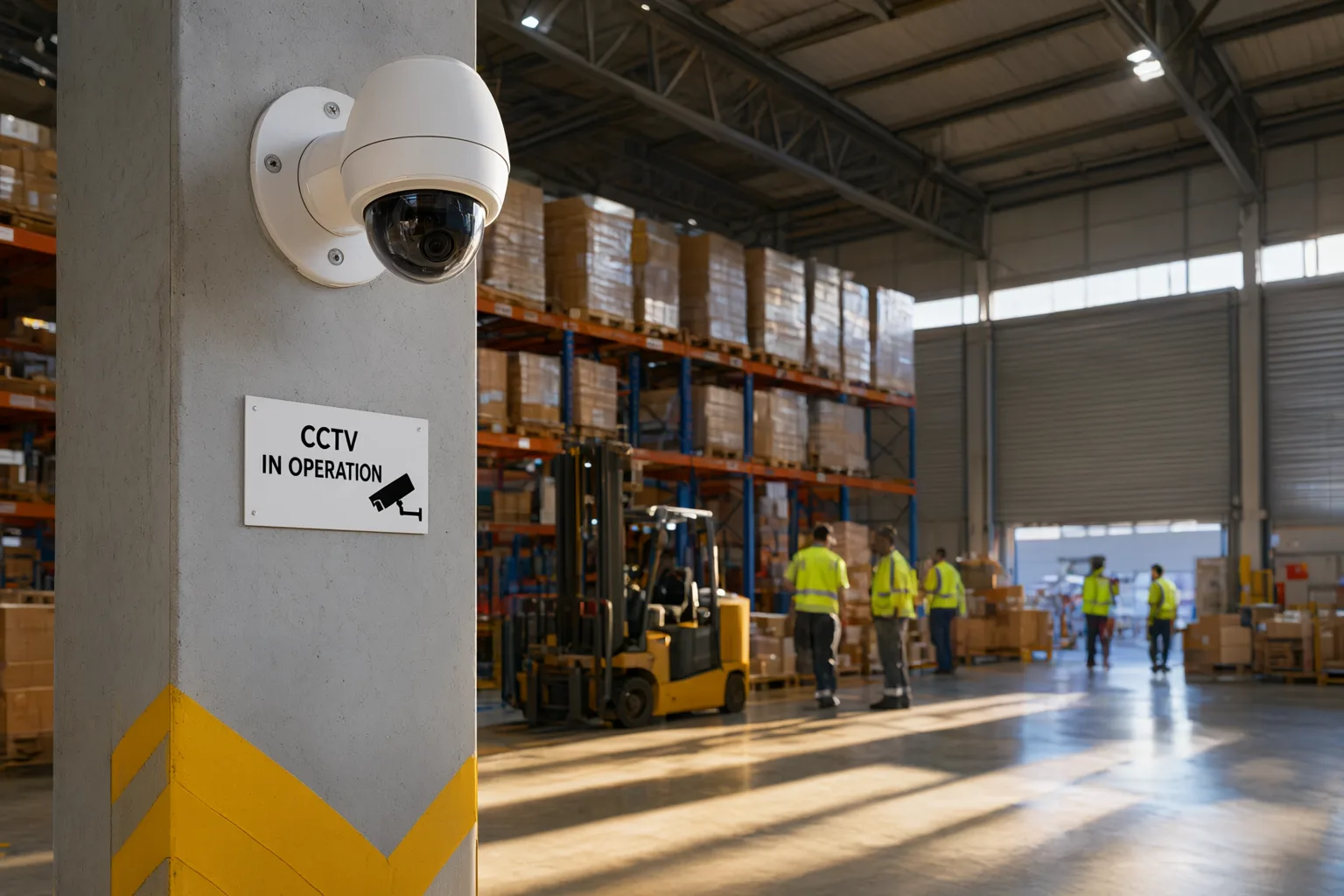
Written notice is the legal minimum, but visible signage remains strongly recommended. Clear signs at entrances and within monitored areas reinforce transparency, deter opportunistic misconduct, and help demonstrate good faith if your practices are ever questioned. Effective signage states that CCTV is in operation and identifies a contact person for enquiries.
Separately from the NSW Act, the federal Privacy Act 1988 (Cth) applies to footage handling. Businesses with annual turnover above $3 million must comply with the Australian Privacy Principles, and CCTV recordings of identifiable people constitute personal information. Businesses below that threshold are not strictly bound, but adopting the same standards is sensible best practice and protects your reputation.
In practical terms, responsible footage management looks like this: restrict access to authorised managers only; store recordings on a secure network video recorder (NVR) protected by strong passwords and, where possible, encryption; define a retention period — commonly 30 to 90 days — and delete footage automatically once it expires; never publish or share footage on social media or public channels; and handle police requests or legal disclosures through a documented process with records kept of what was released, to whom and why.
Are There Penalties for Breaching NSW Surveillance Laws?
Breaching the Workplace Surveillance Act is not merely an administrative slip — it is a criminal offence. Conducting surveillance without proper notice, filming in prohibited areas, or running unauthorised covert cameras exposes both the business and individuals involved, including directors and managers, to fines and personal liability.
There is a second, often overlooked cost: footage captured in breach of the Act may be ruled inadmissible in court proceedings or Fair Work disputes. Imagine documenting months of suspected stock theft, only to have the evidence thrown out because the cameras were installed without valid notice. The system fails at precisely the moment you need it most, and you carry the penalty on top.
The remedy is to build compliance into the installation process itself rather than bolting it on afterwards. A professional installer familiar with NSW requirements will design a layout that achieves your security objectives — entries, tills, stock areas, docks — while steering clear of prohibited and legally fragile placements, and will provide documentation that supports your compliance position.
Is Professional Installation Worth It for Compliance?
Retail store: A Sydney retailer wants coverage over the register, front entrance, stockroom and rear fire exit. All four are defensible security zones. The owner issues a standalone written notice naming each camera location, its purpose and the retention period, collects signed acknowledgements, installs signage at the entrance, and configures the NVR for 60-day retention. No camera faces the staff toilet corridor.
Warehouse: A logistics operator wants cameras over loading docks, racking aisles and the yard, plus dashcams in delivery vehicles. Dock and rack cameras fall under standard camera surveillance notice. Vehicle tracking triggers the tracking provisions of the same Act, so the written notice must disclose the GPS devices, their purpose and whether tracking is continuous. One notice can cover both, provided it describes each type accurately.
Office fit-out: A professional services firm wants lobby and server-room coverage only. Because no camera observes workstations, the proportionality argument is straightforward. The firm still issues the full 14-day written notice — the obligation applies regardless of how benign the coverage seems.
Suspected internal theft: A manager suspects till skimming and wants a hidden camera. The lawful path is an application to the Local Court for a covert surveillance authority, supported by evidence of reasonable suspicion. Self-installing a concealed device would commit an offence and likely render any footage unusable.
Trade-Offs Between Security Coverage and Employee Privacy
Every additional camera increases both protection and privacy exposure. More coverage means more personal information collected, longer review times, greater storage obligations and more surface area for a complaint or claim. Fewer cameras mean blind spots and weaker incident evidence.
The practical resolution is targeted design: modern analytics reduce the temptation to blanket-cover a site. Features such as AcuSense human and vehicle detection on Hikvision, Dahua and Uniview hardware let a small number of well-placed cameras alert you to genuine events instead of relying on wall-to-wall coverage. Motion-triggered recording and privacy masking — blurring parts of the frame in software — further shrink the privacy footprint without sacrificing security.
Resolution matters too. A 4K camera covering an entire dock from one position can replace three lower-resolution units, reducing the number of monitored zones while improving evidentiary quality. Fewer, smarter cameras are usually both cheaper to comply with and better at catching incidents.
How Professional Installation Supports Your Compliance Position
Compliance is easier to demonstrate when it is documented. At Aussie CCTV Cams, our five-step process begins with a consultation that addresses not only your security risks but your obligations under the Workplace Surveillance Act and the Privacy Act. We map proposed camera fields of view against prohibited areas, flag grey-zone placements for your legal review, and align the final layout with the description in your written notices.
We deploy professional-grade Hikvision, Dahua and Uniview equipment with intelligent detection so your system captures what matters — and nothing it shouldn't. Every installation concludes with a documented handover covering camera locations, settings, retention configuration and access controls, giving you a paper trail that substantiates your compliance if your practices are ever examined.
South Australian employers face a different framework. Instead of the NSW Act, [[/adelaide|Adelaide]] businesses operate under the Surveillance Devices Act 2016 (SA) and the Privacy Act 1988 (Cth), which govern how personal information captured on camera is collected, stored and disclosed. While South Australia does not impose the same 14-day written notice rule, best practice — and fair work expectations under consumer and employment law — still favour clear signage, documented policies and proportionate camera placement. An Adelaide warehouse owner installing cameras over loading docks should still brief staff in writing and restrict playback access to authorised managers only.
Budgeting matters as much as legality. In [[/newcastle|Newcastle]] NSW, a compliant four-camera system for a small retail premises typically costs between $1,800 and $3,500 installed, while larger commercial sites such as warehouses or farms may range from $5,000 to $12,000 depending on cabling runs, roof or eaves mounting, and weather-rated housings suited to coastal salt air and summer heat. Every quote we provide itemises equipment, labour and signage so you can demonstrate due diligence to auditors, insurers or Fair Work investigators.
Placement strategy should balance deterrence against intrusion. Mounting cameras under eaves or on brick facades protects hardware from storm damage and harsh sun, while positioning lenses toward entries, cash handling points and high-value stock avoids capturing break areas unnecessarily. Remember that footage of employees is personal information: under the Privacy Act 1988 you should retain recordings only as long as operationally necessary — commonly 30 to 90 days — and restrict who can review exports.
Finally, treat compliance as documentation, not paperwork theatre. Keep dated copies of the notices you issued, photographs of installed signage, a camera location map and a retention policy in one file. If a dispute ever reaches the Fair Work Ombudsman or a court, that evidence pack — combined with professionally installed, correctly positioned cameras — shows you acted reasonably and in good faith from day one.
Comparing common workplace camera options for NSW and SA compliance
| Camera Type | Typical Cost (Installed) | Compliance Notes |
|---|---|---|
| Visible dome (indoor) | $250–$450 per point | Ideal for retail counters and offices; pairs naturally with written notice and signage |
| Weather-rated bullet (outdoor) | $300–$550 per point | Suits Newcastle coastal sites and Adelaide heat; mount under eaves away from break areas |
| PTZ (pan-tilt-zoom) | $600–$1,100 per point | Flexible coverage for warehouses; ensure presets never sweep prohibited zones |
| Covert/hidden camera | Restricted use | Requires magistrate-issued authority in NSW; seek legal advice before any deployment |