
Key Takeaways
- Filming your own property is legal; deliberately capturing a neighbour's private areas is not.
- Audio recording without consent breaches listening device laws in every Australian state.
- Camera placement, signage and neighbour communication prevent most disputes.
- Renters and strata owners need landlord or body corporate consent before installation.
- Licensed installers cost roughly $600–$2,500 for typical home systems in Newcastle and Adelaide.
Is Australian Law Clear on Home CCTV Privacy Boundaries?
The short answer is that home CCTV privacy laws Australia are permissive: you can install security cameras on your own property without a licence, provided they mainly monitor your own land. Problems arise when a camera deliberately records a neighbour's backyard, windows or private conversations. Audio capture is far more restricted than video nationwide.
Every state and territory administers its own Surveillance Devices Act, and while the wording differs, the underlying principle is consistent: using an optical surveillance device to record private activities without consent is an offence. In New South Wales, for instance, installing or using such a device to observe a private activity can attract criminal penalties. What counts as 'private' depends heavily on context—someone sunbaking behind a two-metre fence has a far stronger privacy claim than someone walking along a public footpath.
Federal law adds context but rarely applies directly to households. The Privacy Act 1988 (Cth) governs businesses and organisations rather than residential users, so for homeowners the practical exposure comes from three sources: state surveillance statutes, trespass to land, and the tort of nuisance. If a neighbour can demonstrate your camera unreasonably interferes with their enjoyment of their property, courts can order you to reposition or remove it and award damages.
What Counts as a Reasonable Expectation of Privacy Under Australian Law?
Courts determine privacy expectations by looking at both the character of the space and the steps taken to shield it. A front yard open to the street carries minimal protection; a backyard enclosed by Colorbond fencing signals clear intent to keep activities private. Drawn blinds over a bedroom window make that space unmistakably private, whereas a front porch visible to passers-by generally does not.
The test is not purely physical visibility—it asks what a reasonable person would regard as private in the circumstances. When a [[my-neighbours-camera-points-at-my-yard-what-are-my-rights-in-australia|neighbour]] installs screening, hedges or high fences, they have effectively declared that space off-limits. Training a camera onto that area from an upstairs window, even where technically possible, is likely to cross the legal threshold because intent and positioning matter as much as sightlines.
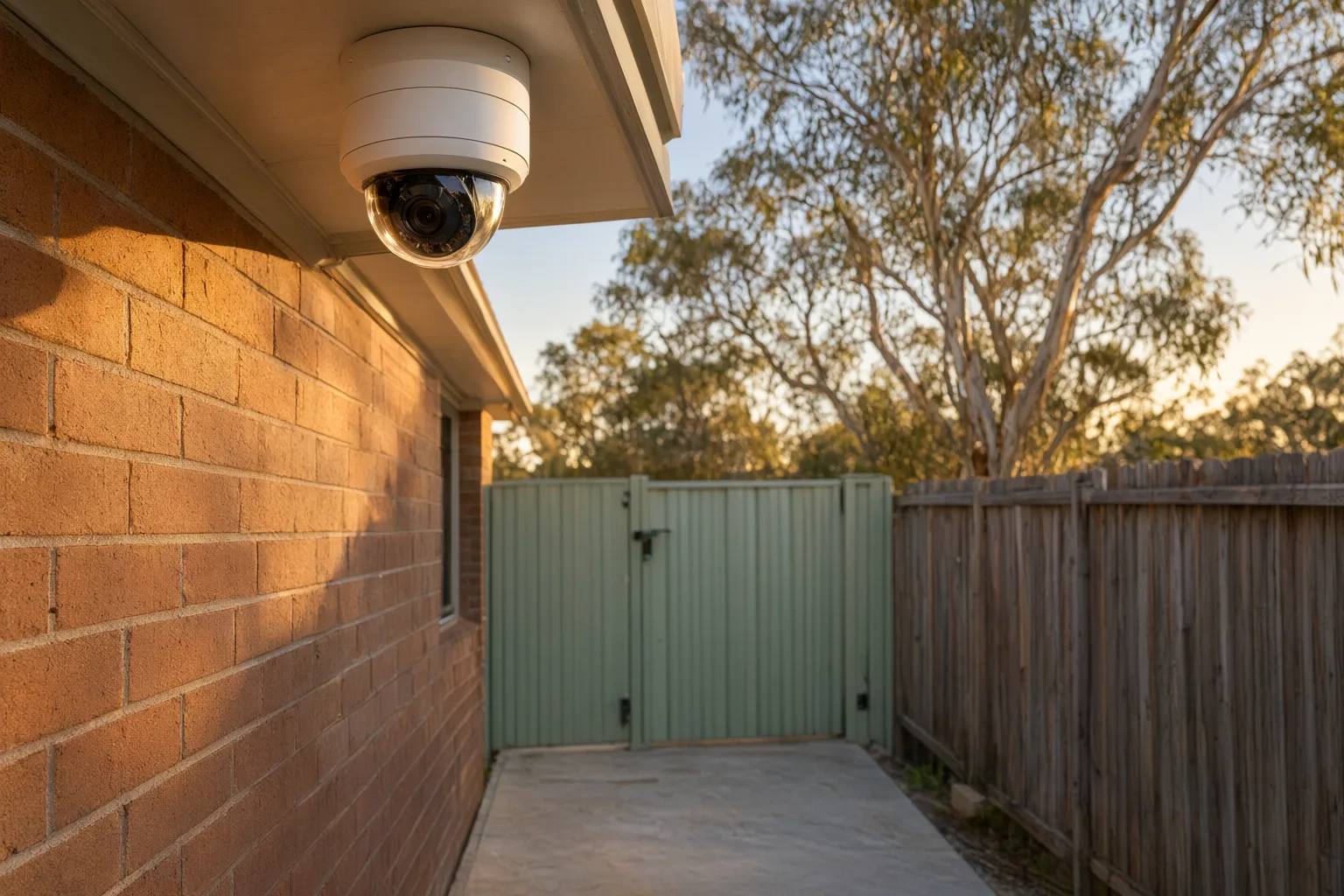
Concrete examples make the boundary easier to see. A camera covering your driveway that incidentally catches a strip of the neighbour's front lawn is normally fine. A camera fixed under your eaves and angled deliberately over their rear fence into their entertaining area is not. The distinguishing factors are purpose, mounting position, and the proportion of private versus public space falling within the frame.
Can Home Security Cameras Legally Record Audio in Australia?
Video surveillance occupies something of a grey zone; audio does not. Across all Australian jurisdictions, recording a private conversation without the consent of at least one party to it is illegal—and in some states every party must consent. This rule applies squarely to security cameras fitted with microphones, regardless of how lawfully the camera itself is positioned.
Surveillance Devices legislation in NSW, Victoria, Queensland and elsewhere treats [[covert-vs-overt-cctv-when-hidden-surveillance-is-permitted-in-australia|covert]] audio capture as a serious invasion of privacy. Penalties escalate with the seriousness of the breach and can include substantial fines or imprisonment. Homeowners frequently overlook this because modern cameras ship with microphones built in, creating a trap for anyone who enables sound capture 'just in case'.
Professional platforms from Hikvision, Dahua and Uniview include audio functionality, yet installers routinely leave it switched off by default precisely because of these restrictions. If you want audio at all, confine it to locations where no private conversation could plausibly occur—such as a front-gate intercom with clear visitor notification—or disable it entirely. A licensed [[licensed-vs-unlicensed-cctv-installation-why-security-licensing-matters-legally|installer]] familiar with local law can advise on what is defensible in your situation.
How Should You Position CCTV Cameras to Stay Compliant?
Thoughtful placement is the strongest protection against both legal exposure and neighbourhood friction. Begin by mapping your boundaries and listing the zones you genuinely need to watch: front door, driveway, side gates and vulnerable windows. Design coverage around those points first, then check whether any neighbouring windows, courtyards or fenced yards fall into view and adjust accordingly.
Modern recorders offer digital tools that help you stay on the right side of the line. Hikvision's AcuSense and Dahua's WizSense ecosystems support privacy masking, which blacks out chosen regions of the frame—so you can monitor your side path while digitally excluding the neighbour's kitchen window. Using these features demonstrates good faith if a complaint ever escalates.
Geometry matters too. Mounting a camera around three metres high and tilting it downward naturally limits how much street and adjoining land enters the frame compared with a horizontal aim. Wide-angle lenses cover more but demand more careful siting; varifocal lenses in the 2.8mm to 12mm range let you fine-tune coverage during installation so the frame ends where your responsibility does.
- Mount cameras to cover your own entry points, driveways, and perimeters first
- Use privacy masking to exclude neighbours' windows, doors, and private outdoor areas
- Avoid pointing cameras over fences, through windows, or into enclosed backyards
- Install visible signage: 'CCTV in operation' notices reduce disputes and may satisfy legal notification requirements in some contexts
- Choose cameras with adjustable lenses (2.8mm to 12mm varifocal) for precise coverage control
- Document your camera positions and angles in case a dispute arises later
Do Neighbour Complaints About CCTV Cameras Escalate Into Legal Disputes?
Treat any concern seriously from the first conversation. Most disputes sour because one side dismisses the other's worries outright. Offering to show the live feed or walk them through your coverage map often resolves things quickly—many complaints stem from assumptions about spying when the truth is simply a wide lens capturing more than intended.
If concerns persist, neighbours have several avenues. Councils rarely intervene unless planning controls apply, such as heritage overlays or strata by-laws, but police can investigate suspected breaches of surveillance legislation. Civil action is also available: a court can grant an injunction requiring removal or repositioning of a camera, alongside damages for nuisance or invasion of privacy.
Strata and community title living introduces further obligations. Townhouse, apartment and gated-community residents should review their owners corporation or body corporate by-laws before mounting anything externally. Some schemes require prior approval for visible cameras, particularly those overlooking common property or other lots, and ignoring those rules can end in removal orders at your own expense.
Should You Notify Neighbours Before Installing Home CCTV?
No national rule obliges homeowners to notify neighbours before installing residential CCTV, but transparency pays dividends. A short conversation before installation—explaining what you monitor and how angles were chosen to respect their privacy—prevents months of tension later. Most people respond well to straightforward courtesy.
Signage serves several purposes even where not strictly required. A clearly displayed 'CCTV in operation' notice deters intruders, signals that your surveillance is overt rather than covert, and strengthens your position if cameras incidentally capture footpaths or shared spaces. In commercial contexts, signage is effectively mandatory under Australian Privacy Principles; while homes face lighter requirements, adopting the same practice is low-cost insurance.
Fixed residential cameras operate in a less regulated space than body-worn devices or dashcams, each of which carries its own state-specific rules. Still, whenever your system records beyond your boundary—street, footpath, adjoining land—visible signage helps demonstrate you are not attempting hidden observation, which matters if a dispute ever reaches police or a court.
Are There Extra Rules for Renters and Strata CCTV Installation?
Renters must clear additional hurdles. Standard tenancy agreements require landlord consent for alterations, and hardwired CCTV installations almost always qualify—even screw-mounted wireless cameras can technically breach a lease. Always obtain written permission, and expect negotiation over placement plus an obligation to remove equipment when the tenancy ends.
Landlords who install cameras at rental properties face a dual compliance burden spanning surveillance laws and residential tenancy legislation. Recording inside an occupied tenanted home without consent is a clear breach. External cameras watching common areas such as driveways or shared laundries can be permissible, but tenants must be informed and lenses must never intrude on private spaces like courtyards or windows.
Strata schemes differ widely in their approach. Some by-laws ban external cameras altogether; others permit them subject to owners corporation approval. Any camera capturing common property—shared drives, gardens, entry foyers—will almost certainly need sign-off first. Proceeding without approval risks orders to dismantle the system at your cost, potentially accompanied by fines.
Which CCTV Installer Best Protects You Under Home CCTV Privacy Laws Australia?
A licensed, insured installer contributes more than technical competence—they bring working knowledge of the legal landscape. Experienced professionals perform sightline analysis, configure privacy masking, and design systems that secure your property without drifting into a neighbour's private space. They have seen the fallout from badly sited DIY cameras and know exactly which mistakes to avoid.
Professionals also future-proof your setup. They will set up privacy zones, switch off audio where appropriate, and document camera positions and angles so evidence exists if questions arise later. Should a neighbour complain, being able to show that a qualified tradesperson designed the system with privacy compliance in mind is a powerful rebuttal to accusations of deliberate intrusion.
At Aussie CCTV Cams, our five-step process begins with a detailed site consultation mapping coverage areas, flagging potential privacy conflicts, and recommending positions that satisfy both your security needs and your legal duties. We fit professional-grade Hikvision, Dahua, Uniview and Axis systems featuring AcuSense person detection and ColorVu night vision—technology that delivers genuine security without needing to watch every corner of the street.
Costs matter when planning a compliant system. In [[/newcastle|Newcastle]] NSW, a typical four-camera residential installation on a brick home ranges from $1,200 to $2,200 including cabling, mounting under the eaves and basic configuration. [[/adelaide|Adelaide]] SA prices are similar, with premium 4K systems with audio disabled by default reaching $2,500 to $3,500. Always get a quote tailored to your property layout, roof type and coastal exposure.
Weather resilience is part of compliance planning too. Coastal homes near Merewether or Glenelg face salt-laden air that corrodes cheap housings, while inland suburbs endure summer heat above 40°C that can degrade camera sensors. Mounting cameras under eaves protects them from storm damage and sun glare while also naturally angling lenses away from neighbouring properties—a neat alignment of durability and privacy law.
The Privacy Act 1988 does not generally apply to individual homeowners recording for personal security, but it does apply if your footage feeds into a business context, such as a home-based commercial operation. Workplace surveillance laws in NSW and South Australia impose notification duties where employees are monitored. If you run staff from a home office or warehouse, signage and written notice become mandatory rather than optional.
Consumer law adds another layer of protection when buying systems. Under Australian Consumer Law, installers must supply equipment fit for purpose, so a camera that fails within warranty after one humid Newcastle summer should be repaired or replaced at no cost. Keep invoices and written quotes—these documents also help demonstrate good faith if a neighbour dispute ever reaches a tribunal.
For farms and rural properties around the Hunter or Adelaide Hills, boundary lines are often long and informal, making accidental over-capture common. A simple site plan marking each camera's field of view against survey pegs prevents disputes before they start. Many insurers now offer premium discounts for professionally installed, compliant systems, which helps offset the upfront investment.
Compliant CCTV options for Australian homes
| Option | Typical Cost (AUD) | Privacy Compliance |
|---|---|---|
| 4-camera wired system (Newcastle/Adelaide home) | $1,200–$2,400 | Audio disabled, privacy masking configured |
| Wireless DIY kit | $400–$900 | Riskier—default audio often enabled; check settings |
| 8-camera business/warehouse system | $3,000–$6,000 | Signage required under workplace surveillance rules |
| Doorbell camera only | $250–$500 | Angle carefully to avoid neighbour's entry |