
Key Takeaways
- Full-duplex two-way audio cameras let you hold natural conversations with visitors via Hik-Connect or DMSS apps.
- Australian couriers deliver mostly on weekdays, so remote talk-through stops parcels returning to the depot.
- NSW Surveillance Devices Act restricts recording private conversations, so signage and mic placement matter.
- IP66/IP67 rated cameras with ColorVu sensors keep audio and full-colour video working after dark in Australia.
- Professional installation by a licensed NSW security technician typically takes three to five hours per home.
- Hardwired two-way CCTV avoids the subscription fees common with battery video doorbells sold in Australia.
What Is a Two-Way Audio Security Camera?
A two-way audio CCTV camera is a security camera with a built-in microphone and speaker that lets you watch live video and speak to visitors, couriers or intruders directly from your phone, wherever you are. It turns any entrance into an answered door, letting you give delivery instructions, greet guests or issue warnings without being home.
This marks a genuine shift in what home security can do. Conventional CCTV was always a silent observer: it recorded events but could never influence them. With two-way talk, the camera becomes part of the conversation. You can tell a delivery driver where to leave a parcel, ask a caller to identify themselves, or let an intruder know they have been spotted and recorded.
Crucially, this capability is not limited to consumer gadgets. Professional outdoor turret and bullet cameras from Hikvision, Dahua and Uniview include two-way audio as standard on many models, engineered to keep working through rain, summer heat and coastal salt air, day and night.
How Does Talking Through a Two-Way Audio Camera Actually Work?
The process is straightforward. When someone approaches your entrance, the camera detects motion or an AI-recognised person and sends a push notification to an app such as Hik-Connect or DMSS. Open the alert and you see live video; press the talk button and your voice plays instantly through the camera's speaker.
Everything travels over your broadband connection at home, or over mobile data when you are out, so distance is irrelevant. On a properly installed system the delay is usually less than a second, making it feel like an ordinary phone call. Because audio runs through the same recorder that stores your footage, conversations can be archived alongside the matching video.
It helps to understand the two communication modes. Half-duplex behaves like a walkie-talkie: one party speaks at a time. Full-duplex, available on higher-specification cameras, allows both sides to speak simultaneously just like a normal call. For entrances where real conversation matters, we specify full-duplex models.
Can You Really Manage Deliveries Without Missing a Parcel?
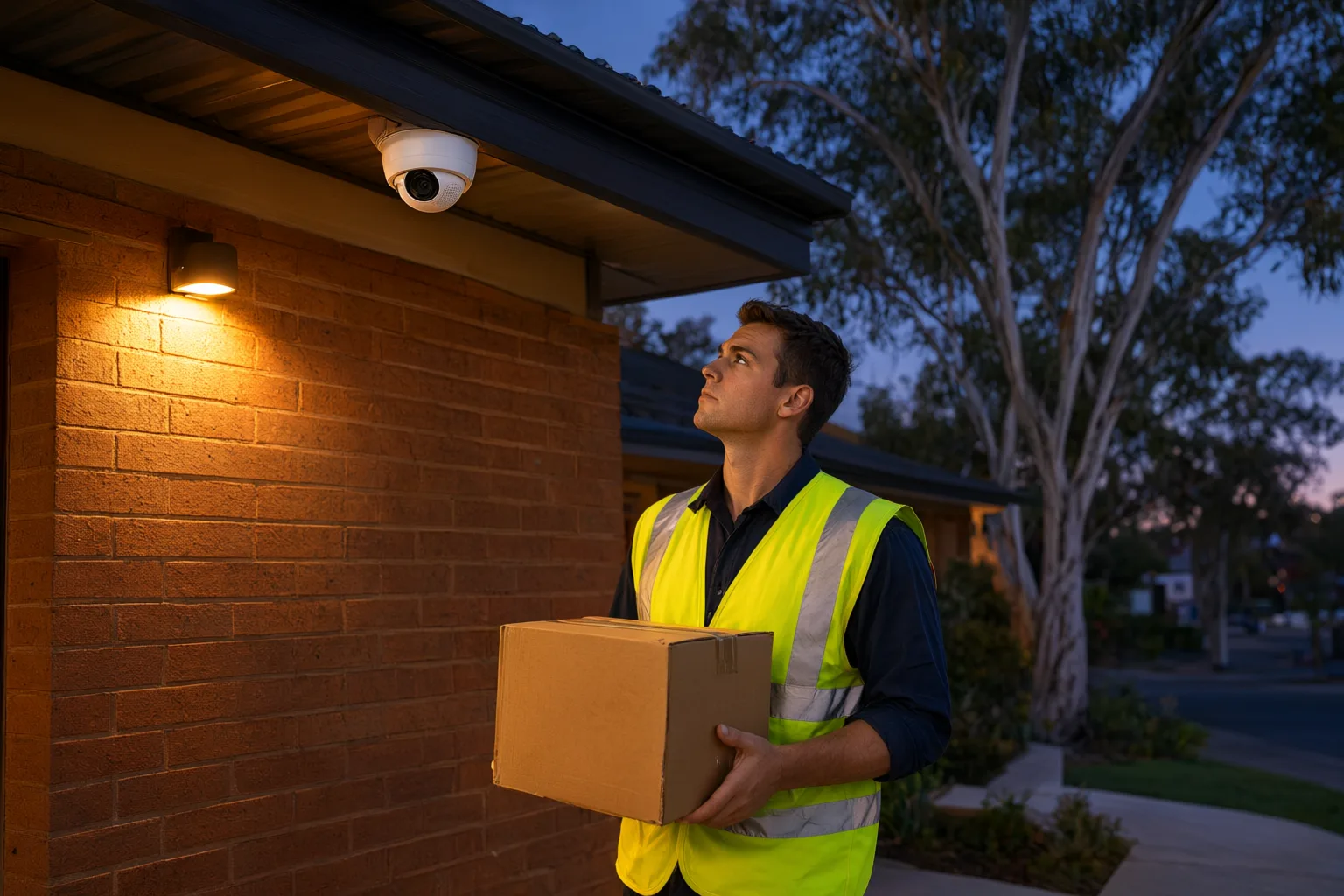
Missed deliveries are the number one frustration for online shoppers. Australia Post, Amazon and private couriers frequently arrive during work hours, and an unattended parcel either goes back to the depot or sits exposed on the porch. With a two-way audio camera you can answer the knock from your desk, tell the driver exactly where to leave the item, and watch them place it safely.
Many clients take this further by linking the camera to a smart gate or garage controller. The sequence becomes: courier arrives, you speak to them, the gate opens remotely, the parcel goes inside, and the gate closes again behind them, all observed live from your phone.
For households in regional areas or on acreage blocks, a two-way camera at the front gate removes long walks to the roadside and lets you admit expected guests without leaving the house.
Should You Screen Visitors Before Anyone Opens the Door?
Answering the door to an unknown caller is one of the more vulnerable moments at home, particularly for people living alone, shift workers sleeping during the day, and children arriving home from school before their parents.
With two-way audio, nobody needs to open anything. You can view the caller, ask who they are, request identification from anyone claiming to be a tradesperson, and verify their story against a booking or invoice, all before a lock is touched. An unexpected salesperson can be politely turned away without any face-to-face contact.
Families find everyday uses too: letting teenagers know you are five minutes away, confirming an elderly relative's care worker has arrived, or reassuring a dog that will not stop barking at the fence line.
Why Does Speaking Through Your Camera Scare Off Intruders?
Convenience aside, the [[solar-powered-security-cameras-are-they-worth-it-for-australian-conditions|security]] value of two-way talk is considerable. Opportunistic burglars count on an empty, quiet house. A voice suddenly announcing that the occupant is watching, that the incident is being recorded and that police have been contacted destroys that assumption immediately, and research consistently shows visible cameras combined with audible warnings push offenders toward easier targets.
Smart detection makes this far more usable. Cameras featuring Hikvision AcuSense or Dahua WizSense apply AI to separate genuine people and vehicles from cats, shadows, rain and swaying branches, so the 2am alert on your phone actually matters. Selected models add active deterrence: a strobing light, siren or pre-recorded spoken warning triggered automatically when someone enters a restricted zone outside permitted hours.
Commercial sites benefit equally. After-hours trespass, vandalism and loitering can often be ended by a live voice challenge from the owner or a monitoring operator stating that the premises are alarmed and response is on the way, preventing damage before it starts.
Which Suits You: Video Doorbell or Full CCTV Camera?
Most Australians encounter two-way audio first through a [[video-doorbells-vs-traditional-cctv-cameras-which-does-your-home-need|video doorbell]], and these devices do have a place. However, a doorbell watches a single position, typically depends on a rechargeable battery, and commonly reserves features such as saved footage behind a monthly subscription.
A professionally installed CCTV camera with two-way audio draws power over PoE cabling, records continuously to your own NVR with no ongoing fees, and can be mounted anywhere on the property: front door, rear gate, driveway, garage or shed. The hardware differences matter too. Professional units use noise-reducing microphones and louder speakers built to cut through traffic and wind, and because they are hardwired they never drop offline due to a flat battery or unstable Wi-Fi.
In practice, the strongest setup for most homes combines both: a doorbell for front-door convenience plus perimeter two-way cameras, all feeding one recording system.
Is Recording Audio Legal Under NSW Surveillance Laws?
Because these cameras capture sound as well as vision, legal obligations apply. Under New South Wales' Surveillance Devices Act, recording a private conversation you are not part of is restricted. For householders, the practical steps are simple: make it obvious that audio-equipped cameras operate on the property using clear signage, and aim microphones away from neighbouring homes and public spaces where people reasonably expect privacy.
Speaking directly to a visitor through the camera is generally unproblematic because you are a participant in that exchange. The grey zone is passive capture of other people's conversations, which should be avoided.
During consultation we assess camera positions and audio settings for compliance, and where circumstances require it we can switch off continuous audio recording on individual cameras while keeping video active.
Do You Know What to Look For in a Two-Way Audio Camera?
Hardware quality determines whether remote conversation feels natural or frustrating. Prioritise full-duplex audio, a speaker loud enough to be understood clearly at two to three metres outdoors, and an IP66 or IP67 ingress rating suited to Australian weather. Combine this with strong imaging: ColorVu-style sensors retain full colour after dark, so you can genuinely see the person you are addressing at night rather than a monochrome silhouette.
[[what-does-a-professional-home-cctv-installation-cost-in-2025|Installation]] technique matters just as much. Mounting height and angle affect how well the microphone captures speech, and eaves or brackets can muffle the speaker. Wind is the biggest enemy of outdoor audio, so sheltered positions and built-in noise suppression deliver noticeably better results.
Are Five Steps Enough for a Professional Installation?
Every system we install follows a proven process handled by licensed, insured NSW technicians. It begins with a consultation to understand your property and priorities, followed by a tailored system design covering camera placement, cabling routes and app configuration.
Installation itself uses PoE cabling so a single run carries power, video and audio with rock-solid reliability. We then configure your network, connect the mobile apps and test two-way talk from multiple locations. Finally, a full handover trains everyone in the household on answering calls, reviewing playback and adjusting alerts.
All installations include lifetime support, and quotes are free with straightforward advice on whether a doorbell, dedicated CCTV cameras, or a blend of both best fits your home and budget.
Video Doorbell vs Professionally Installed Two-Way Audio Camera
| Feature | Video Doorbell | Professional Two-Way Audio Camera |
|---|---|---|
| Power source | Battery or low-voltage wiring | Hardwired PoE, always powered |
| Recording | Event clips, often subscription-gated | Continuous NVR recording, no subscription |
| Coverage | Front door only | Gates, driveway, garage, shed, full perimeter |
| Audio quality | Basic speaker, struggles with street noise | Noise-reduction mic and louder outdoor speaker |
| Night performance | Black-and-white infrared | Full colour at night with ColorVu |
| Smart detection | Simple motion zones | AI person and vehicle detection (AcuSense, WizSense) |
| Reliability | Dependent on Wi-Fi signal and battery charge | Wired connection, performs in all weather |
| Best suited to | Convenience at one entrance | Whole-property security with live two-way talk |