
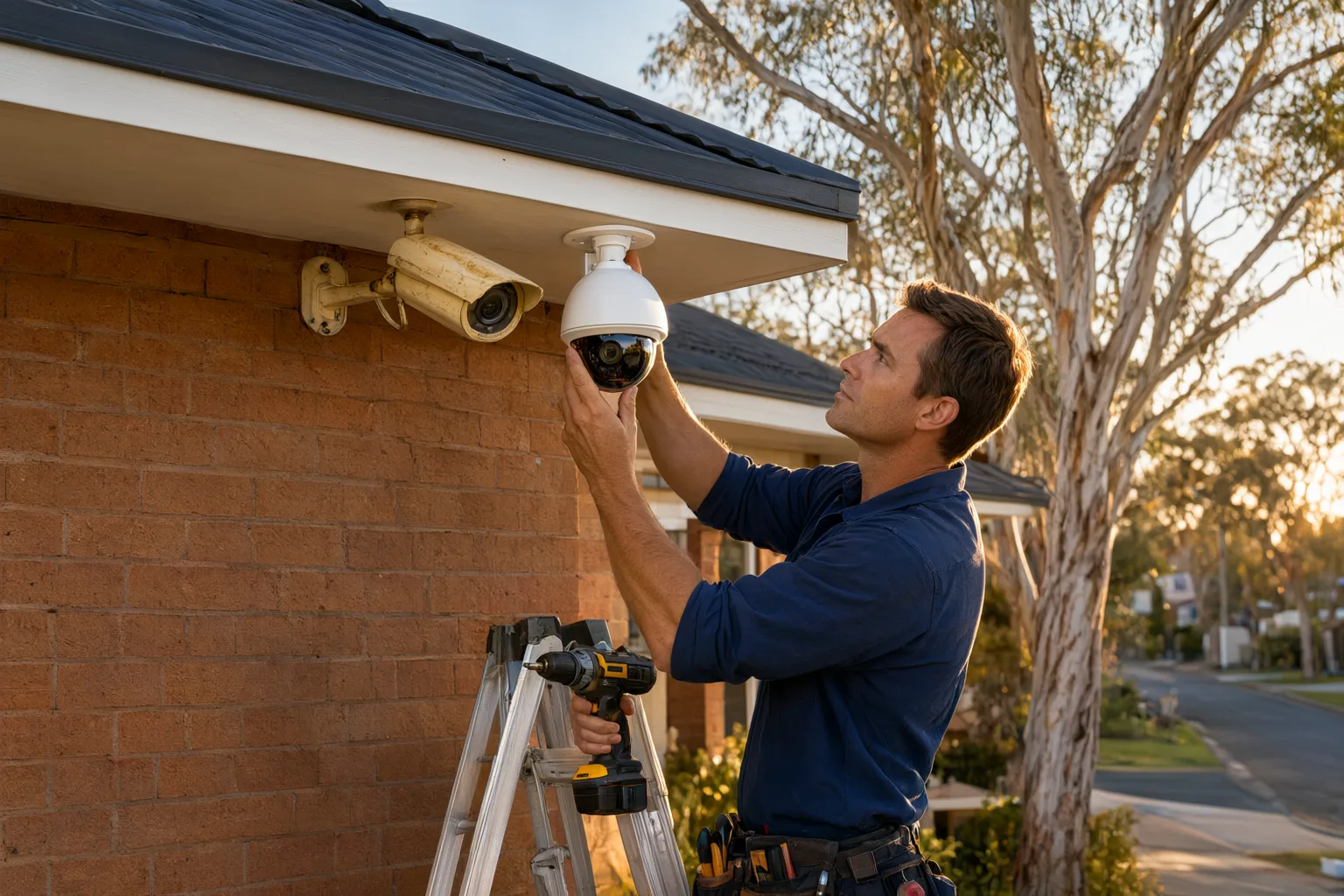
Key Takeaways
- Most Australian CCTV systems reach end of life at 7-10 years, so plan a CCTV system upgrade before failure.
- If footage can't identify faces or number plates day or night, your cameras have failed their core purpose.
- A typical residential CCTV system upgrade cost in Newcastle NSW ranges from $1,500 to $4,000 installed.
- NSW installers must hold a Class 2C Security Licence under the Security Industry Act 1997 (NSW).
- Modern AI detection cuts false alerts from spiders, trees and headlights by distinguishing people and vehicles.
- Coastal salt air in Adelaide accelerates corrosion, making weather-rated IP66+ hardware essential for upgrades.
What Are the Warning Signs You Need a CCTV System Upgrade?
You should upgrade your CCTV system when it can no longer produce clear, usable footage: blurry recordings that miss faces or number plates, cameras that flicker or drop out, no smartphone viewing, useless night vision, or a recorder older than seven years. For most Australian homes, a CCTV system upgrade costs between $1,500 and $4,000 installed — far less than the cost of unusable evidence after a break-in.
This guide walks through each of these ten warning signs in detail, explains why ageing systems create real security risk rather than mere inconvenience, and shows what a professionally installed modern IP system delivers for Australian homes and businesses.
Why Is an Outdated CCTV System a Genuine Security Risk?
Across Australia, countless homes and small businesses still rely on [[the-hidden-costs-of-cheap-wireless-cameras-vs-professional-poe-systems|camera]] systems fitted eight, ten or even fifteen years ago. They power up, they record, and everything looks fine on the surface. The problem only reveals itself when something actually goes wrong: a break-in, a vandalism spree, a liability dispute. That's when owners discover the recording is too grainy to identify anyone, the hard drive quietly died weeks earlier, or the camera watching the side gate has been offline for months.
A security [[the-hidden-costs-of-cheap-cctv-systems-and-why-they-fail|system]] that cannot produce usable evidence is arguably worse than having no system at all, because it breeds false confidence. Insurers, police forces and courts now expect sharp, time-stamped, high-resolution recordings as standard. If your current setup falls short of that benchmark, it isn't protecting you — it's lulling you into a false sense of safety while consuming electricity and shelf space.
Can Blurry Footage That Misses Faces Mean It's Time for a CCTV Upgrade?
Start here, because this is the ultimate pass-or-fail test. Open up recent footage — ideally from a genuine incident, but any ordinary day will do. Can you read a number plate in your driveway? Can you make out the face of someone standing at your front door three metres away? If either answer is no, your cameras have already failed at their primary purpose.
Legacy analogue systems generally top out at 960H or 1080p, further degraded by heavy compression. Contemporary IP cameras from brands such as Hikvision, Dahua and Uniview record at 4MP, 6MP or full 4K, capturing the level of detail police investigators actually need. Pair that with Starlight sensors and ColorVu full-colour night imaging, and you get identifiable footage even in near-total darkness — a world away from the washed-out grey smudges produced by older infrared units.
Should You Upgrade When Your CCTV Has No Smartphone Remote Viewing?
If checking your cameras means physically walking to the recorder's monitor, your system is operating a decade behind current standards. Secure remote viewing through a smartphone app is now baseline functionality, and it's consistently among the features homeowners and business operators value most.
Whether you're at the office, travelling interstate or simply upstairs, pulling up a live feed the moment a motion alert arrives turns CCTV from a passive recorder into an active security tool. Modern NVR-based IP platforms provide encrypted remote access, push notifications, instant playback and two-way audio on supported models — so you can challenge a visitor at the gate from anywhere in the country.
Are False Alarms From Spiders and Headlights a Sign Your CCTV Is Outdated?
Older motion detection relies on simple pixel-change analysis, which means every spider web across the lens, swaying branch, passing headlight or wandering neighbourhood cat sets off a recording or alert. The predictable result is hundreds of worthless clips, alert fatigue, and genuine events buried under a mountain of noise.
Modern cameras equipped with AcuSense or comparable AI detection distinguish between people, vehicles and irrelevant movement. This single capability transforms how useful a system feels day to day: instead of sifting through 200 notifications a week, you receive the five that actually matter. If you've started ignoring your alerts because they're always rubbish, treat that as a loud upgrade signal.
Do Flickering Cameras and Dropouts Signal a Security Camera Replacement?
Wavy lines, rolling bars, intermittent black screens, or cameras that randomly vanish from the recorder all point to degrading infrastructure: ageing coaxial cable, failing baluns, corroded connectors or dying power supplies. Coastal properties cop it worst — salt air dramatically accelerates corrosion — while many older installations used cable runs that were never properly sealed or rated for outdoor exposure.
Individual faults can be patched, but recurring dropouts across several cameras usually signal systemic decay. At that stage, moving to a modern PoE (Power over Ethernet) IP system — where a single Cat6 cable carries both power and data — delivers markedly better reliability and far simpler fault diagnosis.
Is a Recorder Older Than Seven Years Due for a CCTV System Upgrade?
DVRs and NVRs have finite working lives. Hard drives wear out, capacitors degrade, firmware stops receiving updates, and companion apps break as phone operating systems evolve. If your recorder is past the seven-year mark, has needed multiple drive replacements, or its manufacturer no longer issues security patches, it's actively holding your security back.
Unsupported firmware isn't just inconvenient — it's a genuine cyber security exposure. Recorders with known vulnerabilities can be exploited, potentially opening a doorway into your home or business network. A current-generation NVR running up-to-date firmware, offering encrypted remote access and fitted with surveillance-grade drives, is the foundation every other upgrade builds upon.
Which Night Vision Failures Justify Upgrading Home CCTV in Australia?
Most security incidents happen after dark, which makes night performance the true measure of any camera system. If your after-dark footage shows featureless silhouettes, blown-out infrared hotspots washing out faces, or nothing discernible beyond five metres, your system is failing precisely when it matters most. Older infrared cameras typically deliver grainy monochrome images with limited range.
Current-generation cameras using Starlight low-light sensors or ColorVu technology record full-colour video in very dim conditions, preserving crucial details such as clothing colour and vehicle paintwork. For driveways, side access paths and commercial yards, that difference frequently decides whether an offender can be identified or whether you're left with nothing usable at all.
Warning Sign 7: Renovations, Extensions or Changed Property Use Have Created Blind Spots
CCTV coverage is designed around a property's layout on [[what-does-a-professional-home-cctv-installation-cost-in-2025|installation]] day. Add an extension, build a granny flat, put in a pool, alter fencing or convert the garage into a workshop, and your original camera positions almost certainly leave gaps an intruder could exploit.
The same applies commercially: businesses that have expanded floor space, added a loading dock or changed entry points need coverage reflecting today's operations, not yesterday's floor plan. An upgrade isn't solely about sharper cameras — it's a chance to redesign coverage around how the property is genuinely used now.
Warning Sign 8: Storage Overwrites Before You Even Know There Was an Incident
If your system retains only three or four days of footage before overwriting, you may learn about an incident too late to recover the evidence. Police investigations, insurance claims and workplace incidents routinely surface days or even weeks after the event itself.
Modern systems use efficient H.265+ compression, stretching appropriately sized surveillance drives to hold weeks or months of continuous recording. If you're perpetually short on storage or unable to retrieve footage from last fortnight, your recorder and storage configuration need serious attention.
Warning Sign 9: No Integration With Alarms, Intercoms or Access Control
Security performs best as a connected ecosystem. If your CCTV sits in total isolation from your alarm system, video intercom or access control, you're missing out on the layered protection modern installations provide. Integrated setups can trigger recording on alarm events, link door access events to camera bookmarks, and present everything within a single app.
A standalone island with no path to integration delivers nothing beyond sharper pictures. An upgrade unlocks genuinely smarter security — cameras, alarms and access working together rather than side by side.
Warning Sign 10: Repair Bills Are Piling Up on Ageing Hardware
Every ageing system reaches a tipping point where repair costs overtake the value of upgrading. If you've booked a technician multiple times in the past year for failing cameras, recorder faults or cabling problems, those callout fees accumulate fast — and you're spending them propping up technology that still can't match modern performance.
A professional assessment identifies what's worth salvaging. In many cases, existing cable runs and mounting positions can be reused, cutting upgrade costs substantially compared with starting completely from scratch.
What a Modern CCTV Upgrade Delivers for Australian Properties
An upgrade is about far more than resolution numbers. A properly designed modern system provides dependable remote viewing, AI-driven person and vehicle detection, full-colour night footage, weeks of storage retention, cyber-secure firmware and seamless integration with your wider security setup. For Australian conditions specifically, it also means hardware rated for extreme heat, coastal salt corrosion and storm exposure, protected by appropriate surge protection.
At Aussie CCTV Cams, our licensed and insured NSW installers follow a proven five-step process — consult, design, install, configure and handover with training. We fit professional-grade Hikvision, Dahua, Uniview and Axis equipment rather than consumer DIY kits, and back every job with lifetime support. If several of the signs above sound familiar, the smartest next step is a free, no-obligation assessment of your existing system.
Ageing Analogue CCTV vs a Modern IP Upgrade: What Actually Changes
| Capability | Older Analogue / Early HD System | Modern IP CCTV Upgrade |
|---|---|---|
| Typical resolution | 960H to 1080p with heavy compression | 4MP to 4K using efficient H.265+ compression |
| Night footage | Grainy monochrome infrared with limited range | Full-colour ColorVu or Starlight low-light imaging |
| Motion detection | Basic pixel-based triggers, endless false alarms | AcuSense AI distinguishing people and vehicles |
| Remote viewing | Often unavailable or unreliable | Secure encrypted app with push alerts and playback |
| Cabling | Coaxial plus separate power, prone to interference | Single Cat6 PoE cable carrying power and data |
| Storage retention | Days before footage overwrites | Weeks or months on surveillance-grade drives |
| Integration | Standalone with no integration options | Connects with alarms, intercoms and access control |