
Key Takeaways
- A four-to-six camera CCTV package starts at roughly $1,500 installed in NSW, versus $3,000–$6,000 for a basic front fence with manual gate.
- An automated driveway gate adds $4,000–$10,000 on top of fencing costs, pushing a gated property past $15,000 in some cases.
- Most Australian break-ins are opportunistic, so visible cameras deter offenders within seconds while fences only delay entry once they approach.
- Quality fencing runs about $75–$150 per metre installed across New South Wales depending on Colorbond, timber or site conditions.
- Layered security follows the deter-detect-delay-respond model: cameras handle detection, gates delay, and alarms respond to verified alerts.
- NSW privacy laws and licensed installation requirements mean professional CCTV setup ensures compliant camera placement and secure cabling.
Should You Buy CCTV Cameras or Gates First?
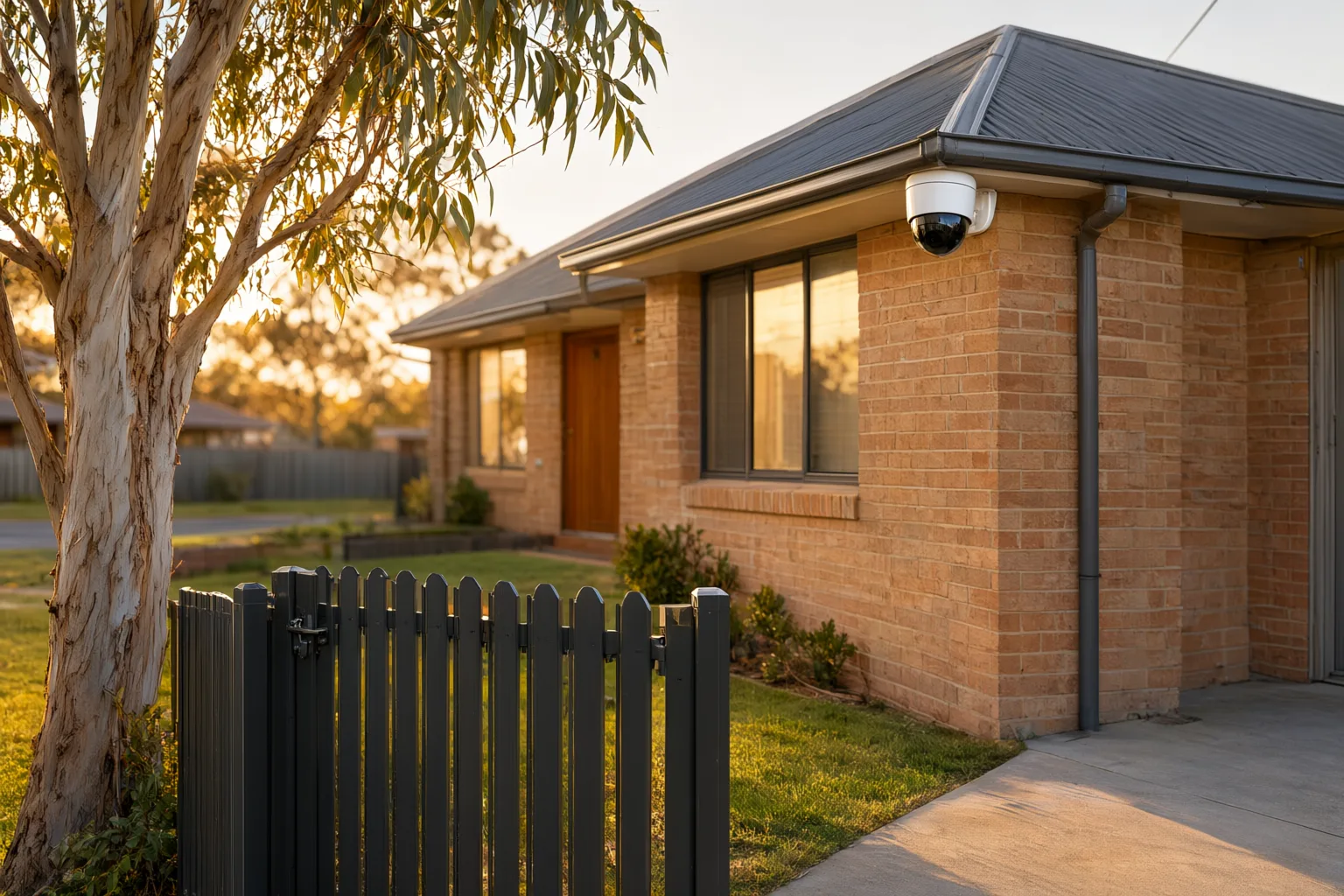
If you can only fund one upgrade this year, put your home security budget into a professionally installed CCTV system before gates or fencing. A quality four-to-six camera package starts at roughly $1,500 installed in NSW, whereas a solid front fence with a manual gate typically begins around $3,000–$6,000, and an automated driveway gate adds $4,000–$10,000 more. Cameras deter thieves before they approach, record identifiable evidence, and alert you in real time.
That does not make fences and gates worthless — far from it. A well-built barrier genuinely slows an intruder down and signals a cared-for property. But delay alone is passive protection. Once someone is over the fence line, the fence has done everything it can do, and you have no idea who they were or what they took. Cameras keep working through every stage of an incident, which is why most security professionals recommend them as the foundation layer.
Why Does This Decision Matter for Your Home Security Budget?
Households across Sydney, [[/newcastle|Newcastle]], Wollongong and regional New South Wales all face the same dilemma: a limited budget and two very different ways to spend it. The right answer depends on understanding how property crime actually happens here. The overwhelming majority of residential break-ins are opportunistic rather than planned. An offender walks or drives past, tries a door handle, glances for cameras and signs of occupancy, and moves on within seconds if the property looks difficult or exposed.
That behaviour pattern is exactly why detection and deterrence often beat pure physical resistance at typical household budgets. A $2,000 camera [[the-hidden-costs-of-cheap-cctv-systems-and-why-they-fail|system]] changes how your home looks to a passing thief every hour of every day. A $10,000 gate looks impressive but only matters at the moment someone decides to test it. Neither choice is wrong, but the order you buy them in determines how much protection each dollar buys along the way.
What Do Fences and Gates Genuinely Deliver?
A Colorbond or timber boundary fence with a lockable side gate performs one function extremely well: it raises the effort required to enter your property. It marks your boundary clearly, keeps out casual trespassers and wandering pets, prevents someone strolling straight up your driveway, and gives children and pets a safe enclosed yard. An automated sliding or swing gate adds daily convenience and broadcasts a visible message that the property is secured and occupied.
The limitations, however, are significant. A fit intruder can scale a standard 1.8-metre fence in a matter of seconds, and side gates are among the most commonly forced entry points because they are so often left unlocked. Critically, a fence is silent and blind. It cannot capture a face for police, cannot log a number plate, cannot distinguish a family member from a stranger, and cannot ping your phone at 2am. Once breached, it offers no further value whatsoever — no evidence, no alerts, no record of what occurred. Licensed under the [[4k-vs-1080p-security-cameras-is-the-upgrade-worth-the-money|Security]] Industry Act, Aussie CCTV Cams ensures every installation satisfies Australia's Privacy Act requirements.
Can Security Cameras Do What Fences Cannot?
Modern CCTV works across the entire timeline of an incident. Before anything happens, visible cameras act as a proven deterrent — offenders consistently avoid properties with obvious surveillance in favour of easier targets nearby. During an incident, intelligent analytics such as Hikvision AcuSense separate genuine human movement from possums, birds and swaying branches, then push an accurate alert to your phone instead of crying wolf. After an incident, high-resolution recordings give police identifiable faces, vehicle colours and number plates, plus a precise timeline for insurance claims.
The technology gap between professional systems and old grainy footage is enormous. Hikvision ColorVu cameras record full-colour video even at night, making clothing and vehicle colours usable as evidence. ANPR (automatic number plate recognition) models can log every vehicle entering your driveway. Remote viewing over the NBN or 4G lets you check on your home from work, holiday or anywhere else. For a typical suburban NSW property, a professionally designed four-to-six camera system with an NVR covers the front door, driveway, side access and rear yard — precisely the routes intruders use in real break-ins.
How Much Does Each Option Cost in NSW?
Price is where the decision sharpens for most families. Quality fencing runs approximately $75–$150 per metre installed depending on material and site conditions, so even a modest front fence with a manual gate quickly lands between $3,000 and $6,000. An automated sliding or swing gate — motor, safety sensors, intercom and [[what-does-a-professional-home-cctv-installation-cost-in-2025|installation]] — typically adds another $4,000 to $10,000 by itself. Combined, a fenced and gated property routinely exceeds $5,000–$15,000.
Against that, a professional-grade camera system covering the whole home often costs less than the gate motor alone. Value goes beyond the invoice, too. Cameras reduce your risk actively every day — deterring, detecting and recording — while a fence delays passively and only until it is crossed. Police and insurers both treat clear CCTV footage as genuinely useful evidence; a breached fence contributes nothing to an investigation. The comparison table below sets out typical NSW figures side by side.
Is Layered Security Better Than One Big Purchase?
Security professionals think in layers: deter, detect, delay, respond. Cameras excel at deter and detection. Fences and gates provide delay. An alarm system handles response. No single product covers all four functions, which is why the best-protected homes combine several layers rather than relying on one expensive purchase.
When the budget stretches to only one layer, cameras are usually the correct starting point for NSW households. They cost less, operate continuously, generate evidence and actively push opportunistic offenders toward easier properties. Once cameras are in place, adding fencing, sensor lighting or a monitored alarm builds on that foundation. And if your property already has good fencing, cameras are the obvious next move — they convert a passive barrier into a monitored perimeter that sees and records everything crossing it.
Where Should Cameras Be Placed for Maximum Value?
Even premium equipment underperforms if it is pointed at the wrong things. A licensed installer will walk your property, map every approach route — front door, driveway, side gates, rear fence line, windows hidden from the street — and position cameras to capture faces at identification height rather than the tops of heads. They will also account for sun glare, night lighting and cable runs.
Professional-grade hardware from brands such as Hikvision, Dahua, Uniview or Axis, properly cabled with PoE and configured for remote viewing, will outlast and outperform any consumer DIY kit. That durability matters especially in Australian conditions: summer heat, coastal salt air near the coast, and storm season all punish cheap consumer gear mounted outdoors.
Do You Need a Plan Before Spending Your Budget?
Start with a free security assessment. Walk your own property and note every way someone could approach: the front door, driveway, side gates, back fence and any windows shielded from street view. Those points are where your first dollars should go, and a single well-designed camera system covers nearly all of them at once.
Aussie CCTV Cams provides free quotes across NSW through a clear five-step process — consultation, design, installation, configuration, and handover with training so you actually know how to use your system. Every installation is fully licensed and insured and backed by lifetime support. Whether your plan is cameras now with a gate later, or cameras to complement fencing you already have, we will design a system matched to your property and your budget.
Gates and Fences vs CCTV Cameras: Typical NSW Costs and Benefits
| Option | Typical Installed Cost | Deters Intruders | Records Evidence | Remote Alerts | Physical Delay |
|---|---|---|---|---|---|
| 4–6 camera CCTV system with NVR | $1,500 – $3,500 | Yes – visible deterrent | Yes – HD/4K footage | Yes – phone notifications | No |
| Colorbond front fence + manual gate | $3,000 – $6,000 | Partial – defines boundary | No | No | Yes – moderate |
| Automated driveway gate | $4,000 – $10,000 | Partial – looks secured | No | No | Yes – vehicles only |
| CCTV + fence + alarm (layered) | $6,000 – $12,000+ | Yes – strongest | Yes | Yes | Yes – strongest |