
Key Takeaways
- Visible CCTV signage is a legal requirement under most state surveillance device laws across Australia.
- Cameras must never record bathrooms, change rooms or a neighbour's private property in Newcastle NSW or Adelaide SA.
- Recording audio without all-party consent breaches listening device legislation in every Australian state.
- NSW's Surveillance Devices Act 2007 prohibits optical surveillance where privacy is reasonably expected.
- Businesses storing identifiable footage must comply with the Privacy Act 1988, including encrypted storage.
- Workplace CCTV requires written notice—NSW's Workplace Surveillance Act 2005 mandates at least 14 days' notice.
Is Your CCTV System Actually Legal? Start Here
Your CCTV system is legal in Australia only if it uses visible signage, avoids recording private areas such as bathrooms and change rooms, stores footage securely with limited retention, and complies with your state's surveillance device laws. Businesses must additionally meet obligations under the federal Privacy Act 1988 when footage identifies individuals.
That single answer captures the core of Australian surveillance compliance, but putting it into practice requires more detail. A camera system that breaches these rules can attract fines, civil claims, and—perhaps most frustratingly—footage ruled inadmissible in court, rendering your entire security investment worthless precisely when you need it most.
This guide walks through every obligation step by step, from where you mount your first camera to how long you keep the recordings. Whether you're a homeowner in Brisbane fitting a two-camera kit or a facilities manager overseeing a multi-site retail operation, the checklist below will help you stay on the right side of the law.
How Do Australian Surveillance Device Laws Work?
Australia regulates CCTV through a two-tier framework. At the top sits federal privacy legislation: the Privacy Act 1988, which governs how organisations collect, store, use and disclose personal information—including video that identifies people. Beneath it, every state and territory maintains its own surveillance device legislation, each with distinct definitions, thresholds and penalties.
For homeowners, the practical burden is lighter. Personal or household use generally falls outside the Privacy Act, though state surveillance laws still apply fully. For [[how-to-write-a-cctv-privacy-policy-for-your-business-with-template-tips|businesses]], both layers bite simultaneously: you must satisfy your state's surveillance statutes and the thirteen Australian Privacy Principles (APPs) whenever your cameras capture identifiable members of the public.
The consequences of getting it wrong are real. State surveillance offences can carry fines reaching $55,000 for individuals, with higher maximums for corporations. Beyond regulatory penalties, an affected neighbour or customer may pursue civil action, and evidence gathered unlawfully can be excluded from legal proceedings—undermining the very reason you installed cameras.
What Are the CCTV Signage Rules Across Australia?
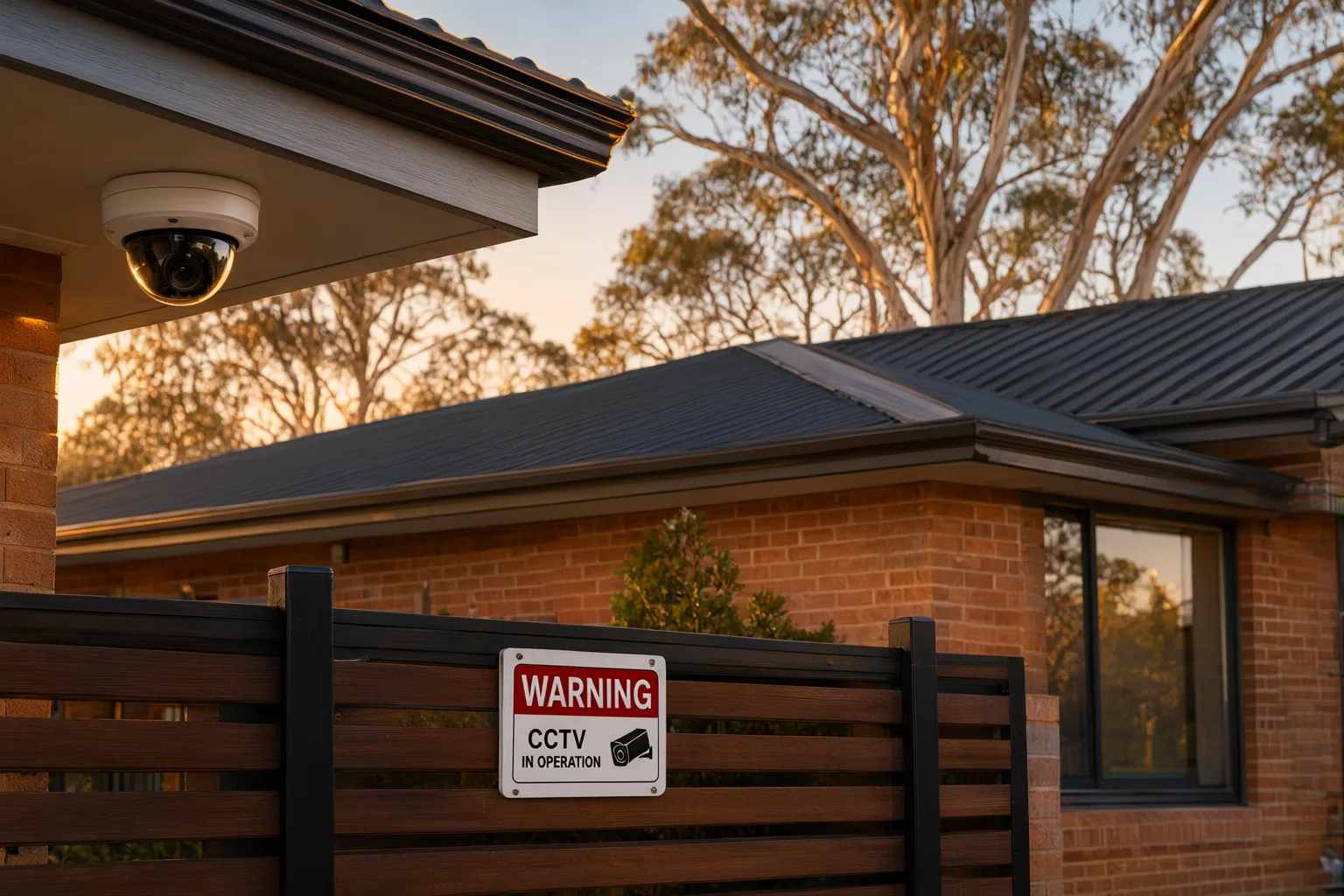
Every lawful CCTV installation in Australia must display clear signage telling people they are entering a monitored area. This is not merely courteous practice—it is embedded in most state surveillance legislation and reinforced by the Australian Privacy Principles' transparency requirements.
Effective signage does three things. It states plainly that video surveillance is operating, it identifies who is responsible for the recording (your business name or 'the property owner'), and it provides a contact point for enquiries. Signs belong at eye level near every entrance, gate, driveway and reception area, written in plain English and built to withstand Australian weather.
Be wary of generic hardware-store stickers reading little more than 'security cameras in use'. Regulators and courts assess whether notification is genuinely adequate, and a vague sticker lacking operator details may fail that test. For businesses, quality signage also delivers a security dividend: intruders aware they are being filmed overwhelmingly choose softer targets.
Which Camera Placements Breach Privacy Laws?
Where your lenses point determines whether your system is lawful. The governing principle across every jurisdiction is simple: you cannot record places where people hold a reasonable expectation of privacy. Bathrooms, toilets, change rooms and similar spaces are absolutely off-limits, and deliberately filming inside a neighbouring property is equally prohibited.
Residential installations should concentrate on your own boundaries—front doors, driveways, garages, side gates and perimeter fencing. Capturing incidental slices of public footpaths or the street is generally tolerated, but angling a camera to monitor a neighbour's backyard, windows or private outdoor areas can constitute an offence under state law and invite civil proceedings for invasion of privacy.
Commercial operators face extra nuance. Filming retail floors, entrances and customer-facing areas is standard and lawful. Staff-only zones demand care: monitoring workspaces for legitimate security purposes is usually acceptable, but training cameras on break rooms or areas where employees reasonably expect privacy crosses the line. Modern platforms from Hikvision and Dahua include privacy masking, which digitally blacks out sensitive zones within a camera's field of view—a tidy technical fix that lets one camera serve security needs without breaching [[common-cctv-privacy-mistakes-australian-businesses-make-and-how-to-avoid-them|compliance]].
Can You Legally Record Audio With CCTV Cameras?
If there is one area where well-intentioned owners routinely breach the law, it is audio. Listening device legislation treats sound far more strictly than vision. In most states and territories, recording a conversation without the consent of those involved is illegal—even on your own property, even if you are a participant.
The default standard is all-party consent: everyone in the conversation must agree to be recorded. Some jurisdictions permit one-party consent, typically where the person recording is part of the conversation, but a CCTV system capturing continuous ambient audio almost never satisfies that threshold because visitors and passers-by have not consented.
The safest position—for homes and businesses alike—is to disable microphone recording entirely unless you have obtained specific legal advice confirming your configuration complies. Many professional cameras from Uniview and Axis ship with built-in microphones; these can be switched off at the NVR during commissioning. Any reputable installer should run an audio [[cctv-and-the-australian-privacy-principles-a-plain-english-guide-for-business-ow|compliance]] check as a standard part of setup.
Is Your CCTV Footage Storage Secure Enough Under the Privacy Act 1988?
Capturing footage lawfully is only half the job—storing it responsibly completes the picture. Under the Privacy Act, businesses must take reasonable steps to protect personal information from misuse, interference, loss and unauthorised access. For CCTV, that translates into encrypted storage, controlled access and auditable user logs.
Practically, this means housing recordings on password-protected NVRs or reputable cloud platforms, restricting viewing, export and deletion rights to authorised personnel only, and ensuring any remote smartphone access runs over encrypted connections with strong authentication. An open, default-password NVR exposed to the internet is a compliance failure waiting to happen.
Retention is the other half of the equation. There is no fixed statutory limit, but privacy principles require you to keep footage no longer than necessary for its stated purpose. As a benchmark, delete routine security footage after 30 to 90 days unless it is needed for an active investigation, insurance claim or legal matter. Hoarding recordings indefinitely 'just in case' violates data-minimisation principles and inflates your liability. Configure your NVR to auto-overwrite after a set period so compliance happens automatically rather than depending on someone remembering to press delete.
Do Employers Need to Notify Staff About Workplace CCTV?
Monitoring staff triggers an additional layer of regulation beyond general privacy law. Most states maintain dedicated workplace surveillance legislation requiring employers to notify employees before camera monitoring begins—and covert surveillance of workers is prohibited except in narrow circumstances approved by a court order.
New South Wales illustrates the model. The Workplace Surveillance Act 2005 obliges employers to give employees written notice at least 14 days before surveillance commences (or as soon as practicable for new starters). The notice must spell out the kind of surveillance, how it will be conducted, when it will begin, and whether it will be continuous or intermittent.
Notification alone is not enough. Using footage for purposes beyond what was disclosed—for example, performance management when staff were told cameras existed purely for security—can breach workplace surveillance legislation as well as unfair dismissal protections. The remedy is straightforward: publish a clear written CCTV policy, distribute it to all staff, and ensure actual practice matches what the policy promises.
Why Does CCTV Compliance Differ State by State?
Although the underlying principles travel well between borders, the fine print changes with geography. New South Wales operates under the Surveillance Devices Act 2007, which prohibits installing or using optical surveillance devices without consent in circumstances where privacy is expected.
Victoria's Surveillance Devices Act 1999 follows a comparable structure while adding specific restrictions on tracking devices. Queensland's Invasion of Privacy Act 1971 concentrates heavily on listening devices but also reaches visual surveillance in private places. Western Australia, South Australia, Tasmania, the ACT and the Northern Territory each maintain their own statutes with subtle but consequential differences in definitions, exemptions and penalty levels.
Multi-state operators should pay particular attention here. A configuration that satisfies NSW requirements may fall short of Victorian expectations, and vice versa. The pragmatic approach is to design every site against the strictest common denominator across your portfolio—an approach experienced installers familiar with cross-border operations can implement consistently, sparing you from maintaining divergent systems in different states.
Should You Use This CCTV Compliance Checklist Before Going Live?
Bringing everything together, a compliant Australian CCTV installation should tick every box below before it goes live:
First, signage: weather-resistant notices at every entry point stating that surveillance operates, naming the responsible party and listing a contact. Second, placement: cameras framed on your own property or legitimate business areas, never on bathrooms, change rooms or neighbours' private spaces, with privacy masking enabled where fields of view overlap sensitive zones. Third, audio: microphones disabled unless you hold documented legal advice confirming consent requirements are met.
Fourth, storage: encrypted, password-protected NVR or cloud storage, restricted user access, and automatic overwrite set to 30–90 days. Fifth, documentation: businesses should maintain a written CCTV policy covering purpose, retention and access, and employers must issue written surveillance notices meeting their state's lead-time requirements—14 days in NSW. Sixth, review: revisit the setup annually and whenever legislation changes, particularly if you expand into new states or territories.
Completing this checklist protects more than your legal standing. It ensures your footage remains usable as evidence, preserves trust with customers, neighbours and staff, and keeps your security investment delivering value for years to come.
Can Aussie CCTV Cams Help You Meet CCTV Compliance Requirements?
Compliance Obligations Compared: Residential vs Commercial CCTV
| Requirement | Residential | Commercial |
|---|---|---|
| Signage required | Yes – at entry points | Yes – all public and staff areas |
| Privacy Act applies | Generally no (personal use) | Yes – if turnover exceeds $3M or handling personal info |
| Audio recording | Prohibited without consent | Prohibited without consent |
| Employee notification | N/A | Written notice required in most states |
| Footage retention | 30-90 days recommended | 30-90 days unless investigation requires longer |
| Neighbour's property | Cannot deliberately record | Cannot deliberately record |
| Secure storage required | Recommended best practice | Legal requirement under Privacy Act |