
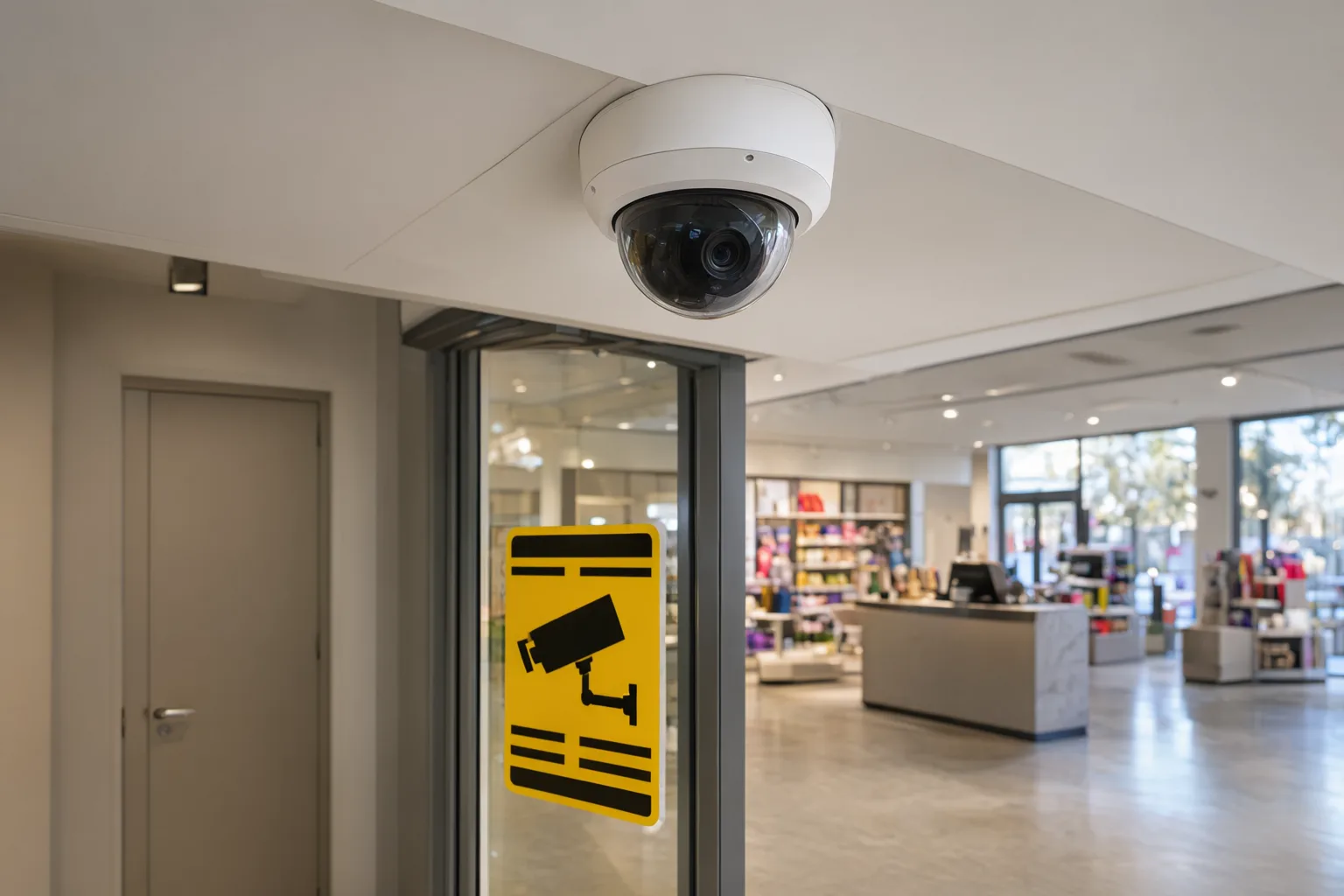
Key Takeaways
- The Privacy Act 1988 and state surveillance device acts both apply to business CCTV in Australia.
- Recording private spaces like change rooms or bathrooms is a criminal offence, not just a civil breach.
- Clear signage is legally required in most Australian states before cameras can lawfully record.
- APP 11.2 requires destroying or de-identifying CCTV footage once it is no longer needed.
- Individuals can request access to footage they appear in under APP 12.
Why CCTV Privacy Compliance Matters More Than Ever in Australia
CCTV privacy compliance costs Australian businesses far less than the penalties for getting it wrong—the short answer is that you must satisfy the federal Privacy Act 1988 and your state's surveillance device laws simultaneously. For a typical retail shop or warehouse in Newcastle or Adelaide, that means correct camera placement, visible signage, secure footage storage, defined retention periods and a process for access requests. This guide walks through the six most expensive mistakes we see and how you can avoid every one of them.
The regulatory environment has hardened considerably. Following the Privacy Legislation Amendment (Enforcement and Other Measures) Act 2022, serious or repeated interferences with privacy can attract civil penalties of up to $2.5 million for individuals and $50 million for corporations. State regulators and the Office of the Australian Information Commissioner (OAIC) are increasingly active in investigating complaints about surveillance practices.
The good news is that nearly every common breach is preventable with careful planning. This guide walks through the seven most frequent compliance failures we encounter across commercial installations, and sets out practical steps to keep your system on the right side of the law.
What Legal Framework Governs Business Surveillance Compliance?
Two layers of legislation govern business CCTV in Australia. At the federal level, the Privacy Act 1988 (Cth) applies to organisations with an annual turnover above $3 million, binding them to the Australian Privacy Principles (APPs) covering how personal information—including video footage—is collected, stored, used and disclosed.
Beneath that sits a patchwork of state and territory laws. New South Wales regulates optical surveillance through the Surveillance Devices Act 2007, Victoria relies on the Surveillance Devices Act 1999, and Queensland's equivalent is the Invasion of Privacy Act 1971. Workplace monitoring adds further layers: NSW employers fall under the Workplace Surveillance Act 2005, while the ACT operates the Workplace Privacy Act 2011.
Because these statutes differ in scope and wording, an installation practice that is acceptable in one jurisdiction may constitute an offence in another. [[how-to-write-a-cctv-privacy-policy-for-your-business-with-template-tips|Businesses]] operating across multiple states should seek advice specific to each location rather than assuming a single national rulebook exists.
Mistake One: Are Your Cameras Pointed at Private Spaces?
Recording people in places where they reasonably expect privacy—toilets, bathrooms, showers, change rooms and similar facilities—is a criminal offence in every Australian jurisdiction. Yet it remains one of the most common problems found during site audits, often inherited from previous contractors or added incrementally over years.
The legal test centres on reasonable expectation of privacy, which extends beyond obvious locations. A camera angled to capture a neighbouring property, a public footpath beyond your boundary, or the view through a window into an adjacent building can all breach state surveillance laws even though the camera itself sits on your premises.
During installations across Sydney and regional NSW, our technicians regularly remove legacy cameras capturing staff locker rooms or toilet entryways—placements that expose the business to criminal liability and potential civil claims from affected employees. A professional design maps every camera's field of view precisely, covering entrances, exits, point-of-sale areas, stock rooms and car parks while steering clear of private zones.
Mistake Two: Is Your CCTV Signage Missing or Inadequate?
Transparency is a cornerstone of lawful surveillance. Most state acts require businesses to notify people clearly that they are entering an area under video observation, typically through prominent signage at all entry points written in plain English.
Signs only satisfy this duty if they are genuinely visible. Notices tucked behind doors, obscured by merchandise displays, or printed in text too small to read from a normal viewing distance fail the test. Best practice places eye-level signs at every public entrance, in car parks and at staff entries; some jurisdictions also specify minimum sizes or particular wording.
Employee notification carries stricter requirements still. Under NSW's Workplace Surveillance Act 2005, employers must give staff written notice at least 14 days before starting camera surveillance, explaining what will be monitored, how, and who can access recordings. The ACT imposes comparable obligations through its Workplace Privacy Act 2011. Skipping this step can render footage inadmissible and expose the employer to penalties.
Mistake Three: Do You Have Weak Security Around Footage?
Because CCTV recordings are personal information, the APPs require businesses to take reasonable steps protecting them from misuse, interference, loss and unauthorised access, modification or disclosure. In practice, many systems fall well short.
Typical failures include default administrator passwords left on network video recorders (NVRs), firmware never updated with security patches, recording equipment stored in unlocked rooms, and viewing access granted to staff with no operational need. Audits have uncovered former employees retaining remote credentials months after termination, and NVRs sitting in open offices accessible to anyone walking past.
Modern IP platforms from manufacturers such as Hikvision, Dahua and Uniview ship with strong safeguards—encrypted transmission, multi-level authentication, audit logs recording who viewed footage and when, and automatic firmware updates. These protections only work when correctly configured at installation. Professional installers apply role-based access controls so only authorised personnel can watch live feeds or export recordings, supported by complete audit trails.
The stakes extend beyond regulatory action. Leaked footage or clips handed to unauthorised third parties can prompt Privacy Act complaints, civil litigation from identifiable individuals, and reputational damage dwarfing any security benefit the system was meant to deliver.
Mistake Four: How Long Should You Keep CCTV Footage in Australia?
Australian Privacy Principle 11.2 obliges organisations to destroy or de-identify personal information once it is no longer needed for the purpose collected. Despite this clear rule, many businesses operate with no documented policy on how long footage is kept or when it should be erased.
Indefinite retention multiplies privacy risk and legal exposure. Deleting too quickly creates the opposite problem: vital evidence may be gone before police investigations, insurance claims or workplace incident reviews need it. The right period depends on your industry, risk profile and any sector-specific obligations.
For most Australian operations, 30 to 90 days strikes a sensible balance. Higher-risk retail environments commonly retain 60-90 days, low-risk offices may need only 30, and licensed venues sometimes face fixed requirements under liquor licensing conditions. Whichever figure you choose, write it into a formal policy, communicate it to relevant staff, and enforce it through your recorder's settings.
Automatic overwrite after the set period produces a consistent, defensible deletion process—but pair it with procedures for identifying and preserving clips tied to incidents such as police requests, workplace accidents or customer disputes before deletion occurs. That means a formal incident-reporting workflow and the technical ability to export and securely store relevant footage separately.
Mistake Five: Can Repurposing Footage Breach Privacy Laws?
Privacy law restricts how collected information may be used. If your signage declares cameras exist for security and theft prevention, you cannot later deploy the same footage to track employee productivity, analyse customer browsing behaviour for marketing, or post amusing clips online.
This trap catches businesses repeatedly. A manager reviewing break-in footage spots an employee taking a long lunch and launches disciplinary action. A retailer mines security video for customer movement patterns to redesign store layout. An owner shares shoplifter clips on Facebook to warn neighbouring traders. Each scenario potentially breaches the use and disclosure principles because the purpose has drifted beyond what was originally notified.
If you want multi-purpose coverage—security plus safety monitoring, analytics or performance management—state those purposes explicitly in signage and workplace policies from day one. Wording such as 'security, safety and operational purposes' offers flexibility, though excessively broad collection raises concerns of its own.
Employee monitoring warrants special care. Even with proper notice, using CCTV to continuously scrutinise individual performance can create workplace relations friction, and the Fair Work Commission has linked covert or disproportionate surveillance to findings of unfair treatment and constructive dismissal.
Mistake Six: Should You Ignore Individual Access Requests?
Under Australian Privacy Principle 12, people can request access to their own personal information—including footage in which they are identifiable. Many businesses discover this obligation only when a customer, employee or their lawyer asks for a copy of a recording.
Without a documented process, requests stall, get refused arbitrarily, or result in footage handed to the wrong person. Both outcomes create complaint risk. A compliant procedure verifies the requester's identity, locates relevant clips, redacts or blurs third parties where appropriate, and responds within the 30-day timeframe expected under the APPs.
Refusal is possible only in limited circumstances—for example where release would unreasonably intrude on others' privacy or expose commercially sensitive material—and any refusal should be explained in writing with reasons.
Which Steps Build a Compliant System from Site Survey to Ongoing Audits?
Avoiding these failures starts before any hardware is purchased. Begin with a documented privacy impact assessment: identify what you need to monitor, why, what risks arise, and how you will mitigate them. That assessment shapes your camera placement plan, ensuring legitimate areas are covered without encroaching on private spaces.
Professional installation goes far beyond mounting brackets. Licensed installers understand sight lines and fields of view, positioning cameras to capture necessary zones while avoiding prohibited ones, and they flag privacy issues before they become expensive repositioning jobs. Our five-step process includes a dedicated site survey and design phase built around these [[the-complete-cctv-compliance-checklist-for-australian-homes-and-businesses|compliance]] requirements.
Next, develop comprehensive written policies covering system operation, access controls, retention periods, and handling of footage requests from police, lawyers or individuals. Train everyone who touches the system on these policies, then implement technical controls—strong passwords, encrypted transmission, role-based access, audit logging—that enforce them automatically.
Finally, treat [[cctv-and-the-australian-privacy-principles-a-plain-english-guide-for-business-ow|compliance]] as ongoing rather than one-off. Review camera positions annually to confirm nothing has shifted into inappropriate views, audit access logs for unauthorised viewing, verify automatic deletion is working, and update signage whenever your stated purposes change. Regular review protects both your business and the people your cameras record.
Location matters more than many owners realise. Coastal properties in [[/newcastle|Newcastle]] face salt air and storm exposure that corrode cheap housings within two years, while [[/adelaide|Adelaide]]'s dry summer heat regularly pushes roofline and eaves-mounted cameras past 45°C, degrading image sensors and shortening equipment life. A compliant system also needs to be a durable one—cameras mounted under eaves or on brick walls with weather-rated enclosures keep recording reliably, because a dead camera during an incident creates its own liability questions under consumer law and your duty of care.
Budget realistically for compliance, not just hardware. A professionally installed four-camera business system in Newcastle or Adelaide typically ranges from $1,800 to $3,500 AUD installed, while larger commercial or warehouse deployments with access controls and retention policies run $6,000 to $15,000 AUD or more. Factor in signage production, a documented privacy impact assessment and annual audits. If you lease premises in a strata complex, check body corporate rules before drilling into common property walls, and confirm whether local council approval applies to heritage-listed facades.
Workplace surveillance deserves special attention if you employ staff. New South Wales' Workplace Surveillance Act 2005 requires written notice at least 14 days before employee monitoring begins, while South Australia's equivalent rules demand clear workplace policies. Retailers monitoring stockrooms, farms watching fuel storage, and offices tracking entrances all fall within scope. Get a quote from a licensed installer who understands these obligations—an experienced technician will flag non-compliant camera angles covering neighbouring properties or staff amenities before they become legal problems rather than after.
Compliance pathway comparison for Australian business CCTV
| Option | Typical Cost (AUD) | Compliance Coverage |
|---|---|---|
| DIY kit installation | $500–$1,500 | Signage and placement risks often missed |
| Professional 4-camera install | $1,800–$3,500 | Privacy assessment, signage and angle audit included |
| Commercial multi-site system | $6,000–$15,000+ | Retention policies, access controls, annual audits |
| Monitored service add-on | $40–$120/month | Incident response plus footage handling protocols |