
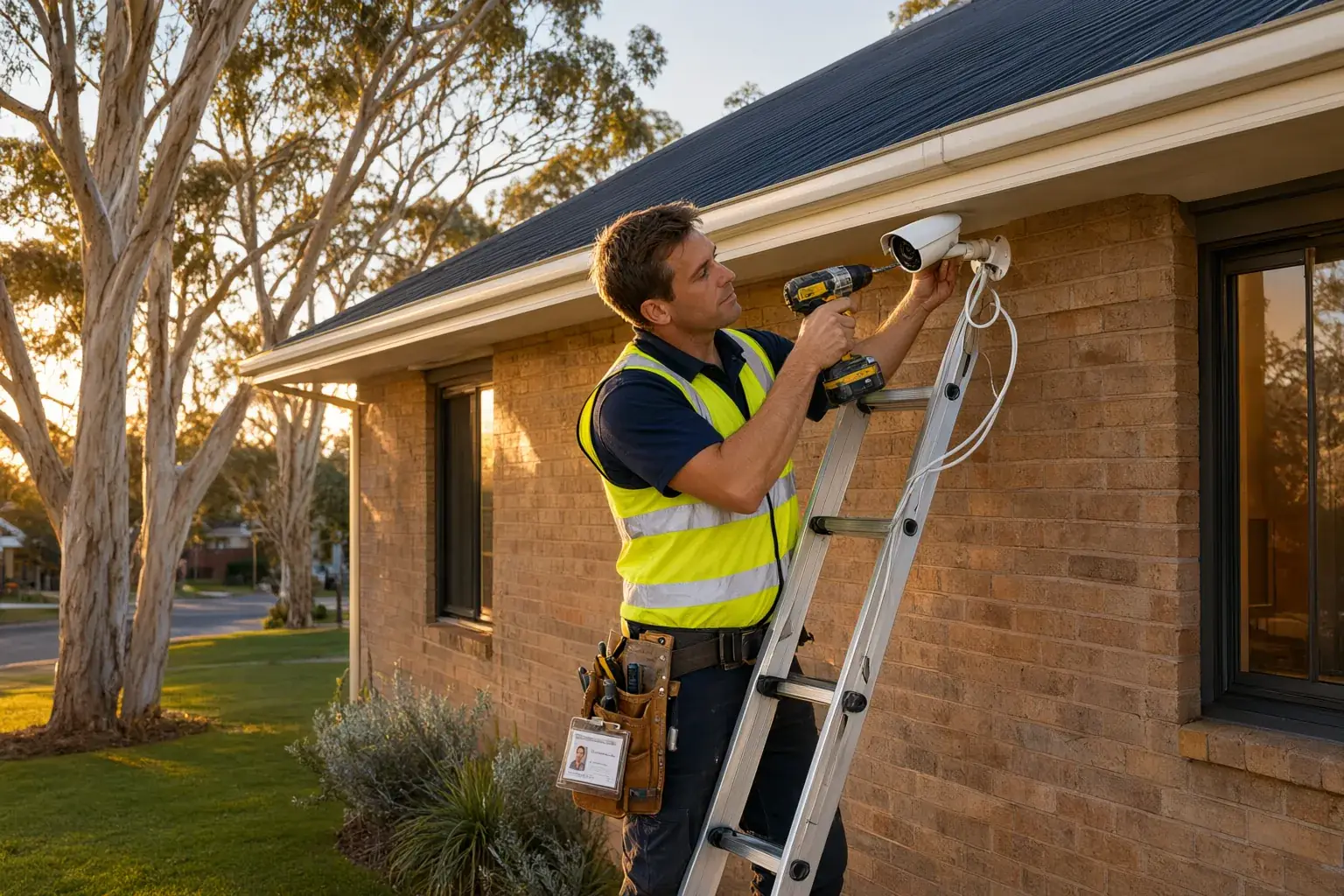
Key Takeaways
- Paid CCTV installation in NSW requires a Class 2C security licence under the Security Industry Act 1997 (NSW).
- Unlicensed installation can void insurance claims and weaken footage used as evidence.
- Adelaide installers are licensed under South Australia's Security and Investigation Agents Act 1995 instead.
- Typical licensed CCTV installation cost in Newcastle or Adelaide is $600–$2,500 AUD per property.
- You can verify any installer's licence free online via NSW Fair Trading before accepting a quote.
Is Paid CCTV Installation Illegal Without a Licence in NSW?
The short answer: paying someone to install security cameras in NSW without a Class 2C security licence is illegal under the Security Industry Act 1997 (NSW), with penalties reaching $11,000 for individuals. A licensed CCTV installer NSW protects your home or business insurance, ensures footage stands up as evidence, and keeps you compliant with Australian privacy law. Here's what Newcastle and Adelaide property owners need to know.
The only exception is genuine do-it-yourself work: you may install cameras on property you own or occupy yourself. The moment money changes hands — whether it's a professional company, a local handyman or a mate doing a cash favour — licensing law kicks in. Hiring an unlicensed operator doesn't just expose them to fines and prosecution; it creates real legal and financial risk for you, the person paying for the system.
This article explains exactly what's at stake: which laws apply, how unlicensed work can unravel an insurance claim or a court case, what a properly licensed installation should include, and how to confirm an installer's credentials in under two minutes before you sign anything.
Why Does NSW Regulate Every Licensed CCTV Installer?
It's easy to assume camera [[how-much-does-professional-cctv-installation-cost-in-australia|installation]] is ordinary trade work, like hanging a TV. In practice, a CCTV installer occupies a uniquely sensitive position in your life. They enter your home or business, learn your floor plan, observe your comings and goings, handle the equipment that records everything on your property, and often hold remote access credentials to that system.
The Class 2C licensing regime exists to control precisely that access. To obtain and keep a licence, an installer must pass criminal history checks, complete recognised industry training, and remain answerable to the Security Licensing & Enforcement Directorate (SLED) of the NSW Police Force. If something goes wrong — theft during an install, a botched job, misuse of system access — there is a regulator to complain to and consequences that follow the individual.
An unlicensed cash operator offers none of that. No background check, no training requirement, no complaints process, and frequently no traceable business identity at all. You're effectively handing keys, routines and surveillance of your property to an unknown quantity.
How Can Unlicensed Installation Sink Your Insurance Claim?
Insurance is where unlicensed installation bites hardest, because the damage surfaces after a break-in — when you're already dealing with loss and stress. Many Australian home and commercial policies attach conditions to security systems: they must be installed by a licensed professional, maintained appropriately, and documented.
When you lodge a claim, insurers can and do ask who installed the system and request evidence of the installation. If the answer is an unlicensed cash job with no paperwork, the insurer may reduce the payout or decline the claim outright on the basis that the security measures weren't compliant. We've heard from Sydney property owners who lost claim value worth tens of thousands of dollars over an installation that saved them a few hundred upfront.
The maths is unforgiving. A licensed installation might cost modestly more than a back-yarder quote, but it preserves the validity of the policy you're already paying for every year. An unlicensed install doesn't just save money — it quietly converts your premium into money at risk.
What Privacy Rules Must Camera Owners Follow?
Most people install CCTV hoping never to need the footage. But when a break-in, vandalism incident or dispute does occur, the recording becomes evidence — and evidence has standards.
Police investigators and defence lawyers scrutinise how surveillance footage was captured: whether the system was installed competently, whether timestamps and settings were reliable, and whether the recording complied with surveillance law. A system put together by an unlicensed operator invites questions about installation integrity and chain of custody. Footage from an illegally installed system, or from cameras positioned in breach of [[recording-your-neighbours-where-the-legal-line-sits-for-home-cctv|privacy]] rules by someone who didn't know those rules exist, can be challenged or excluded entirely.
There's also a darker scenario: if your installer recorded audio covertly or pointed cameras where the law forbids, the illegality attaches to your system, not theirs. Under the Surveillance Devices Act 2007 (NSW), unlawful recording can carry prosecution risk for the system owner. Your evidence becomes not just weak but potentially incriminating.
Should You Compare Licensed vs Unlicensed CCTV Installation?
Camera placement is governed by more than common sense. NSW obligations under the Surveillance Devices Act 2007, alongside expectations flowing from the Privacy Act 1988, shape where cameras may point, whether audio may be captured, and how footage must be stored and handled.
Common breaches include cameras overlooking a neighbour's yard or windows, microphones capturing conversations on public footpaths, and systems left running factory-default passwords accessible to anyone online. Each of these generates complaints, disputes and potential legal exposure — and in every case we've seen, it's the property owner who wears the complaint, not the installer who created the problem.
Licensed installers are trained in these obligations as part of their accreditation. They know to angle cameras away from neighbouring properties, to disable or avoid audio where it isn't lawful, to advise on signage, and to harden network video recorders against intrusion. That knowledge is part of what the licence certifies — and it's precisely what an unlicensed operator cannot demonstrate.
Can You Verify an Installer's Class 2C Security Licence for Free?
The practical differences between the two paths show up across legality, insurance, evidence quality, privacy compliance and long-term support. The comparison below summarises what each option actually delivers once the invoice is paid.
Viewed side by side, the small saving from an unlicensed cash job rarely survives contact with reality. One refused insurance claim, one excluded piece of footage or one neighbour complaint erases years of savings. Licensed installation isn't a premium tier — it's the minimum standard for a system that legally protects you.
Do Licence Rules Differ Between Newcastle and Adelaide Installers?
Verification takes less than two minutes and should happen before you accept any quote, not after. Ask the installer directly for their security licence number. Then search it on the NSW Police Force SLED public register, which is free to use and confirms three things: that the licence is current, its class, and any conditions attached to it.
For CCTV work, the class you're looking for is 2C — security equipment installer, covering installation, maintenance and repair. If the installer operates as a company, the business itself should additionally hold a master licence. A legitimate installer will provide their number immediately; at Aussie CCTV Cams our technicians carry their licences to every job and actively encourage customers to run the check.
Licence verification aside, insist on proof of public liability insurance, references or examples of recent local work, and a written quote that names equipment by brand and model. A quote reading simply '4 cameras and recorder' is a warning sign. Professional proposals specify hardware such as Hikvision ColorVu or Dahua TiOC cameras, the NVR model, storage capacity and warranty terms in black and white.
- Request the Class 2C licence number before accepting any quote
- Check it free of charge on the SLED public register — about two minutes
- Confirm the business holds a master licence and public liability insurance
- Require a written quote naming exact camera, recorder and storage specifications
- Treat cash-only operators with no ABN, website or references as a red flag
Which Costs Should You Expect From a Licensed CCTV Installer NSW?
A licensed installation is a documented end-to-end process, not cameras screwed to a fascia board. It begins with an on-site consultation assessing your layout, lighting, entry points and privacy constraints such as neighbouring windows or footpaths. From there the system is designed around your actual risks — ColorVu cameras for full-colour night vision on an unlit driveway, AcuSense filtering to stop false alerts from pets and moving gum trees, or ANPR cameras for a commercial entrance.
Workmanship follows Australian conditions: cabling routed through roof cavities and conduit rather than stapled along gutters, mounts and housings chosen to survive summer heat and coastal salt air, and PoE connections that keep recording stable through storms and NBN interruptions. Configuration covers remote viewing on your phone, recording schedules, motion zones, unique passwords and current firmware so the system isn't an open door on your network.
Handover matters as much as hardware. You should be walked through the app, shown how to export footage for police, and given documentation of the full system. That documentation doubles as your proof of professional, licensed installation if an insurer ever asks. And with a licensed, insured team offering lifetime support, there's always someone accountable when adjustments are needed — rather than a phone number that stops answering.
Are DIY Security Cameras Legal Under Australian Law?
Security licensing exists because CCTV sits at the intersection of physical protection, privacy law and digital evidence. When you hire a licensed installer, the fee buys accountability, insurance validity, legal compliance and a system engineered to stand up when it matters — not merely a piece of paper.
Before your next installation or upgrade, spend two minutes verifying the licence, demand a written specification, and choose an installer who treats your legal position as seriously as your physical security. For a free, no-obligation quote from a fully licensed and insured NSW team, Aussie CCTV Cams is ready to help.
Why Does the Licence Protect You, Not Just the Industry?
Costs vary by property type. A typical [[/newcastle|Newcastle]] home needing four cameras mounted under the eaves of a tiled roof might pay $1,200–$1,800 installed, while a commercial warehouse requiring sixteen cameras, fibre runs and integration with access control can exceed $6,000. Coastal suburbs face extra weatherproofing considerations — salt air corrodes cheap housings within two years, so marine-grade units are worth the premium.
In [[/adelaide|Adelaide]], licensing sits under the Security and Investigation Agents Act 1995 (SA), administered by Consumer and Business Services (CBS). The practical effect is similar: anyone paid to install surveillance equipment must be licensed, and unlicensed work risks fines plus invalidation of your insurer's obligations. Always confirm which state's register your installer appears on.
Heat matters too. South Australian summers regularly push roof cavities above 60°C, and NVRs tucked into uninsulated ceiling spaces fail early. A professional installer will specify ventilated enclosures and surge protection rated for Australian storm conditions rather than generic imported kits.
Beyond licensing, camera placement triggers privacy obligations. Under the Surveillance Devices Act 2007 (NSW) and the federal Privacy Act 1988, recording neighbours' yards, shared [[installing-cctv-in-a-strata-complex-who-approves-it-and-who-pays|strata]] common areas without consent, or staff areas like change rooms can attract complaints or penalties. Businesses should display signage and restrict footage retention to what's reasonably necessary.
For retail and workplace settings, the Workplace Surveillance Act 2005 (NSW) adds notification requirements before monitoring employees. A licensed installer familiar with these laws will flag problem angles during the site assessment — saving you from costly repositioning later.
Finally, get everything in writing. A compliant quote itemises camera models, cable runs, labour hours, warranty terms and the installer's licence number. If an installer hesitates to provide their licence number, treat that as a red flag and walk away — legitimate operators across Newcastle, Adelaide and greater Australia provide it without prompting.
Licensed vs Unlicensed vs DIY CCTV Installation Comparison
| Option | Typical Cost (AUD) | Key Risk |
|---|---|---|
| Licensed installer (NSW/SA) | $600 – $2,500+ | None — insured, lawful, evidence-ready |
| Unlicensed cash installer | $300 – $900 | Fines up to $11,000; insurance claim denial |
| Full DIY kit | $400 – $1,500 | Legal but no compliance guidance; weather failures |
| Hybrid (pro cabling, DIY setup) | $800 – $1,800 | Mixed liability if paid work is unlicensed |