
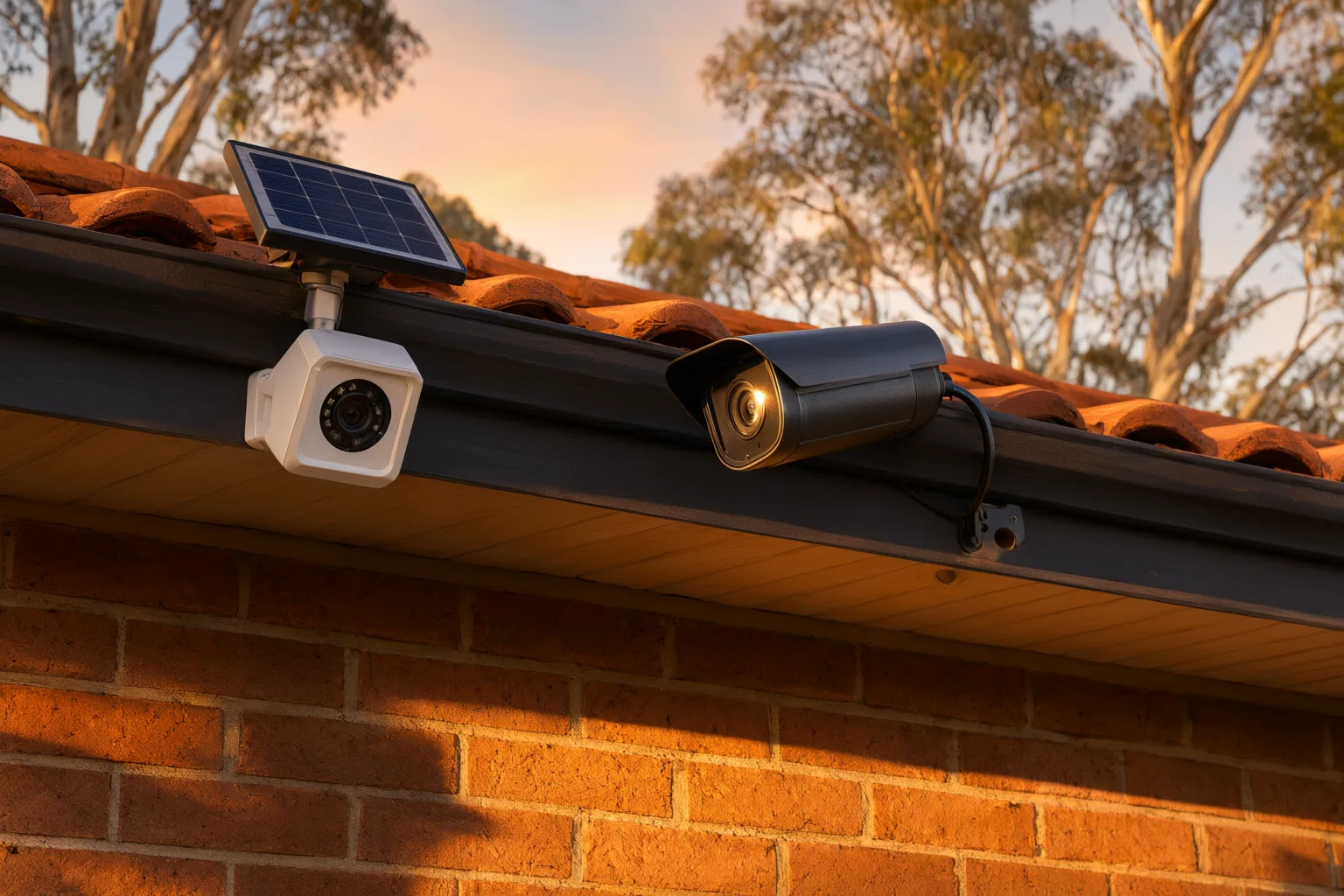
Key Takeaways
- Hardwired security cameras achieve roughly 99.9% uptime versus 85–90% for battery models across Australian homes.
- Battery camera runtimes drop to two or three months per charge when temperatures exceed 35°C in summer.
- Motion-activated recording on battery cameras creates coverage gaps that a complete hardwired timeline eliminates.
- A five-year battery setup costs $800–$1,200 upfront plus $200–$400 in batteries and cloud subscriptions.
- Hardwired systems cost $1,500–$3,000 installed but need a UPS ($300–$600) to survive blackouts.
- CCTV installers in NSW and SA must hold a security licence under state security industry laws.
How Reliable Are Hardwired Security Cameras Compared to Battery Models?
Hardwired security cameras are more reliable than battery models for Australian homes. Drawing constant power from mains or PoE cabling, they record 24/7 with roughly 99.9% uptime, survive 40°C-plus summers without lithium-ion degradation, and capture a complete timeline instead of motion-triggered clips — making them the dependable choice for permanent home security across Australia.
That's not to say battery cameras have no place. They're genuinely useful for renters, heritage homes where cabling isn't allowed, and short-term monitoring projects. But when the question is purely about reliability — consistent uptime, uninterrupted recording and dependable performance through an Australian summer — hardwired systems come out ahead on nearly every measure. This guide breaks down exactly why, so you can decide what fits your property.
What Does Reliability Really Mean for Home Security?
Reliability in a [[4k-vs-1080p-security-cameras-is-the-upgrade-worth-the-money|security]] camera isn't just whether it turns on today. It's whether the camera will still be capturing usable footage three years from now, through heatwaves, storms, blackouts and NBN dropouts. It's about uptime percentage, recording continuity, and how the camera copes with the specific conditions of your suburb — whether that's 40°C-plus afternoons in western Sydney or salt-laden air along the Newcastle coast.
The core difference between the two technologies comes down to power delivery. Battery cameras depend on lithium-ion cells that degrade with every charge cycle and lose capacity faster in heat. Hardwired cameras draw steady power through a single cable that also carries data in PoE setups. One system has a consumable component wearing out inside it; the other doesn't. That single distinction drives most of the reliability gap covered below.
Why Does Australian Heat Destroy Battery Camera Life?
Australia's climate is brutal on batteries. Manufacturers often rate their battery cameras for six months between charges, but those figures assume mild European conditions. In real-world Australian use, expect three to six months at best — and less if you live somewhere hot. Sustained temperatures above 35°C accelerate lithium-ion degradation significantly, and summer days exceeding 40°C in western Sydney can push a camera into thermal protection or cut its effective runtime to two or three months between charges.
Coastal homes face a second challenge: salt air corrodes exposed contacts and battery compartments over time, causing connection faults that mains-powered units with sealed connections simply don't experience. Hardwired cameras sidestep all of this. Whether your home is brick veneer in Parramatta or a weatherboard cottage in the Blue Mountains, consistent mains or PoE power keeps the camera running at full capacity year-round, regardless of what the thermometer says. Licensed under the [[solar-powered-security-cameras-are-they-worth-it-for-australian-conditions|Security]] Industry Act, Aussie CCTV Cams ensures every installation satisfies Australia's Privacy Act requirements.
Can Motion Clips Match a Complete Hardwired Recording Timeline?
Most battery cameras record only when motion is detected, because continuous recording would flatten the battery within days. That creates coverage gaps: if the motion sensor triggers late, misses a slow-moving subject, or the camera is briefly offline during a recharge cycle, the critical moment goes uncaptured. Many battery models also lean on cloud storage subscriptions, which adds ongoing fees and introduces another failure point if your internet drops out during a storm.
Hardwired systems record continuously to a local Network Video Recorder (NVR) or Digital Video Recorder (DVR), building a complete timeline of everything that happened on your property. There's no cloud dependency, no subscription, and no risk of missing footage because the camera was dozing. For NSW homeowners, that complete local record matters when you're filing an insurance claim or providing evidence to police — you get the full sequence, not just fragments.
Are Advanced Features Like Colour Night Vision Possible on Battery Power?
Modern camera technology is power-hungry. Hikvision's ColorVu delivers full-colour night vision instead of grainy infrared, Dahua's AcuSense uses onboard AI to distinguish people and vehicles from rustling trees, and Automatic Number Plate Recognition (ANPR) captures plates on driveways around the clock. Starlight sensors excel in low light. All of these features drain a battery quickly, which is why most battery models either omit them or throttle them aggressively.
On a hardwired system, these features run at full capacity without compromise. If advanced detection and image quality are part of why you're buying a camera in the first place, hardwired power isn't optional — it's the enabling infrastructure. Professional-grade brands like Hikvision, Dahua, Uniview and Axis build their best capabilities around continuous power, and that's where their reliability reputation comes from.
Should Renters Choose Battery or Hardwired Security Cameras?
Battery cameras have one clear advantage: you can mount one anywhere within WiFi range without running a single cable. That makes them ideal for renters, heritage-listed properties where drilling is restricted, holiday houses, or temporary monitoring during renovations. Setup takes minutes, not hours.
But flexibility comes with trade-offs. Batteries need replacing every two to three years as they degrade, mounting positions are constrained by WiFi signal strength, and [[wireless-vs-wired-cctv-which-is-right-for-australian-homes|wireless]] connections can suffer in extreme weather. Hardwired installation takes more planning — licensed installers run cables through roof cavities and wall cavities, protecting connections from weather and tampering — but the result is a permanent system that never depends on battery levels or signal bars. At Aussie CCTV Cams, our five-step process (consult, design, install, configure, handover) ensures the system is tailored to your property's layout rather than bolted on as an afterthought.
Do Five-Year Costs Favour Hardwired or Battery Systems?
Owning battery cameras means regular ladder climbs to recharge units, swapping degraded batteries, and troubleshooting wireless dropouts. Over five years, replacement batteries and cloud subscription fees add up: a quality battery setup might cost $800–$1,200 upfront, then another $200–$400 in maintenance and subscriptions across its life.
Hardwired systems cost more initially — typically $1,500–$3,000 installed depending on camera count and cable runs — but demand very little afterwards. Cameras rated IP66 or IP67 shrug off rain, dust and coastal conditions; annual professional checks, occasional lens cleaning and firmware updates are usually all that's required. When you factor in longevity, near-zero ongoing fees and far higher uptime, hardwired systems generally win on total cost of ownership despite the higher entry price.
Is a Hardwired Camera Useless During a Blackout?
One honest limitation: standard hardwired cameras stop working during a power outage unless they're backed up. The straightforward fix is an Uninterruptible Power Supply (UPS). Aussie CCTV Cams can install UPS backup that keeps your entire camera system and recorder running for roughly two to four hours through a blackout — enough to ride out most storm-related outages while continuing to record.
It's worth noting battery cameras aren't immune here either: they still rely on your router and NBN staying online to send alerts and upload cloud clips, and many go dark during extended outages once local buffering fills. A hardwired system with UPS backup remains the most outage-resilient option for serious security.
Which Camera Type Suits Your Property Best?
Choose battery cameras if you're renting, need short-term monitoring, want to trial camera positions before committing to cabling, or are covering low-traffic areas like a holiday home where continuous recording isn't critical. They're a legitimate tool — just understand their limits before relying on them.
Choose hardwired cameras for primary residences, investment properties, and anywhere guaranteed 24/7 recording matters: entry points, driveways needing ANPR, dim side passages suited to Starlight or ColorVu sensors. Hybrid setups also work well — hardwired cameras guarding the critical zones, with a battery unit covering a shed or gate. For most Australian homeowners who want set-and-forget security they can trust for a decade, hardwired is the answer.
Reliability Comparison: Battery vs Hardwired Cameras in Australian Conditions
| Reliability Factor | Battery Cameras | Hardwired Cameras |
|---|---|---|
| Continuous Recording | Motion-activated only | 24/7 continuous recording |
| Power Source Lifespan | 2-3 years (battery degradation) | 10+ years (mains/PoE) |
| Performance in 40°C+ Heat | Reduced battery life, potential shutdowns | No impact on operation |
| Coastal Salt Air Resistance | Moderate (battery compartments vulnerable) | High (sealed connections) |
| Advanced Feature Support | Limited (power constraints) | Full support (ColorVu, AcuSense, ANPR) |
| Maintenance Frequency | Every 3-6 months (recharging) | Annually (professional check) |
| Typical Uptime | 85-90% (charging gaps) | 99.9% (continuous power) |