
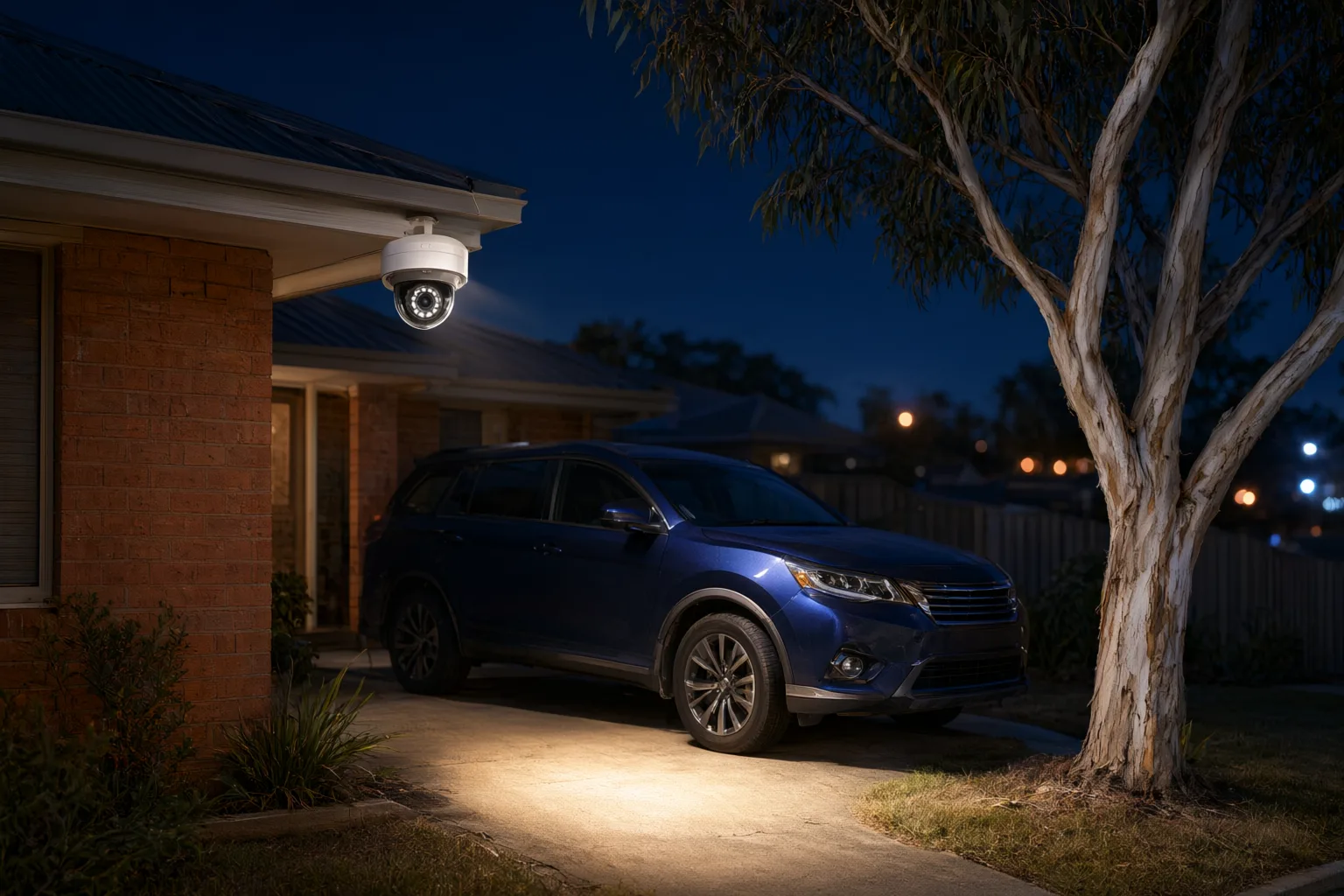
Key Takeaways
- Colour-at-night cameras capture clothing and vehicle colours that NSW Police can use to identify offenders, while IR footage is monochrome only.
- Hikvision ColorVu uses an F1.0 aperture lens and warm white LED to record full colour even in complete darkness across Australian properties.
- Smart hybrid cameras from Hikvision and Dahua stay in discreet IR mode until AI detects a person or vehicle, then switch to colour automatically.
- A four-camera residential system in NSW typically costs $1,800–$3,500 installed, with colour-at-night models adding only a modest premium per camera.
- Security installers in NSW must hold a Class 2C Security Installer licence under the Security Industry Act 1997 (NSW).
- Cameras should be mounted 2.5–3 metres high at entry points in Newcastle and Adelaide homes so faces are captured, not just heads.
Which Night Camera Technology Should You Choose?
If you need to identify people and vehicles after dark, colour-at-night cameras are the stronger choice. If you need discreet, long-range coverage of dark areas like side passages or rural driveways, infrared night vision is usually better. For most NSW homes, the ideal answer is both: colour-at-night cameras at entry points where identification matters, and IR cameras where reach and subtlety matter more.
What Is Infrared Night Vision and How Does It Work?
Infrared night vision is the technology inside most traditional [[4k-vs-1080p-security-cameras-is-the-upgrade-worth-the-money|security cameras]]. Around each lens sits a ring of infrared LEDs. When ambient light falls below a set threshold, the camera's mechanical IR-cut filter slides out of the way, the LEDs fire up, and the sensor records monochrome footage lit by light wavelengths the human eye cannot see. From the street, the only giveaway is a faint red glow from the LED ring itself.
The strengths of IR are maturity, affordability and genuine effectiveness. A quality IR turret from Hikvision or Dahua can illuminate distances of roughly 30 to 60 metres, which comfortably covers suburban backyards, driveways and side access paths. Because the illumination is invisible, IR cameras add no light pollution, will not disturb sleeping neighbours, and remain difficult for an intruder to notice.
The compromise is identification detail. Monochrome footage shows outlines, shapes and movement very clearly, but it cannot distinguish whether a hoodie was red or grey, or whether the ute parked in your driveway was white or silver. Faces can also wash out when someone walks close to the lens, because infrared reflecting off skin overexposes the image.
How Do Colour-at-Night Cameras Capture Full Colour After Dark?
Colour-at-night cameras reject the switch-to-monochrome approach entirely. Instead they combine three elements: a significantly larger image sensor that gathers more light, a wide-aperture lens (commonly F1.0) that lets that light flood in, and a built-in warm white LED that supplements whatever ambient light exists. Together these keep the scene bright enough for the sensor to record in full colour even at midnight.
Hikvision's ColorVu line is the best-known example of this category, with Dahua's Full-Colour series and Uniview's ColorHunter range built on the same principle. Where there is some ambient light, such as a street with lamp posts nearby, these cameras can hold colour without engaging the supplemental LED at all. In true darkness, the warm light activates and effectively converts midnight into a softly lit dusk scene.
For identification purposes this is a genuine leap forward. Footage looks as though it was shot in the evening rather than the middle of the night, preserving jacket colours, backpack colours and vehicle paintwork. Police consistently report that colour detail is often what turns a vague incident report into an actionable lead, which is precisely why this category has grown so quickly in the Australian residential market. All installations comply with Australia's Privacy Act 1988 and applicable state surveillance licensing requirements.
Are Infrared and Colour-at-Night Cameras Different Feature by Feature?
Neither technology wins outright; each trades one advantage for another. Infrared offers longer throw, total discretion and lower running visibility, while colour-at-night delivers identification-grade footage at the cost of a visible warm light and slightly shorter effective range. The comparison table later in this article breaks down the differences across eight practical features, from footage type and night range through to insect attraction and deterrence value, so you can match each [[the-hidden-costs-of-cheap-wireless-cameras-vs-professional-poe-systems|camera]] type to the specific zones of your property.
Should You Place Colour or Infrared Cameras Around Your Home?
The strongest residential systems deliberately mix both technologies rather than choosing one. Front doors, driveways and side gates are prime locations for colour-at-night cameras, because these are exactly the spots where identifying a person or vehicle matters most. A ColorVu turret above the front entry captures a visitor's face, clothing and anything they carry, in detail robust enough to hand to police or your insurer.
Long side passages, rear fence lines and large backyards generally suit infrared better. IR models typically reach further, draw less power and stay completely discreet, which matters when a warm LED glowing all night would shine into a bedroom window or irritate a neighbour. For acreage and rural properties across NSW, long-range IR, or ANPR-style cameras with infrared illumination, is usually the practical choice for gates and lengthy driveways.
Australian conditions shape these decisions too. During summer, insects swarm toward warm white LEDs and can trigger endless motion alerts, although modern cameras equipped with AcuSense AI filtering do an excellent job of ignoring bugs and alerting only on people and vehicles. In coastal suburbs, salt air makes housing quality just as important as sensor quality, which is why professional installers specify hardware rated for harsh outdoor Australian conditions rather than budget consumer kits.
Can Smart Hybrid Cameras Give You the Best of Both Worlds?
If you cannot choose between the two technologies, hybrid cameras remove the dilemma altogether. Hikvision's Smart Hybrid Light and Dahua's Smart Dual Light models operate in discreet infrared mode by default, then switch on the white light and flip to full colour the instant their AI detects a person or vehicle. You receive subtle monitoring the vast majority of the time, and full-colour evidence at the exact moment it counts.
Hybrids double as an active deterrent. An intruder walking up your driveway suddenly triggers a burst of warm light and knows immediately they have been seen and recorded. Combined with AcuSense human and vehicle classification, which filters out possums, pets and swaying branches, you end up with alerts that actually mean something instead of dozens of false alarms every night.
Paired with a network video recorder (NVR) and a remote viewing app, hybrids let you check live colour footage from your phone whether you are at work in the CBD or holidaying up the coast.
Do Colour-at-Night Cameras Cost More Than Infrared Models?
Yes, but only modestly. Colour-at-night models typically carry a small price premium per camera over standard IR equivalents, and that gap has narrowed considerably in recent years as the technology has matured. For a typical four-camera residential system in NSW, the total installed price difference between an all-IR setup and a mixed setup featuring ColorVu units at key entries is generally modest relative to the overall project cost.
Most installers recommend spending the premium where it earns its keep: front entries, driveways and anywhere a face or number plate might appear. Long-range IR remains the economical choice for perimeter and backyard coverage, keeping the budget focused on identification where it matters.
Why Does Professional Installation Matter So Much for Night Footage?
Night performance depends as much on placement and configuration as it does on the camera hardware itself. Mounting height, viewing angle, nearby reflective surfaces and competing light sources all change how well a camera performs after dark. A camera aimed past a white rendered wall can blind its own infrared illumination with reflections, while a ColorVu unit mounted too high will beautifully illuminate the tops of everyone's heads instead of their faces.
Licensed and insured NSW installers typically follow a five-step process: consult, design, [[officeworks-and-bunnings-cctv-vs-professional-systems-an-honest-cost-comparison|install]], configure and hand over with training. Every camera should be tested at night before the installer leaves, motion detection zones tuned to your specific layout, remote viewing configured on your phone, and footage export demonstrated so you know exactly what to do if an incident occurs. Reputable firms back their systems with lifetime support and provide free quotes.
Whether you settle on infrared, colour-at-night or a hybrid mix, a professionally designed system will always outperform a DIY kit pointed vaguely in the direction of the driveway.
Infrared Night Vision vs Colour-at-Night Cameras
| Feature | Infrared (IR) Night Vision | Colour-at-Night (e.g. ColorVu) |
|---|---|---|
| Footage type | Black and white | Full colour, 24/7 |
| Light source | Invisible infrared LEDs | Warm white supplemental LED |
| Typical night range | 30-60 metres | 20-40 metres |
| Identification detail | Shapes and movement only | Clothing, hair and vehicle colour |
| Discretion | Very discreet, faint red glow | Visible warm light when active |
| Insect attraction | Low | Higher in summer (reduced with AI filtering) |
| Deterrence | Passive | Active, light switches on with motion |
| Best for | Long driveways, backyards, rural blocks | Front doors, driveways, entry points |