
Key Takeaways
- CCTV for neighbour disputes NSW costs $1,500–$3,500 installed for a compliant 4-camera system
- Footage is admissible in NCAT and local court only if captured lawfully under NSW privacy rules
- NSW law lets you record your own property but forbids deliberately filming a neighbour's backyard or windows
- Keep at least 30 days of rolling NVR storage and export incident clips immediately to USB or cloud
- Visible cameras typically de-escalate neighbour disputes within days because behaviour changes on camera
- The Dividing Fences Act 1991 governs boundary disputes where CCTV evidence often proves decisive
How Does CCTV Resolve Neighbourhood Disputes in NSW?
CCTV resolves neighbourhood disputes by replacing conflicting accounts with objective, time-stamped video evidence that is admissible in NCAT, local court and insurance claims — provided your cameras are positioned legally under NSW privacy rules. Just as importantly, visible cameras deter bad behaviour before it starts, often ending long-running disputes within days of professional installation.
Why Do 'He Said, She Said' Disputes Drag On Without Evidence?
Few things are as corrosive to daily life as a running battle with the person next door. In Australian suburbs, the most common flashpoints are dividing fences, overhanging trees, stormwater runoff, parked vehicles, pets and noise. What makes these disputes so exhausting is the absence of any objective record: one household insists the fence was always on that line, the other disagrees, and neither can prove anything.
Without evidence, the usual avenues stall. Council officers can't act on hearsay. Police will tell you a boundary disagreement is a civil matter and decline to attend. Insurers deny claims where liability can't be established. And if the matter reaches NCAT, hearings stretch out because both parties are relying on memory, statutory declarations and photographs taken after the fact.
A properly installed security camera [[the-hidden-costs-of-cheap-cctv-systems-and-why-they-fail|system]] breaks this cycle. Every incident is captured with a date and time stamp, creating an objective record that councils, police, insurers and tribunals can rely on. Instead of arguing about what happened last Tuesday, the conversation shifts to what the footage clearly shows — and that shift alone often brings disputes to a rapid close.
Which Disputes Is CCTV Best Suited to Documenting?
Cameras earn their keep on the recurring problems that happen while you're at work, asleep or away. These are the issue types we most often help Sydney homeowners document:
Boundary and fence disputes top the list. Footage can capture a neighbour shifting fence posts, building a shed or retaining wall over the line, or allowing trees and branches to damage your roof, gutters or fencing. This kind of record is central to a claim under the Dividing Fences Act 1991 (NSW) or an application to NCAT.
Property damage is the second major category. Deliberate vandalism, a neighbour's contractor backing into your fence, or a vehicle repeatedly clipping your letterbox all become provable events rather than suspicions. Insurers and police both respond very differently to a claim backed by clear video.
Noise and anti-social behaviour complaints also benefit. While most residential setups record video only — capturing audio raises additional considerations under NSW surveillance law — cameras still document the behaviour itself: parties spilling onto your driveway, aggressive confrontations at your gate, or visitors repeatedly cutting across your land.
- Boundary encroachments: fence movement, tree damage, structures built over the line
- Property damage: vandalism, vehicle damage, damage from neighbouring construction
- Trespassing: neighbours or their visitors entering your property without permission
- Rubbish dumping: illegal dumping on your verge or over your fence
- Pet issues: dogs roaming, attacking your pets, or damaging your garden
- Anti-social behaviour: intimidation, harassment, or aggressive confrontations
Can CCTV Footage Be Used in NCAT, Court and Insurance Claims?
In New South Wales, CCTV footage is admissible evidence in NCAT, local court and civil proceedings — but only if it was obtained lawfully. In practice, that means your cameras must be aimed at your own property and must not deliberately record a neighbour's private areas such as their backyard, windows or pool.
When you lodge a dispute with NCAT over a dividing fence, tree damage or an encroaching structure, video evidence transforms your case. Rather than relying on recollections and after-the-fact photographs, you can show the tribunal precisely what occurred, when it occurred, and how frequently the behaviour has repeated. Tribunals place significant weight on contemporaneous recordings.
Police take complaints far more seriously when footage accompanies them. Trespassing, malicious damage and intimidation are criminal matters — but only if you can substantiate them. A clear video record converts what police might otherwise wave off as a neighbourhood squabble into an actionable offence.
Insurance is the third arena where footage proves decisive. If a neighbour's tree comes down on your roof, their retaining wall fails onto your land, or their renovation cracks your foundations, video of both the incident and the lead-up can be the difference between a paid claim and a denied one. Insurers routinely ask for evidence of how damage occurred; a rolling [[the-hidden-costs-of-cheap-wireless-cameras-vs-professional-poe-systems|camera]] archive answers that question definitively.
Should You Rely on Deterrence to End Bad Behaviour Before It Starts?
Arguably the greatest benefit of CCTV in a neighbourhood dispute isn't the footage you collect — it's the behaviour you never have to record. People behave differently when they know they're on camera.
We regularly see the same pattern: a homeowner installs cameras after months of escalating tension, and within days the problematic conduct stops. The rubbish dumping over the back fence ceases. The hostile confrontations at the gate end. The shortcut across the lawn is abandoned.
The reason is simple: cameras remove anonymity and deniability. Someone who is comfortable acting badly when they believe nobody is watching becomes far more cautious when there's a permanent, time-stamped record of their every move.
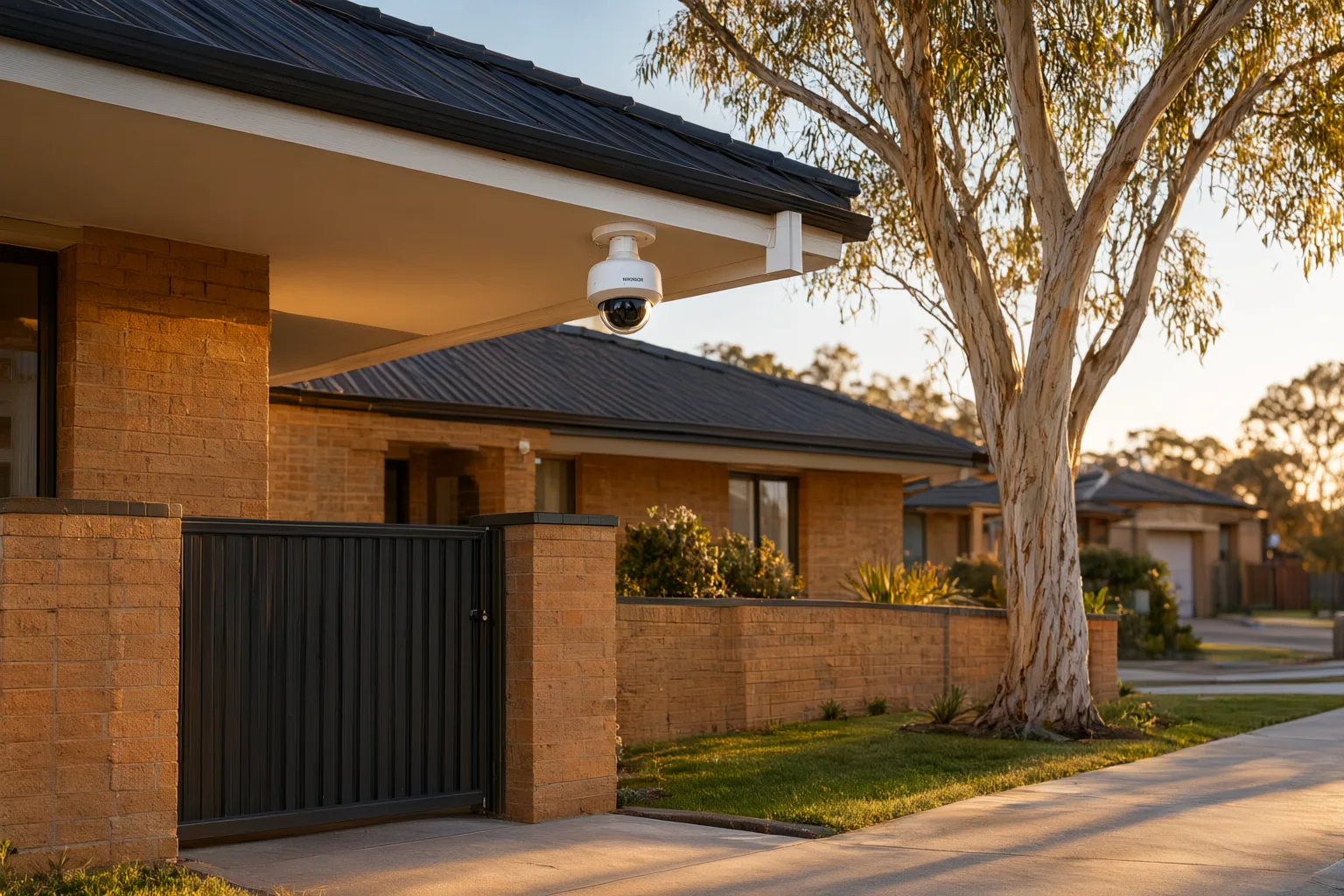
For this reason, we generally recommend visible cameras rather than covert ones for boundary disputes. A clearly mounted Hikvision or Dahua camera on the eaves or fence line sends an unmistakable message: this property is monitored, and actions here are recorded. Covert systems may capture evidence, but they forfeit the deterrent benefit that resolves most disputes before they escalate.
Is Your Camera Placement Legal Under NSW Privacy Rules?
NSW privacy law draws a clear line: you may record your own property, but you may not deliberately record a neighbour's private spaces. Camera positioning is therefore both a legal question and a practical one — the right placement captures compelling evidence while keeping you firmly on the right side of the law.
For boundary disputes, cameras should cover your side of the fence line, your driveway, your front verge and any specific area where encroachment or damage is occurring. It's generally acceptable if the field of view incidentally takes in a slice of the neighbour's property that's visible from the street — such as their front yard — provided the primary focus remains your own land.
This is where professional [[how-much-does-professional-cctv-installation-cost-in-australia|installation]] matters enormously. Licensed installers understand NSW surveillance laws and will angle each camera to maximise evidence capture while remaining compliant. We also configure privacy masking on systems such as Hikvision AcuSense, which digitally blacks out portions of the frame — a neighbour's windows, for example — so they're never recorded.
Legal positioning is only half the equation; the footage must also be usable. A grainy image of a figure near your fence proves little at NCAT. A 4K ColorVu camera recording full-colour video at 25 frames per second captures faces, clothing, vehicles and number plates clearly enough to stand up in proceedings.
What Camera Technology Produces the Best Dispute Evidence?
Not every camera produces evidence fit for a tribunal. When the goal is documenting boundary and neighbour disputes, these are the technologies we specify:
Hikvision ColorVu cameras are our first recommendation because they record full-colour footage around the clock, even in complete darkness. Much anti-social behaviour happens after dark, and colour detail — clothing, vehicle colour, number plates — is often what identifies the person responsible.
AcuSense technology, available across Hikvision and Dahua ranges, uses AI to distinguish people and vehicles from irrelevant movement like cats, birds or swaying branches. You receive an alert when a person enters your property, not every time the neighbour's gum tree moves in the wind. That means genuine incidents are never buried in false alarms.
For long boundary lines or acreage, a combination works best: fixed cameras providing constant coverage of key zones, plus PTZ (pan-tilt-zoom) cameras that can be remotely steered and zoomed onto a live incident. Uniview and Axis PTZ models offer outstanding zoom range and clarity for this role.
Finally, all footage should record to an NVR (network video recorder) with at least 30 days of retention. Incidents aren't always discovered immediately, and a rolling month-long archive ensures the evidence still exists when you find the damage.
Do Remote Viewing Apps Let You Watch Your Boundary in Real Time?
Modern IP camera systems add a capability that older analogue setups never had: live remote viewing. Through apps such as Hik-Connect or DMSS, you can watch your cameras from a phone, tablet or computer anywhere in the world.
During an active dispute this is invaluable. If a neighbour has threatened to damage your property while you're at work, you can check the live feed the moment you receive an alert, confirm what's happening, and call police with real-time information rather than a vague report.
Remote viewing also lets you gather evidence without confrontation. Rather than marching outside to challenge someone trespassing or damaging your fence — and risking a heated escalation — you simply let the system record and use the footage later. De-escalation and documentation beat confrontation every time.
For rural properties, hobby farms and holiday homes, remote monitoring is essential. Boundary disputes are common on large or semi-rural blocks precisely because owners aren't always on-site. We install 4G-enabled systems for properties without NBN coverage, so a landholder in western NSW can monitor their boundary from Sydney in real time.
Are There Rules for Handling Footage After an Incident Is Captured?
Recording an incident is only useful if you handle the footage correctly afterwards. The first rule: export it immediately. NVRs overwrite old footage on a rolling basis, so save the relevant clip to a USB drive or secure cloud storage as soon as you're aware of the incident. Keep the original file unedited — tribunals and courts give far less weight to footage that's been trimmed or altered.
Second, note the context. Record the date, time, camera location and what the footage shows in a simple written log. If similar incidents recur, that log demonstrates a pattern of behaviour, which strengthens both NCAT applications and police reports.
Third, share the footage with the right parties. For criminal conduct such as malicious damage or trespass, provide it to police. For fence and tree matters, include it with your NCAT application or your notice under the Dividing Fences Act. For damage claims, supply it to your insurer with your lodgement.
Handled this way, a single clear recording often ends a dispute outright. Once a neighbour sees that their actions are documented, admissible and being acted upon, continued bad behaviour becomes a losing proposition.
CCTV Features for Neighbourhood Disputes: What You Need
| Feature | Why It Matters | Recommended Technology |
|---|---|---|
| Resolution | Court-admissible evidence requires clear facial and number plate identification | 4K (8MP) minimum; Hikvision, Dahua, Uniview |
| Night vision | Much anti-social behaviour occurs after dark | ColorVu full-colour night vision or Starlight low-light sensors |
| Motion detection | Alerts you to incidents in real-time without false alarms | AcuSense AI human/vehicle detection |
| Storage | You need a rolling archive of footage for evidence | NVR with 30+ days retention, 4TB+ hard drive |
| Remote viewing | Monitor your property from work, holidays, or anywhere | Hik-Connect, DMSS, or Uniview app with 4G/NBN |
| Weatherproofing | Cameras must withstand Australian heat, storms, and coastal conditions | IP67-rated cameras, professional installation |