
Key Takeaways
- AI person detection filters out pets and passing cars so you only get alerts that matter
- Two-way audio lets you instruct couriers or warn off thieves the moment they approach
- Full-colour night vision (ColorVu) captures usable evidence after dark, when most thefts occur
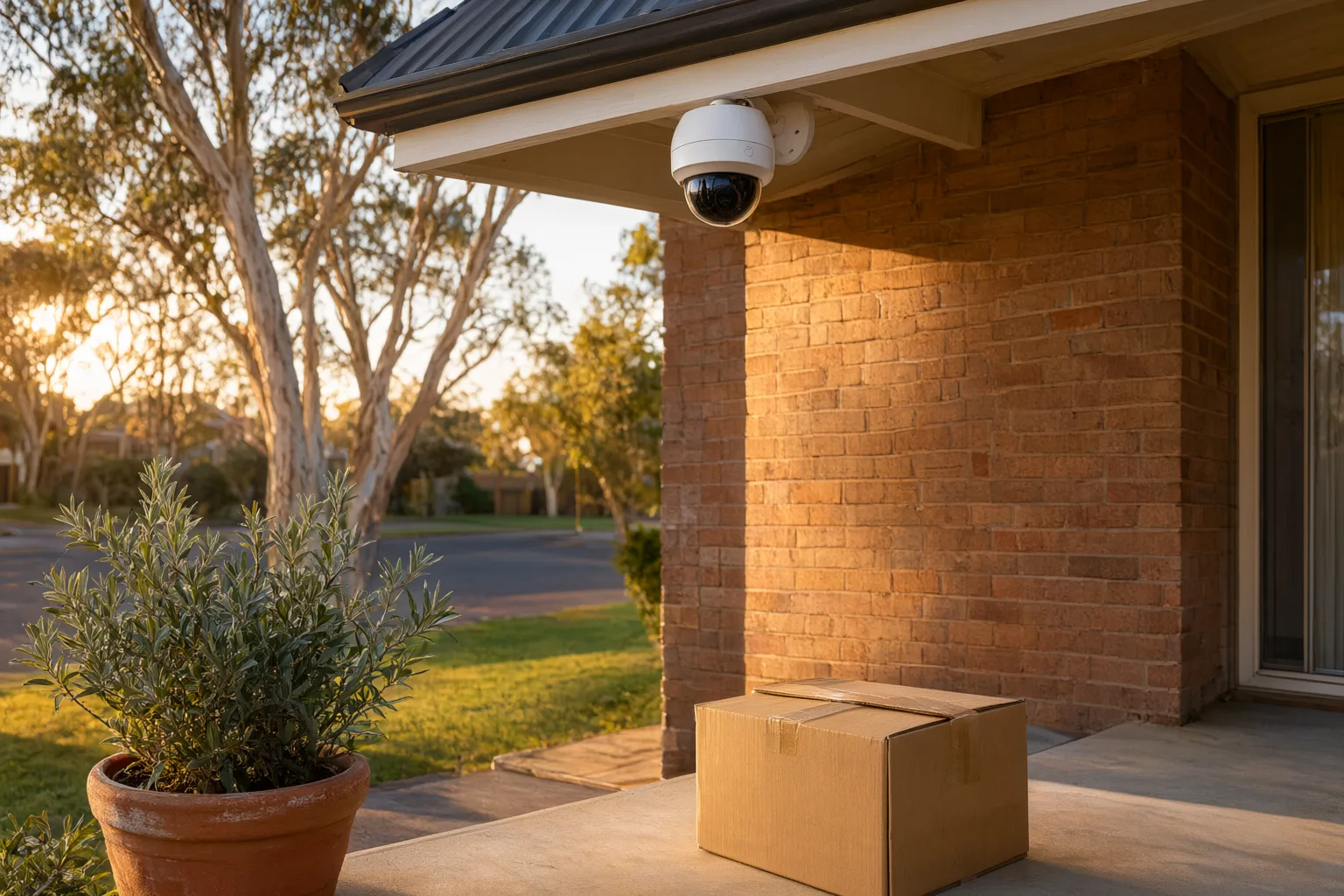
- A video doorbell plus an overhead porch camera covers both faces and packages
- Visible cameras and signage are proven deterrents — most opportunistic thieves move on
- Professional installation ensures correct angles, Wi-Fi strength and weatherproofing for Australian conditions
Why Parcel Theft Is Surging in Australian Suburbs
Online shopping has become the default for most Australian households, and with it has come a sharp rise in parcel theft — often called porch piracy. Couriers routinely leave packages at front doors during work hours, and an unattended box on a veranda is an easy target for opportunistic thieves who follow delivery vans through suburban streets.
The frustrating reality is that most parcel theft goes unsolved. Grainy footage, poor camera angles and delayed notifications mean victims often discover the crime hours later with nothing usable to hand to police. The good news is that modern smart cameras have closed this gap. With the right hardware and setup, you can detect a person the second they step onto your porch, speak to them live, and record court-quality evidence in full colour — day or night.
How Smart Cameras Actually Deter Porch Pirates
A camera stops parcel theft in three ways: deterrence, intervention and evidence. A clearly visible camera and warning signage make your home a harder target than the place next door — most opportunistic thieves simply move on. If someone does approach, instant AI-driven alerts and two-way audio let you intervene in real time, which is usually enough to send them running. And if a theft does occur, high-resolution colour footage gives police something they can actually act on.
The key word is 'smart'. Older motion-based cameras bombarded owners with false alarms from passing cars, magpies and swaying branches, so people muted notifications and missed the events that mattered. Modern cameras with AI person and vehicle detection — such as Hikvision's AcuSense range — only alert you when a human is detected in your defined zone, which means the notification on your phone genuinely deserves your attention.
- Deterrence: visible cameras and stickers discourage opportunistic theft
- Intervention: live alerts and two-way talk let you act within seconds
- Evidence: 4K colour footage captures faces, clothing and number plates
Essential Camera Features for Porch Protection
Not every camera is suited to watching a front porch. Australian conditions — harsh summer sun, coastal salt air, storms and long distances from the router — demand professional-grade hardware with the right feature set. Here is what actually matters.
AI person detection is non-negotiable. Technologies like Hikvision AcuSense and Dahua's Smart Motion Detection classify humans and vehicles, slashing false alarms by up to 90 per cent. Full-colour night vision is equally critical: Hikvision ColorVu cameras use large-aperture lenses and warm supplemental lighting to record in vivid colour around the clock, so a thief's clothing and vehicle colour are captured instead of a washed-out black-and-white silhouette.
Two-way audio with a built-in speaker and microphone lets you tell a courier where to hide a parcel — or firmly inform a stranger that they are being recorded. Active deterrence models go further, triggering a strobe light and audible warning when a person enters your zone after hours. Finally, look for IP66 or IP67 weather ratings to survive Australian heat, dust and driving rain, and Power over Ethernet (PoE) for a rock-solid wired connection that never depends on patchy Wi-Fi.
- AI person/vehicle detection (AcuSense, SMD) to eliminate false alerts
- ColorVu or Starlight full-colour night vision for usable after-dark evidence
- Two-way audio to speak with couriers and warn off intruders
- Active deterrence: strobe lights and sirens triggered by human detection
- IP66/67 weatherproofing for Australian heat, storms and coastal air
- PoE wired connection or strong dual-band Wi-Fi for reliable alerts
Where to Position Cameras to Cover Your Porch
Placement is where most DIY installs fail. A single doorbell camera pointed straight ahead captures the top of a visitor's head and nothing of the street. For genuine porch protection you need overlapping coverage: one camera mounted at roughly 2.4 to 3 metres, angled down to capture faces and the parcel drop zone, plus a video doorbell at chest height for close-up identification and two-way conversation.
If your porch faces the street, a second camera covering the driveway and footpath lets you see a thief's vehicle and direction of travel — often the detail that solves the case. Angle cameras to avoid pointing directly into the rising or setting sun, and make sure the porch light or the camera's own supplemental lighting covers the drop zone at night. A licensed installer will map your sightlines, check Wi-Fi or cable runs, and ensure your cameras comply with NSW privacy expectations by focusing on your own property rather than a neighbour's.
Smart Delivery Habits That Back Up Your Cameras
Cameras work best as part of a routine. When a delivery notification arrives, open the live view and use two-way audio to ask the courier to place the parcel behind a pot plant, side gate or parcel box rather than in plain sight. Many couriers are happy to oblige when someone is clearly watching.
Combine this with carrier options like Australia Post's safe-drop instructions, parcel lockers and delivery-day tracking. If your camera supports custom detection zones, draw the zone tightly around your porch so you are alerted the moment a package is delivered — and again if anyone returns for it. Some households even set an automated voice warning through the camera speaker after business hours, which is remarkably effective at moving loiterers along.
- Use two-way audio to direct couriers to concealed drop spots
- Set tight detection zones around the porch for instant delivery alerts
- Add safe-drop instructions and parcel lockers as a second layer
- Schedule after-hours voice warnings or strobe deterrence
DIY Cameras vs Professional Installation
Battery-powered DIY doorbells are a reasonable starting point, but they come with real limitations: delayed wake-up times that miss the first seconds of an event, subscription fees for cloud storage, batteries that fade in summer heat, and Wi-Fi dropouts at the front of the house where signal is weakest.
A professionally installed system uses wired PoE cameras recording 24/7 to a local NVR — no subscriptions, no gaps, no flat batteries. Your installer configures AI detection zones, remote viewing on your phone, and secure storage, then walks you through the app before leaving. At Aussie CCTV Cams, our licensed and insured NSW team follows a five-step process — consult, design, install, configure and handover with training — and backs every job with lifetime support. For most households, a two or three camera porch-and-driveway package is surprisingly affordable, and it protects far more than just parcels.
Camera Options for Parcel Theft Prevention Compared
| Feature | DIY Battery Doorbell | Video Doorbell + Porch Camera (Pro Install) | Full PoE System with NVR |
|---|---|---|---|
| Recording | Event clips only, cloud subscription | Doorbell clips + continuous porch coverage | 24/7 continuous recording, local storage |
| Night vision | Basic infrared, black and white | Colour night vision on porch camera | ColorVu full-colour on all cameras |
| AI person detection | Basic, often subscription-locked | Yes, on-camera AcuSense/SMD | Advanced AI zones on every channel |
| Two-way audio | Yes | Yes, at door and porch | Via deterrence cameras |
| Power reliability | Battery fades in heat, needs recharging | Wired doorbell + PoE camera | PoE wired, no batteries |
| Ongoing costs | Monthly cloud fees | None for local recording | None for local recording |
| Typical installed cost | $150–$400 DIY | $700–$1,200 installed | $1,500–$2,500 installed |