
Key Takeaways
- Contact sensors installed on NSW doors and windows typically cost $40–$90 per opening as part of an alarm system.
- A professionally installed four-camera PoE system with NVR starts around $2,000–$3,500 in Australia.
- A combined alarm-plus-camera package for a three-bedroom NSW home usually totals $3,000–$5,500 fully installed.
- Layered security follows the deter-detect-delay-respond model, with sensors owning detection and cameras owning evidence.
- Many Australian insurers offer 5–15% premium discounts for professionally installed and monitored systems.
- Security installers in NSW must hold a Master Security Licence under the Security Industry Act to legally fit alarms.
How Do Door and Window Sensors Detect a Break-In?
Neither sensors nor cameras alone is enough — the strongest home security comes from layering both. Contact sensors detect every door and window opening within seconds, even in darkness, while cameras record faces, vehicles and behaviour that deter intruders and give police usable evidence. For NSW homeowners weighing up sensors vs cameras, the right move is installing both together.
A properly layered system combines the two with an alarm siren and optional back-to-base monitoring. The result is a home where every realistic entry point is detected, key approaches are filmed, and any genuine event triggers an immediate response you can verify from your phone. This guide explains exactly what each device does, how they compare on cost and capability, and how to design a layered setup that suits an Australian home.
What Do Security Cameras Add: Evidence, Deterrence and Remote Eyes?
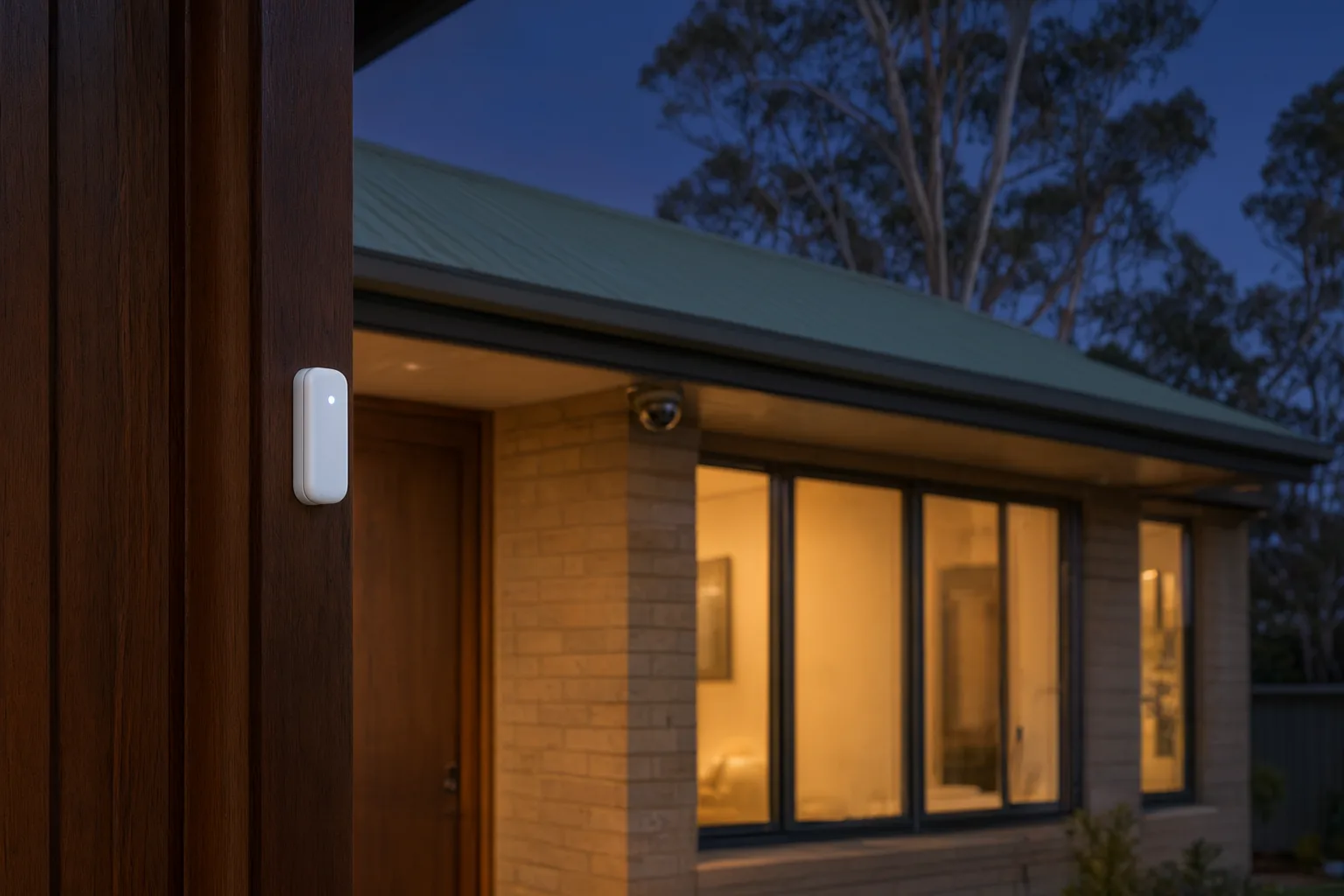
Contact sensors — sometimes called reed switches — are among the simplest devices in home [[4k-vs-1080p-security-cameras-is-the-upgrade-worth-the-money|security]], and among the most reliable. Each sensor has two parts: one mounted on the door or window frame, the other on the moving sash or door itself. The moment the gap between them exceeds a few millimetres, the circuit breaks and your alarm system registers an opening event.
That immediacy is their superpower. A forced laundry window or a kicked-in back door triggers the sensor within seconds, which can sound the siren, push an alert to your phone, or notify a monitoring centre. Sensors don't rely on light, so they work identically at 3am and midday. They're unaffected by dust, heat or an intruder masking their face — none of the workarounds that can defeat a camera matter to a contact sensor.
The trade-off is context. A sensor confirms that something opened, but nothing more. There's no footage for police, no image for your insurance claim, and no way to distinguish a burglar from a teenager sneaking home late or a door blown open by wind. That verification gap is precisely what cameras fill.
Which Wins in Sensors vs Cameras Home Security Comparisons?
Cameras are the evidentiary layer of your security. Positioned over the front approach, driveway and rear yard, they capture faces, clothing, vehicles and number plates — the kind of material NSW Police can genuinely use. Modern professional-grade cameras such as Hikvision ColorVu models record full-colour footage after dark, while AcuSense AI analytics separate people and vehicles from possums, moving branches and passing headlights, dramatically cutting false notifications.
Deterrence matters just as much as recording. A clearly visible camera at the front of the house signals that entry will be filmed, and most opportunistic offenders simply choose an easier target. Remote viewing adds another dimension: whether you're at the office in the CBD or away on holidays, you can pull up live footage, check on a delivery, or verify an alarm before deciding what to do.
Cameras do have a blind spot — literally. They only cover what's inside their field of view, and they don't inherently know that a window has been opened. A camera watching the front door tells you nothing about someone entering through a bathroom window down the side of the house. Without sensors on those openings, an intrusion may only surface when you review footage hours later.
Should You Choose Sensors or Cameras First for Your Home?
When you line the two technologies up factor by factor, it becomes obvious how little they overlap — and why pairing them works so well. The comparison below covers detection speed, evidence quality, night performance, false-alarm behaviour, coverage area, installed cost, deterrence value and ideal placement.
Can Layered Security Outperform Either Device Alone?
Security professionals design around four layers: deter, detect, delay, respond. Cameras own deterrence and evidence. Contact sensors own detection at every opening. A siren and monitoring handle response. Strip out any single layer and you leave a gap a determined intruder can exploit.
A real-world layered event shows why this matters. Someone slips through your side gate — a camera with AcuSense picks up a person, starts recording and sends a snapshot to your phone. They force the laundry window — the contact sensor fires instantly, the siren sounds, and your app displays the alert alongside the live camera feed. You can call 000 knowing exactly what's happening, or stand down if it turns out to be a false alarm. Instant detection plus visual verification is a combination neither device delivers by itself.
Layering also tames false-alarm fatigue. When a sensor trips, you glance at the camera to confirm. When a camera flags motion, you check whether any sensor was triggered. Cross-verification means you respond to genuine events and ignore the noise — which is especially important if your [[the-hidden-costs-of-cheap-cctv-systems-and-why-they-fail|system]] is back-to-base monitored, where repeated false alarms can lower your response priority.
Do You Design a Layered System Differently for Australian Homes?
A typical NSW brick veneer or weatherboard house has far more entry points than owners realise: front and back doors, sliding doors, garage access doors, and commonly eight to fifteen windows. Sensible design places contact sensors on every ground-floor door and accessible window, then positions cameras to cover the front approach, driveway, rear yard and side passages — the routes an intruder would actually take.
For most homes we recommend a hardwired or hybrid alarm panel carrying the sensors, paired with PoE (Power over Ethernet) cameras recording to an NVR. Wired connections avoid the flat batteries and Wi-Fi dropouts that undermine cheap DIY kits, and PoE cameras keep recording locally even if your internet connection fails. For rural and bushfire-prone properties, systems are designed for heat, dust and 4G failover so alerts and monitoring stay connected when conditions are at their worst.
[[how-much-does-professional-cctv-installation-cost-in-australia|Installation]] should follow a structured process — consultation, design, installation, configuration and a handover with training — so every sensor sits correctly, every camera angle is optimised, and you finish knowing exactly how to arm, disarm and review events from the app. Ongoing lifetime support means you're never left troubleshooting on your own.
Is a Layered System Affordable? What Does It Cost in NSW?
Budgeting realistically helps. Quality contact sensors installed as part of an alarm system typically run $40–$90 per opening. A professionally installed four-camera PoE system with an NVR generally starts around $2,000–$3,500. For a standard three-bedroom home, a combined alarm-plus-camera package usually lands between $3,000 and $5,500 fully installed and configured.
Put those figures against the alternative. NSW Bureau of Crime Statistics data consistently shows that stolen goods, property damage and insurance excesses add up to several thousand dollars per break-in — before accounting for the lasting loss of peace of mind. Many insurers also discount premiums for professionally installed, monitored systems, which recovers part of the investment over time. A free, no-obligation quote gives you exact numbers for your own home before you commit to anything.
Why Start With a Professional Layered Security Assessment?
The practical first step is a professional assessment of your home's entry points and sightlines. A licensed installer will map every door and accessible window, identify camera positions that capture approaches without breaching neighbours' privacy, and recommend a mix of sensors, cameras, sirens and monitoring suited to your budget and location.
Whether you live in a Sydney terrace, a Western Sydney family home or a regional property, the principle holds: sensors ensure nothing gets in unnoticed, cameras ensure everything important is recorded, and integration ties it all into one app with real-time alerts. Book a free assessment to get a tailored design rather than guessing at gadgets off a shelf.
Door and Window Sensors vs Security Cameras at a Glance
| Factor | Door/Window Sensors | Security Cameras |
|---|---|---|
| Primary job | Detect an opening instantly | Record, deter and identify |
| Visual evidence | None | Full footage for police and insurance |
| Works in darkness | Yes, unaffected | Yes, with IR or ColorVu night vision |
| False alarm filtering | Very few false triggers | High accuracy with AcuSense AI analytics |
| Coverage | Only the fitted opening | Wide area within field of view |
| Typical installed cost | $40–$90 per opening | $2,000–$3,500 for a 4-camera system |
| Deterrence value | Low (hidden devices) | High (visible cameras discourage intruders) |
| Best used for | Perimeter detection on every opening | Approaches, driveways, yards and verification |