
Key Takeaways
- The Privacy Act 1988 makes a published CCTV privacy policy mandatory for businesses with $3 million+ annual turnover.
- APP 1, 3, 5, 11 and 12 govern camera use: policy publication, collection limits, notification, security and access rights.
- NSW's Workplace Surveillance Act 2005 requires visible cameras and prior notice before monitoring employees.
- Most Australian businesses retain CCTV footage 30–90 days before NVR auto-overwrite, per proportionality principles.
- Audio recording without consent breaches the Surveillance Devices Act 2007 (NSW) — disable microphones on business cameras.
- Covert workplace surveillance in NSW needs a magistrate-issued covert surveillance authority; hidden cameras otherwise risk penalties.
What Is a CCTV Privacy Policy and Why Does Your Business Need One?
A compliant CCTV privacy policy in Australia is a short written document explaining how your security cameras collect, use, store and disclose footage — and if your business turns over $3 million or more, the Privacy Act 1988 makes publishing one mandatory. It should state your recording purpose, retention period, access process and complaint channels.
The legal driver is the Privacy Act 1988 (Cth). Any recording in which a person can be reasonably identified — by their face, clothing, vehicle or location — is personal information, and the Australian Privacy Principles (APPs) govern how it must be handled. Businesses with an annual turnover of more than $3 million are bound by the Act. Many smaller operators fall outside the strict threshold but choose to comply anyway, particularly those handling sensitive customer data, working with government clients or answering insurer and franchise requirements.
Beyond compliance, a written policy earns trust and prevents disputes. In our experience installing commercial systems across NSW, businesses with a documented policy run tighter operations overall: retention cycles are configured properly, export permissions are restricted, and nobody scrambles when a customer or police officer asks for a recording. The Office of the Australian Information Commissioner (OAIC) also takes a documented policy as evidence that an operator takes its obligations seriously if a complaint ever lands on its desk.
How Do the Australian Privacy Principles Apply to Security Cameras?
Five of the thirteen APPs matter most for camera operators. APP 1 requires a clearly expressed, up-to-date and accessible privacy policy. APP 3 limits collection to what is reasonably necessary for your functions — you cannot film beyond your stated purpose. APP 5 obliges you to notify people that recording is occurring. APP 11 requires you to keep footage secure against misuse, loss and unauthorised access. APP 12 gives individuals the right to request access to footage of themselves.
State law adds further obligations, especially for employers. In New South Wales, the Workplace Surveillance Act 2005 requires written notice to employees before camera surveillance starts — at least 14 days' advance notice for new surveillance, or before a new employee begins work. Cameras used for workplace surveillance must be visibly operating; hidden cameras are unlawful unless a magistrate has issued a covert surveillance authority, generally reserved for investigating serious wrongdoing. Filming in change rooms, toilets, showers or prayer rooms is prohibited outright.
Audio deserves special caution. Under the Surveillance Devices Act 2007 (NSW) and equivalent legislation in other states, recording private conversations without consent can be a criminal offence. For most shops, offices and warehouses, the safest course is to disable microphone recording entirely and note this in your policy.
Which Core Elements Must Your CCTV Privacy Policy Contain?
Aim for one to two pages of plain English — long enough to be complete, short enough that people read it. Publish it on your website, keep printed copies at reception and include it in the staff handbook. Every robust policy covers eight core elements: Australia's extreme UV, coastal salt air, and summer heat demand weatherproof housings — IP66-rated cameras handle [[/newcastle|Newcastle]]'s humidity and [[/adelaide|Adelaide]]'s 40°C+ days.
- Purpose: why cameras operate (safety, theft prevention, incident investigation) plus an explicit statement that they are not used to monitor staff performance
- Camera locations: the general areas covered — entrances, registers, car parks, loading docks — with confirmation that private areas are never filmed
- Notification: how people are told, including entrance signage and written notice to employees
- Storage and retention: where footage lives (an encrypted, password-protected NVR), how long it is kept (typically 30–90 days) and how deletion occurs
- Access controls: which named roles may view or export footage, and confirmation that every access event is logged
- Disclosure: the narrow circumstances in which footage leaves the business — police requests, court orders, insurers investigating a claim
- Individual rights: how to request access to footage of yourself and how to lodge a privacy complaint
- Contact details: your nominated privacy contact, plus the OAIC as the external complaints body
Do Australian Laws Require CCTV Signage and Staff Notification?
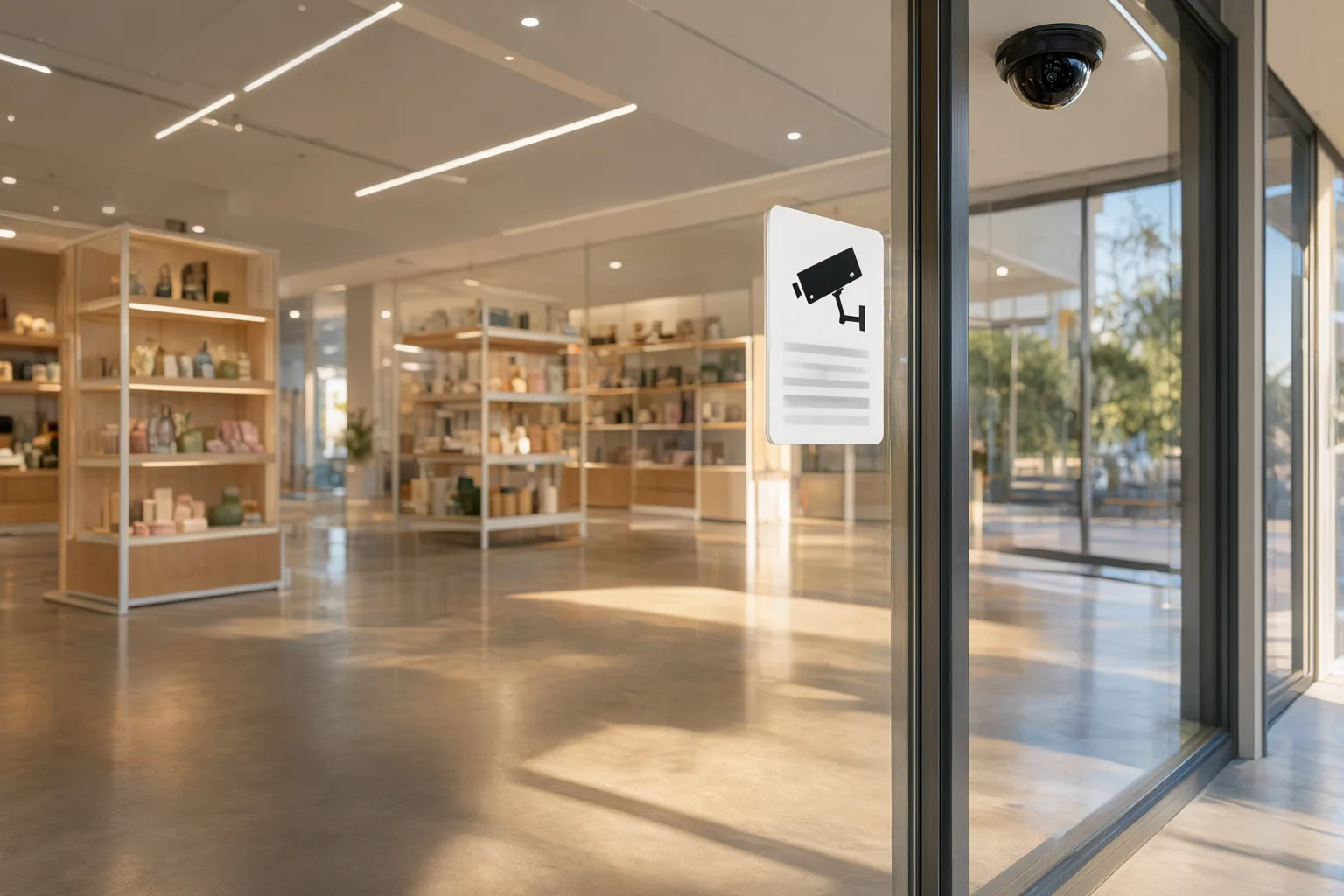
Signage is the visible face of your policy. Place clear signs at every public entrance and within monitored areas, positioned so people can read them before stepping into a camera's field of view. A simple message works best: 'CCTV in operation for your safety and security', along with the name of the business operating the system. You do not need to map every individual camera; you simply need to guarantee that nobody is recorded without a reasonable opportunity to know about it.
For employees, signs alone do not satisfy NSW workplace surveillance law. Provide written notice describing where cameras are located, their purpose and how footage will be used, then file a signed acknowledgment from each staff member. This is one reason we build documentation into our five-step [[how-much-does-professional-cctv-installation-cost-in-australia|installation]] process — consult, design, install, configure, and handover with training — so the paperwork matches the physical system from day one rather than being patched together afterwards.
Is There a Legal Retention Period for CCTV Footage in Australia?
Australia has no single legislated retention period for general business CCTV. The governing principle under the APPs is proportionality: retain footage only as long as genuinely needed for your stated purposes. In practice, most retail, office and warehouse sites configure their network video recorder to hold 30 to 90 days of continuous footage before it automatically overwrites. Some sectors carry specific requirements — licensed venues, childcare services and financial services firms often face longer minimum retention under their own regulatory frameworks.
Storage security carries equal weight. Recordings should sit on a password-protected NVR inside a locked comms cabinet or server room, with user-level permissions ensuring only authorised managers can view or export clips. Modern Hikvision and Dahua recorders support encrypted storage, audit logs and configurable overwrite cycles, which makes demonstrating APP 11 [[cctv-and-the-australian-privacy-principles-a-plain-english-guide-for-business-ow|compliance]] straightforward during an audit or investigation.
When an individual asks for footage of themselves, treat it as a formal access request: verify their identity, respond within a reasonable period (30 days is the accepted benchmark) and blur or redact other identifiable people before releasing anything.
Can You Use a CCTV Privacy Policy Template for Your Business?
Use the seven-part skeleton below as your starting point. Replace the bracketed details with your own information, check it against your state's surveillance laws, and publish it where both staff and customers can find it.
1. Introduction — '[Business Name] operates closed-circuit television (CCTV) cameras at [premises address]. This policy explains how we collect, use, store and disclose CCTV footage in accordance with the Privacy Act 1988 (Cth) and the Australian Privacy Principles.'
2. Purpose — 'Cameras are used to protect the safety of staff, customers and visitors, deter theft and vandalism, and assist incident investigations. Cameras are not used to monitor employee performance.'
3. Camera locations and signage — list the monitored areas, confirm no cameras operate in toilets or change rooms, and note that warning signs appear at all entrances.
4. Collection, storage and retention — 'Footage is recorded continuously and stored securely on an encrypted network video recorder. Recordings are retained for [30–90] days and then automatically deleted, unless required for an investigation or legal request.'
5. Access and disclosure — name the authorised roles, confirm access is logged, and list the limited disclosure circumstances such as law enforcement, court order or insurer.
6. Your rights — explain how to request access to footage and how to complain, first internally to your privacy contact, then externally to the OAIC (oaic.gov.au, 1300 363 992).
7. Contact and review — provide a named contact and commit to reviewing the policy annually, or whenever the camera system changes.
Why Does Camera System Design Make or Break Privacy Compliance?
Even the best-written policy cannot rescue a poorly designed system. [[common-cctv-privacy-mistakes-australian-businesses-make-and-how-to-avoid-them|Compliance]] becomes dramatically easier when the hardware and configuration support it from the outset: camera placement that avoids neighbouring properties and private areas, recorders with role-based user accounts and audit trails, and retention cycles set correctly at installation rather than left on factory defaults.
Modern analytics also shrink your privacy footprint. Features such as AcuSense human and vehicle detection mean cameras record events that matter instead of endless empty frames, reducing the volume of personal information you hold. When we hand over a commercial system, the final session walks your team through exactly how footage is stored, who holds access rights and how to handle an access request — so the people running the system understand the policy they are operating under.
If you are upgrading ageing equipment or starting from scratch, aligning the hardware, configuration and written policy in a single project eliminates the grey areas that generate complaints later. Look for an installer offering lifetime support and a free, no-obligation quote so the ongoing management burden does not fall entirely on you.
Are These the Most Common CCTV Privacy Mistakes Australian Businesses Make?
The same avoidable errors recur across complaints to regulators. Cameras drift out of alignment over time and begin filming neighbouring properties or adjoining change room entrances — schedule periodic checks. Retention settings are left at defaults, sometimes holding years of footage far beyond any legitimate need. Export permissions are shared among too many logins, making it impossible to show who viewed what and when.
Another frequent failure is treating staff notification as a one-off. New employees must receive written notice before they start, and any change to camera locations triggers fresh notification obligations in NSW. Finally, businesses occasionally enable audio 'because it was free' — exposing themselves to surveillance device offences that video alone would never create. A short annual review of your policy, signage and recorder settings catches nearly all of these issues before they become formal complaints.
Recommended CCTV Retention Periods by Australian Business Type
| Business Type | Typical Retention | Key Considerations |
|---|---|---|
| Retail and hospitality | 30–60 days | Covers most theft and incident reporting windows; licensed venues may require longer |
| Offices and professional services | 30 days | Lower incident rates; shorter retention reduces privacy exposure |
| Warehouses and industrial sites | 60–90 days | Longer window for stock discrepancies and workplace incident claims |
| Childcare and education | 90+ days | Sector regulations and mandatory incident reporting may extend retention |
| Construction sites | 30–90 days | Retain longer where WHS incidents or insurance claims are likely |