
Key Takeaways
- Aim home security cameras at your own doors, driveway and boundary line, never at neighbours' windows or pools.
- The NSW Surveillance Devices Act 2007 protects areas where people reasonably expect privacy from optical recording.
- Filming streets and footpaths is generally legal in Australia, but zooming on individuals can raise harassment concerns.
- Privacy masking lets you black out a neighbour's window or yard so it is never recorded or displayed.
- Professional site surveys for CCTV installation in Newcastle typically cost $0-$150 and prevent privacy disputes.
- There is no legal requirement in NSW to notify neighbours about security cameras, but a quick chat prevents complaints.
What Is the Golden Rule of Camera Placement in Australia?
In Australia, you should point home security cameras at your own property — front door, driveway, side gates, rear access points and perimeter — while keeping neighbours' windows, yards and pools out of frame. State laws such as the NSW Surveillance Devices Act 2007 protect areas where people expect privacy, so compliant placement covers your assets without capturing private spaces.
Australia doesn't have one national law that bans residential CCTV outright. Instead, each state and territory has its own surveillance legislation, and courts and councils look to the concept of a 'reasonable expectation of privacy' when disputes arise. A camera that happens to catch the edge of a neighbour's fence line is rarely a problem. A camera deliberately aimed at their bedroom window, pool or entertaining area very much is.
Positioning your cameras correctly from day one saves you from awkward conversations over the fence, formal complaints to your local council or police, and in serious cases, civil action. It also protects the value of your footage: recordings captured compliantly are far more useful for insurance claims and police reports than footage that itself becomes the subject of a complaint.
How Do State Surveillance Laws Apply to Home CCTV?
In New South Wales, the Surveillance Devices Act 2007 governs the use of optical surveillance devices. For homeowners, the practical test is whether your camera records activity in a place where a person would reasonably expect [[cctv-privacy-laws-in-australia-can-your-camera-see-the-neighbours-yard|privacy]]. Filming the street, footpath or your own front garden is generally fine. Filming into a neighbour's bedroom, an enclosed courtyard or their pool area is not.
Importantly, the law doesn't outlaw cameras that incidentally pick up a sliver of a neighbouring property at the edge of the frame. What regulators and courts care about is intent and focus. If your camera is deliberately trained on a neighbour's back deck or zoomed in on their living room window, you're likely over the line, even if you never share or publish the footage.
Other states follow similar logic. Victoria's Surveillance Devices Act 1999 and Queensland's Invasion of Privacy Act 1971 both protect private activities from intrusive or covert recording. And even where a setup falls short of being strictly unlawful, it can still breach community privacy expectations, prompting civil disputes, council intervention or a visit from police. When in doubt, reframe the camera.
Which Places Are Best to Mount Cameras on Your Property?
The highest-value, lowest-risk camera positions are the ones that watch your own assets: entry doors, driveway, side gates, rear doors, sheds and the boundary line itself. These locations capture the people and vehicles that actually matter to your security while keeping neighbouring properties out of shot.
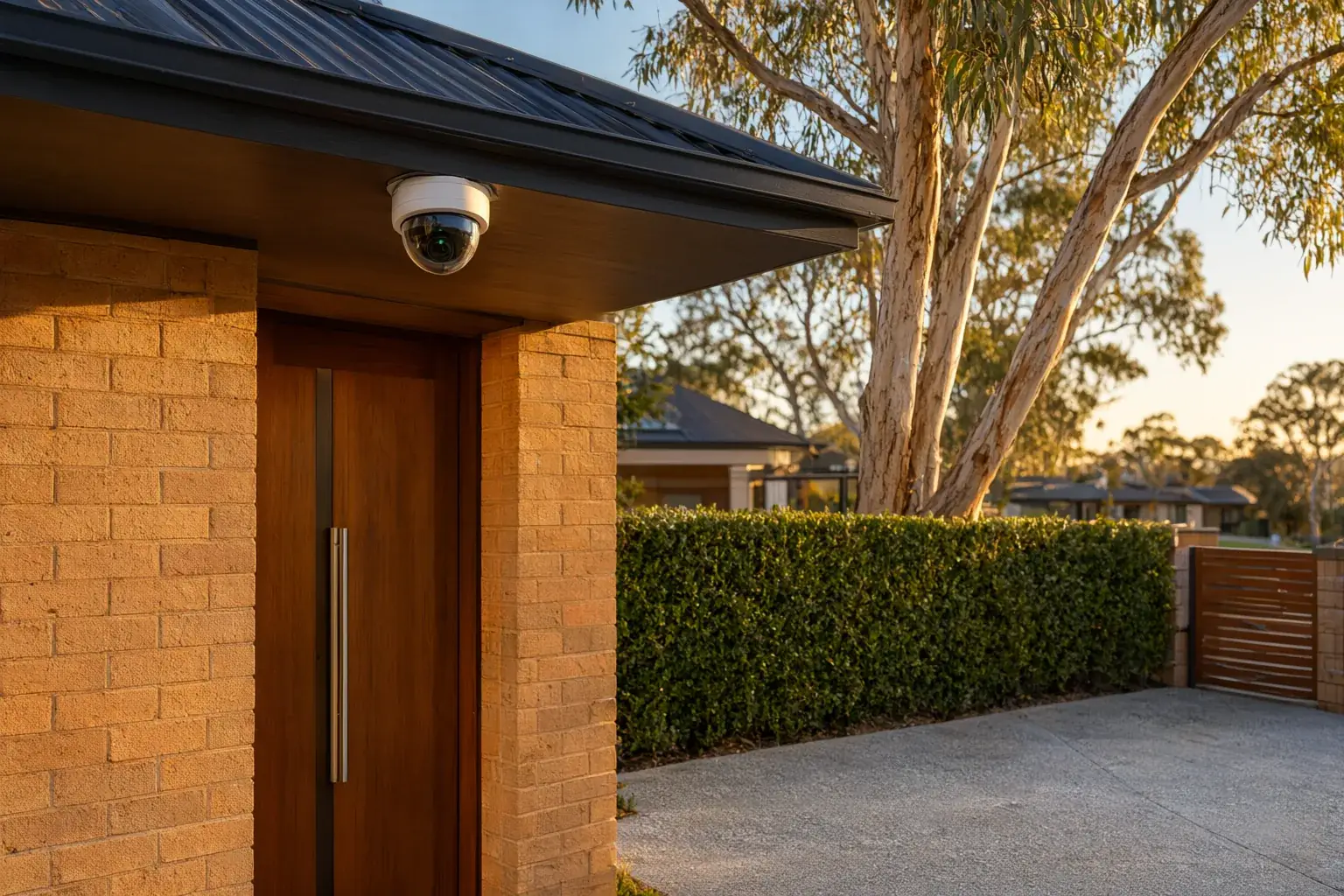
At the front door, angle the camera downward so it records faces and parcels clearly without sweeping across the road to the homes opposite. For the driveway, mount the camera high and aim it along the length of the driveway rather than across the fence line. Side and rear cameras should watch your gates, sheds and access points without peering over or through boundary fencing.
Corner blocks, steep sites and unusual layouts often need extra finesse. Professional installers use adjustable mounting brackets and varifocal lenses to dial in exactly the right field of view. Modern cameras from brands such as Hikvision, Dahua and Uniview also support privacy masking, which lets you digitally black out specific zones — a neighbour's window, for example — while the rest of the scene continues to record normally. Roof and eave mounting angles protect lenses from direct sun glare — critical in [[/adelaide|Adelaide]]'s harsh summers and [[/newcastle|Newcastle]]'s wet coastal winters.
Why Do Some Camera Angles Invite Complaints?
Some placements almost guarantee trouble. The most obvious is any camera that looks directly into a neighbour's windows — particularly bedrooms, bathrooms and living areas. Even if your goal is simply to cover your own fence line, if the dominant view is their private space, you're likely breaching privacy expectations.
Never aim cameras at a neighbour's pool, outdoor entertaining area or children's play space. These are treated as highly private zones, and recording them can trigger serious complaints or police involvement. The same applies to any angle that could capture people undressing, showering or otherwise going about private activities, even by accident.
Elevated cameras that peer over fences into enclosed backyards are another frequent mistake. If your neighbour has invested in fencing, screening or landscaping to create privacy, your camera shouldn't undo that. A simple self-test works well: ask yourself whether you'd be comfortable if your neighbour had a camera pointed at that exact part of your property. If the answer is no, adjust the angle.
Can Privacy Masking and Smart Detection Keep You Compliant?
Modern IP cameras come with tools that let you stay compliant without giving up coverage. The most valuable is privacy masking: you draw a black or blurred box over part of the camera's view — say, a neighbour's window or yard — and that zone is never recorded or displayed in live view or playback.
Smart detection adds another layer of control. Hikvision's AcuSense and Dahua's SMD (Smart Motion Detection) cameras let you define detection zones, so motion alerts only fire for areas you care about, such as your driveway or front gate, while ignoring movement in neighbouring yards. That means fewer false alarms and a record that only contains relevant activity.
Varifocal lenses and PTZ (pan-tilt-zoom) cameras give you flexibility after installation. If a neighbour raises a concern, you can reframe the shot or apply a mask in minutes without remounting anything. Professional installers typically configure these features during the initial setup, striking the right balance between security coverage and privacy from day one.
Should You Book a Professional Site Survey Before Installation?
Every professional [[how-much-does-professional-cctv-installation-cost-in-australia|CCTV installation]] should begin with a site survey. A licensed installer walks your property, identifies the key security zones and assesses sightlines towards neighbouring homes. That information drives a camera layout that maximises your coverage while respecting privacy boundaries.
Height, lens type and mounting angle all matter. A camera at 2.5 metres with a wide-angle lens captures a very different scene from one at 4 metres with a narrow lens. Getting these variables right means you cover your vehicles, doors and gates without unnecessary overspill onto adjacent properties.
At handover, a good installer will walk you through adjusting privacy masks, detection zones and camera angles using the NVR or mobile app, and explain your obligations under NSW surveillance law. They'll also provide documentation showing the system was installed professionally and compliantly — paperwork that can prove invaluable if a dispute ever arises.
Do You Need to Tell Neighbours About Your Cameras?
There's no legal requirement in NSW to notify neighbours that you have [[4k-vs-1080p-security-cameras-is-the-upgrade-worth-the-money|security cameras]], but a quick conversation is one of the cheapest forms of dispute prevention. Explaining that your cameras are for security, and showing what they do and don't cover, defuses suspicion before it starts.
This matters most when cameras are visible from a neighbour's property. A visible dome aimed at your own front door reads very differently from one that appears to track their comings and goings. Offering to adjust the angle or apply a mask if they have concerns builds goodwill and often resolves issues before they escalate to council or police.
If a complaint does arrive, treat it seriously. Review the footage, check what the camera actually captures, and be prepared to re-angle it or enable privacy masking. Most neighbour disputes over CCTV are resolved with a simple adjustment — and a cooperative response on your part makes that outcome far more likely.
Is Your Pre-Installation Privacy Checklist Complete?
Before you drill a single hole, walk your property and sketch out what each planned camera will actually see. Stand at the proposed mounting height and look through the intended field of view. Note every window, yard, pool or entertaining area that falls inside the frame, and adjust the position or lens until those are excluded or masked.
Check your camera's field-of-view calculator or app preview before mounting. Most manufacturers publish the horizontal angle for each lens, which lets you predict overspill accurately. If a small portion of a neighbour's boundary is unavoidable at the frame's edge, plan to apply a privacy mask during setup rather than after a complaint.
Finally, keep records. Save screenshots of your camera layouts, privacy mask settings and detection zones, and hold onto your installer's compliance documentation. If anyone ever questions your setup, being able to demonstrate that your cameras were deliberately configured to respect privacy is your strongest defence.
Compliant vs Non-Compliant Camera Positions
| Camera Location | Compliant Use | Non-Compliant Use |
|---|---|---|
| Front door / porch | Angled down to capture visitors and packages | Pointed across the street into neighbours' windows |
| Driveway | Covers your vehicles and garage entry | Zoomed into neighbour's yard or side gate |
| Side fence / gate | Monitors your side access and boundary | Peers over fence into neighbour's pool or deck |
| Backyard | Covers your shed, garden and rear entry | Captures neighbour's outdoor living or bathroom window |
| Front yard / nature strip | Wide view of your property frontage | Focused on public footpath to monitor pedestrians |