
Key Takeaways
- Quality solar security cameras cost $300–$800 AUD, with professional installation adding $150–$400
- Battery capacity of 10,000mAh+ is essential for surviving cloudy winter days in NSW and South Australia
- Undersized panels cause most solar camera failures — match panel wattage to camera power draw
- Solar cameras suit farms, gates, sheds and remote property corners where running mains power is expensive
- Installers must comply with the Privacy Act 1988 and state surveillance laws when positioning cameras
Are Solar Security Cameras Worth It in Australia?
The short answer on solar security camera cost Australia in 2025 is that you can expect to pay $300–$800 for quality hardware plus $150–$400 for professional installation. For most Australian properties without easy access to mains power, that investment pays off quickly — no trenching, no electrician call-outs and no ongoing power bills. Whether you're securing a farm gate outside Adelaide SA or a coastal home in Newcastle NSW, solar-powered CCTV delivers reliable surveillance wherever the sun shines.
That said, solar isn't automatically the right choice everywhere. If you have an outdoor power point near your preferred camera position, a traditional PoE (Power over Ethernet) system usually delivers better long-term value with unlimited runtime. The decision comes down to four factors: distance from power, available sunlight at the mounting point, connectivity options (4G versus Wi-Fi), and whether you value the flexibility to relocate cameras later. This guide walks through each of those considerations so you can judge whether solar suits your specific property.
How Do Solar-Powered Security Cameras Actually Work?
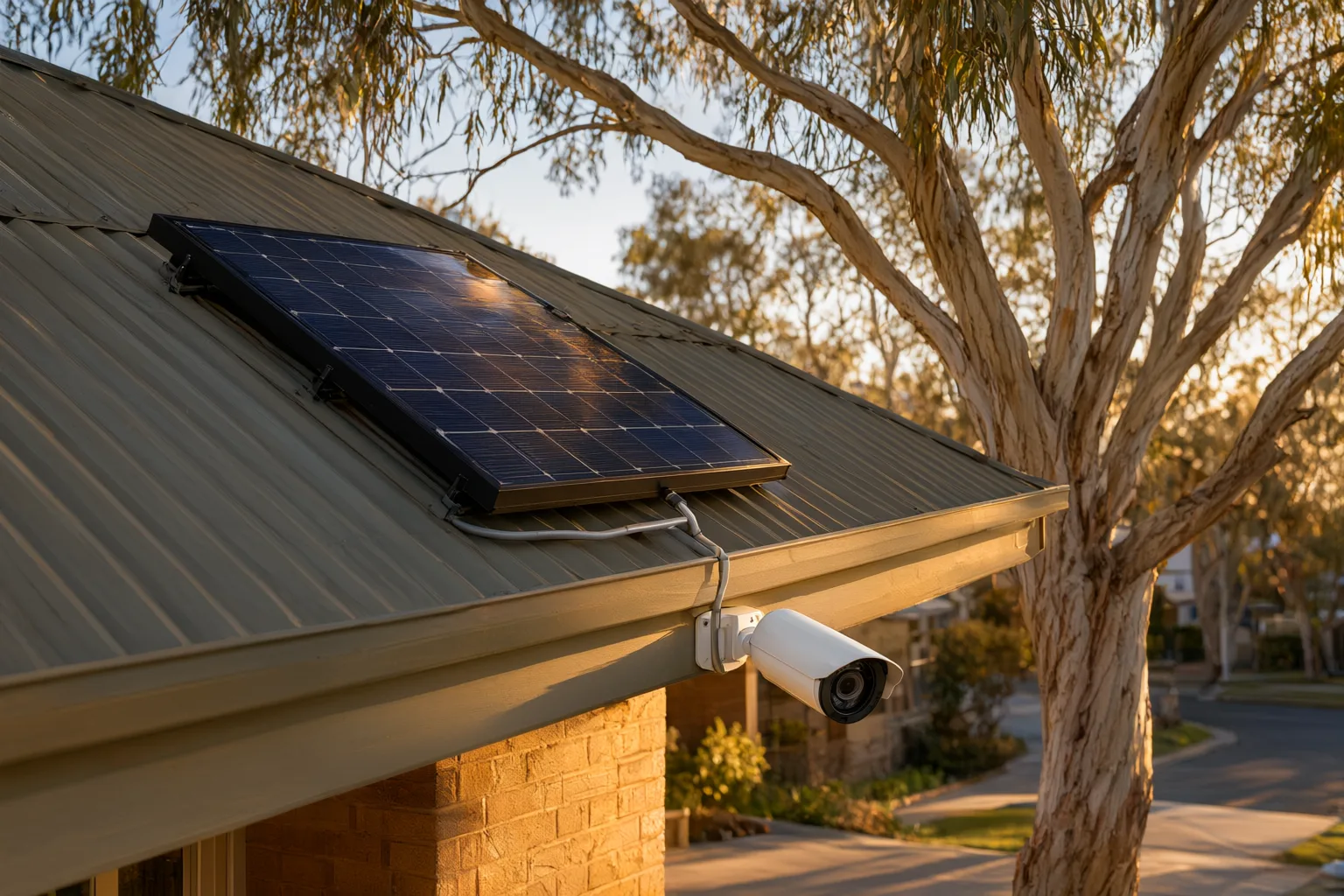
A solar [[4k-vs-1080p-security-cameras-is-the-upgrade-worth-the-money|security]] camera is a self-contained surveillance system combining three components: a photovoltaic panel that harvests daylight, a rechargeable battery that stores that energy, and the camera unit itself. During daylight hours the panel charges the battery; overnight and during overcast spells, the battery carries the load. Because nothing ties the system to the grid, it can be mounted anywhere sunlight reaches — a paddock gate 300 metres from the farmhouse, a shipping container on a construction site, or a rear fence line with no cabling nearby.
Battery chemistry matters enormously here. Older budget systems used lead-acid or standard lithium-ion cells, both of which degrade quickly when cycled daily in heat. Professional-grade systems now specify LiFePO4 batteries rated for -20°C to 60°C operation, surviving 2,000+ charge cycles compared with 500-800 for standard lithium-ion. Given that an Australian solar camera charges and discharges every single day, that difference translates directly into years of extra service life.
Build quality separates reliable systems from disappointing ones. Quality housings use powder-coated aluminium rather than brittle plastics, tempered glass on the panel rather than acrylic, and IP66-or-better weatherproofing to shrug off driving rain and coastal salt spray. Brands such as Hikvision, Dahua and Uniview now produce solar units whose reliability rivals hardwired installations when they're properly specified and positioned.
What Scenarios Make Solar the Best Choice on Your Property?
Certain scenarios make solar the obvious winner. Rural properties and farms top the list: running power to a gate 200 metres from the house can cost around $2,000 in trenching, conduit and labour, while a solar 4G camera covers the same spot for under $1,000. Construction sites benefit because temporary power is costly or simply unavailable, and equipment moves as the project progresses. Holiday homes, investment properties and remote sheds without dependable power access round out the ideal use cases.
Suburban homes occupy more nuanced territory. If an accessible power point sits near your desired camera location, a hardwired PoE [[the-hidden-costs-of-cheap-cctv-systems-and-why-they-fail|system]] generally wins on value and eliminates any concern about battery degradation or cloudy-week autonomy. Solar still earns its place for awkward spots — detached garages, rear gates, pool equipment areas or side boundaries where digging up paving and garden beds would be disruptive and expensive.
Sunlight availability is the deal-breaker either way. Panels need roughly 4-6 hours of direct sun daily, ideally facing true north in Australia. Shaded eaves, dense tree canopy or south-facing walls can render solar impractical unless you mount the panel remotely from the camera, which adds cable runs, cost and complexity. Before committing, assess the proposed mounting point across seasons — winter sun sits much lower than summer sun, and a spot that's sunny in January may be shaded all July.
Which Battery Capacity Handles Aussie Conditions Best?
Battery capacity determines how many grey days your camera survives without meaningful solar input. Entry-level systems carrying 6,000-8,000mAh batteries may last only 1-2 days without sun — not enough for Melbourne's overcast winters or Sydney's storm season. Professional specifications call for 20,000mAh or higher, delivering 3-5 days of autonomy. When comparing products, treat advertised battery figures sceptically and prioritise systems that publish temperature ratings and cycle-life data.
Panel wattage must match what the camera actually consumes. A fixed 4G camera running infrared night vision draws roughly 3-8 watts continuously; add pan-tilt-zoom functionality and consumption roughly doubles. As a rule of thumb, specify a minimum 20W panel for basic fixed cameras, 40W for PTZ models, and 60W or more for units with spotlights or sirens. Undersizing the panel is the single most common cause of solar camera failure we encounter — the system limps through autumn, then dies outright in winter.
Tilt angle has an outsized effect on charging efficiency. In Sydney (latitude 34°S), panels perform best tilted 30-35 degrees facing true north. Melbourne (38°S) calls for 35-40 degrees. Get the angle wrong and you sacrifice 20-40% of charging capacity — often the difference between a system that sails through June and one that needs fortnightly manual recharging.
Can Solar Cameras Survive Australian Heat, Wind, Bushfire and Salt Air?
Every solar camera needs a way to transmit footage, and the right choice depends heavily on where the camera lives. Wi-Fi models suit suburban properties where the camera sits within 30-50 metres of the router with minimal obstructions. They typically offer the highest video quality and no ongoing data costs, but Australian building materials work against them: brick veneer walls, Colorbond roofing and metal sheds all significantly attenuate Wi-Fi signals.
4G cameras operate anywhere mobile coverage exists, making them the default choice for rural properties, remote gates and construction sites beyond NBN reach. Modern 4G units from manufacturers like Uniview stream 2K-4K video efficiently, but they require an active SIM with a data plan — budget $10-$30 per month depending on recording resolution and how often you view live footage.
Local storage deserves attention regardless of connectivity type. Systems with microSD card slots record continuously even when the network drops, then upload buffered footage once signal returns. For critical applications we recommend dual-path setups: 4G as the primary link with local storage as backup, ensuring no footage is lost during outages, theft attempts on infrastructure, or deliberate jamming.
Do Most Solar Camera Installations Fail — and Why?
Quality solar camera hardware runs $300-$800, with professional [[what-does-a-professional-home-cctv-installation-cost-in-2025|installation]] adding $150-$400 depending on mounting complexity and panel positioning. A complete single-camera solar setup therefore totals $450-$1,200. Hardwired alternatives look cheaper on paper — hardware of $200-$600 — but cabling costs $50-$150 per metre once you account for trenching, conduit and labour. A camera positioned 20 metres from the house can easily cost $1,500-$3,500 installed, at which point solar becomes the economical option.
Running costs diverge too. Hardwired cameras draw $15-$40 annually in electricity; solar eliminates that entirely but requires battery replacement every 3-5 years at $80-$200 a time. Solar panels themselves degrade slowly — roughly 0.5% per year, meaning they retain 85%+ output after two decades. Over a ten-year horizon, the total cost of ownership between the two approaches converges; the deciding factor is almost always site-specific: distance from power, soil type affecting trenching difficulty, and how much you value being able to relocate cameras as your security needs evolve.
Is Professional Installation Worth It Compared to DIY?
Most solar camera failures trace back to installation shortcuts rather than product faults. Panels must be secured against genuine wind loads: Colorbond roofs require purpose-designed clamps that don't void the roof warranty, while brick walls need anchors rated for the panel's weight plus its wind profile. Panel placement should account for shading from chimneys, trees and neighbouring structures across all seasons — a proper solar path analysis predicts where shadows fall in June, not just December.
Camera positioning balances surveillance effectiveness against panel efficiency. Mount the camera 2.5-4 metres high: low enough for usable facial recognition, high enough to deter tampering and stay clear of everyday activity. Regional conditions add further requirements. Bushfire-prone areas call for ember-resistant housings and a strict avoidance of mounting beneath flammable eaves. Coastal installations demand marine-grade stainless steel fasteners and additional corrosion protection against salt-laden air.
A structured process prevents costly mistakes. We follow five steps — consultation, design, installation, configuration, and handover with training — so owners understand their system's alerts, app settings and maintenance schedule before we leave site. Done properly, a solar camera should run unattended through heatwaves, storms and everything in between.
Why Does Connectivity Choice Matter for Remote Locations?
Undersized panels head the list. Buyers attracted by slimline 10W panels discover their PTZ camera with spotlight drains the battery faster than the panel replenishes it, particularly once winter shortens the charging window. Match panel wattage to actual consumption with headroom to spare.
Poor orientation is the second culprit. A panel bolted flat to a fence rail or facing east captures a fraction of its rated output. True-north facing with a latitude-appropriate tilt is non-negotiable in Australia. Third, cheap batteries undo otherwise good systems: standard lithium-ion cells cycled daily in 40°C heat can fail within 18 months, whereas LiFePO4 units routinely exceed five years.
Finally, neglecting connectivity planning causes frustration that gets misattributed to the camera itself. A Wi-Fi model mounted past three brick walls will drop streams regardless of signal bars shown indoors. Test signal strength at the exact mounting point before purchasing, or choose 4G with a suitable data plan.
Should You Choose Solar or Hardwired CCTV in 2025?
Solar cameras are low-maintenance but not zero-maintenance. Plan to clean panel surfaces every few months — dust, bird droppings and pollen can cut charging efficiency noticeably, especially through dry summers. Inspect mounts annually for corrosion or loosening after storm season, and keep vegetation trimmed back from both panel and camera sightlines.
Budget for battery replacement every 3-5 years at $80-$200 depending on capacity and chemistry. Most quality systems send low-battery alerts through their apps well before failure, giving you time to act. Firmware updates delivered over 4G or Wi-Fi keep security patches current — enable automatic updates where offered, since an unpatched camera is a network vulnerability regardless of how it's powered.
Panels degrade gracefully rather than suddenly. At roughly 0.5% annual degradation, a decade-old panel still delivers about 95% of original output, so there's no mid-life replacement cliff to plan around. With sensible siting and periodic cleaning, expect 7-10+ years of service from a quality system before major component renewal.
Beyond the upfront figures, it's worth understanding what drives price variation. A basic fixed-lens bullet camera with a 10W panel might land near $300, while a 4K PTZ unit with spotlight, siren and a 20W panel can exceed $800. In Australia, brands like Reolink, Eufy and Hikvision dominate the solar segment, and availability through [[/newcastle|Newcastle]] and [[/adelaide|Adelaide]] suppliers keeps replacement parts close at hand.
Legal compliance matters too. Under the Privacy Act 1988 and the Surveillance Devices Act (NSW) and South Australia's equivalent legislation, cameras must not record neighbouring private areas or public footpaths beyond your boundary. Businesses installing solar CCTV over staff parking or loading docks should also review workplace surveillance requirements before mounting panels on eaves or brick walls.
Weather resilience is where quality shows. Coastal salt air around Newcastle corrodes cheap mounts within seasons, while South Australian summer heat above 40°C degrades budget lithium batteries faster than rated. Spending more on IP66-rated housings and UV-stable cabling protects your investment against storm, sun and bushfire-season dust alike.
For commercial sites — warehouses, retail yards, rural supply depots — solar cameras paired with 4G connectivity remove the single biggest cost barrier: cabling. A hardwired run to a distant paddock or container yard can cost thousands; a solar unit installed on an existing pole costs a fraction of that and relocates as your site evolves.
Solar vs Hardwired vs Battery-Only CCTV Options in Australia (2025)
| Option | Typical Cost (AUD) | Best Suited To |
|---|---|---|
| Solar + 4G camera | $450–$1,200 installed | Farms, gates, remote sheds with no Wi-Fi or power |
| Solar + Wi-Fi camera | $300–$800 installed | Suburban homes in Newcastle & Adelaide with strong Wi-Fi |
| Hardwired CCTV system | $1,500–$3,500 installed | Commercial sites, warehouses, multi-camera retail premises |
| Battery-only camera | $200–$500 | Short-term rentals, temporary sites, low-use monitoring |