
Key Takeaways
- Shelf price is not the real cost: DIY kits commonly add $300–$700 in cabling, mounts, storage and tools
- Licensed installers in NSW must hold a security licence under the Security Industry Act 1997
- Professional installs in Adelaide SA typically range $1,200–$3,500 for a 4–8 camera system
- Camera placement can breach the Surveillance Devices Act 2007 if it captures neighbours or public footpaths
- Coastal salt air and 40°C+ summers kill cheap consumer cameras faster than commercial-grade units
Is professional CCTV installation worth it compared to a DIY kit?
The short answer: a DIY CCTV kit costs $200–$800 on the shelf, but most Australian homeowners spend another $300–$700 on cabling, mounts, storage and repairs within two years. Professional CCTV installation typically costs $1,200–$3,500 installed, including a licensed technician, correct camera placement, legal compliance and a workmanship warranty. For most homes in Newcastle and Adelaide, the professional route wins on total cost of ownership.
That said, 'worth it' depends on your property and your confidence with tools. This guide breaks down exactly what each option includes, what DIY kits don't tell you on the box, how both cope with Australian conditions, and where the law comes into play — so you can decide which path genuinely suits your home rather than defaulting to the cheapest option.
What's actually inside the box when you buy a DIY CCTV kit?
Pick up any consumer security kit from a major electronics retailer or online marketplace and you'll find a familiar bundle: four to eight cameras, an NVR or DVR recorder, cables, mounting brackets and a quick-start guide. Most use wireless or Power over Ethernet (PoE) cameras designed for plug-and-play setup, with app-based viewing and optional cloud storage. Swann, Arlo and Ring are the names most shoppers recognise in this space.
The pitch is simple: low cost, no tradesperson, a weekend project. And for the right home, that pitch holds up. The catch is that these products are engineered for global mass markets — not for 40°C summers, coastal salt spray, or backyards that swing from blinding glare to deep shadow in a single frame. Plastic housings chalk and crack under UV exposure, and budget image sensors struggle with the harsh light contrast typical of Australian outdoor scenes.
How much does a DIY kit really cost once you start installing?
The price tag on the shelf is only the opening bid. Most homeowners discover mid-project that the included cable doesn't reach, their Wi-Fi dies at the back fence, or drilling through double-brick walls demands tools they don't own. Add the extras and the gap between DIY and professional pricing narrows fast:
Then there's time. A job marketed as four hours routinely stretches across multiple weekends — particularly if you hit asbestos eaves, awkward rooflines or long cable runs. And if a camera ends up angled wrong or the NVR is misconfigured, you're either living with blind spots or paying a professional to undo and redo the work. Paying twice is the most common hidden cost of all.
- Additional cable and conduit: $80–$200
- Ladder hire or purchase: $100–$400
- Electrician for new power points: $150–$300
- Replacement cameras after weather damage: $100–$250 each
- Your time across multiple weekends: 12–20 hours
Should you pay $1,200–$3,500 for a licensed CCTV installer instead of a DIY kit?
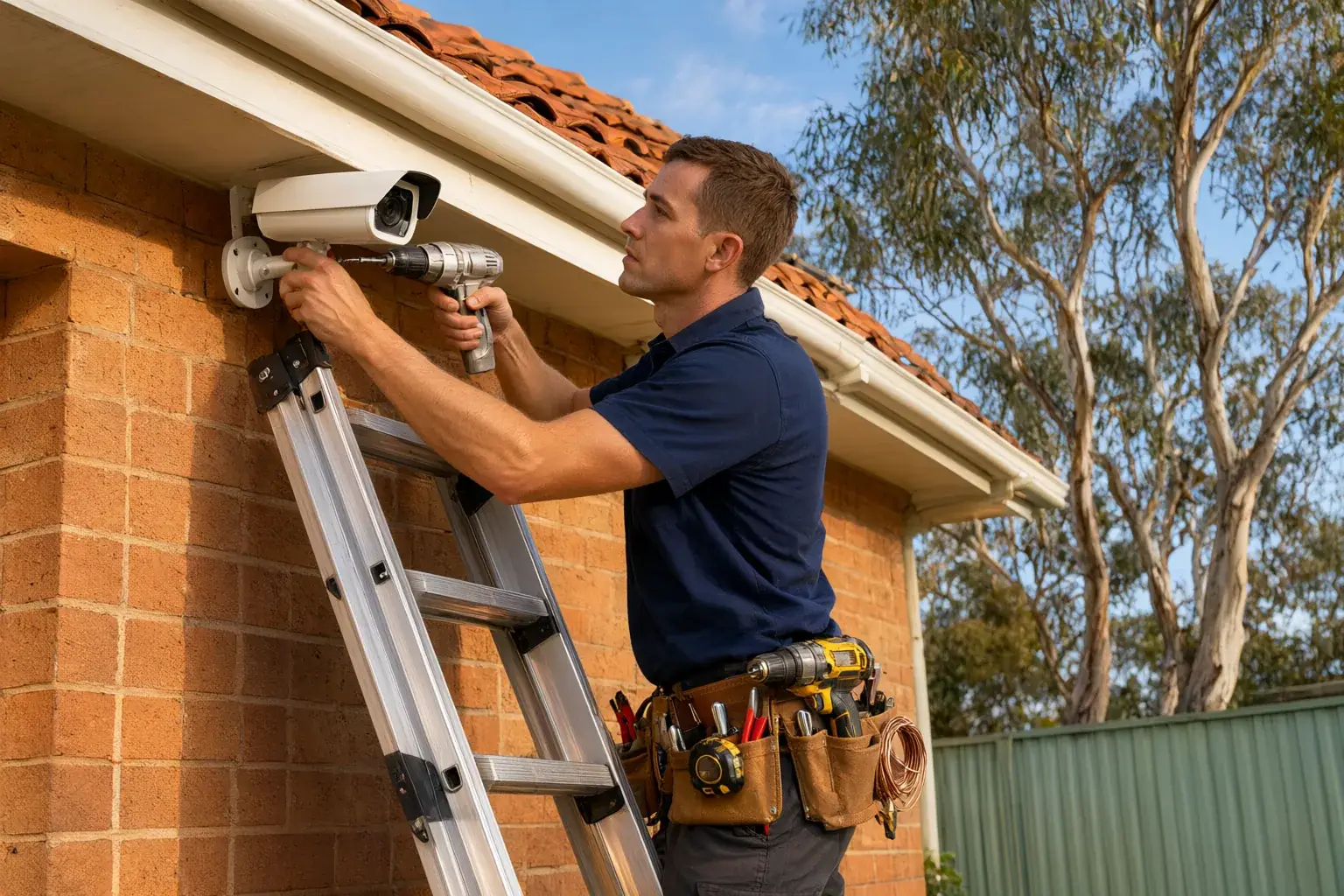
A professional [[what-does-a-professional-home-cctv-installation-cost-in-2025|installation]] isn't just labour — it's a structured process that starts before anyone drills a hole. It begins with an on-site assessment: the installer walks your property, identifies vulnerable entry points, and matches camera types to each location. That might mean ColorVu cameras where you need full-colour night vision, or AcuSense models that filter out false triggers from pets and moving vegetation.
The hardware itself sits in a different class. Licensed installers fit commercial-grade equipment from manufacturers such as Hikvision, Dahua, Uniview and Axis — cameras with superior sensors, metal housings, genuine weatherproofing and Starlight low-light technology. Cabling runs through roof cavities or conduit, is properly terminated and sealed, and stays out of sight and weather. Finally, the NVR is configured with secure passwords, current firmware and remote viewing access, and you get hands-on training so you actually know how to use the [[the-hidden-costs-of-cheap-cctv-systems-and-why-they-fail|system]] from day one.
Can your DIY camera placement break NSW privacy laws?
This is the area DIY buyers most often overlook. In NSW, the Surveillance Devices Act 2007 and common law privacy principles mean a camera pointed carelessly can create real legal exposure. Capturing a neighbour's yard, a public footpath or a shared driveway — even accidentally — can breach privacy expectations, and some situations call for signage telling visitors recording is taking place.
Licensed installers position every camera to cover your property without infringing on others', and they understand council requirements too — relevant if you're in a strata complex or heritage area where external modifications may need approval.
Insurance adds another layer. Some home and contents policies offer discounts for professionally installed and monitored systems, because insurers know commercial-grade gear fails less often and produces fewer false alarms. Just as importantly, if you ever need footage for a claim, a professionally installed camera is far more likely to have captured usable evidence — correct timestamps, adequate resolution, no gaps from a dead battery or failed SD card.
Do cheap cameras survive an Australian summer?
Short answer: often they don't. Australian conditions are brutal on electronics — summer temperatures above 40°C, corrosive salt air along the coast, dust, storms and bushfire risk inland. Consumer DIY cameras may carry a nominal rating, but prolonged UV and daily heat cycling degrade plastic housings and seals within a few seasons.
Professional-grade cameras are built differently: higher IP ratings (IP66/IP67), metal construction with proper heat dissipation, sealed cable entries, silicone-sealed mountings and UV-resistant conduit on external runs. They're tested to operate reliably well beyond what a consumer unit endures.
For rural properties or homes in bushfire-prone areas, installers can also integrate solar power and 4G connectivity, keeping cameras running through mains power or NBN outages. That level of customisation simply doesn't exist in off-the-shelf kits.
Why is a DIY CCTV kit sometimes the smarter choice for Aussie homes?
Honesty cuts both ways: there are situations where DIY is genuinely the right call. If you're comfortable with technology, live in a single-storey home with easy roof access, and only need basic coverage of a small area, a quality kit can do the job at a fraction of the cost.
DIY also fits renters who can't make permanent modifications, and homeowners who want interim coverage while saving toward a full professional system. Battery- or solar-powered wireless cameras offer flexibility with zero drilling or cabling.
Even then, a free consultation with a licensed [[questions-to-ask-before-hiring-a-cctv-installer-in-australia|installer]] costs nothing and can save you money. Many will tell you plainly whether your property suits DIY — or flag the challenges (brick construction, complex rooflines, privacy risks) that make professional installation cheaper over the life of the system.
Which option should you choose for your home?
Weigh four things: budget, technical confidence, property layout and how long you expect the system to serve you. If reliability, legal compliance and ongoing support matter, professional installation wins despite the upfront difference — a commercial-grade system typically runs eight to ten years with minimal maintenance, while consumer cameras commonly need replacing at three to five years. Count those replacement cycles and total cost of ownership tilts clearly toward professional.
If you're undecided, request free quotes from licensed installers. A reputable company will assess your property, explain options in plain English and give transparent, obligation-free pricing. Within one visit you'll know whether DIY is realistic for your situation — or whether expert installation is the better investment.
DIY CCTV kit vs professional installation: key differences for Australian homes
| Factor | DIY CCTV Kit | Professional Installation |
|---|---|---|
| Upfront cost (AUD) | $200–$800 per kit | $1,200–$3,500 installed |
| Hidden/ongoing costs | $300–$700 in cables, storage, replacements | Minimal; covered by quote and warranty |
| Installer licensing | Not applicable (self-install) | Licensed under Security Industry Act 1997 (NSW) |
| Typical lifespan | 2–4 years in Aussie heat/coastal air | 7–10 years with commercial-grade gear |
| Legal compliance risk | High — placement errors breach privacy laws | Low — assessed during site visit |