
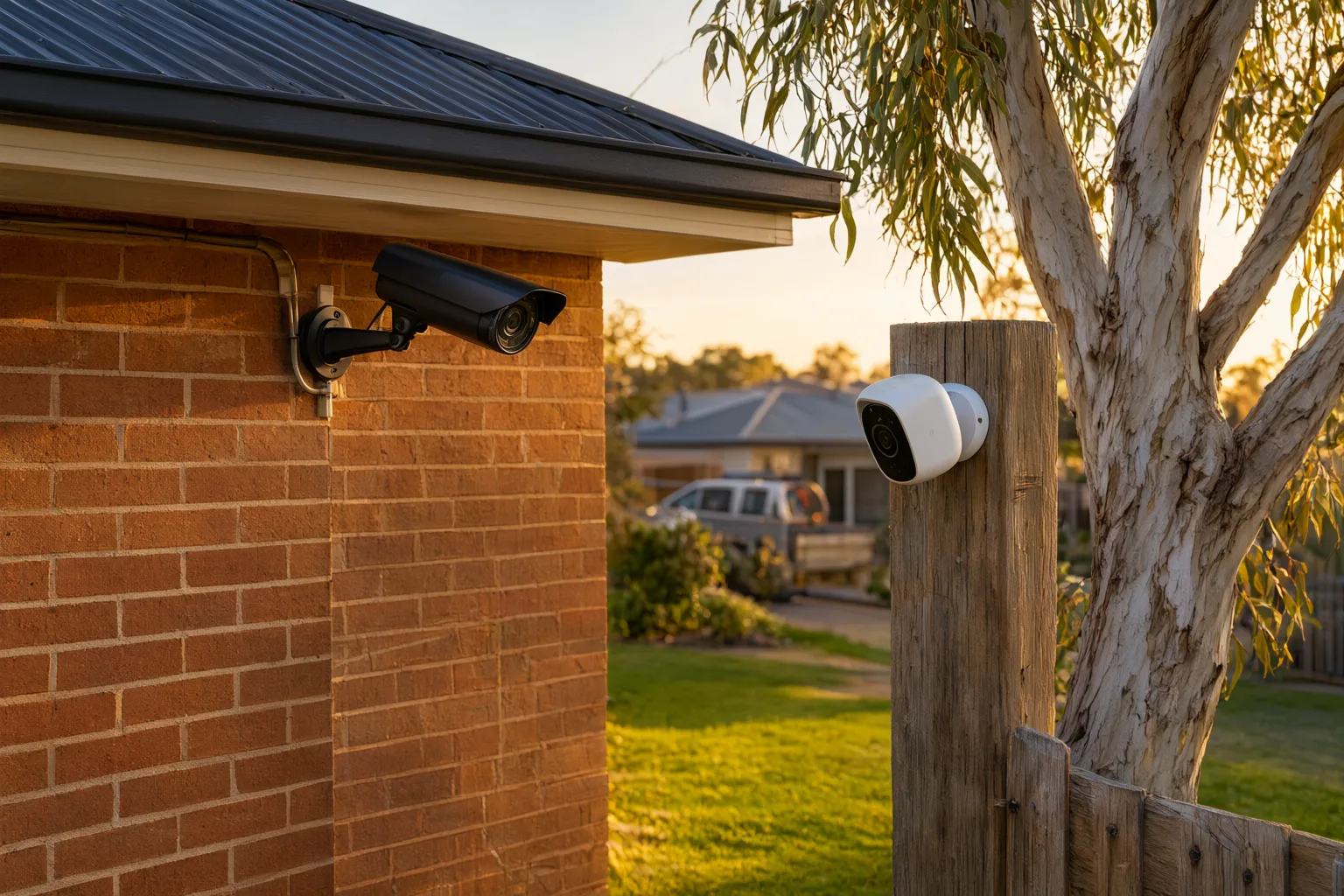
Key Takeaways
- Wired PoE CCTV typically costs $1,800–$4,500 professionally installed in Australia, while wireless kits run $200–$1,500 upfront but carry ongoing battery and subscription costs.
- Double-brick walls common across NSW and South Australia significantly weaken Wi-Fi camera signals.
- Wireless cameras are more vulnerable to jamming and interception than closed-circuit wired systems.
- Hybrid systems let Newcastle and Adelaide homeowners combine wired entry-point coverage with flexible wireless cameras.
- Licensed installers ensure compliance with the Privacy Act 1988 and state surveillance laws.
What Separates Wired CCTV From Wireless Cameras?
The short answer on wired vs wireless CCTV Australia costs is that wired PoE systems typically cost $1,800–$4,500 professionally installed, while wireless security cameras range from $200–$1,500 upfront but add battery, cloud subscription and replacement expenses over five years. For most homes in Newcastle NSW and Adelaide SA, wired delivers better long-term value.
Wireless cameras still earn their place. If you rent, live in a heritage-listed home where drilling is off the table, or need to watch a shed or granny flat that's impractical to cable, a quality Wi-Fi camera can be mounted and running within minutes.
This guide walks through how each system works, what they cost in Australia, how local construction materials and climate affect performance, and when a hybrid of both makes sense — so you can invest in the right setup the first time.
Why Are Wired Systems the Reliability Gold Standard?
The core difference comes down to two things: how footage travels and how cameras get their power.
A wired [[the-hidden-costs-of-cheap-cctv-systems-and-why-they-fail|CCTV system]] links each camera directly to a Network Video Recorder (NVR) or Digital Video Recorder (DVR) using Ethernet or coaxial cable. Modern installations overwhelmingly use Power over Ethernet (PoE), which sends both power and data down one cable — simplifying installation while guaranteeing a stable connection.
Wireless cameras do away with the data cable entirely. They transmit video over your home Wi-Fi network and draw power from rechargeable batteries, small solar panels, or a nearby power outlet. Footage is stored on an SD card, in the cloud, or on a compatible recorder.
Neither approach is universally better. The right fit depends on your property's construction, whether you own or rent, your budget, and how critical uninterrupted recording is to your household.
Where Do Wireless Security Cameras Genuinely Shine?
Because each camera has its own dedicated cable back to the recorder, a wired system forms a closed circuit that doesn't lean on your home Wi-Fi at all. Your cameras keep recording through router reboots, NBN outages, summer storms, and interference from neighbouring networks.
Professional-grade brands installed in Australia — Hikvision, Dahua, Uniview and Axis among them — unlock features that demand consistent bandwidth and stable power. Think ColorVu full-colour night vision, AcuSense human and vehicle detection, and ANPR number plate recognition. These simply don't perform reliably over a congested wireless link.
Once cabled and configured, a quality wired system runs for years with minimal attention. There are no batteries to charge, no dropouts to troubleshoot, and no subscription renewals to remember.
- Uninterrupted 24/7 recording with zero reliance on Wi-Fi
- Consistent high-bitrate footage supporting 4K resolution and beyond
- PoE cabling carries both power and data through a single run
- Immune to wireless interference and far harder to jam
- Minimal ongoing maintenance — no batteries, no cloud fees
How Do Australian Homes Interfere With Wi-Fi Cameras?
Flexibility is the wireless camera's superpower. Battery-powered models are genuinely cable-free, so they can be mounted on a fence post, repositioned next month, or taken with you when you move — something renters in particular value.
They're also the practical answer for detached structures. Running conduit to a back shed, pool area, or granny flat can cost hundreds of dollars in labour; a solar-powered wireless camera covers those spots for a fraction of the price.
That said, wireless systems come with real trade-offs in Australian homes. Brick veneer walls, foil insulation and Colorbond roofing all degrade Wi-Fi signals significantly. Battery models need recharging every few months, and heavy dependence on cloud storage means monthly fees plus reliance on a stable NBN connection.
- Fast, non-invasive setup — perfect for rentals and heritage homes
- Cameras can be relocated or added as your needs change
- No cables through walls, ceilings or roof cavities
- Battery and solar options suit remote or off-grid locations
- Best suited to smaller properties with strong Wi-Fi coverage
Are Wireless Cameras Built for Australian Heat and Salt Air?
Local building methods matter more than most buyers expect. Double-brick and brick veneer construction — standard across much of Australia — attenuates Wi-Fi signals dramatically. A camera mounted above the garage door may struggle to hold a stable link to a router inside the lounge room, producing delayed notifications and gaps in recordings.
Colorbond roofing and foil-backed insulation add further attenuation, particularly for single-storey homes where the signal must pass through the roof line. Metal fencing and water tanks create additional dead zones around the yard.
None of this affects wired cameras. Their cable runs carry full bandwidth regardless of what's between the camera and the recorder, which is why professional installers routinely recommend PoE for perimeter coverage on brick homes.
How Much Does CCTV Really Cost in Australia Over Five Years?
Australian summers test [[4k-vs-1080p-security-cameras-is-the-upgrade-worth-the-money|security]] hardware hard. Temperatures above 40 degrees Celsius shorten lithium battery life in wireless cameras and can push cheap consumer units into thermal shutdown. Professional wired cameras carry wide operating temperature ratings and are built for year-round exposure.
Coastal properties face salt-laden air that corrodes exposed connectors and housings. Licensed installers use sealed, weatherproof connections and marine-grade mounts; wireless cameras with exposed charging ports and plastic enclosures degrade faster in these environments.
Rural and bushfire-prone areas bring another wrinkle: many rely on 4G rather than fixed-line NBN. Cloud-dependent wireless cameras choke on limited bandwidth and data caps precisely when you need footage most. A wired system with local NVR storage keeps recording through congested or downed networks — critical during emergencies.
Can a Hybrid System Give You the Best of Both Approaches?
Wireless looks cheaper on day one. A single battery-powered camera can be had for under $200 with no cabling or installer required. But tally the ongoing costs: cloud storage typically runs $5 to $15 per camera per month, batteries need periodic replacement, and consumer-grade units often need full replacement within two to three years.
A professionally installed wired system demands more upfront — typically $1,500 to $4,000 for a four-to-eight-camera setup on a standard Australian home. That figure covers the NVR, hard drive storage, professional cabling, configuration and user training. After installation there are no subscription fees, and quality hardware from Hikvision, Dahua or Axis is built to last five to ten years or more.
Over a five-year horizon, total cost of ownership frequently favours wired — while also delivering better reliability, sharper footage and fewer headaches.
Which System Is Safer From Jamming and Hacking?
You don't have to pick a side. For larger Australian properties, a hybrid design often makes the most sense: wired PoE cameras guarding entry points, the driveway and the perimeter, with wireless cameras covering spots where cabling is impractical — a detached garage, back shed or upstairs balcony.
The trick is unification. Professional NVRs from Hikvision and Dahua can integrate compatible wireless cameras alongside wired ones, giving you a single app for live viewing, playback and intelligent alerts across every camera on site.
This is where professional design pays off. Rather than mixing consumer brands that won't talk to each other, a licensed installer selects hardware that works together seamlessly and configures it in line with Australian privacy and surveillance regulations.
Should Most Australian Homeowners Choose Wired or Wireless?
Anything transmitted over the air can theoretically be attacked. Wireless cameras are more exposed to Wi-Fi jamming and interception than wired systems, and poorly secured consumer models have been exploited via default passwords and outdated firmware.
If you go wireless, choose cameras with strong encryption, change default credentials immediately, and keep firmware updated. Wired systems are inherently harder to compromise because footage never leaves the cable until it reaches the recorder.
Either way, basic cyber hygiene matters: unique passwords, two-factor authentication where available, and keeping the NVR or app software current.
Is Our Verdict Clear for Most Australian Homeowners?
For the majority of owned homes, a wired PoE CCTV system is the best long-term investment. It delivers unmatched reliability, superior image quality and lower total cost of ownership — and it shrugs off Wi-Fi congestion, NBN outages and the signal-blocking realities of Australian building materials.
Wireless cameras deserve a place too: for renters, temporary monitoring, and supplementary coverage of hard-to-cable zones. Just approach them with realistic expectations about battery maintenance, range limits and subscription costs.
At Aussie CCTV Cams, we assess every property individually during a free consultation. Our licensed and insured NSW installers weigh up your home's construction, layout, Wi-Fi coverage and [[solar-powered-security-cameras-are-they-worth-it-for-australian-conditions|security]] priorities before recommending anything. Whether that's a fully wired Hikvision system, a hybrid setup or a wireless configuration, we design it to perform in Australian conditions and back it with lifetime support.
Wired vs Wireless vs Hybrid CCTV: Five-Year Cost Comparison (AUD)
| Option | Typical Upfront Cost | Five-Year Total Cost |
|---|---|---|
| Wired PoE (4 cameras) | $1,800–$4,500 installed | $1,900–$4,700 (minimal upkeep) |
| Wireless battery kit (4 cameras) | $200–$1,500 | $1,400–$3,200 (batteries + subscriptions) |
| Hybrid wired + wireless | $3,500–$6,000 installed | $3,700–$6,500 |
| DIY plug-in wireless (2 cameras) | $150–$500 | $500–$1,200 |