
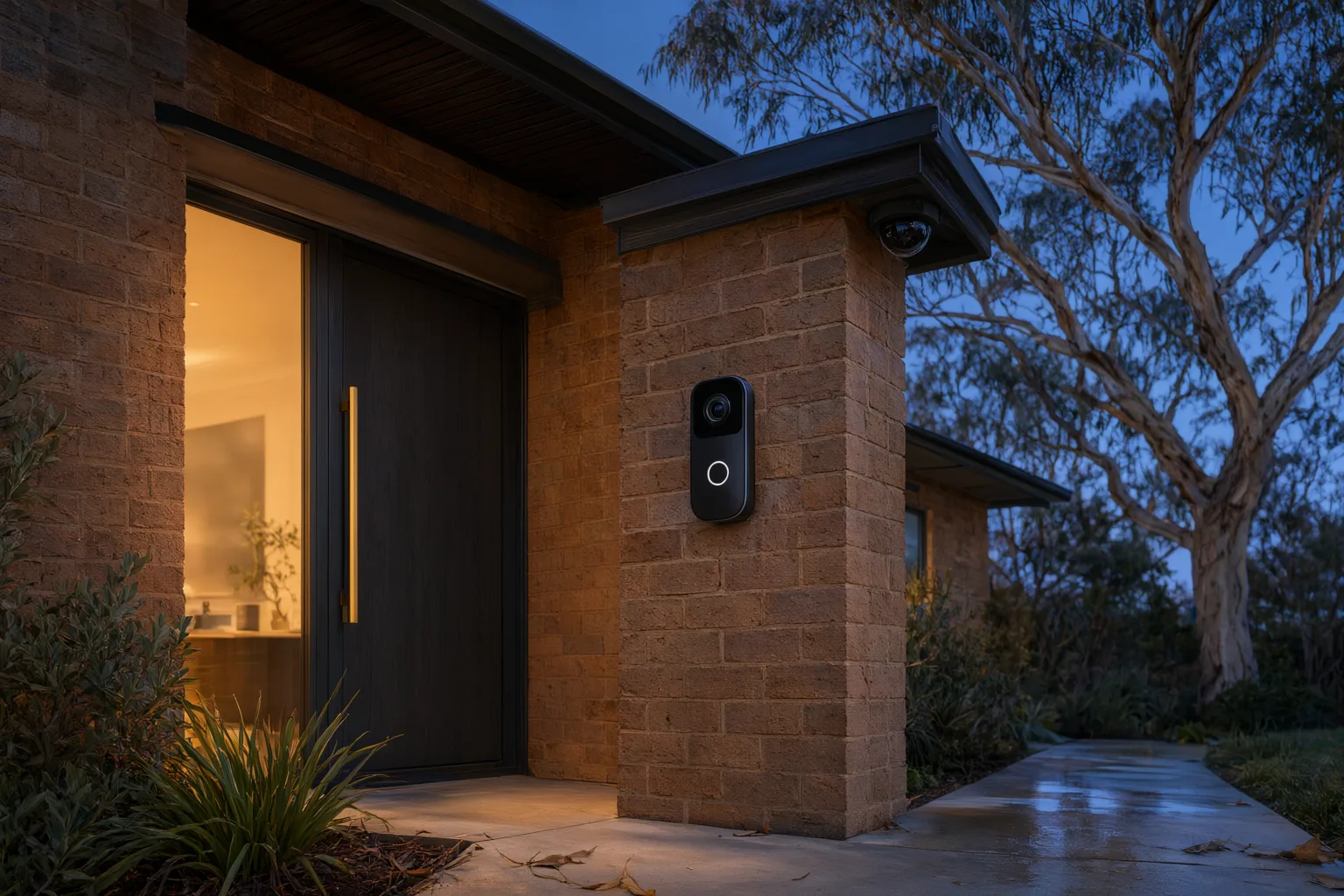
Key Takeaways
- A video doorbell plus CCTV combo is the best home security setup for most Australian houses.
- Quality video doorbells cost $200–$500 upfront plus $5–$15/month cloud subscriptions in Australia.
- A four-camera CCTV system installed in Newcastle NSW typically runs $2,000–$5,000 with no ongoing fees.
- NSW and SA privacy laws restrict filming neighbours' backyards and windows from security cameras.
- CCTV records continuously to an NVR; doorbells capture short motion clips that can miss events.
- Licensed installers in Adelaide SA ensure camera placement complies with state surveillance laws.
Do You Need a Video Doorbell, CCTV, or Both?
For most Australian homes, the right answer is both: a video doorbell to screen visitors and monitor parcels at your front door, plus a professionally installed CCTV system covering your driveway, backyard and side gates. A doorbell alone leaves most of your property unmonitored, while CCTV without a doorbell misses convenient front-door interaction. Together they form complete home security.
This guide breaks down exactly how the two technologies differ, what each costs in Australia, where each one falls short, and how to decide what your home actually needs. By the end, you'll know whether a $300 doorbell is enough or whether a full camera system is the smarter investment.
What Is a Video Doorbell and How Does It Work?
A video doorbell replaces your standard doorbell chime with a smart device containing a camera, motion sensor, microphone and speaker. When someone approaches your front door, you receive an alert on your smartphone, can view a live video feed, and can hold a two-way conversation with the visitor — whether you're upstairs, at work or on holidays.
Most models are either battery-powered, which makes them genuinely DIY-friendly, or hardwired into your existing doorbell wiring for continuous power and more reliable operation. Footage is typically stored in the cloud, which is why most manufacturers charge a monthly subscription for video history and advanced features such as person detection.
It's worth understanding what a doorbell is not: it's an interaction device that happens to record, not a dedicated surveillance tool. Its field of view is limited to your entrance area, it usually records only short motion-triggered clips rather than continuous video, and its image quality is designed for close-range identification rather than reading number plates or capturing detail across a driveway.
What Is a Traditional CCTV System and How Does It Work?
A CCTV (closed-circuit television) system is a network of dedicated surveillance cameras connected to a Network Video Recorder (NVR), which stores footage continuously on local hard drives. Unlike a doorbell, a [[the-hidden-costs-of-cheap-cctv-systems-and-why-they-fail|CCTV system]] is designed from the ground up for evidence gathering and broad property monitoring.
A well-designed system covers multiple zones — driveway, side access points, backyard, garage and key internal areas — with overlapping fields of view that eliminate blind spots. Modern IP cameras from manufacturers such as Hikvision, Dahua and Uniview offer high-resolution sensors and intelligent features. Hikvision's ColorVu technology, for example, captures full-colour footage even in complete darkness, a significant improvement over grainy black-and-white [[night-vision-vs-colour-at-night-cameras-what-works-best-after-dark|infrared]]. AcuSense technology uses smart detection to distinguish humans and vehicles from irrelevant movement like animals or swaying branches, dramatically cutting false alerts.
Because recording is continuous, nothing is missed. If an incident happens at 3am or while you're away for a fortnight, the footage exists. That continuous record is exactly what insurers and police want, and the visible presence of quality cameras is itself a strong deterrent — most opportunistic offenders simply move on to an easier target.
Where Do Video Doorbells Shine for Australian Homes?
Video doorbells have earned their place in Australian home security. They excel at screening callers before you open the door — genuinely valuable for elderly residents, people living alone, or anyone wary of unexpected visitors. Two-way audio lets you give instructions to couriers, tell a cold-caller you're not interested, or make an intruder think twice, all without opening the door.
Package theft has become a familiar problem across Australian suburbs, and a doorbell camera provides both a deterrent and a record of who took what. You get an instant notification the moment someone approaches, can watch live, and can review recorded clips afterwards. Many models also integrate with smart home ecosystems, letting you remotely unlock a compatible smart lock for a trusted visitor.
Installation is straightforward for battery models, though hardwired versions connected to existing doorbell wiring avoid the hassle of regular battery charging. The limitations, however, are real: coverage is confined to your entrance, recording is usually motion-triggered rather than continuous, and footage quality often falls short for identifying faces at distance or capturing vehicle registration plates.
Why Are CCTV Cameras Essential for Complete Property Security?
A doorbell camera leaves the rest of your property unmonitored, and that's precisely the gap CCTV fills. Detached homes typically have multiple access points — driveways, side gates, rear doors, garage doors — and offenders rarely announce themselves at the front door. A professionally designed CCTV system maps your property's layout, identifies blind spots, and positions cameras to capture genuinely useful footage rather than empty space.
Modern equipment is also built for Australian conditions. Professional-grade cameras withstand the heat, dust, coastal salt air and storms that quickly destroy consumer devices, making them a sensible choice for bushfire-prone and coastal regions alike.
Continuous recording to an NVR means you never miss an event, whether it happens overnight, during a workday or while you're interstate. This matters for insurance claims, police reports and dispute resolution, where a complete timestamped record carries far more weight than a handful of motion clips. Add the deterrent effect of visible, quality cameras, and CCTV remains the backbone of serious home security.
How Do Upfront Prices and Ongoing Fees Compare in Australia?
Video doorbells look affordable at first glance. Quality hardware typically runs $200 to $500, but most brands lock cloud storage and smart features behind a subscription costing roughly $5 to $15 per month. Over five years, a $300 doorbell with a $10 monthly plan costs you $900 — and you still only have your front door covered.
A professionally installed CCTV system demands more upfront: expect roughly $2,000 to $5,000 for a quality four-camera system with NVR, depending on your property's size and cabling requirements. The trade-off is that there are no mandatory ongoing fees. Footage stores locally on your own recorder, you own the equipment outright, and remote viewing via smartphone apps is included at no extra cost.
Measured by cost per area protected, CCTV frequently wins. A doorbell might monitor ten square metres around your entrance; a four-camera system can cover 200 square metres or more, including driveway, side gates, backyard and interior zones. For many Australian homeowners, the real question isn't which system to choose — it's which one to install first.
How Does Recording, Storage and Evidence Quality Compare?
Recording behaviour is one of the sharpest differences between the two technologies. Video doorbells generally capture short clips when motion is detected, which conserves battery and cloud storage but risks missing events — a person lingering just outside the detection zone, or activity that begins and ends between clips.
CCTV systems record continuously around the clock to the NVR, so every moment is captured regardless of motion triggers. Smart analytics such as AcuSense still flag the events that matter, filtering out animals and vegetation so you're not flooded with useless alerts.
Evidence quality follows the same pattern. Doorbell footage is well suited to close-range identification at your front door. Professional CCTV cameras, with higher resolutions, full-colour night vision and better optics, capture clearer facial detail and number plates at distance — the kind of footage police and insurers can actually act on.
Which System Suits Your Property Type?
Your ideal setup depends on your circumstances. If you live in an apartment or townhouse where the front door is the only access point, a video doorbell may provide adequate coverage. If package theft and visitor screening are your main concerns, a doorbell camera addresses them directly and cheaply.
If you own a detached house with a driveway, side access, backyard, or valuables stored in sheds and garages, CCTV becomes essential. Homes in higher-crime areas, properties that have experienced break-in attempts, and residences left unoccupied for long stretches all benefit enormously from comprehensive camera coverage.
For most Australian homeowners, the optimal answer is layered security: a video doorbell handling front-door interaction, backed by CCTV cameras providing continuous surveillance of the broader property. That way you're covered whether someone rings the bell or tries a side gate at midnight.
Should You DIY a Doorbell or Hire Professional CCTV Installation?
Battery-powered video doorbells are marketed as DIY products, and for good reason — most homeowners can mount one in under an hour. Hardwired doorbells and CCTV systems are a different story. Correct camera placement demands an understanding of sight lines, lighting conditions, obstructions and how to maximise useful coverage while respecting neighbours' privacy.
Professional installers route cabling through walls and roof spaces, weatherproof connections for Australian conditions, and configure the NVR for optimal recording settings. They integrate the system with your home network, set up remote viewing on your devices, and verify everything works reliably before leaving.
Ongoing support matters just as much. A system installed by a licensed installer comes with access to lifetime support for troubleshooting, expansions and maintenance. If a camera fails or you want to adjust settings, expert help is a phone call away — support that DIY installations simply don't include.
What Privacy Laws Apply to Security Cameras in Australia?
Security cameras in Australia must respect privacy laws. Your own property is fair game, but cameras should not capture your neighbours' private spaces such as their backyard or windows, and audio recording of conversations you're not part of can raise additional legal issues in some states and territories.
A licensed security installer understands these obligations and will design camera positions that comply with privacy regulations while still capturing footage that's genuinely useful if an incident occurs. This is another reason professional installation pays for itself — an improperly aimed camera can create legal headaches and produce evidence that's inadmissible or unusable.
If you're in a strata-titled property such as an apartment building, check with your body corporate before installing anything in common areas. Doorbell cameras on your own door are generally straightforward, but shared spaces are a different matter.
Is a Video Doorbell or CCTV System Right for Your Home?
Video doorbells and CCTV systems aren't competitors so much as complements. A doorbell gives you convenient front-door interaction, package [[using-home-cctv-to-monitor-pets-while-youre-at-work|monitoring]] and visitor screening at a low entry price. A CCTV system delivers the continuous recording, wide coverage and evidence-grade footage that protect a whole property.
Start by assessing your property's vulnerabilities: how many access points do you have, what's stored in sheds and garages, and how often is the home unoccupied? If the answer points beyond the front door, CCTV deserves priority. If your main concern is who's knocking, start with a doorbell.
A professional assessment takes the guesswork out. A licensed installer can evaluate your property, recommend the right cameras and placements, and design a system that addresses your concerns without unnecessary equipment — then support it for the life of the system. Request a free quote to find out exactly what your home needs.
Video Doorbells vs CCTV Cameras: Feature Comparison
| Feature | Video Doorbell | CCTV Camera System |
|---|---|---|
| Primary Purpose | Front door monitoring and visitor interaction | Comprehensive property surveillance |
| Coverage Area | Front entrance only (typically 3-5 metres) | Multiple zones across entire property |
| Recording Type | Motion-activated clips | Continuous 24/7 recording |
| Two-Way Audio | Yes, standard feature | Available on select models |
| Night Vision | Infrared (black and white) | ColorVu full-colour or Starlight options |
| Storage | Cloud (subscription required) | Local NVR (no ongoing fees) |
| Typical Upfront Cost | $200-$500 | $2,000-$5,000 installed |
| Ongoing Costs | $5-$15/month subscription | None (optional maintenance) |
| Evidence Quality | Good for close-range identification | Superior for distance and detail |
| Deterrent Value | Moderate | High |
| Best For | Apartments, package monitoring, visitor screening | Detached homes, comprehensive security, evidence gathering |