
Key Takeaways
- Covert cameras aimed at employees are illegal in most Australian workplaces without prior written notice.
- NSW requires 14 days' written notice and clear signage under the Workplace Surveillance Act 2005.
- South Australia regulates covert filming through the Summary Offences Act 1953 (SA) and criminal trespass provisions.
- Audio recording is far riskier than video and often breaches listening device laws.
- Visible, professionally installed CCTV with signage keeps Newcastle and Adelaide businesses compliant.
Is It Legal to Install Hidden Cameras in Your Own Business?
The short answer is that hidden cameras in business Australia settings are typically illegal when used to monitor employees covertly. Every state restricts concealed surveillance of staff, and penalties can include fines and prosecution. If you run a retail store in Newcastle or an office in Adelaide, you can stay protected and lawful by installing visible CCTV with clear signage—and a professional installer will usually complete a compliant system for $1,500–$3,500 AUD.
The rules differ from state to state, but the direction is consistent everywhere: if you want to monitor your workplace with cameras, your staff need to know about it, and the system needs to be installed lawfully. For customers and visitors, visible cameras with clear signage are generally acceptable, provided they never point into private areas and footage is handled responsibly under privacy laws such as the Privacy Act 1988 (Cth), which applies to businesses turning over more than $3 million a year.
Why Does Australia Regulate Workplace Surveillance State by State?
There is no single national statute covering [[workplace-surveillance-act-compliance-what-employers-must-do-before-installing-c|workplace]] surveillance. Instead, each state and territory administers its own legislation, so the obligations on your business depend entirely on where your premises are located. In New South Wales, the Workplace Surveillance Act 2005 sets out when and how employers may monitor staff. Victoria relies on the Surveillance Devices Act 1999, while Queensland, South Australia and the remaining jurisdictions each maintain their own equivalent instruments.
Despite the differences in wording, every jurisdiction shares the same underlying principle: hidden cameras used to record employees without their knowledge are prohibited except in tightly controlled circumstances — usually requiring approval from a magistrate or court. The practical takeaway for any Australian business owner is that secrecy and surveillance do not mix legally.
What Must NSW Employers Do Under the Workplace Surveillance Act 2005?
If your business operates in New South Wales, the Workplace Surveillance Act 2005 (NSW) governs how you may use cameras to monitor employees. Before any camera surveillance begins, you must give written notice. For existing staff, that notice must be issued at least 14 days in advance; for new hires, it must be provided before they start work. The notice has to spell out what kind of surveillance will take place, how it will be carried out, and when it will occur.
Covert surveillance is off the table unless you have obtained a covert surveillance authority from a magistrate. These authorities are granted only in limited situations — typically where an employer reasonably suspects unlawful activity such as theft or fraud — and even then they come with strict conditions and time limits.
One rule is absolute: cameras must never be installed anywhere employees have a reasonable expectation of privacy. Bathrooms, toilets, change rooms and shower facilities are completely off limits. Fitting a camera in any of these spaces is a criminal offence whether the device is hidden or plainly visible.
How Do Covert Cameras Compare to Visible CCTV for Compliance?
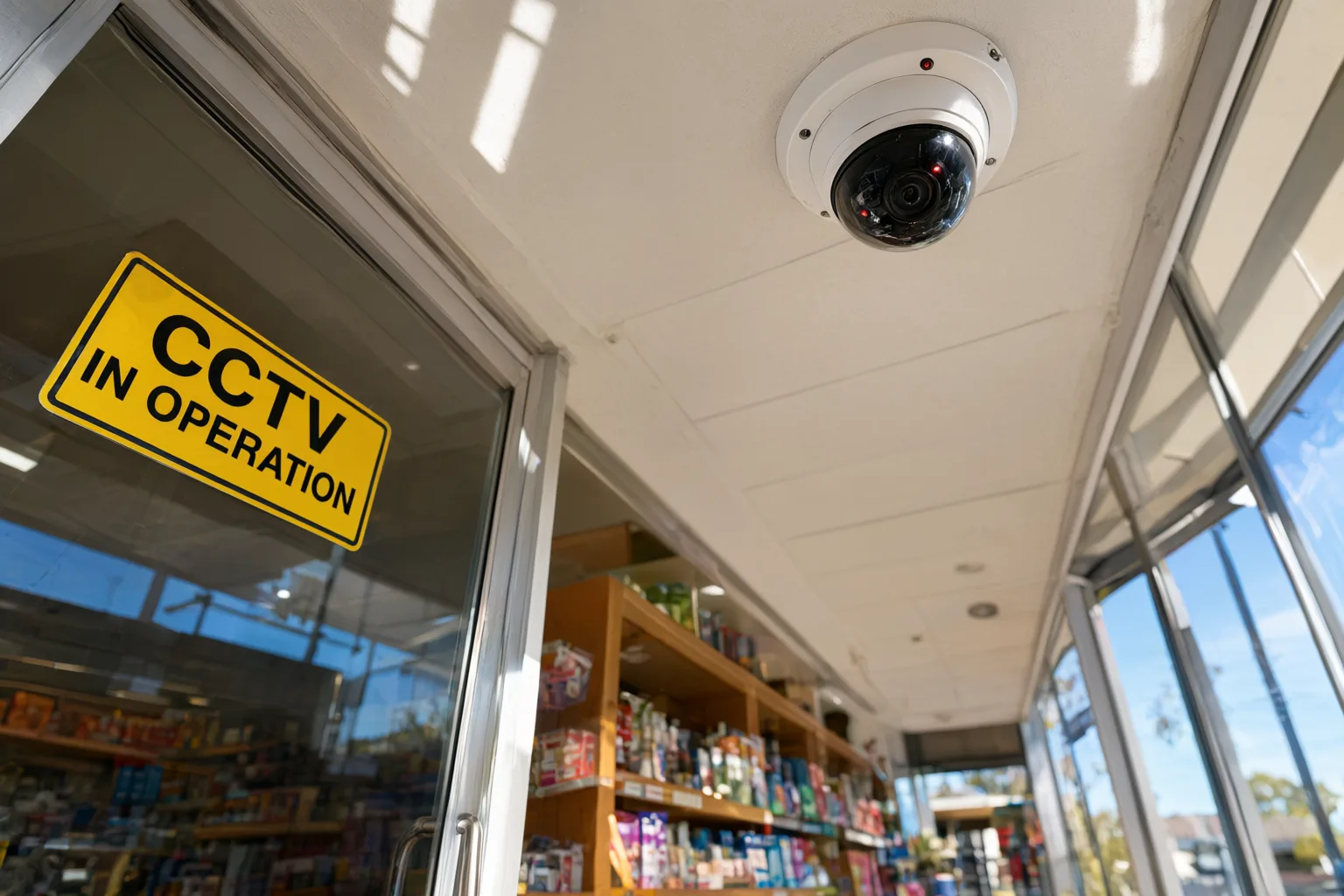
The legal gulf between hidden and visible cameras could not be wider. [[covert-vs-overt-cctv-when-hidden-surveillance-is-permitted-in-australia|Overt CCTV]], paired with clear signage telling people that surveillance is operating, is generally lawful in commercial premises across Australia — as long as cameras avoid private areas and employees have been properly notified. This is why virtually every compliant Australian business takes this approach.
Concealed cameras, on the other hand, expose owners to serious legal risk. Beyond workplace surveillance legislation, secretly recording someone in circumstances where they have a reasonable expectation of privacy can breach state surveillance devices laws. In NSW, the Surveillance Devices Act 2007 makes it an offence to install or use a listening or optical surveillance device to capture a private conversation or activity without consent.
Visibility also delivers better security outcomes. A camera people can see changes behaviour; a camera they cannot see does not deter anyone until after the fact. For preventing theft, misconduct and safety incidents, overt systems consistently outperform covert ones.
Can Covert Surveillance Ever Be Allowed in an Australian Business?
There are a handful of situations where covert monitoring in a business setting can be justified. In NSW, an employer who genuinely suspects an employee of unlawful conduct — such as pilfering stock or cash — may apply to a magistrate for a covert surveillance authority. This is a formal legal process requiring evidence and grounds; it is not something a business owner can decide to pursue unilaterally.
Licensed private investigators investigating suspected fraud or theft operate under related but distinct rules, yet they too must comply with surveillance devices legislation and cannot simply deploy hidden cameras at will.
For most owners dealing with shrinkage, safety concerns or general security, the lawful and effective answer is not concealment — it is a well-designed, clearly visible CCTV system that deters offending while capturing usable evidence.
Should You Record Audio on Business CCTV Systems?
Many owners are startled to discover that sound is treated far more harshly than video under Australian law. In NSW, Victoria, Queensland and most other states, recording a private conversation without consent — all parties' consent in some jurisdictions, at least one party's in others — is a criminal offence. The safest position for any business is to disable audio capture on CCTV systems entirely unless legal advice says otherwise.
Crucially, this applies even to fully visible, correctly signposted cameras. A video-only installation that is otherwise perfectly lawful can still generate criminal liability if it is simultaneously capturing private conversations between staff or customers.
When Aussie CCTV Cams configures a commercial system, audio is switched off by default and only enabled where a client has obtained specific legal advice confirming it suits their circumstances.
Which Steps Build a Fully Compliant CCTV System?
The encouraging news is that a professionally installed, visible CCTV system meets the security needs of nearly every Australian business without creating legal exposure. [[common-cctv-privacy-mistakes-australian-businesses-make-and-how-to-avoid-them|Compliance]] comes down to a handful of straightforward steps: notify employees in writing before cameras go live, erect clear signage at entrances and throughout the premises, keep lenses away from private areas, disable audio recording, and store footage securely with access restricted to authorised personnel only.
At Aussie CCTV Cams, our licensed and insured NSW installers follow a five-step process — consult, design, install, configure, and handover with training — so every commercial system we deliver is both technically effective and legally sound. We fit professional-grade hardware from Hikvision, Dahua, Uniview and Axis, including models with AcuSense AI detection and ColorVu full-colour night vision, giving you genuine security outcomes without legal grey areas.
Unsure whether your existing setup complies, or planning a new installation and wanting to get it right first time? We provide free quotes and plain-English advice. Getting this wrong risks criminal charges, civil claims from employees, and footage ruled inadmissible in court — outcomes no business can afford.
Do Illegal Hidden Cameras Put Your Business Finances at Risk?
It is worth pausing on the consequences. An unlawfully placed or concealed camera can trigger criminal charges under state surveillance legislation, fines, and civil claims from affected employees whose privacy was breached. Footage gathered illegally may also be rejected by courts and insurers, meaning the very evidence you hoped to obtain becomes worthless precisely when you need it most.
Beyond the immediate penalties, non-compliance damages trust within your workforce and can attract regulatory scrutiny. By contrast, a transparent, signposted, professionally installed system protects your stock, your staff and your legal position simultaneously — which is why compliance should be treated as a design requirement, not an afterthought.
Weather matters when planning compliant camera placement across Australia. Coastal properties in [[/newcastle|Newcastle]] face salt air and storm exposure, so marine-grade housings mounted under eaves protect equipment from corrosion and driving rain. In [[/adelaide|Adelaide]], summer heat regularly exceeds 40°C, which degrades cheap consumer cameras and can corrupt footage; commercial-grade units rated for high temperatures, positioned away from direct sun on north-facing brick walls, deliver reliable year-round recording for your business property.
Budget realistically for a lawful system rather than risking covert shortcuts. A typical four-camera package for a small retail premises costs around $1,800–$2,800 AUD installed, while larger warehouses or commercial sites needing 16 channels, night vision and remote monitoring generally fall between $4,000 and $9,000 AUD. Every quote from Aussie CCTV Cams includes compliant signage, correct camera placement away from change rooms and amenities, and documentation showing employees were notified—paperwork that protects you if the Privacy Act 1988 or a state regulator ever reviews your surveillance practices.
Placement discipline prevents most compliance failures. Never position any camera, visible or otherwise, where people undress: toilets, change rooms and shower facilities are prohibited zones in every Australian jurisdiction. Focus lenses on entrances, registers, stockrooms and loading docks instead. For farms and rural properties, boundary and gate coverage deters theft without capturing neighbours' land, while strata-titled buildings require body corporate approval before mounting cameras on shared rooflines or common-area eaves.
Finally, document everything. Keep dated records of employee notifications, signage photographs, footage retention periods (30–90 days is standard) and access controls limiting who can review recordings. Under Australian Consumer Law expectations and workplace surveillance legislation, demonstrating good-faith compliance dramatically reduces penalty exposure if a complaint arises. A licensed installer provides this audit trail as standard, giving Newcastle and Adelaide business owners genuine peace of mind alongside their security coverage.
Surveillance options for Australian businesses compared
| Option | Legal Status | Best For |
|---|---|---|
| Visible CCTV with signage | Fully compliant in all states with written staff notice | Retail shops, offices, warehouses |
| Hidden/covert cameras | Illegal for routine employee monitoring; authorised cases only | Court-approved investigations |
| Audio-enabled CCTV | High risk; often breaches listening device laws | Duress alarms with consent protocols |
| Dashcam-style mobile units | Compliant if disclosed to staff driving vehicles | Delivery fleets, trade vehicles |