
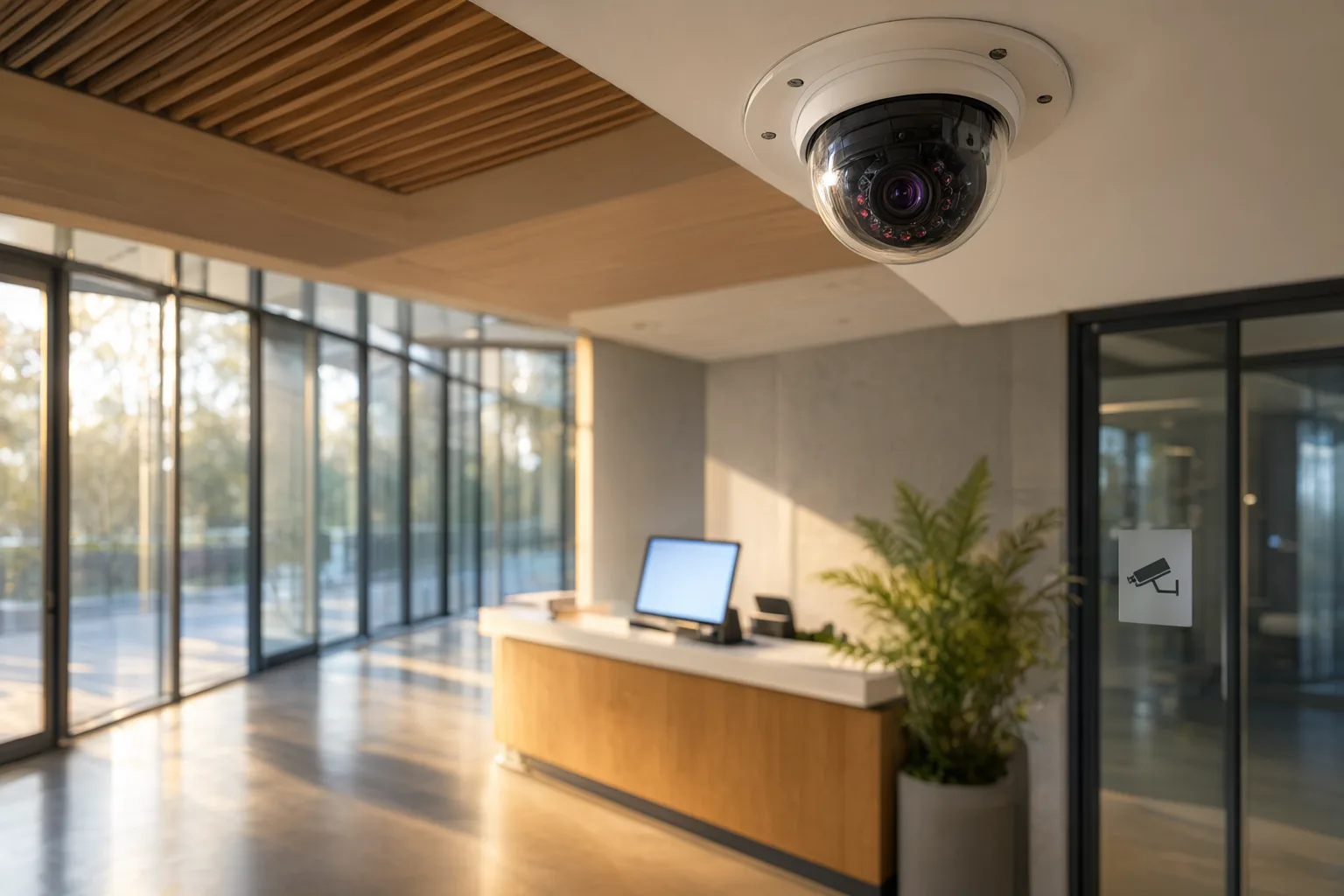
Key Takeaways
- NSW requires 14 days' written notice before any workplace camera records; Victoria has no fixed countdown but expects reasonable, proportionate monitoring.
- Toilets, change rooms and showers are off-limits in both states without exception.
- Signage at every entrance is mandatory in NSW and effectively essential in Victoria.
- Penalties in NSW can exceed $11,000 for individuals and far more for corporations.
- Cross-border businesses should run parallel NSW and Victoria compliance tracks.
Why Do NSW and Victoria Treat Workplace Cameras So Differently?
The short answer is that workplace CCTV is legal in both NSW and Victoria, but the compliance paths differ sharply. New South Wales requires written notice to every affected employee at least 14 days before cameras begin recording, while Victoria relies on the Surveillance Devices Act 1999 and a reasonableness standard. This 2025 guide compares both regimes, explains signage, penalties and camera placement rules, and shows how businesses in Newcastle, Adelaide and beyond can install compliant systems.
NSW has dedicated legislation: the Workplace Surveillance Act 2005 exists solely to govern how employers monitor their staff. It sets hard deadlines, prescribes what notices must contain and restricts how footage can be used. Victoria works differently. The Surveillance Devices Act 1999 is a general-purpose law covering all surveillance devices, not just workplace monitoring, so employer obligations flow from it indirectly, alongside occupational health and safety duties and common law privacy principles.
The practical consequence is that compliance in one state does not transfer to the other. A Melbourne business that consults staff and installs cameras may find that same process unlawful if repeated at a Sydney site without formal written notice. This guide walks through each state's requirements, the locations where cameras can never go, and the penalties waiting for businesses that cut corners.
What Does the Workplace Surveillance Act 2005 Require of NSW Employers?
NSW operates the most detailed [[workplace-surveillance-act-compliance-what-employers-must-do-before-installing-c|workplace CCTV]] regime in the country. The centrepiece is a mandatory 14-day written notice period: no camera may begin recording until every affected employee has received written notice at least 14 days beforehand.
That notice cannot be vague. The Act requires it to state the type of surveillance being introduced, how it will be carried out, when it will commence, whether it will be continuous or intermittent, and whether it will run indefinitely or for a defined period. Employers who skip these details risk having their entire scheme declared non-compliant.
The Act also recognises three distinct forms of monitoring—camera, computer and tracking surveillance—and each triggers the same notification process. For camera systems specifically, there are extra conditions: cameras must be clearly visible rather than concealed, and prominent signage must announce that surveillance is operating at entrances and throughout every monitored area.
Footage handling carries its own rules. Recordings must be stored securely and used or disclosed only for legitimate employment or business purposes. Critically, if you did not declare performance monitoring as a purpose in your original notice, you cannot later use footage to assess how employees work. The purposes stated up front lock in what the footage can legitimately be used for.
How Does Victoria's Surveillance Devices Act 1999 Approach Employer Monitoring?
Victoria's framework is less prescriptive but still demanding in its own way. There is no statutory countdown like NSW's 14-day rule. Instead, employers must genuinely consult with employees before installing surveillance equipment—an obligation grounded in occupational health and safety legislation and common law duties rather than a dedicated workplace statute.
The Act itself targets the use of surveillance devices to record private conversations or activities without consent. Applied to workplaces, this means hidden cameras and covert monitoring are off the table unless employees have agreed. One complication: the definition of 'private activity' under Victorian law is narrower than NSW's privacy framework, which leaves some grey zones about where acceptable monitoring ends.
Signage remains essential even though the Act does not spell out exact sign specifications. Signs must be clearly displayed at entry points and within monitored areas. Inadequate notice does more than annoy staff—it can make recordings inadmissible in legal proceedings and expose the business to civil claims.
Where Victoria diverges most sharply from NSW is covert surveillance. With explicit employee agreement, typically captured through employment contracts or workplace policies, limited covert monitoring can be lawful. In NSW, no amount of consent substitutes for a court order. Even in Victoria, however, agreement never legitimises cameras in toilets, bathrooms or change rooms.
Which Camera Locations Are Illegal in NSW and Victorian Workplaces?
Some boundaries are identical in both states. Toilets, bathrooms, showers and change rooms are absolutely off-limits for cameras, full stop. No security justification overrides the expectation of privacy attached to these spaces, and installing equipment there constitutes a serious offence regardless of notification or consent.
Beyond those universal prohibitions, the states interpret grey areas differently. NSW prohibits surveillance anywhere employees hold a reasonable expectation of privacy—a standard courts have applied to spaces such as prayer rooms, lactation rooms and first aid rooms. Victoria reaches similar conclusions through general privacy principles, but with less legal certainty, leaving employers to exercise more judgement.
Break rooms and lunch areas sit in contested territory in both states. NSW permits monitoring there provided it was properly notified, though employers should ask whether continuous coverage of staff downtime serves any genuine security purpose. Victoria is formally more permissive, but watching employees during breaks invites industrial relations friction that often costs more than the footage is worth.
By contrast, entry points, cash handling areas, storage rooms, loading docks and customer service zones are broadly accepted camera locations in both states. These areas carry clear security rationales and low privacy expectations. Modern analytics-driven systems such as Hikvision AcuSense or Dahua WizSense let businesses concentrate detection on these high-risk zones while steering clear of areas where staff gather outside working tasks.
Is Signage Legally Required for Employee Monitoring Cameras in Both States?
Signage is not optional decoration—it is a legal requirement everywhere this article covers. Signs must be plainly visible, positioned at eye level and installed at every entrance to a monitored area. The wording must explicitly state that CCTV surveillance is operating; a generic 'security in operation' placard may fall short of what the law expects.
NSW employers carry the heavier documentation load. Written notice goes to each affected worker individually—not merely pinned to a communal noticeboard. Best practice is to collect a signed acknowledgment from every employee confirming they received and understood the surveillance notice. That paper trail becomes decisive evidence if a dispute ever reaches the Fair Work Commission or a court.
Victorian employers should treat consultation as a real conversation, not a formality. Toolbox talks, direct emails or discussions through health and safety committees all count, provided they happen before installation and are thoroughly documented. Although Victoria does not mandate written notice, providing it anyway signals good faith and creates a defensible record.
One further layer applies to unionised workplaces: enterprise agreements may impose consultation or notification requirements above the statutory floor. Check the relevant awards and agreements before scheduling any installation date.
Do Penalties Apply to Employers Who Breach Workplace Surveillance Laws?
Getting surveillance wrong carries heavy financial and personal consequences. In NSW, breaching the Workplace Surveillance Act exposes corporations to fines up to $55,000 and individuals to $11,000. Magistrates can additionally order destruction of unlawfully obtained footage and prohibit further surveillance altogether.
Victoria's penalty structure differs in shape. Under the Surveillance Devices Act, corporations face fines up to $37,000 while individuals face up to $18,000—and serious offences can attract imprisonment of up to two years. These penalties attach chiefly to prohibited activities, especially covert monitoring conducted without consent.
Statutory fines are only the beginning. Employees can pursue civil damages for privacy breaches, particularly where footage is misused or disclosed improperly. In unfair dismissal proceedings, the Fair Work Commission routinely scrutinises whether surveillance was lawful; evidence gathered through non-compliant monitoring may be ruled inadmissible, collapsing an otherwise well-founded dismissal case.
Reputational fallout frequently outweighs the monetary hit. Discoveries of illegal workplace surveillance travel fast through industry networks and social media, and rebuilding trust with staff and customers can cost far more than any fine.
Can You Build a Compliant CCTV System in Stages?
Begin with a documented business case. Identify the specific security risks, safety concerns or operational needs that justify cameras, because this record demonstrates legitimate purpose if anyone later challenges your practices.
Engage licensed professional installers who understand the legal landscape. At Aussie CCTV Cams, our licensed and insured NSW installers design systems that satisfy technical and statutory requirements together—positioning cameras over high-risk areas, steering clear of prohibited zones and ensuring signage meets the relevant standards.
Draft a comprehensive surveillance policy covering camera locations, retention periods, access controls and permitted uses. Specify who may view footage, under what circumstances, and how long recordings are kept. Most businesses retain footage for 30 to 90 days unless an incident requires longer preservation.
Lock down system access. Modern IP camera systems paired with network video recorders support granular user permissions and audit trails. Restrict viewing rights to authorised managers and log every access event—who watched what, and when. This protects employee privacy and evidences responsible data handling.
Finally, audit annually. As premises and operations change, last year's compliant camera positions may now capture prohibited areas or excessive employee activity. Regular reviews keep both your legal position and your security coverage current.
Are Two Compliance Tracks Needed by Businesses Operating in Both States?
Businesses operating in both NSW and Victoria should maintain two parallel [[cctv-and-the-australian-privacy-principles-a-plain-english-guide-for-business-ow|compliance]] tracks rather than one national policy. The simplest approach is to adopt NSW's stricter requirements as your baseline—written individual notice, 14-day lead time, signed acknowledgments—then layer Victoria's consultation requirement on top for southern sites.
Documentation discipline matters more when you span jurisdictions. Keep separate records for each state showing who was notified, when consultation occurred, what signage was installed and what purposes were declared. If a dispute arises in either jurisdiction, those records determine whether your footage survives legal scrutiny.
Review any acquisition, expansion or refit against both statutes before cameras go live. An installation schedule that satisfies a Melbourne landlord may breach NSW notice requirements at a Sydney branch, and vice versa. Building the legal review into your project timeline—rather than after installation—is the cheapest [[the-complete-cctv-compliance-checklist-for-australian-homes-and-businesses|compliance]] step available.
Should Customers, Visitors and Break Rooms Be Covered by Your CCTV Policy?
Do Workplace CCTV Laws Apply to Customers and Visitors Too?
Budgeting realistically matters as much as legal compliance. A compliant four-camera system covering entrances, a warehouse floor and a retail counter typically costs $1,800–$3,500 installed in Australian capital cities, while larger commercial sites needing 16-plus cameras, night vision and cloud retention often sit between $6,000 and $15,000. Factor in signage printing, privacy policy updates and staff training sessions, which add a few hundred dollars but dramatically reduce your legal exposure under both state regimes.
Weather resilience is an underrated compliance issue. Coastal installations around [[/newcastle|Newcastle]] face salt-laden air that corrodes cheap housings within two years, while South Australian summers regularly push roof-mounted equipment past 60°C. Specify IP66-rated housings, marine-grade brackets and adequate shading for eaves-mounted cameras, because a failed camera is not just a security gap—it can mean your documented surveillance scheme no longer matches what is actually operating, creating a technical breach.
Retention policy deserves equal attention. Neither state prescribes an exact retention period, but the Australian Privacy Principles expect footage to be deleted once its purpose is served; 30 to 90 days is the accepted commercial norm. Document who can access footage, log every export, and restrict playback rights to trained managers. If an employee makes a access request under the Privacy Act 1988, you must be able to locate and disclose relevant footage about them promptly.
Finally, treat installation day as a compliance event, not just a technical one. Confirm notices were issued 14 days prior in NSW, photograph every sign position, record camera fields of view against your approved plan, and archive the commissioning report. Businesses we work with across Newcastle NSW and [[/adelaide|Adelaide]] SA find this paper trail invaluable if a Fair Work claim or Privacy Act complaint ever questions their employee monitoring practices.
NSW vs Victoria workplace CCTV compliance at a glance (2025)
| Requirement | New South Wales | Victoria |
|---|---|---|
| Governing law | Workplace Surveillance Act 2005 (NSW) | Surveillance Devices Act 1999 (Vic) |
| Advance notice | 14 days' written notice to each affected employee | No fixed period; reasonable disclosure expected |
| Signage | Mandatory, plainly visible at entrances | Strongly expected; supports consent defence |
| Prohibited areas | Toilets, change rooms, showers | Same prohibitions apply |
| Typical penalty exposure | Up to $11,000 individuals / $55,000 corporations | Criminal offences and civil damages possible |