
Key Takeaways
- A $500–$900 retail CCTV kit becomes an $860–$1,770 project once hidden extras are counted
- Kits include only 18m pre-made leads but real Aussie homes need 25–40m per camera run
- UV-stabilised conduit is mandatory outdoors or cable sheaths crack within two summers
- First-time DIYers spend 8–16 hours versus 4–6 hours for a professional crew
- NSW homeowners may install own CCTV but cabling must meet Australian standards
- Professional installation in Newcastle or Adelaide is often comparable on total price
How Much Does DIY CCTV Really Cost in Australia?
A DIY CCTV kit advertised at $500–$900 typically ends up costing $860–$1,770 all-in once you add cable, conduit, fixings, tools and access equipment — plus eight to sixteen hours of your own time across one or two weekends. That's the direct answer most Australian homeowners are looking for, and it's the number the sticker price conveniently leaves out.
This guide breaks down every hidden cost line by line, explains why Australian homes make DIY cabling harder than the YouTube tutorials suggest, and shows exactly where a licensed professional installation becomes the cheaper, safer and more reliable option. If you're weighing up a weekend project against a fixed-price quote, the numbers below will settle it.
What Makes the Box-Store Price Only the Beginning?
Big-box electronics retailers sell four-camera CCTV kits for a few hundred dollars, and the pitch is seductive: one Saturday on the ladder, no labour bill, and your home protected by dinner. What the box actually contains is cameras, a recorder and — if you're lucky — a handful of short pre-terminated leads.
Everything required to make that kit safe, weatherproof and compliant in Australian conditions is sold separately. The right cable for your run lengths. UV-stabilised conduit so the sun doesn't destroy your wiring within a couple of summers. Junction boxes, glands, anchors, sealant, and the tools to terminate and test it all. Add those up and the gap between DIY and [[diy-vs-professional-cctv-installation-which-option-saves-you-more-in-the-long-ru|professional]] installation narrows dramatically — before you've valued a single hour of your weekend.
Why Is 18 Metres of Cable Never Enough for Aussie Homes?
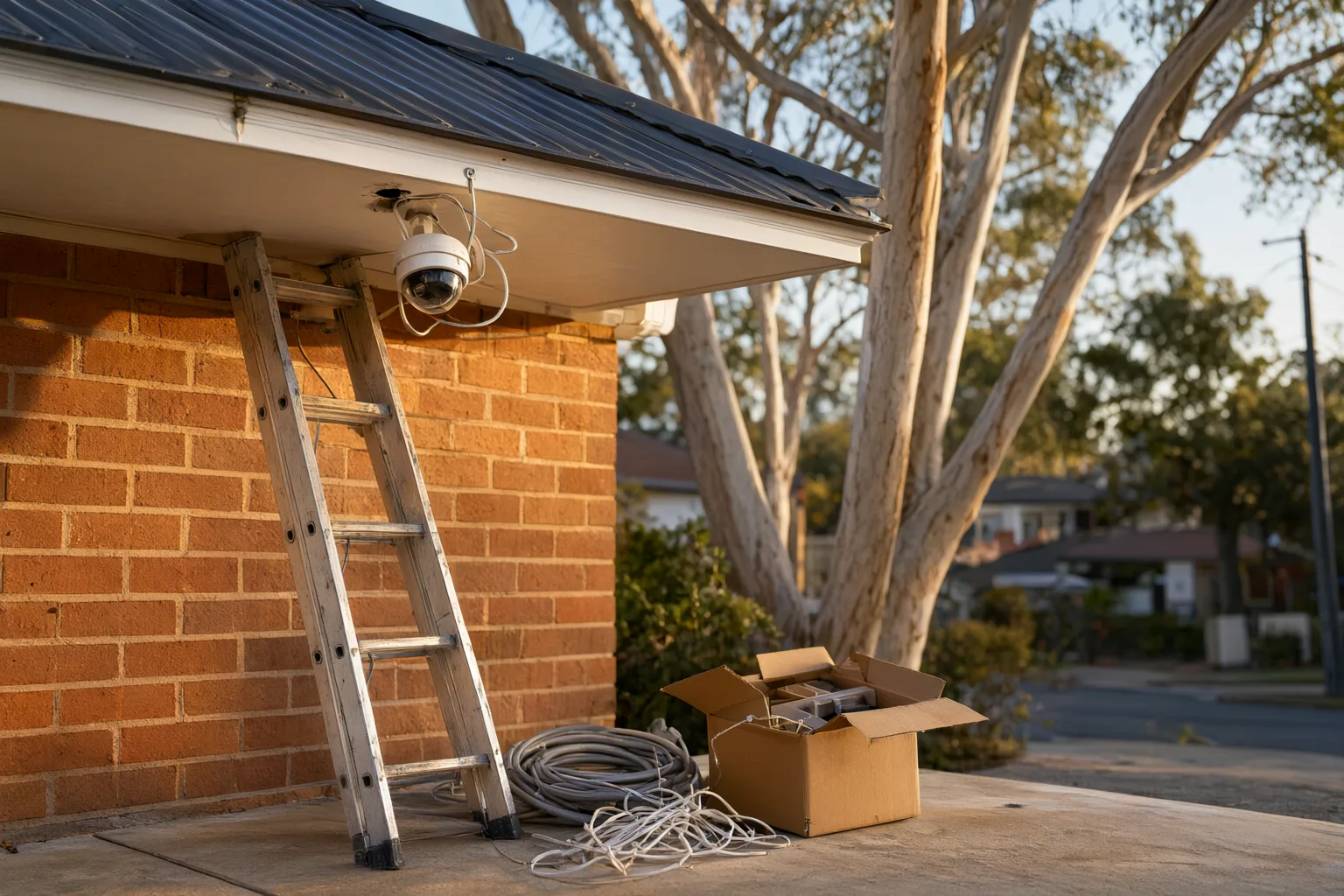
Retail kits typically include 18-metre pre-made leads per camera. Real Australian homes don't cooperate. Take a typical brick veneer with a Colorbond roof: cameras mounted at the eaves, the recorder tucked in a hallway cupboard, and the only sensible cable path running up through the roof cavity and down a wall cavity. Once you route around insulation, ducting and structural members, you routinely need 25 to 40 metres per run.
That forces a choice: buy bulk cable and terminate it yourself (which means buying a crimper, connectors and a tester), or daisy-chain extension leads that introduce connection points — the most common failure location in DIY systems. Every join is a future fault call, and in a roof cavity, every fault call is an unpleasant one. Licensed under the Security Industry Act, Aussie CCTV Cams ensures every [[the-real-cost-of-a-4-camera-poe-system-installed-in-australia|installation]] satisfies Australia's Privacy Act requirements.
Do You Need Conduit and Weatherproofing Under Australian Sun?
Australian sun is brutal on exposed cabling. Any external cable run needs UV-stabilised conduit, or the sheath will degrade and crack within a couple of summers, leaving you re-running the lot. Add a weatherproof junction box at every camera mount, cable glands to keep water out of terminations, and saddles to fix the conduit neatly to brick or render.
Then there's the fixing itself. Masonry anchors for brick, the right silicone to seal penetrations, and masonry drill bits — which you will burn through on double brick, often more than one. None of this appears on the kit's box, and all of it appears on your receipt.
What's on the Hidden Shopping List Line by Line?
Here's what the missing items typically cost an Australian homeowner buying retail, based on what our installers see left over in DIY customers' garages:
- Bulk RG59 or Cat6 cable plus connectors and termination tools: $80–$180
- UV-rated corrugated conduit, elbows and junction boxes: $60–$150
- Weatherproof glands, silicone, anchors and fixings: $40–$90
- Crimping tool, cable tester, long masonry bits, fish tape or rods: $100–$250 if you don't already own them
- Extension ladder or roof access equipment hire: $80–$200
Should You Count Your Weekend as a Real Cost?
A professional two-person crew installs a typical four-camera home system in four to six hours because they've done it thousands of times. A first-time DIYer should budget eight to sixteen hours — and that assumes nothing goes wrong. Something always goes wrong: a cable that won't fish through an insulated wall, a camera angle that misses the driveway, an NVR that won't appear on your phone because of a router setting you've never heard of.
There's also the physical reality of Australian roof spaces. In summer, roof cavities regularly exceed 60°C. You're working around insulation, electrical wiring and downlights, stepping only on ceiling joists. Falls through ceilings are among the most common DIY injuries, and one misstep onto gyprock costs more in plaster repairs than a professional [[how-much-does-professional-cctv-installation-cost-in-australia|installation]] would have in the first place.
Value your weekend at even a modest hourly rate and the DIY 'savings' often evaporate entirely — while you keep all the risk if a camera fails or a cable faults six months down the track.
Are Technical Gaps Making Your DIY Footage Useless?
Getting a picture on your phone is the easy part. Getting a system that reliably captures court-usable evidence is where DIY installs typically fall short. Camera height and angle matter enormously: mount too high and you record the tops of heads; too low and cameras invite tampering. Backlighting from a western sun can silhouette faces at precisely the time of day most break-ins occur.
Configuration is the other silent failure. We regularly see DIY systems recording at low resolution to stretch hard drive space, motion detection triggering on every gum tree shadow, or remote viewing that dies the moment the NBN modem reboots and assigns a new IP address. Professional features such as Hikvision's AcuSense human and vehicle detection, or ColorVu full-colour night imaging, need proper setup to deliver what they promise.
Finally, there's compliance and insurance. Fixed cabling work in NSW must meet Australian standards, and some insurers ask pointed questions about unlicensed security work after a claim. A licensed, insured installer removes that risk entirely.
Is DIY vs Professional Installation Really Cheaper Overall?
When you line up the real numbers, professional installation is rarely the expensive option — it's the predictable one. You know the total cost upfront, the job is finished in a day, and every component from the PoE switch to the last conduit saddle is covered by warranty and lifetime support.
The table below compares a typical four-camera outdoor installation on a single-storey Sydney home, using equivalent-quality hardware rather than the entry-level components bundled in retail kits.
When Does DIY CCTV Actually Make Sense?
To be fair, DIY has its place. A single wireless camera over a garage, a temporary solar camera on a fence line, or a video doorbell are all reasonable weekend projects with minimal cabling. If you're genuinely handy, already own the tools, and want a basic setup in a single-storey home with easy roof access, a quality kit can work well.
But for multi-camera systems, two-storey homes, rendered or double-brick walls, long cable runs, rural properties relying on 4G, or any business premises, the hidden costs and risks stack up fast. That's exactly the work our licensed NSW installers do every day — professionally designed, neatly cabled in conduit, configured for your phone, and handed over with training so you actually know how to use it. With a free quote, you'll know the real number before you commit to either path.
DIY vs Professional CCTV Installation: Real Cost Comparison
| Cost Factor | DIY Kit Route | Professional Installation |
|---|---|---|
| Cameras and recorder | $500–$900 (retail kit) | Included in quote (Hikvision, Dahua, Uniview or Axis) |
| Cable, conduit, boxes and fixings | $180–$420 | Included |
| Tools and access equipment | $180–$450 (purchased or hired) | Included |
| Your time | 8–16 hours over 1–2 weekends | 4–6 hours, done for you |
| Design and camera placement | Guesswork | Professional site design |
| Configuration and remote viewing setup | Self-taught, often incomplete | Fully configured with handover training |
| Workmanship warranty and support | None | Warranty plus lifetime support |
| Realistic total | $860–$1,770 plus your weekend | One fixed, quoted price |