
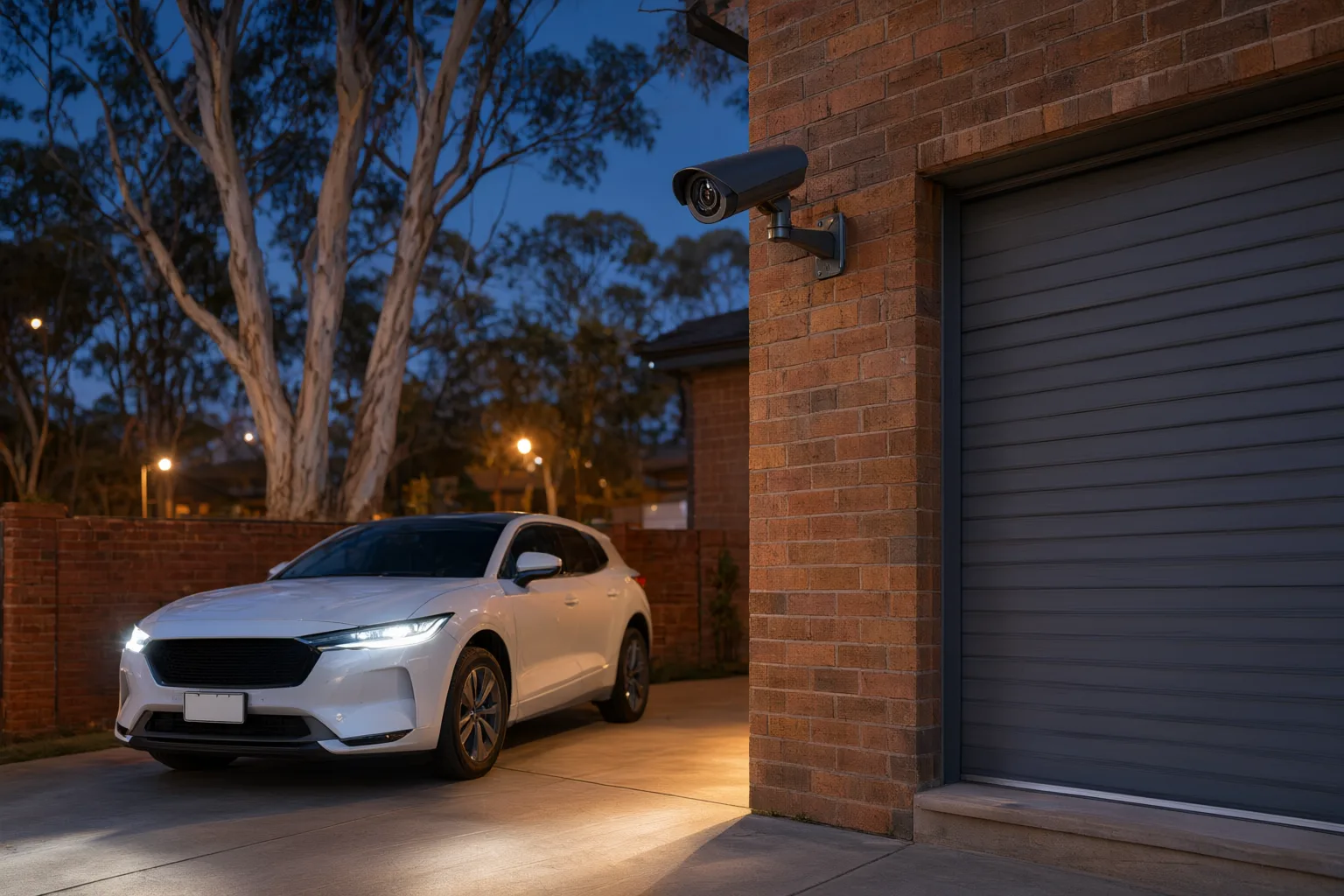
Key Takeaways
- Mount plate cameras 2.5–4 metres high with a 15–30 degree tilt for reliable number plate capture in Australia.
- Keep the lens within 30 degrees of the vehicle's path of travel or ANPR-style reading fails even in daylight.
- Use WDR of 120dB or better to beat harsh Australian sunlight and shaded Colorbound carport contrast.
- Lock shutter speed at 1/500s–1/1000s at night so headlights don't blow out retro-reflective plates.
- A two-camera setup — wide overview plus dedicated plate camera — beats any single-camera compromise.
- Licensed NSW and SA installers test with real vehicles before handover, typically within 1–2 weeks of quote.
How Do You Position a Driveway Camera to Read Number Plates?
To get readable driveway camera number plate capture, mount the camera 2.5 to 4 metres high, tilt it down 15 to 30 degrees, aim it within 30 degrees of the vehicle's path at a choke point like your gate or garage approach, and use either a dedicated ANPR camera or a varifocal lens zoomed tightly onto the plate zone.
At night, the settings matter as much as the position. Lock the shutter speed fast (1/500s to 1/1000s), enable highlight compensation to tame headlight glare, and make sure the infrared illumination reaches your plate zone. Get these elements right and reliable plate capture is well within reach on an ordinary Australian driveway.
Why Do Most Driveway Cameras Fail to Capture Plates?
It's one of the most common complaints we hear from homeowners across NSW: they had a camera running over the driveway, something happened, they pulled up the footage — and the number plate is nothing but a white smear. The problem isn't usually the camera's resolution. It's that capturing a plate is one of the hardest jobs in CCTV.
Think about what a number plate actually is from a camera's perspective. It's small, often moving, covered in retro-reflective material designed to bounce light straight back at its source, and at night it sits directly between two high-beam headlights. A general-purpose wide-angle security camera is simply not engineered for that challenge. Its automatic exposure is tuned to keep the overall scene visible, which means the brightest object in frame — the plate under headlights — gets blown out to pure white.
The encouraging news is that with deliberate positioning, the right lens and a handful of configuration changes, consistent plate capture is achievable on virtually any residential or commercial driveway in Australia.
What Mounting Height and Tilt Captures Plates Best?
Height is where most DIY installations go wrong. Homeowners instinctively screw the camera up under the eaves, five or six metres above the ground, because that feels like the natural spot for a security camera. From that height looking down a driveway, the lens sees bonnets, windscreens and rooftops — not plates.
For plate capture, the sweet spot is 2.5 to 4 metres above ground level with a downward tilt of 15 to 30 degrees. This geometry keeps the plate close to perpendicular with the lens, which is critical because plates are retro-reflective. Viewed from a steep angle, infrared light bounces away from the sensor instead of back into it, and the characters distort into unreadable smudges.
Horizontal placement matters just as much as height. Aim to keep the camera within about 30 degrees of the vehicle's direction of travel. A camera bolted hard against one side wall of the carport views plates obliquely, compressing the characters sideways until they're illegible. On a straightforward driveway running to the garage, one of the best positions we use is beside the garage door itself, looking back down the drive toward the street.
- Mounting height: 2.5 to 4 metres
- Vertical tilt: 15 to 30 degrees downward
- Horizontal offset: within 30 degrees of the vehicle's path
- Distance from camera to plate zone: ideally 3 to 10 metres
Which Choke Point Should Your Plate Camera Watch Instead of the Whole Driveway?
Here's a truth that surprises many buyers: no single camera can both watch your entire driveway and read number plates. A readable plate needs to occupy a meaningful slice of the image, and that only happens when the field of view is deliberately narrowed.
The solution is to identify a choke point — a location every vehicle must pass through, and ideally one where drivers slow down. On typical Australian properties this might be the driveway entrance at the front boundary, an automatic gate, a narrow gap between garden beds or fences, or the final few metres before the garage. Vehicles move slower at turning points and gates, giving the sensor more frames per metre of travel, which dramatically sharpens results.
Once you've chosen the choke point, zoom the camera's field of view down to a zone roughly three to four metres wide covering it. This is where a varifocal lens earns its keep — a motorised 2.8–12mm lens on a Hikvision or Dahua camera, for example, lets you fine-tune framing after the bracket is fixed, without climbing the ladder again.
Can Your Settings Beat Harsh Australian Sunlight During the Day?
Australian daylight is brutal on camera sensors. A car parked half in shade beneath a Colorbond carport presents extreme contrast in a single frame, and a shaded plate on a sunlit bonnet can vanish entirely. The fix is Wide Dynamic Range — WDR — rated at 120dB or better, which lets the sensor balance bright highlights and deep shadow simultaneously.
Without WDR enabled, you'll see one of two failures: plates washing out to white in bright conditions, or crushing to black when the vehicle sits in shadow. Both render the footage useless as evidence. During [[the-real-cost-of-a-4-camera-poe-system-installed-in-australia|installation]] we always test WDR performance with a real vehicle parked in the exact positions cars occupy on your driveway, not just with the manufacturer's demo footage.
Are Night Settings Freezing Plates Against Headlight Glare?
Night is where most systems fall apart. When headlights hit the sensor, the camera's auto-exposure does exactly what it's designed to do — brightens the whole scene — and the retro-reflective plate turns into a glowing white rectangle with no characters visible.
The counter-intuitive fix is to lock the shutter speed fast, typically between 1/500s and 1/1000s. Yes, the rest of the scene goes darker, but the plate itself is exposed correctly and motion blur disappears. Purpose-built ANPR cameras handle this automatically using Highlight Compensation (HLC), which actively suppresses headlight glare before exposure is calculated.
Infrared illumination is the other half of the night equation. Check the camera's specified IR range in metres and match it to your actual plate distance — marketing claims on the box are notoriously optimistic. And whatever hardware you choose, always run a live test with a real car driving in and out after dark [[how-to-test-every-camera-angle-before-you-drill-a-single-hole|before you]] sign off on the install.
- Enable 120dB+ WDR for harsh Australian daylight
- Lock shutter to 1/500s–1/1000s at night to freeze plates
- Use HLC or headlight suppression on ANPR models
- Match IR range to your real plate distance, not the brochure
- Test with an actual vehicle at night before finalising
Do You Need Dedicated ANPR Hardware for Plate Capture?
For most driveways, our recommendation is a two-camera strategy. The first is a wide overview camera covering the general driveway area for context and security. The second is a dedicated plate camera zoomed into the choke point. Trying to make one device do both jobs reliably is the fastest route to disappointment.
On the dedicated side, current options include Hikvision's ANPR cameras with built-in plate recognition, Dahua's WizMind plate series, and Uniview's LPR range. These don't just record — they read plates automatically, trigger alerts, log entries and exits, and integrate with your NVR so you can search footage by plate number. For businesses, strata complexes and gated properties, that automation is genuinely transformative.
If a full ANPR camera stretches the budget, a 4K varifocal bullet camera with smart detection such as AcuSense, zoomed tight on the choke point with a locked fast shutter, will still capture readable plates — you'll just review the footage manually rather than having software read it for you. What you should avoid entirely is relying on consumer wireless doorbell-style cameras. Their ultra-wide lenses and automatic exposure are built for faces at the front door, not plates at driveway distance.
Should You Avoid These Common Placement Mistakes Across NSW?
Even quality hardware produces garbage footage when placed poorly. On repair and upgrade call-outs, the recurring errors are remarkably consistent: cameras mounted under eaves staring straight down the drive (too high, too steep), lenses pointed east or west directly into the rising or setting sun, and single cameras attempting to cover the street, the driveway and the front door all at once.
Backlight deserves special mention. A west-facing driveway at sunset puts the low sun directly behind approaching vehicles, and no amount of post-processing recovers a plate silhouetted against glare. Reposition the camera or lean heavily on WDR rather than fighting physics.
Then there are the distinctly Australian environmental factors. Heat haze shimmering off a long stretch of bitumen softens fine detail on hot afternoons. Coastal salt air corrodes budget housings within a couple of seasons. And spiders adore warm infrared LEDs — a web across the lens triggers false alerts night after night and blurs everything behind it. Professional installs account for all of this with quality housings, correct sealing and sensible siting.
- Don't mount above 4 metres if plate capture is the goal
- Don't aim the lens toward sunrise or sunset
- Don't expect one camera to deliver both overview and plates
- Don't overlook spider webs, heat shimmer and salt corrosion
Why Does Professional Installation Pay Off for Plate Capture?
Every driveway is different, but most Australian properties fall into a handful of common layouts, each with a proven mounting recipe. A short, straight run to the garage suits a camera mounted 2.5 to 3.5 metres up beside the garage door, looking back toward the street. A long driveway with an entry gate is ideal for a dedicated ANPR unit on the gate post or adjacent fence, reading plates as cars wait at the gate.
Wide or shared driveways need a tighter zoom at a defined choke point to stop neighbouring vehicles diluting the frame. Sloped or curved drives benefit from placing the camera at the bend apex where vehicles are already slowing. And if you want both context and evidence, run two cameras at different heights — around 4 metres for the overview and 2.5 metres for the plate zone — with separate recording zones configured on the NVR.
Why Professional Installation Pays Off for Plate Capture
Plate capture is a discipline of millimetres and milliseconds. A few degrees of tilt, a shutter setting left on auto, or IR aimed slightly past the plate zone can be the difference between usable evidence and a useless blur. Our licensed and insured NSW installers work through a structured five-step process — consultation, system design, [[how-much-does-professional-cctv-installation-cost-in-australia|installation]], configuration and handover with training — and during configuration we test with real vehicles in real conditions, tuning focus, shutter, WDR and IR until plates read consistently day and night.
We fit professional-grade Hikvision, Dahua, Uniview and Axis equipment backed by lifetime support, so if a plate stops reading after a storm or a spider sets up camp across the lens, help is a phone call away. Request a free quote and we'll design a driveway setup that captures the evidence you actually need.
Recommended Plate Camera Setup by Driveway Scenario
| Scenario | Mounting Height | Distance to Plate Zone | Recommended Camera Type | Key Setting |
|---|---|---|---|---|
| Straight driveway to garage | 2.5–3.5 m beside garage | 4–8 m | Varifocal bullet or ANPR | 1/1000s shutter at night |
| Long driveway with entry gate | 3–4 m on gate post or fence | 3–6 m at gate | Dedicated ANPR camera | HLC + plate recognition on |
| Shared or wide driveway | 2.5–3 m at choke point | 3–5 m | 4K varifocal zoomed tight | WDR 120dB enabled |
| Sloped or curved driveway | 2.5–3.5 m on bend apex | 4–7 m where cars slow | ANPR or motorised varifocal | Fast shutter + strong IR |
| Street-facing overview plus plates | Two cameras: 4 m + 2.5 m | Varies | Overview turret + plate bullet | Separate zones on NVR |