
Key Takeaways
- Double-storey CCTV installation typically costs $1,200–$3,500 installed in Australia
- Second-storey eave mounting improves tamper protection but demands careful angle planning for face capture
- Cable routing through roof spaces or wall cavities is the biggest technical challenge on two-storey homes
- NSW and SA surveillance laws apply to camera placement and audio recording
- Licensed installers carry working-at-height insurance and deliver compliant, weatherproof results
What Makes Double-Storey CCTV Installation Different From Single-Level Homes?
The short answer: double-storey CCTV installation typically costs between $1,200 and $3,500 for a quality four-camera system in Australia, including labour, cabling and configuration. Working on a two-storey home adds real complexity — elevated eaves, longer cable runs through roof cavities and stricter safety requirements all push the job beyond a simple DIY weekend project. This guide breaks down placement strategy, cable routing, legal obligations under NSW and South Australian law, and what you can expect to pay in Newcastle and Adelaide.
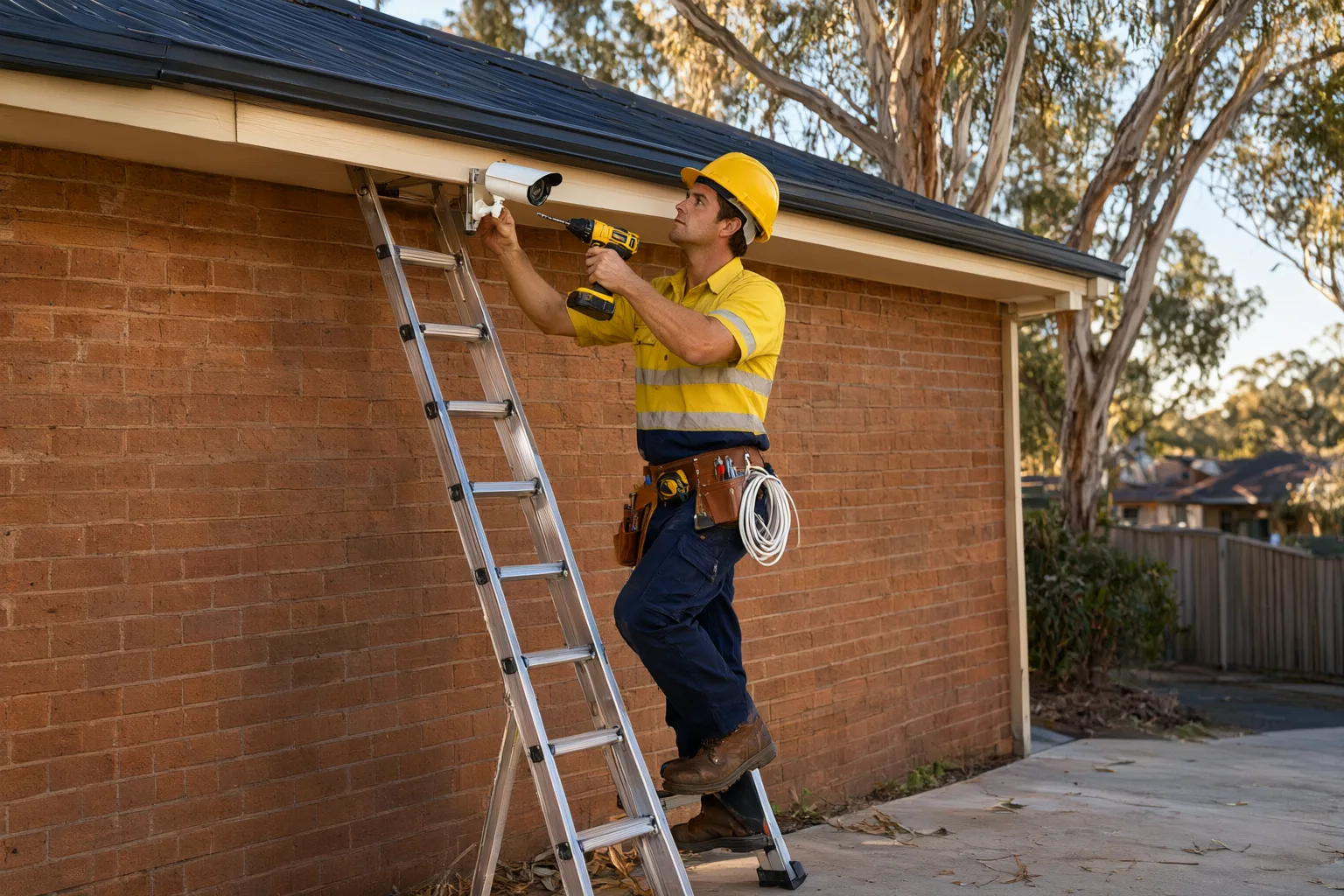
Safety is the other major difference. Every metre of extra elevation increases the consequences of a slip, a dropped tool or contact with overhead electrical services. In New South Wales and across Australia, safe work at height is governed by firm expectations around ladder use and fall prevention — these are not optional considerations for anyone climbing beyond ground level. It is one of the main reasons many homeowners hand the job to a licensed installer rather than attempting it with a household ladder and a cordless drill.
A well-designed system for a double-storey home should provide coverage of the front entry, driveway, side passages, rear yard and any upper-level balconies or climbable structures. The objective is not simply to fix cameras as high as possible; it is to produce clear, identifiable footage while keeping the installation safe, tidy and durable enough for Australian weather.
Where Should Cameras Be Mounted on a Two-Storey House?
The most common mistake homeowners make is assuming that maximum height equals maximum [[what-is-the-ideal-mounting-height-for-home-security-cameras-in-australia|security]]. Elevation does help protect cameras from tampering and vandalism, but a camera mounted too high with too steep a downward angle will capture hats and shoulders instead of faces. For most double-storey homes, the strongest results come from combining elevated positions with some eye-level or near-eye-level placements.
Front door and driveway cameras typically perform well under eaves or on first-floor fascia boards, where they can frame faces and vehicle number plates clearly. Rear cameras can sit higher out of easy reach, provided they are angled deliberately to cover gates, alfresco zones and sliding doors. Side access points generally need narrower fields of view and careful aiming, because long narrow passages create blind spots if the camera is simply pointed down the middle.
Upper-level features deserve their own assessment. Balconies, accessible pergolas, carports, flat roof sections and adjoining structures all give intruders potential routes that bypass ground-level defences. If any part of your home is climbable from outside, that area should be included in the camera plan rather than treated as an afterthought.
- Front entry: mount to capture faces without an excessive downward angle
- Driveway: cover vehicles, garage doors and approach paths
- Rear yard: protect back doors, decks and outdoor living areas
- Side passages: monitor gates, bins and concealed access routes
- Upper levels: assess balconies, rooflines and climbable structures
How Do You Work Safely at Height During an Elevated Camera Install?
Ladder safety sits at the centre of any elevated CCTV installation. A stable setup involves far more than simply reaching the wall: it means maintaining three points of contact at all times, selecting a ladder rated and sized for the task, and confirming the base rests on firm, level ground. Soft garden soil, uneven pavers and wet surfaces are among the most common causes of ladder incidents around Australian homes.
The surrounding environment matters just as much as the ladder itself. Overhead power lines, roof edges, gutters and brittle roofing materials all present hazards. Over-extending a ladder, leaning sideways beyond the stiles, or carrying tools by hand while climbing each dramatically increase risk. Professional crews mitigate these dangers with ladder stabilisers, tool belts and, where the job demands it, fall protection equipment.
For homeowners weighing up a DIY attempt, the rule of thumb is straightforward: if the installation requires awkward reaching, roof access or work anywhere near electrical services, it should not be treated as a do-it-yourself project. Even a minor slip from second-storey height can result in life-changing injury, and no [[camera-placement-101-covering-entry-points-without-wasting-cameras|camera placement]] is worth that outcome.
Should You Route CCTV Cables Through the Roof Space or Wall Cavities?
Cable management is where double-storey installations become genuinely complex. Running cabling neatly from an upper eave back to an internal recorder location usually means navigating wall cavities, roof spaces, conduit runs and carefully sealed penetrations. Sloppy routing leaves a system exposed to water ingress, UV degradation and vermin [[uv-damage-to-cctv-cabling-why-cheap-cable-fails-in-the-australian-sun|damage]] — three problems that show up repeatedly in poorly executed installs.
Australian conditions make weatherproofing non-negotiable. Intense summer heat, sudden storms and coastal salt air all shorten the lifespan of badly protected equipment. Junction boxes, conduit entries and every external penetration should be properly sealed, and exposed cable runs kept to a minimum, particularly anywhere within reach or at risk of accidental damage.
For many homes, a PoE camera system offers the cleanest solution. Power and data travel through a single Ethernet cable, simplifying the run and improving overall reliability. Wireless cameras have their place, but two-storey homes frequently suffer Wi-Fi dead spots — thick brick walls and the distance between levels make signal dropouts a common complaint, especially at upper-floor mounting points.
Can Homeowners Legally DIY a Two-Storey Security Camera Install?
Consumer camera kits are marketed as quick weekend projects, but double-storey installation is precisely where many homeowners hit trouble. The difficulty is not limited to physically mounting the camera. It extends to achieving the correct viewing angle, protecting the cable run, avoiding damage to cladding or brickwork, and doing all of it safely at height with borrowed or inadequate equipment.
Professional installers arrive with appropriate access gear, verify the field of view before final fixing, and configure the recorder, remote viewing and motion detection settings correctly. They also know how to sidestep recurring problems such as infrared reflection off nearby surfaces at night, backlighting from streetlights, and water tracking along cables into wall cavities after rain.
Engaging a licensed and insured NSW installer also delivers a cleaner finish and dependable long-term support — both of which matter when the system eventually needs maintenance, expansion or fault-finding. At Aussie CCTV Cams, the workflow is deliberately simple: consult, design, install, configure, then hand over with user training and lifetime support behind the system.
Is Professional Installation Worth It for Elevated Cameras?
Not every camera suits every position, and elevated mounts place particular demands on hardware. Look for strong low-light performance, intelligent detection and enough resolution to resolve useful detail at distance. Technologies such as ColorVu help maintain full-colour footage after dark, while AcuSense-style smart detection filters out false alerts triggered by pets, swaying trees and passing headlights.
Varifocal lenses earn their keep where the viewing distance needs fine-tuning on site, whereas fixed-lens models suit predictable zones like side paths and entry points. If number plate capture on your driveway is a priority, ANPR-capable or high-resolution cameras may justify the additional investment.
Brand quality carries real weight in this context. Professional-grade Hikvision, Dahua, Uniview and Axis cameras are engineered for reliability and image consistency, in contrast to many consumer DIY kits. On a double-storey home — where every future adjustment requires another trip up a ladder — dependable hardware is a genuinely practical investment rather than a luxury.
Are All Cameras Suited to High Mounting Points?
Before any drilling begins, a thorough site assessment maps out the safest mounting points, the most effective camera types and the practical cable routes for your specific home. The assessor will look at eave heights, roof pitch, existing penetrations, internal pathways to the recorder location and any structural features that could block fields of view.
This planning stage is what separates a system that works as expected from one that needs constant rework. Identifying blind spots, backlighting issues and Wi-Fi weak points before installation day means fewer surprises, less wasted hardware and a cleaner final result. It also allows accurate quoting, so you know the full cost upfront rather than discovering extras mid-job.
When comparing installers, ask whether the assessment and quote are free, confirm licensing and insurance, and check their experience specifically with two-storey properties. Elevated work has its own skill set, and an installer who routinely handles single-storey jobs may not be equipped for yours.
Why Does a Site Assessment Matter Before Drilling?
Certain situations make professional installation the clear choice. High eaves, restricted ladder access, complicated cable paths, multiple blind spots or a desire for remote viewing, NVR configuration, alarm integration or future expansion all point toward engaging an expert. In these scenarios, professional installation is typically both the safest and the most cost-effective path over the life of the system.
Licensing matters in NSW. A licensed installer works within established safety standards, carries insurance that protects your property, and delivers workmanship that holds up to scrutiny. Combined with proper equipment and experience at height, this reduces risk during the install and improves reliability for years afterwards.
If you are ready to move forward, request a free quote and use the consultation to test the installer's knowledge of elevated placements, cable sealing and camera selection. A competent professional will answer confidently and tailor recommendations to your home's layout rather than pushing a generic package.
Do Double-Storey CCTV Costs Differ Between Newcastle and Adelaide?
What Does Double-Storey CCTV Installation Cost in Newcastle and Adelaide?
Elevated mounts also change the hardware equation. Cameras fixed under second-storey eaves face intense summer sun, coastal salt air in [[/newcastle|Newcastle]] suburbs like Merewether and Bar Beach, and storm-driven rain that tests every seal. Choosing IP66-or-better rated units with solid mounting brackets prevents the sagging and water ingress that plague cheap kits within eighteen months of installation.
In South Australia, the Surveillance Devices Act 1972 governs where cameras can point, while NSW falls under the Privacy Act 1988 (Cth) and workplace surveillance rules if staff are present. Both states restrict recording neighbouring properties and public footpaths beyond what's necessary for your own security. A licensed installer will angle lenses to stay compliant while still covering driveways, entries and blind spots around your property.
For business owners, double-storey commercial premises — retail shops with storage upstairs, warehouses with mezzanine offices — add another layer of complexity. Workplace surveillance legislation requires signage and, in some cases, staff notification before recording commences. Getting this wrong can attract penalties far exceeding the cost of professional installation, so it pays to have an installer who understands both the technical and legal sides of elevated camera work.
Weather exposure is a defining factor for elevated cameras on Australian homes. A camera fixed beneath second-storey eaves in Newcastle copes with coastal salt air and summer heat that regularly exceeds 35°C, while [[/adelaide|Adelaide]] installations face dry heat and UV intensity that degrades cheap plastic housings within a few years. Quality installs specify IP66-or-better rated housings, UV-stable mounts and stainless fixings so your investment survives storm season and bushfire smoke without fogging or corrosion.
Insurance and liability matter more at height than most homeowners realise. A licensed installer carries public liability cover and works under safe-work-at-height procedures; a homeowner falling from an unstable ladder while drilling into brick above a doorway faces serious injury risk plus potential issues with their own insurer. For business premises such as retail shops or warehouses, Workplace Surveillance Act obligations in NSW add another layer where professional documentation of camera placement protects you legally.
Finally, think about future-proofing. Running Cat6 cable to every elevated position during the initial install costs little extra, but retrofitting later means opening ceilings twice. Ask your installer about adding conduits for extra cameras, a doorbell camera position near the entry, and NVR capacity headroom so your system grows with your property rather than against it.
Camera options compared for double-storey Australian homes
| Option | Best For | Typical Installed Cost (AUD) |
|---|---|---|
| Wired PoE bullet cameras | Permanent two-storey homes wanting reliability | $1,200–$2,800 (4 cameras) |
| Wireless battery cameras | Renters avoiding wall-cavity cabling | $600–$1,500 (4 cameras) |
| PTZ dome cameras | Large driveways and warehouse yards | $1,800–$3,500 (3–4 cameras) |
| Mixed high/low mount system | Face capture plus deterrence coverage | $1,600–$3,200 (5–6 cameras) |