
Key Takeaways
- A video doorbell frames roughly one square metre of doorstep, while a PoE CCTV camera covers your entire frontage in Newcastle and Adelaide homes.
- DIY video doorbells cost $150–$400 upfront but usually require paid monthly cloud subscriptions to store recorded clips.
- Professionally installed front door CCTV systems in Australia typically start from around $1,500 with no ongoing fees.
- NSW privacy rules allow filming your own property and incidental street views, but cameras must not target neighbours' private spaces.
- Battery doorbells can shut down on 40-degree Australian summer days, while IP66/IP67-rated cameras are built for harsh local conditions.
- In NSW residential break-ins, the front door remains one of the most common entry points, making approach coverage critical.
What Actually Protects Your Front Door Best in Australia?
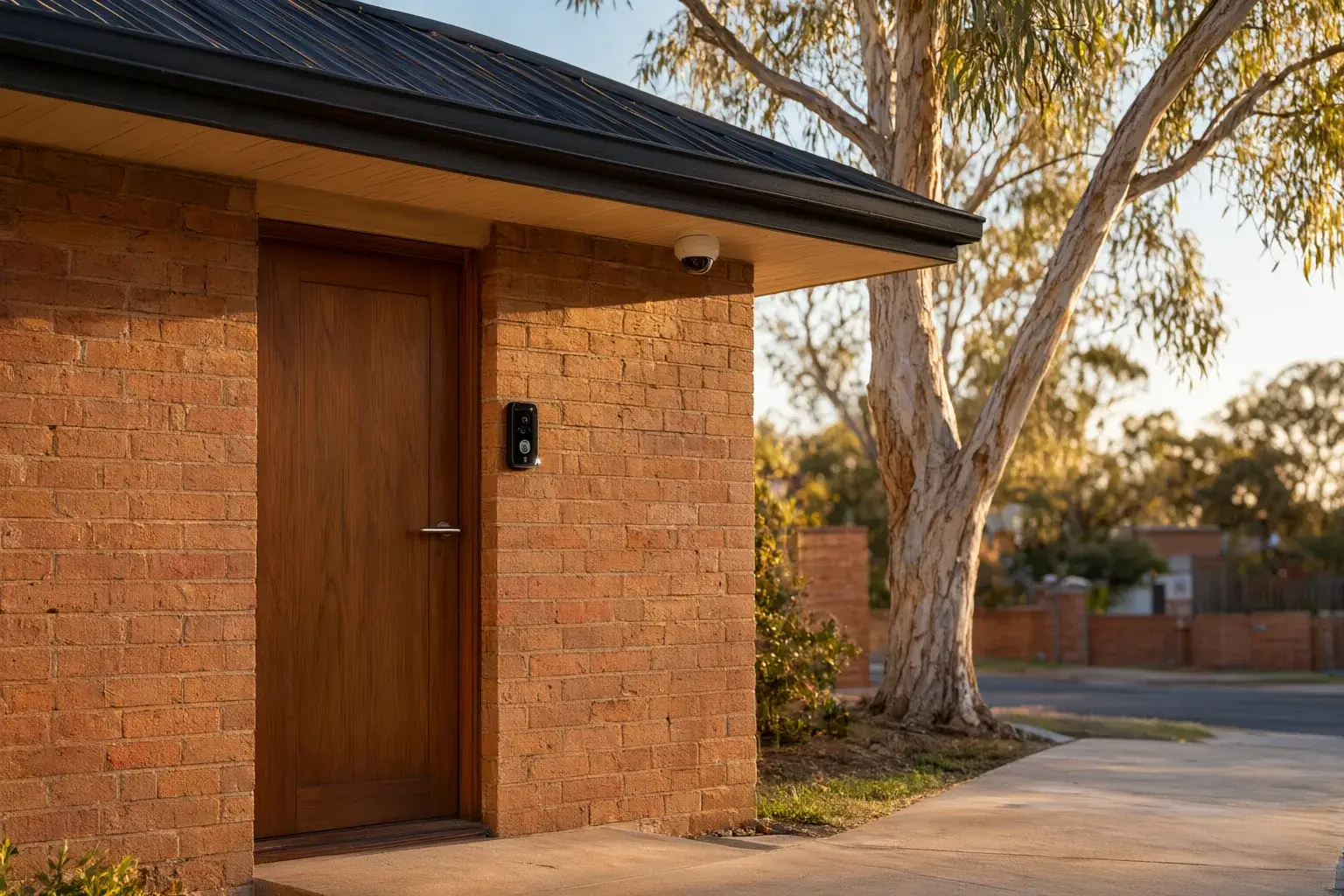
For most Australian homes, the best front door security is both devices working together: a video doorbell to see and speak with visitors at the doorstep, plus a professionally installed CCTV camera watching the whole approach — driveway, path and street — recording continuously to a local recorder. A doorbell alone covers about one square metre of wall; a correctly positioned PoE camera covers your entire frontage.
That's the short answer. The rest of this guide explains why the two technologies do such different jobs, where consumer doorbells fall short in Australian conditions, what a full system costs, and how to decide what your property genuinely needs.
Why Your Front Door Is More Than an Entry Point
Across New South Wales, the front door remains one of the most common points of entry in residential break-ins. It's also the stage for a surprising amount of everyday friction: stolen parcels left on the porch, doorknockers pushing questionable deals, and unwanted visitors testing whether anyone is home.
This is why video doorbells have become so popular. They're inexpensive, simple to mount, and ping your phone the moment someone appears. But popularity has created a widespread misconception — that a $200 gadget stuck beside the doorframe constitutes a [[how-many-cameras-does-the-average-australian-home-actually-need|security]] system. In reality, a doorbell camera and a full CCTV installation solve different problems, and confusing the two can leave serious blind spots right where you're most vulnerable.
Where Do Video Doorbells Genuinely Shine?
Let's be fair to doorbells: they do several things remarkably well. When the button is pressed or motion is detected, you receive an instant notification and can view live video and hold a conversation from anywhere — whether you're cooking dinner or travelling interstate. For managing courier deliveries, checking on tradies, and screening strangers before opening the door, nothing beats them for convenience.
Current-generation models offer high-definition video, infrared night vision and increasingly clever person detection. Premium units from professional brands can also tie into wider security platforms. The limitations, though, are structural rather than fixable with software updates: a wide fisheye lens tuned for close-up faces, total dependence on your home Wi-Fi network, clip-based recording triggered by motion rather than continuous capture, and cloud storage that generally locks your own footage behind a recurring subscription fee.
The practical consequence? If someone approaches along the side of the house, moves quickly through the frame, or your Wi-Fi hiccups at the wrong moment, the doorbell simply never captures it.
How Does a Full CCTV System Watch Your Whole Approach?
A professionally installed CCTV system flips the perspective entirely. Rather than staring at the doorstep, a dedicated camera mounted under the eaves or on the fascia surveys everything leading up to it — the driveway, the front path, the nature strip and frequently part of the street. You can see who walked up, which direction they came from, what vehicle they arrived in, and how they left.
These cameras connect via Power over Ethernet (PoE) cabling back to a network video recorder (NVR), which means no batteries to recharge, no reliance on wireless signal, and continuous 24/7 recording stored locally on hardware you own. There are no monthly cloud fees, and your footage never leaves your premises unless you choose to share it.
Modern professional cameras also outperform doorbells after dark. Technologies such as Hikvision ColorVu capture full-colour video in near-darkness, while AcuSense-style intelligent detection distinguishes people and vehicles from spiders, rain, swaying branches and passing headlights — so you get alerts that matter instead of constant false alarms.
Which Option Wins on Coverage, Recording and Reliability?
When you line the two options up side by side, the trade-off becomes obvious. Doorbells lead on interaction and upfront price; CCTV leads on field of view, evidence quality and dependability. The comparison table below summarises how each performs across the factors that matter most for front door coverage.
Can Consumer Doorbells Survive Australian Conditions?
Much of the doorbell marketing Australians see comes from overseas markets with milder climates, and it rarely mentions local realities. On a scorching summer afternoon, a sun-baked porch can push battery-powered doorbells beyond their rated operating temperatures, triggering shutdowns on 40-degree days precisely when you want them working.
Coastal homeowners face another problem: salt-laden air corrodes exposed terminals and charging contacts on battery models. And inside double-brick or Colorbond-clad homes, Wi-Fi signals degrade badly — particularly when the router sits at the far end of the house from the front door, causing dropped connections and missed events.
Professional-grade cameras from manufacturers like Hikvision, Dahua, Uniview and Axis are engineered for exactly these conditions, carrying IP66 or IP67 weather sealing and operating ranges designed for Australian summers. Just as importantly, a licensed installer positions each camera to avoid morning backlighting and to respect privacy expectations — covering your property without deliberately filming into a neighbour's windows or private outdoor areas.
Should You Run a Video Doorbell and CCTV Together?
After installing security systems across NSW homes and businesses, our consistent finding is that the best front door protection isn't either/or — it's both technologies doing what they're each built for. The video doorbell manages the doorstep interaction: couriers, guests, kids arriving home from school. A dedicated CCTV camera mounted higher up captures the fuller story: the approach, the vehicle, and the person who scoped the property without ever ringing the bell.
That pairing closes the classic gaps. Someone casing your house from the street lands on continuous CCTV recording even if they never approach the door. A parcel snatched minutes after delivery is caught from two angles. And because everything feeds into a single NVR, you review one unified [[from-quote-to-commissioning-what-a-professional-cctv-installation-timeline-looks|timeline]] instead of juggling multiple apps and subscriptions.
Our five-step process — consultation, design, [[the-real-cost-of-a-4-camera-poe-system-installed-in-australia|installation]], configuration and handover with training — means we map your frontage's blind spots before drilling anything, and every job is backed by lifetime support.
Is the Cost of CCTV Worth It Compared to a Doorbell?
Upfront, the doorbell wins on price. A quality DIY unit typically lands between $150 and $400 installed by yourself, though premium wired models and professional fitting push higher. Remember to factor in the subscription: most brands charge a monthly fee to store and review recorded clips, which adds up over the life of the device.
A complete professionally installed CCTV system starts from approximately $1,500, depending on camera count, cable runs and recorder capacity. That figure usually includes design, cabling, mounting, configuration and training — and because footage stores locally on your NVR, there's no ongoing cost. Over five years, the gap between the two options narrows considerably once subscription fees are counted.
Are You Making the Right Call for Your Property?
If money is tight and your priority is answering the door remotely, a reputable video doorbell is a sensible first step. But if your goal is genuine security — deterring break-ins, capturing court-usable evidence and eliminating blind spots across your frontage — a professionally installed CCTV system is the stronger investment, and often more affordable than people assume.
Aussie CCTV Cams is fully licensed and insured in NSW, and we design front door security around your specific block: layout, lighting, Wi-Fi realities and privacy obligations. Request a free quote and we'll walk you through exactly what coverage your front door needs — straightforward advice, no pressure.
Front Door Security Compared: Video Doorbell vs Professionally Installed CCTV
| Feature | Video Doorbell | Full CCTV Camera (PoE) |
|---|---|---|
| Field of view | Narrow, doorstep only | Wide — approach, driveway and street |
| Recording | Motion-triggered clips | Continuous 24/7 recording |
| Power | Battery or low-voltage wiring | Hardwired PoE — no charging |
| Storage | Cloud, monthly subscription | Local NVR, no ongoing fees |
| Night performance | Basic infrared, faces only | ColorVu full-colour night video |
| Weather durability | Limited in extreme heat | IP66/IP67 rated for Aussie conditions |
| Two-way talk | Yes — built for it | Available on select models |
| Typical installed cost | $150–$400 DIY | From ~$1,500 for a full system |