
Key Takeaways
- Correct security camera placement at 2.5-3m height captures faces, while mounts above 3.5m record only heads—a fix that costs nothing extra.
- ABS break-in data shows offenders favour rear doors and side access, so entry point coverage must prioritise concealed approaches first.
- Corner mounting with a 90-110 degree lens lets one camera watch two directions, cutting typical Newcastle install quotes by up to 40%.
- ANPR plate capture on driveways needs specific geometry; getting it wrong is the top reason Adelaide homeowners get unusable footage.
- A professional site assessment takes just 30-45 minutes and routinely saves clients thousands in unnecessary equipment under Australian conditions.
- Visible cameras deter around 60% of opportunistic burglars, making obvious placement at entries more effective than hidden units.
Where Should You Put Security Cameras? The Short Answer
Position security cameras at the five locations every intruder must pass through or target: the front door, the driveway, the back door, side gates and access paths, and ground-floor windows hidden from street view. Mount each camera between 2.5 and 3 metres high, angled slightly downward at roughly 15-20 degrees so you capture faces rather than the tops of heads.
Done properly, this approach means most Australian homes are fully covered by four to six cameras. The alternative—buying a big DIY kit and spreading cameras evenly around the house—almost always leaves genuine gaps at the exact points burglars use while wasting budget on zones nobody enters.
Why Placement Beats Camera Count Every Time
Walk down any hardware aisle in Australia and you'll find eight and twelve camera kits promising total home [[poe-vs-wi-fi-cameras-which-is-better-for-australian-homes|security]] at tempting prices. Yet our installers regularly attend Sydney properties with ten or more cameras mounted that still fail to record a clear image of anyone who actually entered the home. The equipment wasn't the problem—the positioning was.
After thousands of installations across NSW, we've found that understanding how intruders approach a property matters far more than the number of lenses on the wall. Burglars follow predictable patterns: they avoid street visibility, they favour concealed side and rear access, and they test whether anyone is home before committing. Cameras placed at these natural choke points capture useful evidence; cameras scattered across rooflines and garden beds mostly record birds and passing clouds.
Poor placement also creates expensive downstream costs. We've been called to fix systems where cameras stare into the afternoon sun, sit so high they only show hat brims, or bounce infrared light off eaves into a white-out every night. In many of those cases the homeowner ends up paying twice—once for the original kit and again for professional reinstallation. Getting the layout right before purchase is always cheaper than correcting it afterwards.
What Are the Five Entry Points That Must Be Covered First?
Australian Bureau of Statistics data on household break-ins shows offenders overwhelmingly use a small set of predictable entry points. Before you think about covering the pool, the shed or the letterbox, make sure these five zones have dedicated coverage. Miss any one of them and your system has a real hole in it, no matter how many other angles you've captured. Aussie CCTV Cams holds the required [[what-is-the-ideal-mounting-height-for-home-security-cameras-in-australia|security]] industry licence under NSW and SA law, ensuring full Privacy Act compliance.
- Front door and porch area—captures faces and deliveries, and deters knockers checking whether anyone is home
- Driveway and garage—records vehicles, number plates and everyone approaching the property
- Back door and patio—frequently the true break-in point while front-facing cameras create false confidence
- Side gates and access paths—the classic route for intruders avoiding street view, especially along Colorbond fence lines
- Ground-floor windows hidden by fences or vegetation—concealed from neighbours and therefore attractive to offenders
How High and at What Angle Should Front Door Cameras Sit?
The front door camera does more work than any other unit in the system. It identifies visitors, records parcel deliveries, deters opportunistic offenders and provides the facial footage police actually want when investigating a break-in. But only if it's positioned correctly.
Mount the camera 2.5 to 3 metres above ground level. At that height it's out of easy reach of tampering yet still angled enough to capture full faces rather than scalps. Tilt it downward approximately 15-20 degrees toward the porch and the approach path. Anything mounted above about 3.5 metres starts capturing the tops of heads, which makes identification effectively impossible.
Resist the temptation to aim the camera straight down the street. Passing headlights will overexpose the sensor at night and half your footage becomes unusable white frames. Cover the porch and the walk-up instead. Modern sensors such as Hikvision's ColorVu maintain full colour recording in very low light, but no technology compensates for a camera pointed at the wrong thing.
Can Corner Mounting Let One Camera Watch Two Directions?
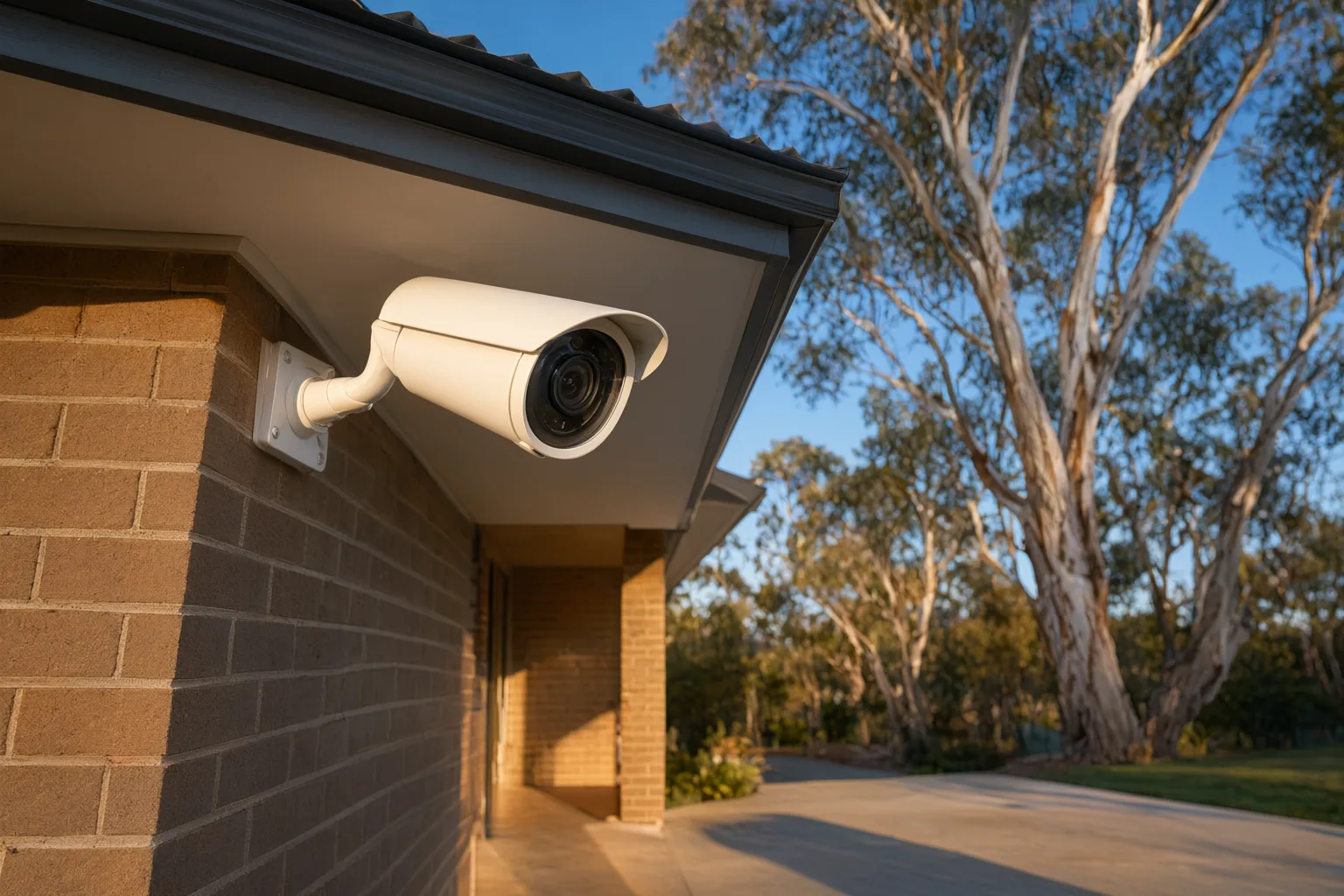
This is where professional design pays for itself. A single camera fixed to the corner of the house can watch two directions at once—the driveway and front path together, or the back patio and side gate together. On typical Australian brick veneer homes, external corners provide strong, natural mounting points that suit this technique perfectly.
Position the unit at the corner junction with a field of view of roughly 90 degrees spanning both approaches. One quality wide-angle camera doing double duty replaces two cheaper units pointed at each direction separately, halving cabling, [[installing-cctv-on-a-double-storey-home-ladders-heights-and-safety-rules|installation]] time and ongoing maintenance.
We generally specify varifocal lenses for corner positions because they allow the field of view to be adjusted on site during installation. Every property has its own quirks—a water tank here, a carport there—and varifocal optics let us fine-tune coverage to eliminate the specific blind spots of your layout. Fixed-lens consumer cameras lock you into whatever angle the manufacturer guessed at in a factory overseas.
Do Driveway Cameras Really Capture Number Plates With ANPR?
A driveway camera performs two jobs simultaneously: it records every person approaching the home and it captures the number plates of vehicles entering the property. Plate capture demands stricter geometry than general surveillance, and getting it wrong is one of the most common reasons ANPR footage disappoints.
For reliable number plate recognition, position the camera 3-5 metres back from where vehicles stop, with the lens angled no more than 30 degrees off the plate's plane. Mount it at 2-2.5 metres height, tilted slightly down toward the natural pause point of the driveway. Mount too high or too distant and even a dedicated ANPR bullet camera cannot resolve plates reliably, day or night.
Many Australian homes have garages set well back from the street, with the driveway funnelling vehicles along a single predictable line. That funnel is a gift—one well-placed camera catches every vehicle and pedestrian using it. Add a second unit over the garage door itself and the entire zone is secured with just two cameras.
Are Rear and Side Access Points the Vulnerabilities Everyone Forgets?
While homeowners obsess over the front door, experienced burglars head straight for the back. Rear doors, patios and side passages offer concealment from both the street and neighbouring properties, which is precisely why they feature so heavily in Australian break-in statistics.
Side gates deserve particular attention. Colorbond fencing creates narrow, private corridors running directly from the front boundary to the rear of the property—an offender's highway. A camera mounted high enough to see over the fence line, angled to catch faces as people move along the path toward the back door, closes this gap completely.
At the rear, outdoor furniture, clotheslines and BBQ areas frequently obstruct sight lines. Our usual solution is mounting under the eaves at the rear corner of the house, giving overlapping coverage of both the back door and the whole patio area. This position also shields the camera from harsh western afternoon sun and storm-driven rain, extending its working life considerably.
Should You Avoid These Six Placement Mistakes That Waste Money?
The same errors appear again and again in DIY installations we're asked to rescue. Each one degrades footage quality, and several force a complete reinstallation. If you take nothing else from this guide, avoid the following.
- Mounting too high—anything above 3.5 metres captures crowns of heads, not identifiable faces
- Facing direct sunlight—afternoon sun blinds sensors and produces washed-out, unusable video
- Ignoring infrared reflection—cameras tucked under eaves can bounce IR light off soffits, whiting out the entire night image
- Asking one camera to cover too much—ultra-wide angles destroy detail and make identification impossible
- Forgetting vegetation growth—that small shrub beside the camera will block the view within 18 months
- Mounting within reach—anything below 2.5 metres can be tampered with, covered or disabled
What Does a Professional Site Assessment Cover?
Every Aussie CCTV Cams job begins with a full site assessment. We walk the property with you, mapping entry points, sight lines, lighting conditions and obstructions. It takes 30-45 minutes and routinely saves clients thousands of dollars in unnecessary equipment.
We assess factors most homeowners never consider: the sun's track across the block through the day, how street lighting interacts with night vision modes, where the NBN connection point sits relative to cable runs, and how to keep visible wiring to a minimum on brick veneer and weatherboard homes. Just as importantly, we identify which areas genuinely need a dedicated camera and which can be covered incidentally through smarter placement of fewer units.
Australian conditions also shape our specifications. Coastal salt air corrodes inferior housings, bushfire-prone zones demand specific cable protection, and storm-exposed sites need reinforced mounts. We install professional-grade Hikvision, Dahua or Uniview equipment rated for these environments—not consumer kits designed for milder climates elsewhere in the world.
Is Getting It Right the First Time Possible?
Good camera placement isn't about blanketing every square metre of the block. It's about identifying the natural choke points—doorways, gates, driveways and paths—where anyone entering your property must pass, and putting quality glass on those points. Fewer cameras, lower installation cost, simpler maintenance and better actual security.
Our five-step process locks placement decisions in before a single hole is drilled. We consult on your specific concerns, design a coverage plan showing exactly what each camera will capture, install with minimal disruption, configure remote viewing and alerts on your phone, then walk you through operating the whole system until you're confident with it.
Whether you're protecting a suburban family home or a rural property outside Tamworth, the principles are identical. Contact Aussie CCTV Cams for a free site assessment and quote—we'll show you precisely where each camera should go, and why.
Which Security Camera Placement Suits Your Home Best?
Camera Placement Guide by Entry Point
| Entry Point | Mounting Height | Camera Type | Field of View | Special Features |
|---|---|---|---|---|
| Front Door | 2.5-3 metres | ColorVu bullet or turret | 90-110 degrees | Full colour night vision, two-way audio |
| Driveway | 2-2.5 metres | ANPR bullet camera | 60-90 degrees | Number plate recognition, 30m IR range |
| Back Door | 2.5-3 metres | AcuSense turret | 90-110 degrees | Human/vehicle detection, smart alerts |
| Side Gate | 2.5-3 metres | Wide-angle bullet | 110-130 degrees | Weatherproof IP67, vandal-resistant |
| Garage | 2.5-3 metres | Varifocal turret | Adjustable 30-110 degrees | Zoom lens, Starlight low-light sensor |