
Key Takeaways
- Cheap CCTV kits rarely stay cheap — hidden costs push five-year spend past $1,800–$3,000 AUD
- Professional CCTV installation in Newcastle NSW typically costs $2,200–$4,500 fully installed
- Australian heat, coastal salt air and storms destroy consumer-grade cameras faster than most buyers expect
- NSW Police often can't use grainy budget footage as evidence under evidentiary standards
- Licensed installers ensure compliance with the Privacy Act 1988 and state surveillance laws
How Much Does a Cheap CCTV Kit Really Cost Over Five Years Compared to Professional Installation?
The short answer is that cheap CCTV kits usually cost Australian homeowners more than professional installation within three years. A $600 four-camera kit from a big-box retailer looks like a bargain beside a $3,000 professionally installed system, but replacement cameras, failed hard drives, cloud subscription fees and unusable footage quietly erode those savings. For homes and businesses in Newcastle NSW and Adelaide SA, the true comparison is total cost of ownership — not the sticker price on the shelf.
This article breaks down exactly where that hidden cost comes from, why Australian conditions are particularly brutal on consumer-grade cameras, and how to spend once instead of twice.
Why Isn't a $500 CCTV Kit Really a $500 Purchase for Australian Homes?
Walk into any electronics retailer or scroll an online marketplace and you'll find four-camera security kits for a few hundred dollars, complete with a recorder, phone app and promises of full HD coverage. Next to a professional [[diy-vs-professional-cctv-installation-real-cost-comparison-for-australians|installation]] quote, the maths looks like a no-brainer: save yourself well over a grand and do it in an afternoon.
The problem is that this comparison only counts the first purchase. Budget security cameras are consumables, not investments. Consumer components aren't engineered for what an Australian summer does to a sun-facing wall, and most owners discover this not through a warning light or an error message, but through a break-in — when they go looking for footage and find either nothing recorded or an unidentifiable blur where a face should be.
That's the crucial difference between a cheap appliance failing and a cheap security [[how-much-does-a-4-camera-cctv-system-cost-in-australia|system]] failing. A kettle dying is annoying; a security system dying silently is a hole in your protection you don't know exists until the moment you need it most.
So the real question isn't "$500 or $2,000?" It's: "What will I spend keeping cameras alive and useful for five years?" On that measure, the bargain kit loses almost every time.
What Are the Six Ways Budget Camera Kits Fail Their Owners?
Before looking at dollar figures, it's worth understanding precisely how these systems let people down. The failure modes are consistent enough that experienced installers can predict them before opening the box.
- Hardware cooked by heat and corrosion: consumer components typically survive just 18–24 months against Australian summer temperatures, humidity and coastal salt air
- Footage that identifies nobody: low-resolution sensors paired with weak infrared produce images police can't use to confirm a face or read a plate
- Support that vanishes overnight: when an overseas brand abandons an app or shuts down cloud servers, otherwise-working cameras become ornaments
- An open door for hackers: default passwords and unpatched firmware on cheap cameras are a well-documented entry point into home networks
- Insurance friction: claims supported only by poor-quality or non-compliant footage can attract questions from insurers at the worst possible time
- Lost weekends: chasing Wi-Fi dropouts, re-pairing cameras and climbing ladders to power-cycle units becomes an unpaid second job
Can Australian Conditions Destroy Consumer-Grade Cameras in Newcastle and Adelaide?
Australia is one of the hardest places on earth to run cheap electronics outdoors, and most buyers never factor this in.
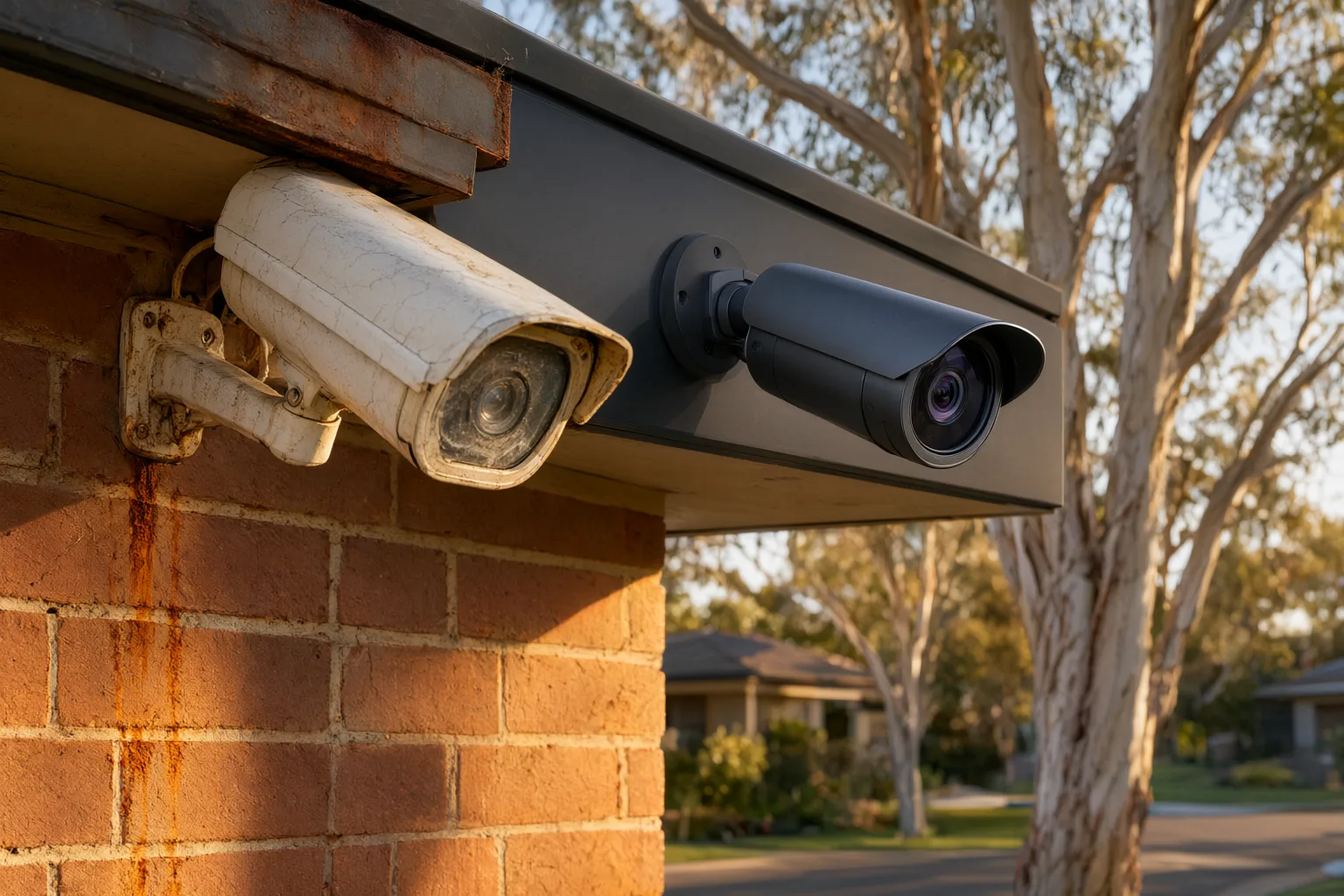
Start with heat. On a January afternoon, the surface of a west-facing wall can push past 60°C, and a plastic-housed camera bolted to it has nowhere to shed that heat. Internal components rated for temperate European conditions degrade quickly: lenses fog from the inside, solder joints fatigue, and infrared emitters dim until night vision is effectively gone. Most failures land just outside the short warranty window — often 90 days to a year — which is not a coincidence but a design outcome.
Then there's moisture and salt. Humidity works its way into connectors, and within a few kilometres of the coast, salt air corrodes terminals and mounting brackets at a pace that surprises inland buyers. A camera that looked fine in autumn can be dead by the following summer.
Finally, there's the software side. Many budget kits depend entirely on overseas cloud infrastructure and apps. When the manufacturer loses interest — which happens regularly in the ultra-cheap segment — remote viewing stops working and firmware updates stop arriving, leaving cameras exposed and half-functional even if the hardware survives.
Professional-grade equipment is specified differently: metal housings with IP66/67 weather ratings, components rated for extended temperature ranges, and firmware support that continues for years. That's why a quality system measures its lifespan in five to eight years rather than eighteen months.
Is Budget CCTV Footage Usable by Police in NSW or South Australia?
Often, no — and this is where the false economy bites hardest. NSW Police regularly receive footage from budget systems that's too grainy to identify a face or a number plate. Low-resolution sensors, aggressive compression and weak infrared combine to produce images that technically "captured" the intruder but prove nothing.
Professional cameras solve this with better sensors and dedicated low-light technology such as ColorVu or Starlight imaging, which produce genuinely identifiable colour images after dark. Combined with correct camera placement — angles chosen for identification rather than just coverage — the footage becomes evidence instead of a disappointment.
Insurers follow similar logic. If a claim rests on footage that's ambiguous or comes from a non-compliant setup, expect questions. Clear, timestamped, correctly stored recordings from a reputable system make the claims process dramatically smoother.
Do Cheap Wi-Fi Cameras Create Security Risks for Your Home Network?
Yes, and it's one of the least-discussed costs of going cheap. Budget cameras frequently ship with default passwords, firmware that never receives patches, and video routed through overseas cloud servers. Security researchers have repeatedly demonstrated how easily these devices are compromised — and once a camera is on your network, it can be a stepping stone to everything else connected to it.
Professionally installed systems take a different approach: wired PoE cabling instead of vulnerable wireless links, network hardening during setup, and reputable brands that ship ongoing firmware updates. You're not just buying better images; you're buying a smaller attack surface.
Which CCTV Brands and Setups Survive Australian Conditions Best?
You don't need the most expensive system on the market — you need the right equipment, installed properly. Three decisions make almost all the difference.
First, choose proven professional brands with Australian warranty backing. Hikvision, Dahua, Uniview and Axis all maintain local distribution networks and multi-year warranties, so support is a phone call away rather than an email into the void. Look for IP66/67 weather ratings, smart detection features such as AcuSense person and vehicle analytics, and strong low-light performance.
Second, insist on a licensed installer. In NSW, that means a current security licence and appropriate insurance. A licensed installer also gives you something a box kit never will: a written design explaining the purpose of every camera position, tuned motion detection that doesn't ping you every time a possum crosses the driveway, surge protection, and secure remote access configured correctly from day one.
Third, judge the purchase on total cost of ownership, not shelf price. A quality four-camera system with a 3-year warranty, lifetime installer support and footage that genuinely identifies people costs less across five years than buying bargain kits twice — and unlike the cheap kit, it's protecting you continuously throughout those five years rather than sitting dead above the garage door waiting for its replacement.
Aussie CCTV Cams provides free, no-obligation quotes across NSW. We assess your property, recommend professional-grade equipment matched to your budget and conditions, and back every job with our 5-step installation process and lifetime support. That's the difference between buying cameras and buying security.
Should You Choose Professional CCTV Installation Over a DIY Kit in Newcastle or Adelaide?
Let's put real numbers against each path. A typical cheap CCTV kit purchase in Australia breaks down like this: $500–$900 for the kit itself, $150–$300 for cabling, mounts and a larger storage drive, $100–$250 for cloud subscriptions if you want off-site backup, and $400–$1,200 in replacements when cameras die from heat or moisture. Over five years, many owners report spending $1,800–$3,000 — sometimes more than a professional system would have cost on day one.
Professional installation pricing in [[/newcastle|Newcastle]] NSW generally sits between $2,200 and $4,500 for a quality four-to-eight camera system, depending on cable runs, roof access and whether you need commercial-grade recording equipment. In [[/adelaide|Adelaide]] SA, similar systems typically quote between $2,100 and $4,300. That figure includes licensed labour, weatherproof cabling through eaves and brick walls, correct camera placement, configuration, and a warranty that actually means something when something fails.
There's also the compliance angle many buyers overlook entirely. Under the Surveillance Devices Act 2007 (NSW) and the Surveillance Devices Act 2016 (SA), cameras pointed at neighbouring properties, shared strata areas or public footpaths can create legal exposure for property owners. The Privacy Act 1988 adds obligations for businesses capturing footage of customers or staff. A licensed installer knows where cameras can legally point; a DIY buyer usually finds out after a complaint arrives.
Insurance outcomes differ sharply too. Several Australian insurers now ask whether security systems were professionally installed when assessing break-in claims. Footage from a properly positioned, correctly configured system supports a claim; grainy footage from a misaligned budget camera may not. Some policies even offer [[budget-vs-premium-cctv-is-it-worth-spending-more-on-security-cameras|premium]] discounts for monitored, professionally installed systems — savings that offset a meaningful slice of the installation cost every single year.
For business owners the maths tilts further toward professional installation. Retail shops, warehouses and commercial properties face workplace surveillance obligations under the Workplace Surveillance Act 2005 (NSW), requiring proper signage and notification. A cheap kit slapped above a stockroom door can breach these requirements and expose the business to penalties. Professional installers document compliance as part of the job, which matters enormously if footage is ever needed in a dispute or Fair Work matter.
Finally, consider what you're actually buying with professional installation: expertise. An experienced installer assesses sight lines, night-time lighting, blind spots created by gutters and eaves, and the coastal corrosion risks specific to Newcastle's salt air or Adelaide's dry summer heat. They mount cameras under eaves where possible, seal penetrations against storm-driven rain, and position recorders away from heat. That site-specific judgement is precisely what no boxed kit includes — and it's the difference between footage you can use and footage you can't.
Five-Year Cost Comparison: Cheap CCTV Kits vs Professional Installation in Australia
| Option | Upfront Cost (AUD) | Typical 5-Year Total |
|---|---|---|
| $500–$900 retail DIY kit | $500–$900 | $1,800–$3,000 incl. replacements |
| Premium DIY kit + cloud plan | $1,200–$1,800 | $2,400–$3,600 incl. subscriptions |
| Professional install – home (Newcastle/Adelaide) | $2,200–$3,500 | $2,400–$3,800 incl. servicing |
| Professional install – commercial | $4,000–$8,000+ | $4,500–$9,500 incl. maintenance |