
Key Takeaways
- A professionally installed solar CCTV system in Australia typically costs $900–$2,500 per camera including panel, battery and mounting.
- Solar beats wired on cost only when trenching or long cable runs would otherwise be required.
- Quality lithium batteries sized for three cloudy days handle Australian winters, coastal storms and summer heat.
- Payback usually lands between 3–6 years versus wired systems needing electricians and trenching.
- Licensed installers must comply with the Privacy Act 1988 and state surveillance laws in NSW and South Australia.
Are Solar-Powered CCTV Cameras Worth It in Australia?
The short answer is that solar CCTV cameras are worth it for most Australian properties without mains power within reach, and often the only sensible option at all. A professionally installed solar camera system in Newcastle NSW or Adelaide SA typically costs $900–$2,500 per camera, runs entirely off-grid, and avoids the trenching, electrician call-outs and ongoing power draw of a wired setup.
The short answer to the payback question: most quality solar systems recover their premium within two to four years on unpowered sites, and they keep recording through blackouts and storms when wired systems go dark. Where the maths changes is the well-serviced suburban home, where cheap mains power and easy roof access usually make a wired PoE system better value. This guide breaks down both scenarios with real installed prices.
What Does Solar CCTV Cost to Install in Australia in 2025?
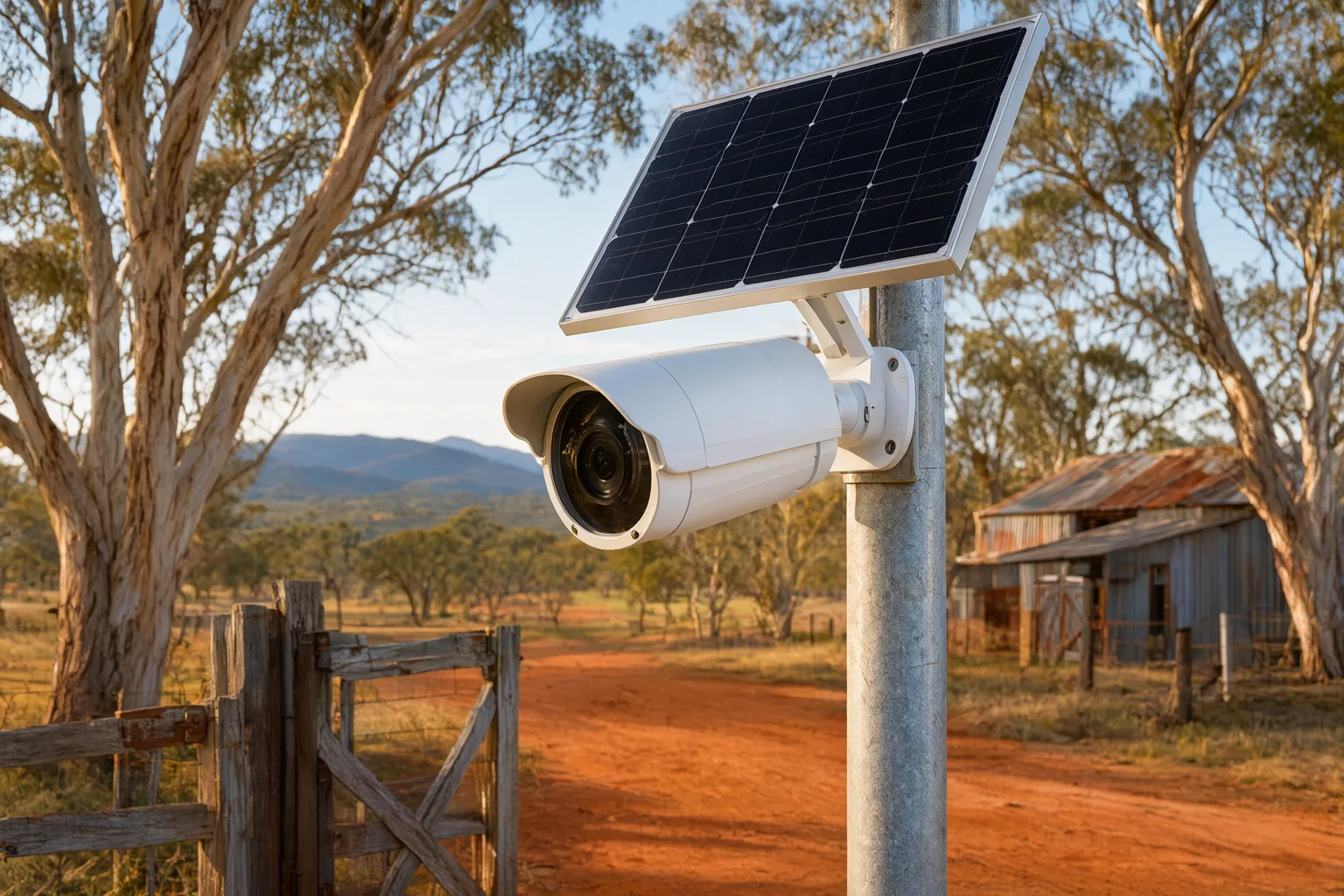
A solar [[axis-cameras-why-premium-cctv-costs-more-and-when-its-worth-it|camera]] system is really three products bundled together: the camera, the power system (panel, battery and charge controller), and often a 4G modem for sites beyond NBN reach. Pricing reflects all three.
As a realistic guide, one professional-grade 4G solar camera, installed, starts around $600 to $900. A two-camera configuration with a larger panel and battery bank generally lands between $1,500 and $2,500. A four-camera [[how-much-does-a-4-camera-cctv-system-cost-in-australia|system]] covering a farm gate, machinery shed and driveway typically reaches $3,500 to $4,500 or more.
Online marketplaces advertise DIY solar cameras for $100 to $300, and it is worth understanding why these are false economy in Australian conditions. Thin batteries degrade quickly in 40-degree heat, undersized panels struggle through winter, and app support frequently vanishes within a year. Professional systems from brands like Hikvision, Dahua and Uniview use lithium cells rated for thousands of charge cycles, monocrystalline panels sized for Australian latitude, and IP66 or IP67 housings that handle dust, storms and coastal salt air.
Which Costs More Upfront: Solar vs Wired CCTV Systems?
In a standard suburban setting, solar is the pricier option. A wired four-camera PoE system on a brick veneer home with straightforward roof access might cost $2,000 to $3,000 installed. A comparable solar setup pushes $3,000 to $4,500, because you are paying for the panel, battery, charge controller and weatherproof enclosure on top of the camera, plus the extra labour to mount and orient the panel correctly.
That comparison inverts completely where power doesn't exist. Running mains electricity to a farm gate 200 metres from the house can cost $2,000 to $5,000 in trenching and electrical work alone — before a single camera is installed. Construction sites face the same problem: temporary power poles, electrician callouts and cable protection add up quickly, and everything has to be redone when the project moves.
On those sites, solar is not the expensive choice — it is the only economical one. The same logic applies to rural sheds, stockyards, water tanks, boat ramps and holiday houses where mains power simply isn't available.
How Much Can You Save with Solar CCTV Over Time?
The long-term savings case rests on four pillars, and the first is the most obvious: zero electricity costs. A wired system drawing 30 to 60 watts continuously adds roughly $80 to $150 per year to your power bill. Solar eliminates that entirely.
Second, there is no cabling infrastructure to pay for. Trenching, conduit and electrician fees are one-off costs that solar customers never incur — and on remote sites those costs are often the largest line item in a wired quote.
Third, solar cameras are portable. When a construction project moves to its next stage, or a farm's risk area shifts to a different paddock, a solar camera relocates with a spanner and an hour's labour. A wired camera needs a rewire.
Fourth — and most overlooked — is continuity during outages. Wired systems die the moment power drops unless you have invested in a UPS. A correctly sized solar system with three to five days of battery autonomy keeps recording through blackouts, storms and the grid failures that often accompany bushfire weather, which is precisely when [[price-per-camera-explained-what-australian-homeowners-should-expect-to-pay|security]] footage matters most.
Over a ten-year lifespan, these savings typically recover the solar premium two to three times over on unpowered sites, and break even within about four years even where mains power was already available.
Do Solar vs Wired CCTV Costs Differ by Property Type?
The table below compares realistic installed costs for a typical four-camera system across three common Australian scenarios. Figures assume professional-grade hardware and licensed installation at 2025 pricing.
Is Solar CCTV Reliable Through Australian Winter Conditions?
The difference between a solar camera that runs reliably for a decade and one that frustrates you within months comes down to component sizing, not brand loyalty.
Southern Australia's winters are the real test: days are short and frequently overcast, so the panel must harvest enough energy in four to five hours of weak sun to run the camera for a full 24 hours. That means panels of at least 40 to 60 watts per camera, paired with lithium batteries offering genuine three-to-five-day autonomy — not the optimistic figures printed on consumer packaging.
Summer brings the opposite challenge. Heat degrades cheap cells rapidly, which is why professional systems specify lithium batteries rated for 2,000 or more charge cycles. That translates to roughly five to eight years of daily service, whereas lower-grade cells in budget units often fail within 12 to 24 months in hot Australian conditions.
Can You Size Solar Panels and Batteries for Australian Conditions Yourself?
Because every watt counts on a solar system, camera technology choices directly affect reliability. Look for Starlight or ColorVu sensors, which capture usable colour footage at night without drawing power for spotlights. AcuSense-style AI detection is equally valuable: it distinguishes people and vehicles from swaying branches, cutting false alerts and reducing 4G data consumption at the same time.
Data management deserves particular attention on remote sites. A 4G camera streaming continuously will burn through a mobile plan quickly. Smarter configurations record locally to an SD card or a solar-powered NVR and upload only detection clips, keeping monthly data costs between $10 and $30. For properties without NBN, a 4G model with a SIM plan is usually the most practical remote-viewing option.
Should You Choose Solar CCTV Features Like Starlight Sensors and AI Detection?
Honest advice includes knowing when solar isn't the answer. For a standard suburban home with roof access and power points throughout, a wired PoE system usually remains better value. The upfront solar premium takes much longer to recover when electricity is cheap and already available, and wired systems need no battery maintenance or panel cleaning.
Solar makes clear sense for farms, construction sites, rural sheds, gates, marinas and any location more than about 50 metres from existing power. It is also increasingly chosen by eco-conscious homeowners, rental properties where cabling is impractical, and owners in bushfire-prone areas who value grid independence as a genuine safety feature.
Why Does a Professional Site Assessment Save Money on Solar CCTV?
The smartest first step is a site assessment that prices both wired and solar options honestly for your specific property. A licensed installer will check panel orientation, shading from gum trees or neighbouring buildings, 4G signal strength at the mounting location, and your actual coverage needs before recommending a configuration.
That assessment typically costs nothing and prevents the most expensive mistake in solar security: buying hardware that cannot see through winter because the panel was undersized or installed in shade. Licensed installation also protects your warranty and ensures weatherproofing and panel angles are correct for Australian sun paths, storms and coastal conditions.
For farms, acreage blocks, construction sites, warehouses and rural commercial properties across New South Wales and South Australia, the economics flip decisively toward solar. Running armoured cable 200 metres from the nearest switchboard can add $80–$150 per metre once you account for conduit, trenching through rock or clay, and an electrician's labour under AS/NZS 3000 wiring rules. A single four-camera solar package at $6,000–$9,000 installed frequently undercuts a wired alternative quoted at $15,000 or more purely because of cable distance.
Climate matters more than most buyers expect. Coastal suburbs around [[/newcastle|Newcastle]] face salt-laden air and summer humidity that corrode cheap charge controllers, while [[/adelaide|Adelaide]]'s dry heat regularly pushes roof-mounted equipment past 60°C — temperatures that degrade bargain-bin lithium cells within two seasons. We specify IP66-rated enclosures, marine-grade brackets on brick and Colorbond surfaces, and batteries rated to 60°C discharge so your investment survives storm season and bushfire smoke alike.
Legally, camera placement is not a free-for-all. The Privacy Act 1988 governs how footage of identifiable people may be collected and used by businesses, while the Workplace Surveillance Act 2005 applies to staff areas in NSW workplaces, and South Australia's Surveillance Devices Act restricts recording private conversations. Pointing a camera into a neighbour's yard or over a shared strata boundary can trigger complaints, council disputes or penalties, so professional placement advice protects you as much as the hardware does.
Maintenance is genuinely minimal but not zero. Expect a panel wipe every few months — more often near dusty paddocks or after storms — plus a battery replacement roughly every five to seven years at $250–$500 per unit. Budget this into your payback maths honestly rather than assuming set-and-forget operation, and ask any installer quoting you whether battery replacement is included in their service plan.
Finally, treat quotes sceptically. Some sellers advertise a '$299 solar camera' that ships with a 10-watt panel incapable of sustaining night-time infrared use through a Hunter Valley winter. Ask specifically for panel wattage, battery capacity in watt-hours, expected autonomy in days without sun, and whether 4G data costs are included. A reputable installer will answer all four without hesitation — and if they won't, get a quote elsewhere before committing.
Installed cost comparison: solar vs wired CCTV by property type (four-camera systems, 2025 AUD)
| Property Type | Wired System Cost | Solar System Cost |
|---|---|---|
| Suburban home (Newcastle NSW) | $3,500 – $5,500 | $6,000 – $8,500 |
| Rural farm / acreage | $12,000 – $18,000+ | $6,500 – $9,500 |
| Commercial warehouse / worksite | $8,000 – $14,000 | $7,500 – $12,000 |