
Key Takeaways
- A typical CCTV installation timeline runs two to four weeks from approved quote to fully commissioned system in Newcastle and Adelaide.
- Site walkthroughs, licensed design and equipment sourcing account for most of the wait before install day.
- Installation day itself takes six to eight hours for a standard four-camera home or small business system.
- Testing, training and handover are essential commissioning steps that protect your warranty and footage quality.
- Choosing a licensed installer keeps you compliant with the Privacy Act 1988 and state surveillance laws.
What Happens Between Your CCTV Quote and Commissioning Day?
The short answer is that a professional CCTV installation timeline in Australia typically runs two to four weeks from your first quote to a fully commissioned system. In Newcastle and Adelaide, that window covers the site walkthrough, system design, equipment sourcing, a six-to-eight-hour install day, remote viewing setup, testing and final handover. Rushing any stage usually costs more later.
When people compare quotes, they tend to focus on camera counts and dollar figures. But how an installer structures the job tells you far more about the quality you'll end up with. A rushed one-day installation might get cameras on walls quickly, yet without proper design and testing you're likely to discover blind spots, false alarms and storage problems long after the installer has driven away.
This guide walks through each stage so you know exactly what to expect, what's happening between your approval and installation day, and which questions are worth asking at every point.
Why Does the CCTV Installation Timeline Matter More Than Price?
It's tempting to treat a CCTV purchase like any other retail transaction—pay, receive, done. Security systems don't work that way. The value of a camera system lies almost entirely in decisions made before a single screw is driven: where cameras point, how cables are routed, how motion detection is tuned and whether footage will actually be usable when something goes wrong.
A structured professional process spreads those decisions across several stages. Assessment identifies what needs covering. Design specifies the right gear for each position. Procurement ensures commercial-grade equipment arrives tested and ready. Installation executes the plan. [[what-installers-check-before-leaving-your-property-inside-a-professional-commiss|Commissioning]] proves it all works under real conditions.
Understanding this sequence helps you judge installers fairly. Someone promising same-week [[the-real-cost-of-a-4-camera-poe-system-installed-in-australia|installation]] with off-the-shelf gear isn't necessarily faster—they may simply be skipping steps you'll pay for later. Ask any prospective installer which of these stages they include, and how long each takes them.
How Does a Site Walkthrough Shape Your Newcastle or Adelaide Install?
Before any quote is worth trusting, a licensed installer needs to see your property in person. This isn't a quick look over the fence—it's a systematic evaluation of entry points, lighting conditions, existing infrastructure and the specific risks you want covered.
Expect the conversation to be practical and specific. For homes, that means talking through priorities like front-door package theft, rear laneway visibility or capturing number plates at the driveway. For commercial sites, the discussion shifts to cash handling zones, stock rooms, staff entrances and high-traffic areas. A residential walkthrough generally runs 45 to 90 minutes; complex commercial sites can take half a day or more.
Australian conditions add considerations many overseas guides ignore. Coastal properties need corrosion-resistant housings to survive salt air. Bushfire-prone areas demand careful cable routing and equipment placement. The assessor will also check your NBN connection quality for remote viewing and confirm power availability at each proposed camera position. Getting this groundwork right prevents expensive surprises later—and if an installer offers to quote without visiting, treat that as a warning sign rather than a convenience.
Is Your System Designed Around Your Property or a Package Deal?
With the assessment complete, the installer designs a system matched to your actual needs and budget. A four-camera suburban home has very different requirements from a warehouse needing ANPR cameras at vehicle entries and Starlight-rated cameras for dim storage areas.
Professional designs specify commercial-grade equipment from brands such as Hikvision, Dahua, Uniview and Axis—gear built for Australian conditions rather than retail shelf products. Smart feature selection matters too: AcuSense-style cameras can distinguish people and vehicles from animals and moving foliage, which is the difference between useful alerts and constant notifications about possums.
You'll receive a written proposal detailing camera types, lens specifications, mounting positions, cable routes and NVR capacity, with pricing covering hardware, cabling, labour, configuration and training. This design phase usually takes two to five business days. Once you approve, equipment is ordered and an installation date is locked in. Read the proposal carefully—what's itemised there is your benchmark for what gets delivered.
Which Questions Should You Ask Before Approving a Quote?
Professional-grade security gear isn't stocked at Bunnings. Cameras, recorders and accessories are ordered specifically for your design, which typically takes three to seven business days depending on availability and whether specialised components like ANPR cameras or long-range wireless bridges are required.
Good installers use this waiting period productively. The NVR is pre-configured with your network settings, firmware is updated, and every camera is bench-tested before it ever reaches your property. Larger commercial jobs may involve pre-terminating cables and preparing mounting brackets off-site, which shortens time on your premises considerably.
Ahead of installation day, you'll confirm access arrangements—roof space entry, side gates, someone home during work hours—and for businesses, coordinate timing with operations so disruption is minimised. A short phone call here saves a wasted trip later.
Do Testing and Handover Complete the Commissioning Process?
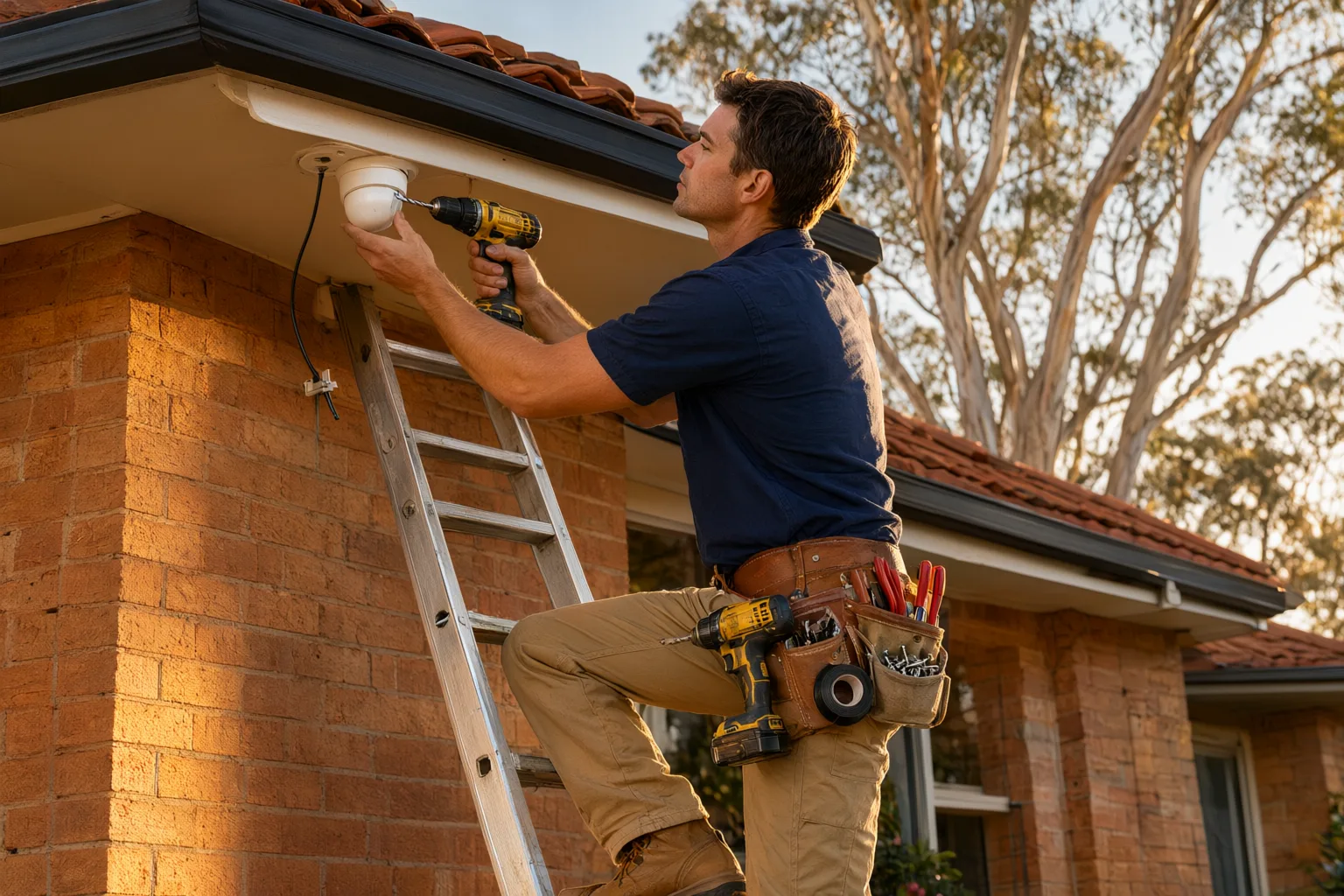
A standard four-camera residential installation takes six to eight hours; larger commercial jobs can run across several days. Installers arrive with everything needed to finish the job in one visit wherever possible.
Camera placement is more technical than it looks. Mounting height is typically set between 2.5 and 3.5 metres—high enough to deter tampering, low enough to capture usable facial detail. Viewing angles, sun glare and weather exposure all influence final positioning, and each camera stays accessible for future maintenance.
Cabling consumes most of the day. Cables are routed through roof cavities and wall spaces, with conduit protecting exposed runs. Every external penetration is sealed against water ingress—a non-negotiable detail heading into storm season. Cable is rated for Australian temperature extremes rather than cheaper imports that degrade in summer heat. Power over Ethernet (PoE) simplifies things further by carrying power and data down a single cable.
Difficult properties—double-brick construction, Colorbond roofs with limited access, detached sheds or gates—may call for wireless bridges or 4G cameras instead of long cable runs. Your installer should flag these alternatives during the assessment, not discover them on the day.
Can You Keep Your CCTV Installation Timeline on Track?
With hardware in place, the NVR is configured and the system brought online. IP addresses are assigned, recording schedules are set, and video settings are tuned per camera based on its environment.
Motion detection zones are drawn to match your property. A front door camera might alert on any movement while a backyard camera ignores the neighbour's cat but flags human-shaped objects—intelligent filtering that keeps notifications meaningful rather than exhausting.
Remote viewing is configured next: secure app-based access to live feeds and recordings from anywhere, user accounts with appropriate permissions, and testing on your actual devices before the installer leaves. Commercial systems often integrate with access control, alarm panels or intercoms—for example, triggering recording when a door opens or linking cameras to the alarm for video verification.
Are There Ways to Fast-Track Without Skipping Proper Commissioning?
No system is signed off until it's tested against real scenarios: someone approaching the front door, a car entering the driveway, night vision performance after dark. Each camera's field of view is verified against the original design, and recording storage is confirmed working correctly.
Image settings are then fine-tuned per camera—a west-facing lens needs different exposure handling than one watching a shaded entrance. Frame rates, resolution and compression are balanced so you achieve your desired retention period without paying for hard drive capacity you don't need.
Handover includes 30 to 60 minutes of training: viewing live feeds, searching recorded footage, exporting video for police reports, and adjusting basic settings yourself. You receive written documentation covering camera locations, password changes (default passwords are changed with you), warranty details and troubleshooting basics.
Finally, clarify ongoing support. Quality installers offer lifetime support for as long as you own the system—not a 30-day window—along with maintenance guidance such as quarterly lens cleaning and annual hard drive health checks.
Should You Choose a Licensed Installer for Your CCTV Timeline?
Armed with an understanding of the full process, you're in a strong position to vet installers. Ask whether they conduct an on-site assessment before quoting, which brands they specify and why, whether pricing includes configuration and training, and what their support arrangement looks like after handover.
Ask about [[the-ultimate-cctv-commissioning-checklist-for-a-flawless-handover|commissioning]] specifically. An installer who describes motion zone tuning, night vision verification and device testing in detail is one who actually performs them. Vague answers like 'we'll set everything up' deserve follow-up questions.
Finally, ask for the documentation list in writing: camera location map, cable routes, passwords changed from defaults, warranty terms and retention settings. A professional won't blink at this request—an amateur will.
Are There Ways to Keep Your CCTV Installation Timeline on Track?
While most delays come from equipment availability or scheduling, there are practical things you can do to keep things moving. Be decisive when reviewing the design proposal—each round of revisions adds days. Confirm access arrangements early, including pets, parking and any landlord permissions needed for strata or rental properties.
For businesses, nominate a single decision-maker so sign-offs don't stall, and brief staff about the installation window. For homes, clear roof access and note anything the assessor should know, like recent renovations or planned extensions that could affect cable routes.
Handled well, the whole journey—from first call to pressing record on your own phone—is measured in weeks, not months, and ends with a system you actually understand how to use.
Should You Fast-Track a CCTV Install or Wait for Proper Commissioning?
Why Does a Licensed Installer Matter for Your CCTV Timeline in Australia?
Weather plays a bigger role than most property owners expect. Coastal suburbs like Merewether and Glenelg expose cameras to salt air and storm fronts, so installers schedule external cabling runs for dry days and specify marine-grade housings. In summer, roof cavities across both cities regularly exceed 50 degrees Celsius, which is why professional installs route cable through shaded eaves rather than sun-baked tile lines wherever possible.
Budget clarity helps too. A quality four-camera residential package in [[/newcastle|Newcastle]] or [[/adelaide|Adelaide]] typically lands between $1,800 and $3,500 installed, while commercial warehouse or retail fit-outs with sixteen-plus cameras commonly range from $6,000 to $15,000 depending on cabling distance and storage requirements. Getting a detailed written quote after the walkthrough locks these figures in and prevents mid-project variations.
Licensing matters at every stage of the timeline. Installers working on security systems in South Australia must hold an appropriate security agent licence under the Security and Investigation Industry Act 1995, while NSW technicians carry equivalent security licensing. Using an unlicensed operator risks voided warranties, non-compliant camera placement under the Privacy Act 1988, and footage that may be inadmissible if you ever need it as evidence.
Finally, plan around your own availability. You do not need to hover over the crew all day, but someone should be reachable at the start for access decisions and at the end for the training walkthrough. Booking a Tuesday-to-Thursday slot often avoids Monday backlog delays and Friday rush compressions, keeping your overall timeline tighter by a day or two.
Comparing CCTV installation options for Newcastle and Adelaide properties
| Option | Typical Timeline | Best Suited To |
|---|---|---|
| DIY kit self-install | 1–2 days, no commissioning | Tech-savvy renters wanting basic coverage |
| Professional 4-camera install | 2–3 weeks quote to handover | Homes and small retail shops |
| Commercial multi-camera system | 3–6 weeks incl. design phase | Warehouses, offices, farms, large sites |
| Monitored security package | 2–4 weeks plus monitoring contract | Businesses needing after-hours response |