
Key Takeaways
- Always verify the installer holds a current security licence — a NSW master licence through SLED for Newcastle, or registration under South Australia's Security and Investigation Agents Act 1995 for Adelaide.
- Insist on an on-site inspection and an itemised written quote naming exact camera models, storage sizing and cable runs before committing.
- Commercial-grade brands like Hikvision, Dahua, Uniview and Axis with local warranty support signal a professional operator.
- Confirm footage retention (typically 30–90 days), remote viewing setup and who administers warranty claims at handover.
- Walk away from cash-only operators, day-of-signing pressure and quotes that never name hardware models.
What Should You Check Before Hiring a Commercial CCTV Installer?
The short answer is that a commercial CCTV installer checklist protects your business from costly mistakes before you sign anything. In Australia, vetting an installer means verifying their security licence, demanding an on-site inspection, comparing itemised written quotes and confirming warranty terms in writing. Businesses in Newcastle NSW and Adelaide SA that follow this process typically pay between $2,500 and $15,000 AUD installed — and get systems that actually meet insurer and Privacy Act expectations.
Next, request a certificate of currency for public liability insurance. Around $20 million cover is the professional standard, and it protects your business if an installer damages property, drops equipment through a ceiling tile, or causes an injury on your site. An installer who hesitates to produce the certificate is telling you something important.
Finally, ask how many commercial installations they have completed in your specific industry. Retail, warehousing, construction sites and offices each carry distinct requirements — point-of-sale camera integration for retail, ANPR cameras at vehicle gates for industrial sites, vandal-resistant housings for public-facing areas. A residential-focused operator will learn on your budget.
Why Does Installer Quality Matter More Than Camera Choice?
A [[how-much-does-commercial-cctv-cost-in-australia-a-2025-pricing-guide|commercial CCTV]] system is typically a five-to-ten-year investment touching security, insurance compliance and liability protection. The identical camera model can produce court-usable footage in one installation and grainy, unusable video in another — and the difference comes down to design decisions made by the installer: camera positioning, lens selection, lighting assessment and recorder configuration.
This is why vetting the installer matters more than comparing camera spec sheets. Every year, businesses hand thousands of dollars to unlicensed operators, generalist electricians without surveillance training, or interstate call centres that subcontract to whichever tradie is cheapest that week. The questions in this checklist exist to filter out all three before money changes hands.
Which Hardware Brands Should a Commercial Installer Specify?
Professional installers specify [[cctv-maintenance-schedules-how-often-should-commercial-systems-be-serviced|commercial]]-grade equipment from Hikvision, Dahua, Uniview or Axis. These brands carry Australian distribution, local warranty support and firmware that receives regular security updates — three things grey-imported or marketplace-sourced cameras cannot offer. If a quote lists unbranded cameras or names you would only find on an online marketplace, expect compromises in footage quality, cybersecurity and lifespan.
Ask specifically about technologies matched to your risks rather than accepting a one-size-fits-all camera list. ColorVu or Starlight sensors deliver full-colour footage in dim car parks and loading docks where standard infrared cameras show black-and-white silhouettes. AcuSense AI filters false alarms triggered by animals, foliage and weather. ANPR cameras read number plates at vehicle entry points. PoE (Power over Ethernet) cabling runs power and data over a single cable for cleaner, more reliable installations.
A capable installer will explain why each camera sits where it does — coverage angles, mounting heights, backlight problems from roller doors and glass fronts — before presenting a quote. If they cannot articulate the design logic, they have not done the design.
How Do Australian Conditions Affect CCTV Equipment Selection?
Yes, and it deserves a direct question during vetting. Coastal businesses face corrosion from salt air, so housings and mounts need appropriate corrosion resistance. Western Sydney warehouses routinely see summer temperatures above 45°C inside metal roofs, which pushes cheap electronics past their rated limits. Sites in bushfire-prone areas may need hardened cabling paths and ember-aware mounting decisions.
An installer who raises these factors unprompted has thought about your site's longevity. One who installs generic indoor-rated gear outdoors because 'it usually works' is setting up a warranty dispute two summers from now. Make environmental suitability an explicit line item in your written quote.
Can You Trust a Quote Without an On-Site Inspection?
The process itself tells you as much as the price. A professional sequence runs: initial consultation, on-site inspection and design, itemised written quote, installation, configuration, then handover with training. Phone quotes based on a flat per-camera rate almost always balloon once 'unexpected' cabling runs, switch upgrades or mounting challenges appear — costs a proper site inspection would have identified upfront.
Your itemised quote should name exact camera models, recorder specifications, cable types and quantities, labour breakdown, and any network equipment required. It should also state the footage retention target so the NVR hard drive sizing is transparent. If two quotes differ significantly, compare what is actually listed rather than the bottom-line figure — the cheaper quote frequently achieves its price through fewer cameras, inferior models or unlicensed labour.
Is Warranty and After-Sales Support Included in Your Contract?
Equipment warranties on commercial-grade hardware typically run three years, but the critical question is who handles the claim. The best installers manage warranty replacements end-to-end — you report a fault, they diagnose, swap and reconfigure. Weaker operators hand you a manufacturer's phone number and disappear.
Beyond warranty, ask about ongoing support: configuration changes, remote viewing troubleshooting, password resets and future expansions. Lifetime support for these matters far more than saving a few hundred dollars upfront, because you will want to add cameras, adjust motion detection zones or onboard new staff over the system's life. Check Google reviews specifically for mentions of after-sales service, not just installation-day experiences.
Should Remote Viewing and Footage Storage Be Confirmed Before Handover?
Two configurations must be confirmed before handover. First, storage: most Australian businesses retain footage for 30 to 90 days depending on insurer requirements, industry regulations and incident reporting timeframes. Your installer should size the NVR drives to meet that target and confirm the retention period in writing — not leave it at whatever default the recorder shipped with.
Second, remote viewing: secure access via a phone app should be set up and tested on your actual devices before the installer leaves. That includes proper password hygiene (no factory defaults), firmware updates applied, and a walkthrough showing you how to retrieve and export footage. Export capability matters when police or insurers request clips after an incident.
Are There Red Flags When Comparing Commercial CCTV Quotes?
Several warning signs reliably indicate a risky operator: pressure to sign on the day, cash-only pricing with no paperwork, quotes that never name specific camera models, no mention of licensing, and subcontractors whose identity you cannot verify. A dramatically cheaper quote usually gets there through grey-import hardware with no Australian warranty, fewer cameras than your site genuinely needs, or unlicensed labour.
The right installer welcomes scrutiny. They will walk your site, explain the design in plain English, put everything in writing, and still answer the phone two years later when you want another camera or a changed detection zone. Treat reluctance to document anything as a reason to walk away.
Do You Know How to Compare Two Professional Quotes Fairly?
Once you have two or more compliant quotes, compare them on substance: named camera models and their suitability for each location, storage sizing against your retention target, cabling quality and route planning, warranty terms including who administers claims, and the support commitment after installation. Weight design quality heavily — a slightly dearer quote with better camera placement delivers more usable footage than a cheaper one with gaps over entrances and blind spots at night.
Also weigh local presence. An installer based near your premises can attend faults quickly and knows local conditions. A distant head office subcontracting unknown tradies removes accountability precisely when you need it most.
For Newcastle businesses, confirm your installer's Class 2C security licence through Service NSW's public register, and ask whether they hold current electrical licensing for any hardwired work near switchboards. In Adelaide, check the installer against Consumer and [[future-proofing-your-business-cctv-4k-ai-and-what-comes-next|Business]] Services (CBS) registration under the Security and Investigation Industry Act 1995 (SA). Both checks take minutes online and immediately separate legitimate operators from fly-by-night traders who vanish after taking a deposit.
Pricing transparency is another early signal. Across Australia, expect commercial installations to range from roughly $1,500 for a small four-camera retail fit-out to $10,000+ for multi-storey warehouses or sites requiring fibre runs and enterprise NVRs. A trustworthy quote breaks this down line by line: per-camera supply and labour, cabling, NVR capacity, networking hardware and commissioning. Vague lump sums like 'CCTV package – $4,800' give you no basis for comparison and often hide inferior equipment.
The Privacy Act 1988 (Cth) and state surveillance legislation shape what you can legally record and how footage must be handled. Businesses should not point cameras into neighbouring properties or public toilets, and signage notifying people of recording is best practice in staffed areas. Under the Workplace Surveillance Act 2005 (NSW), employers generally need to notify employees about workplace surveillance, while South Australian businesses should follow equivalent guidance under the Surveillance Devices Act 2016 (SA). Ask prospective installers whether they advise on compliance as part of the design stage — good ones do.
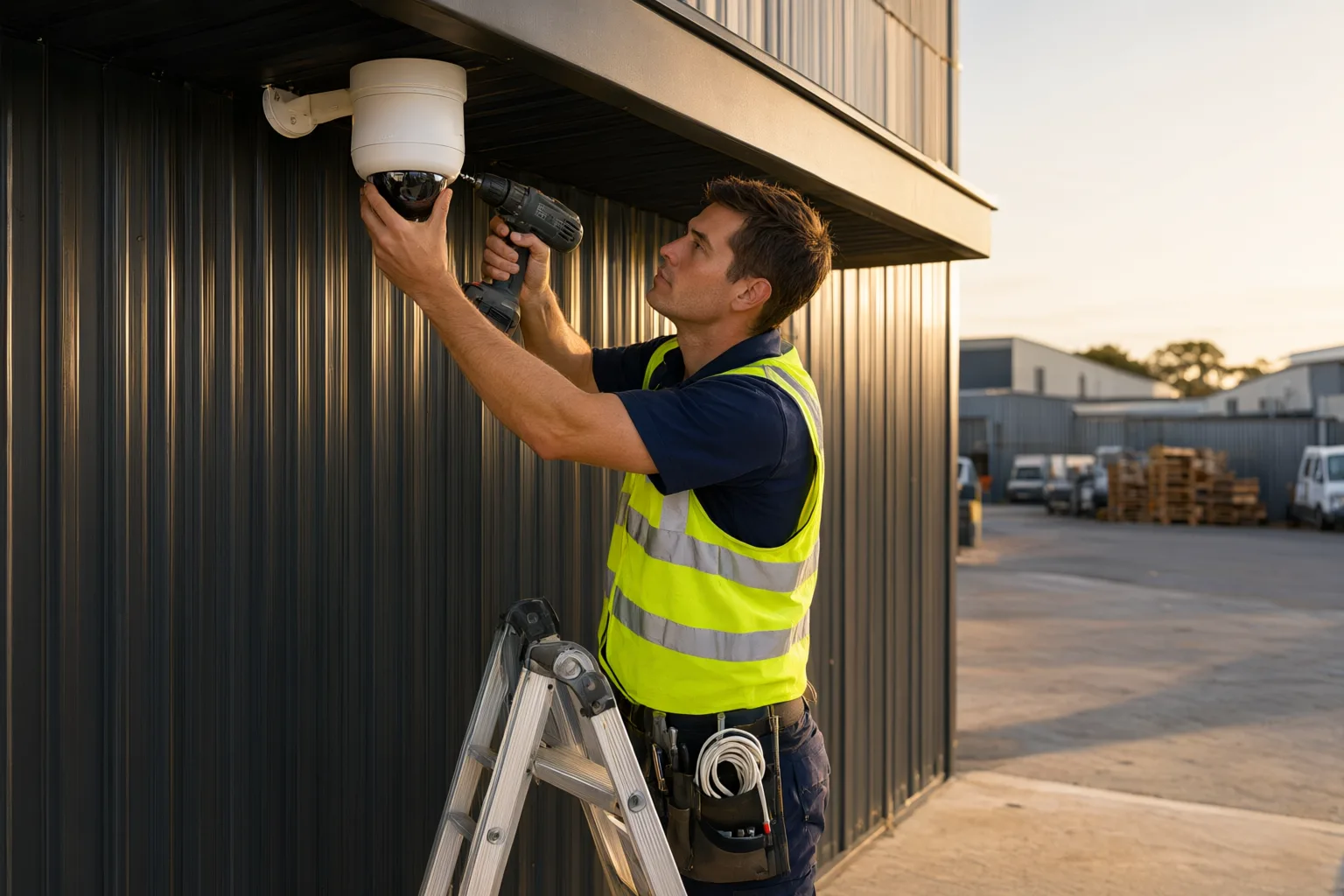
Physical mounting quality separates professional work from shortcuts. Cameras fixed under eaves on brick walls with sealed conduits resist [[/newcastle|Newcastle]]'s coastal humidity and storm-driven rain far better than surface-clipped cable runs exposed to direct sun. In [[/adelaide|Adelaide]]'s hot, dry summers, ask about operating temperature ratings — cheap consumer cameras degrade quickly above 40°C. Bushfire-prone fringe areas may also warrant metal housings rather than plastic. Insist that mounts are corrosion-resistant stainless or powder-coated aluminium, especially within a few kilometres of the coast.
Finally, think about the long term. A five-year maintenance agreement covering firmware updates, lens cleaning, storage health checks and priority callouts typically adds modest annual cost but dramatically extends system life. Aussie CCTV Cams offers commercial clients in both Newcastle and Adelaide scheduled servicing options — get a quote that includes ongoing support so your investment keeps protecting your business well beyond installation day.
Comparing commercial CCTV quote options for Australian businesses
| Quote Type | Typical Cost (AUD) | Best Suited To |
|---|---|---|
| Basic 4-camera retail package | $2,500 – $4,500 | Small shops and offices in Newcastle or Adelaide |
| Mid-tier 8–12 camera system | $6,000 – $10,000 | Restaurants, clinics and multi-room commercial sites |
| Enterprise 16+ camera with analytics | $12,000 – $20,000+ | Warehouses, farms and large commercial properties |
| Phone-quote 'special' (no inspection) | Often $1,500 – $2,000 | Avoid — high variation risk, no accountability |