
Key Takeaways
- Professionally installed CCTV in Newcastle NSW typically costs $1,800–$4,500; hardwired alarms cost $900–$2,500 plus $30–$60/month back-to-base monitoring in Adelaide SA.
- Visible cameras deter offenders before entry; alarms interrupt intruders after they are inside — many properties benefit from both staged over time.
- Installers must hold a NSW Master Security Licence or South Australian security agent registration under the Security and Investigation Industry Act 1995 (SA).
- Cheap DIY wireless kits routinely fail in Australian summer heat, coastal salt air and storm conditions common around Newcastle and Adelaide.
How Should You Choose Between CCTV and an Alarm System First?
The short answer on CCTV vs alarm system costs: professionally installed CCTV in Newcastle NSW typically runs $1,800–$4,500, while a hardwired alarm system costs $900–$2,500 plus monthly back-to-base monitoring from $30–$60 in Adelaide SA. For most Australian homes, cameras deliver stronger day-to-day deterrence, while alarms provide verified intrusion response — and the right choice depends on your property, budget and risk profile.
That's the headline. The rest of this guide explains what each system genuinely does, what it costs to have installed properly in NSW, which one changes offender behaviour, and how to sequence your spending so every dollar delivers real protection rather than security theatre.
What Does an Alarm System Actually Do (and Not Do)?
An alarm is built around interruption. Magnetic contacts on doors, reed switches on windows and passive infrared motion detectors feed a control panel; when the system is armed and something trips, a siren screams and — if you pay for monitoring — a control room operator follows your response plan.
That interruption matters. A siren can startle an intruder mid-entry, wake sleeping occupants, and prompt neighbours to look outside. But understand its limits: an alarm tells you that someone is breaking in right now. It cannot show you their face, their vehicle, or how they got in, and after the event all you're left with is an event log. Neighbour surveys also consistently show that most people ignore external sirens, assuming they're false alarms.
What Can Modern CCTV Do That an Alarm Cannot?
A [[how-much-does-a-4-camera-cctv-system-cost-in-australia|CCTV system]] is an always-on witness. Cameras record continuously or on detected movement to a network video recorder (NVR), storing footage locally on hard drives. You review clips on your phone via the manufacturer's app, watch live feeds from anywhere with internet, and hand police or your insurer high-resolution video showing exactly what happened.
The technology has moved well beyond passive recording. Professional-grade cameras from Hikvision, Dahua and Uniview now include AI classification — Hikvision's AcuSense being the best-known example — that distinguishes humans and vehicles from cats, birds and swaying branches. That means far fewer false alerts, and it enables active deterrence: when a person steps onto your driveway after hours, the camera can fire a strobe light, play a recorded warning through its built-in speaker and push an instant notification to your phone. In other words, today's CCTV doesn't just document a break-in — it can stop one, then keep the evidence.
Which System Costs More to Install Professionally in NSW?
These figures reflect properly licensed installations across Sydney and regional NSW — not hardware-store DIY kits.
A wired alarm system covering main entry points, with a keypad or touchscreen panel and professional [[dahua-cctv-cost-breakdown-from-entry-level-to-enterprise-in-australia|installation]], typically lands between $1,200 and $2,000. If you want 24/7 back-to-base monitoring, budget $30 to $60 per month indefinitely. Self-monitoring through an app removes that fee but puts the burden of noticing and acting on alerts squarely on you.
A four-camera IP CCTV package — PoE cabling, an NVR with ColourVu full-colour night vision, app setup and handover training — generally runs $1,800 to $2,800 depending on roof access, cable runs and camera placement. Critically, there are no compulsory ongoing costs: footage lives on your recorder and remote viewing through the app is free. Over five years, a monitored alarm can easily cost thousands more than the camera system that also gives you evidence.
Do Visible Cameras Change Offender Behaviour More Than Sirens?
Interviews with convicted burglars in widely cited US and UK research point the same way repeatedly: visible cameras are among the strongest deterrents an offender weighs when choosing a target. A camera over the front door and another watching the driveway signals that entry will be recorded and identifiable — so the opportunistic thief moves to the easier house down the street.
Sirens work differently. They respond during an offence rather than preventing one, and most break-ins are over within three to five minutes anyway — long before a monitoring centre could verify an activation and dispatch a patrol. Alarms still earn their keep in specific situations: waking you if someone enters while you sleep, protecting vulnerable occupants, and meeting insurance conditions for premises holding cash or stock.
The practical middle ground is a camera system with built-in active deterrence. An AcuSense-style unit that detects a person at 2am, flashes a warning light and barks a recorded message performs much of the alarm's role while simultaneously capturing the footage an alarm never could.
Are Alarms or CCTV Better Value? The Comparison at a Glance
The table below condenses the decision factors for a typical Australian home or small business, using typical 2025 pricing for professionally installed equipment.
Can You Sequence Your Security Budget by Property Type?
For suburban households, stage one is a well-designed four-camera layout: front door, driveway, side access and rear yard. Those positions cover the approaches used in the overwhelming majority of residential break-ins, and they double as everyday tools — checking whether the kids got home, confirming a delivery arrived, keeping an eye on tradies while you're at work.
Stage two, an alarm, makes sense when specific risk factors apply: regular travel, high-value contents such as jewellery or collectables, a home business holding stock, or a prior break-in at the address. Some insurers discount premiums for monitored alarms, so ask your insurer before committing — the savings may offset part of the monthly fee.
Commercial sites usually need both from day one. Retailers and warehouses rely on CCTV for shrinkage, staff disputes and liability evidence, while a monitored alarm satisfies after-hours response expectations and insurance compliance. Construction sites and rural properties are a different story again: with no mains power and no NBN connection, a conventional panel is impractical, so solar-powered 4G cameras with onboard AI detection have become the default choice.
Why Do Cheap DIY Kits Undermine Your Home Security Budget?
The biggest mistake we see is buying a sub-$300 wireless kit from a big-box store. These systems routinely struggle in Australian summer heat, drop off congested Wi-Fi networks at the worst possible moment, compress footage until faces are unrecognisable, and depend on batteries that die unnoticed.
Professional-grade gear wired with PoE cabling, mounted correctly, configured by a licensed and insured technician, and backed by proper warranties produces footage that actually identifies people and plates. If the output can't identify anyone, it isn't [[price-per-camera-explained-what-australian-homeowners-should-expect-to-pay|security]] — it's decoration. Spend once, properly.
How Do You Get a CCTV vs Alarm System Plan Designed for Your Property?
No two sites need the same design. A single-storey brick veneer in the suburbs calls for a different camera mix than a two-storey coastal home battling salt-laden air, or a warehouse with a twenty-metre roller door and loading dock.
At Aussie CCTV Cams, every free quote begins with a genuine walkthrough of your property. From there we design a tailored layout, handle the installation end-to-end, configure recording, alerts and remote access, and stay for a handover session until you're confident using the app. We install Hikvision, Dahua, Uniview and Axis equipment with lifetime support behind it — and we'll tell you plainly whether your situation calls for cameras, an alarm, or both, because the right answer fits your risks and budget, not our sales targets.
Legal context matters more than most buyers realise. In New South Wales, anyone installing commercial-grade security equipment must hold a Master Security Licence issued under the Security Industry Act 1997 (NSW), and using an unlicensed installer can void insurance claims and expose you to penalties. In South Australia, installers must be registered under the Security and Investigation Industry Act 1995 (SA). Both states also sit under the federal Privacy Act 1988, which governs how recorded footage of customers, staff or neighbours may be collected, stored and disclosed — particularly relevant for retail shops and warehouses where workplace surveillance rules apply.
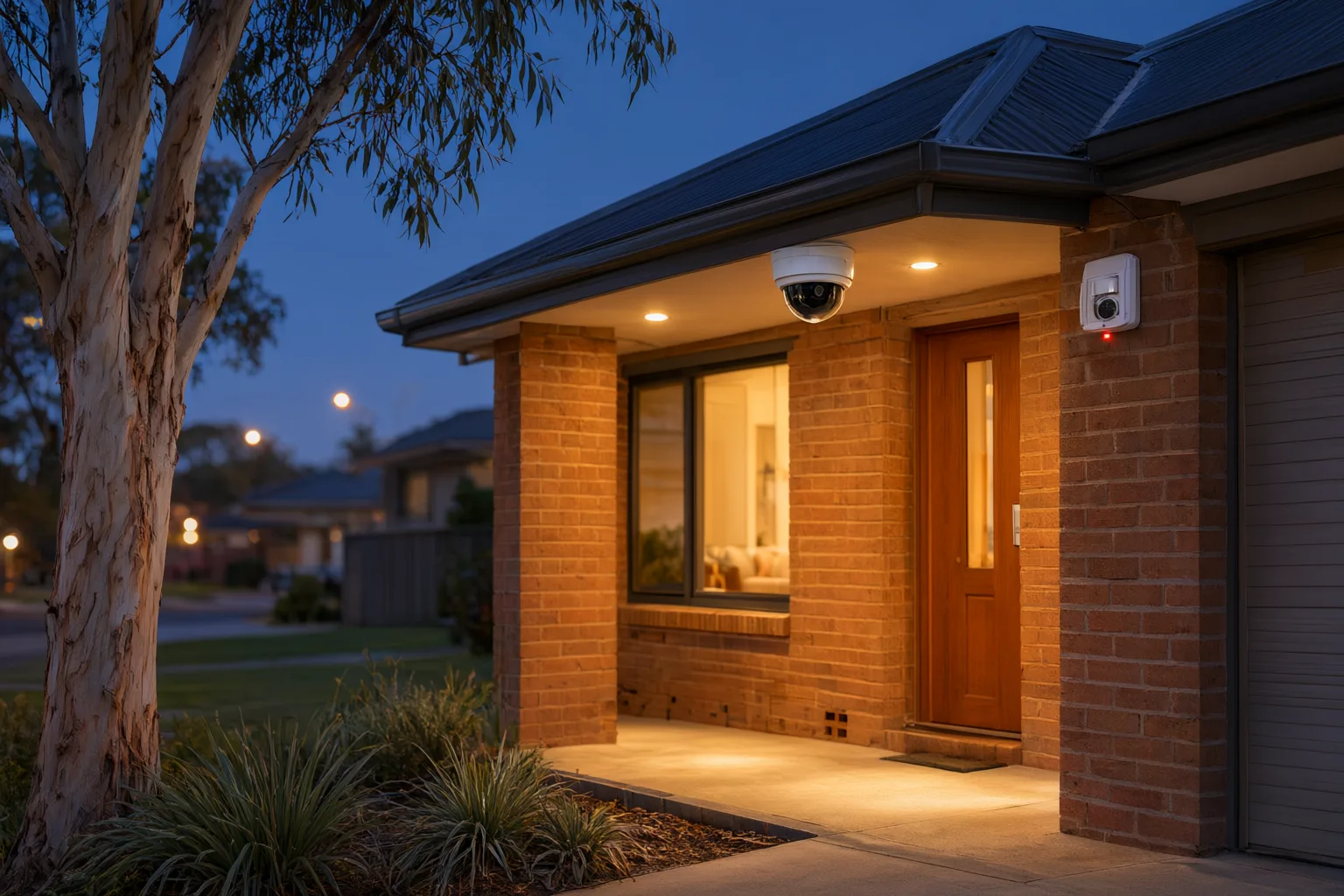
Placement decisions interact heavily with Australian building styles and climate. Cameras mounted under eaves on a brick veneer home stay cooler and out of direct sun, extending component life well beyond five years, while coastal installations near [[/newcastle|Newcastle]]'s beaches need marine-rated housings to resist salt corrosion. In [[/adelaide|Adelaide]]'s hot dry summers, roof-mounted units without adequate shading can exceed safe operating temperatures, causing dropouts exactly when you need footage most. Storm season along the Hunter coast also argues for surge protection on every NVR and control panel.
For business owners, the calculus shifts further. A retail store in the Adelaide CBD generally needs both: CCTV for liability evidence, staff safety and loss prevention, plus a monitored alarm meeting insurer requirements after hours. Commercial insurers increasingly ask whether systems are professionally monitored and installed by licensed technicians, and some offer premium discounts of 5–15% for verified alarm response combined with quality camera coverage. Before signing any contract, ask your installer to confirm licensing, warranty terms and compliance with Australian Consumer Law guarantees.
CCTV vs alarm system: 2025 comparison for Australian homes and businesses
| Factor | Professional CCTV | Monitored Alarm |
|---|---|---|
| Typical installed cost (AUD) | $1,800–$4,500 (Newcastle NSW) | $900–$2,500 + $30–$60/mo monitoring (Adelaide SA) |
| Primary strength | Visible deterrence and recorded evidence | Verified intrusion response and siren interruption |
| Ongoing fees | None unless cloud storage added | Monthly back-to-base contract required |
| Best suited to | Homes, farms, retail, warehouses needing footage | Insurer-mandated after-hours commercial response |