
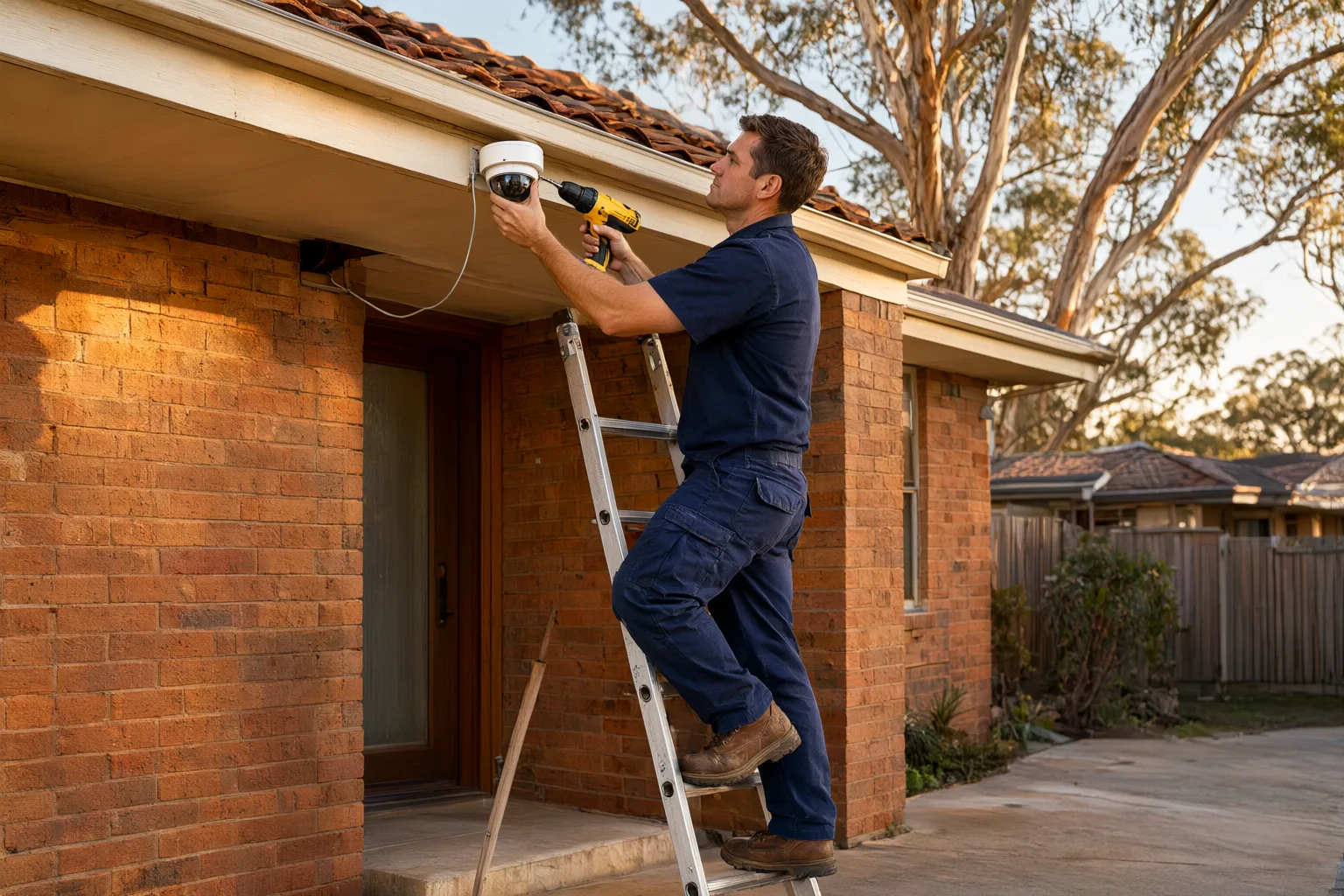
Key Takeaways
- Installed 4-camera PoE systems in Newcastle NSW and Adelaide SA typically run $2,500–$5,000 AUD fully fitted.
- Quotes split into three buckets: cameras ($600–$1,800), NVR and storage ($450–$900), and licensed labour ($800–$1,600).
- DIY kits save money upfront but skip code-compliant cabling, warranty support and lawful camera placement advice.
- Australian summer heat, coastal salt air in Newcastle and Adelaide's dry summers punish cheap cameras—buy weather-rated units.
- Surveillance device laws, the Privacy Act 1988 and workplace surveillance rules shape where you can legally point cameras.
How Much Does a 4-Camera PoE CCTV System Cost Installed in Newcastle or Adelaide?
The short answer: a professionally installed 4-camera PoE CCTV system in Newcastle NSW or Adelaide SA typically costs between $2,500 and $5,000 fully installed. That figure covers four PoE cameras, an NVR with a surveillance-grade hard drive, Cat6 cabling, mounting hardware and licensed labour. Your final price depends on camera tier, roof access, cable runs and whether the property is a home, retail shop or commercial warehouse.
The spread within that range comes down to four things: the resolution and features of the cameras you choose, how much footage you need to retain, how difficult it is to run cable around your property, and whether your location demands extra weatherproofing.
It's worth stating upfront that retail DIY kits advertise at $600 to $1,200. That comparison gets its own section later in this article, because the sticker price tells you very little about what the system will cost you over five years.
What Are the Three Cost Buckets in a Professional CCTV Installation Quote?
Every [[diy-vs-professional-cctv-installation-which-option-saves-you-more-in-the-long-ru|professional]] quote can be broken into three buckets. Knowing the rough proportions helps you judge whether a quote is fair or padded.
Hardware is the biggest slice, typically 50 to 60 per cent of the total. That's four IP cameras (generally 4MP to 8MP), an 8-channel NVR with a 2TB to 4TB drive, PoE ports or a separate switch, plus Cat6 cable, connectors and mounting gear.
Labour accounts for 30 to 40 per cent. This covers the site assessment, running cable through roof cavities or wall conduits, mounting and aiming each camera, configuring the NVR and your network, setting up the viewing app on your phone, and walking you through the system. Licensed installers also supply compliance certificates where they're required.
The third bucket is property-specific extras, which add anywhere from $200 to $800. Long cable runs, awkward roof access, extra network points, or tricky mounting surfaces like Colorbond roofing, double-brick walls or heritage facades all push labour time up.
Which Camera Price Tier Should Newcastle and Adelaide Homeowners Choose?
The gap between a $150 camera and a $450 camera isn't marketing. It shows up in night footage, false alarms and how long the unit survives an Australian summer.
Entry-level professional cameras, around $180 to $280 each, deliver 4MP resolution, infrared night vision out to about 30 metres, and IP66 weatherproofing. They're well suited to sheltered spots: under eaves, inside garages, in covered warehouse areas.
Mid-range units ($320 to $480 each) move to 6MP or 8MP, add ColorVu or Starlight sensors that record genuine colour after dark, and include AI detection such as AcuSense, which tells the difference between a person and a possum. They also handle tricky lighting better, which matters for driveways that cop the morning sun.
Premium cameras ($500 to $750 each) bring ANPR number plate reading for driveways, remotely adjustable varifocal lenses, built-in microphones and speakers, and tougher vandal-resistant housings for exposed commercial sites.
For the majority of Australian homes, mid-range is the sweet spot. You get dependable colour night vision, smart detection that cuts false alerts from trees and wildlife, and enough resolution to identify faces and plates at normal residential distances.
Do You Need More Than 2TB of NVR Storage for a 4-Camera PoE System?
The recorder determines how much history you keep. A basic 8-channel NVR with a 2TB drive runs roughly $450 to $650 and holds about 14 to 21 days of continuous 4MP footage across four cameras. Upgrading to 4TB adds $150 to $220 and stretches retention to four to six weeks — worthwhile if you travel often or your insurer wants longer evidence retention.
Professional NVRs from Hikvision, Dahua and Uniview include things consumer recorders don't: H.265+ compression that roughly halves storage needs, smart search that locates footage by person or vehicle, secure remote access, and firmware updates that patch vulnerabilities.
If the NVR lacks built-in PoE ports, budget $180 to $320 for an 8-port managed switch. This is common in larger installs where the recorder lives in a comms rack away from the camera cabling.
One item people forget: remote viewing depends on your internet. On decent NBN it's fine, but rural properties with patchy NBN should consider a 4G failover router ($280 to $450) so the cameras are never out of reach.
Is Professional CCTV Installation Labour Worth $800–$1,600?
Labour for a standard residential 4-camera job runs $800 to $1,600, and it buys expertise no tutorial can replicate.
It starts with a site assessment: working out the best camera positions, cable routes and NVR location, and checking roof access, existing network gear, power points and obstructions like ducted air conditioning or solar panels.
Cable running is the slowest part. Getting Cat6 through roof spaces, down wall cavities or through conduit takes specialist tools, knowledge of building codes, and the insurance backing to cover mistakes. A single-storey brick veneer with easy roof access might take four to six hours; a two-storey home with tight access can consume a full day.
Mounting is more than drilling holes. Installers position cameras to avoid backlighting at sunrise and sunset, keep number plates readable at the driveway, and balance height against tamper risk so faces are still captured.
Finally, configuration and handover: motion detection zones, recording schedules, the viewing app on your devices, a full day-and-night test of every camera, and training for you. It takes an hour or two, and it's what makes the system actually work when you need it.
Why Do Cheap CCTV Systems Struggle in Australian Summer Conditions?
The climate is where budget systems reveal their true cost.
Summer heat in western Sydney, Brisbane or Perth regularly tops 40°C, and roof cavities can hit 70°C. Consumer cameras rated to 50°C commonly fail within two summers. Professional cameras are rated to 60°C or beyond, with better heat dissipation.
Within about five kilometres of the coast, salt air corrodes cheap housings and connectors. Professional installs use marine-grade stainless mounts and sealed connectors — dearer at the start, but they last a decade instead of two years.
In bushfire zones, standard PVC conduit melts at ember temperatures. Metal conduit costs more but meets BAL (Bushfire Attack Level) requirements, and cameras need to keep running through extreme heat and smoke.
Storm season adds another threat. Surge protection on the NVR and camera lines ($120 to $280) is cheap insurance in Queensland and northern NSW, where summer storms are routine.
Should You Buy a DIY Kit or Hire a Licensed Installer in Adelaide or Newcastle?
A $600 to $1,200 DIY kit gets you four cameras, an NVR and cables. What it doesn't get you: [[how-much-does-professional-cctv-installation-cost-in-australia|installation]] labour, cable work that meets electrical codes, weatherproof connectors, remote viewing setup, warranty support beyond about 12 months, or anyone accountable when it stops working.
Component grade is the real difference. DIY cameras typically last two to four years in Australian conditions; professional hardware lasts seven to twelve. When a DIY camera dies, you're buying and installing a replacement yourself.
Professional installs come with ongoing support from licensed installers — if a camera fails at year five, it gets diagnosed remotely or replaced under warranty. DIY manufacturers offer email support from overseas call centres, if anything.
For businesses, compliance is decisive. Many commercial insurance policies require professionally installed [[poe-vs-wi-fi-cameras-which-is-better-for-australian-homes|security]] systems, and a DIY install may not satisfy the policy — potentially voiding a theft claim.
What Do Australian Surveillance Laws Mean for Your CCTV Installation?
No two properties are the same, which is why reputable installers quote on site rather than over the phone. They need to see the layout, roof access, existing infrastructure and your specific concerns.
During the assessment, the installer identifies the four positions that give you maximum coverage — front door, driveway, backyard and side gate for a typical home, or loading dock, entry, car park and rear access for a warehouse.
A proper quote itemises hardware (specific models and NVR specs), labour (hours and inclusions), extras (long runs, difficult access, extra network points) and warranty terms for both hardware and workmanship.
Ask about the process end to end: initial consultation, system design, installation, configuration and testing, then handover with training. Good installers provide written quotes valid for 30 days, explain how unexpected issues like asbestos or difficult cable access are handled, and don't demand full payment upfront.
Can You Get a Trustworthy CCTV Quote in Newcastle or Adelaide Without an On-Site Visit?
PoE (Power over Ethernet) is the reason this setup is cheaper to run than older analogue systems: a single Cat6 cable delivers both power and video to each camera, so there's no separate electrician visit for power points at every mounting position. For a typical single-storey brick home in [[/newcastle|Newcastle]] or [[/adelaide|Adelaide]], that means one clean cable run from each camera back to the NVR, usually through the roof cavity or eaves.
Across Australia, pricing varies less between cities than between properties. A two-storey home with a tiled roof and long external cable runs will cost more than a single-storey home with easy ceiling access, whether it's in Merewether or Glenelg. Coastal suburbs add another consideration: salt-laden air corrodes cheap housings within a few summers, so marine-rated mounts are worth the extra $30–$60 per camera.
Camera tiers break down roughly like this: entry-level 4MP bullet cameras at $120–$180 each suit front doors and driveways; mid-tier 4K turret cameras at $200–$320 offer better low-light performance and wider dynamic range for sun-drenched western-facing walls; premium models at $350–$500 add smart person/vehicle detection, colour night vision and IK10 vandal resistance suited to commercial sites.
Storage maths matters more than most buyers expect. Four cameras recording continuously at 4MP H.265 consume roughly 100–150GB per day combined. A 2TB drive gives you about two weeks of continuous footage; upgrading to 4TB costs around $120–$180 more and doubles your retention window, which insurers and police in NSW and South Australia often ask about when reviewing incident footage.
Licensed installers carry a security licence (a Class 2C security installer licence in NSW, and equivalent registration under South Australia's Security and Investigation Industry Act), public liability insurance and knowledge of where cameras can legally point. That last part matters: aiming a camera into a neighbour's yard or over a shared boundary can breach surveillance device laws and expose you to complaints or penalties.
On Australian summer conditions: Newcastle's humid coastal climate and Adelaide's dry 40°C+ heatwaves both stress camera electronics. Budget units without proper thermal design suffer image sensor degradation, condensation behind lenses after storms, and IR LED failure within 18–24 months. Quality IP66/IP67-rated cameras with operating ranges to 60°C cost more but routinely last five-plus years in these conditions.
For businesses, additional rules apply. The Privacy Act 1988 governs how footage of customers and staff is collected, stored and disclosed if your annual turnover exceeds $3 million, and workplace surveillance legislation in both states requires employee notification before monitoring work areas. Signage, retention policies and restricted camera placement in change rooms or amenities aren't optional extras—they're legal requirements.
Consumer law protections also apply to your purchase. Under Australian Consumer Law, your installer must supply equipment of acceptable quality and perform the installation with due care and skill, so keep your quote, invoice and warranty paperwork together. Reputable Newcastle and Adelaide installers will happily provide all three upfront.
Finally, timing affects price. Many installers offer better rates outside peak periods (pre-Christmas and post-break-in spikes), and bundling a 4-camera job with future expansion—conduit run for two extra cameras, spare NVR channels—costs far less than a second callout later. Ask for that option when you get a quote.
4-Camera PoE CCTV Package Options: Newcastle NSW & Adelaide SA
| Package | Typical Installed Price (AUD) | Best Suited To |
|---|---|---|
| Essential 4MP PoE | $2,500 – $3,200 | Homes, driveways, entry points |
| Advanced 4K Smart Detection | $3,500 – $4,500 | Retail shops, larger homes, low-light areas |
| Premium Commercial Grade | $4,500 – $5,500+ | Warehouses, farms, high-risk commercial sites |
| DIY Kit (self-installed) | $600 – $1,200 + your time | Budget-conscious, tech-confident homeowners |