
Key Takeaways
- Australia's extreme UV levels crack standard PVC CCTV jackets within two to four years outdoors
- UV-rated polyethylene or stabilised PVC cable typically adds $1–$3 per metre over indoor-grade cable
- Moisture wicking through UV cracks causes camera dropouts, corrosion and full system failure
- Conduit, eaves routing and licensed installation extend outdoor cable life dramatically
- Re-cabling a failed run in Newcastle or Adelaide typically costs $300–$900
How Does Australian Sun Destroy Cheap Outdoor CCTV Cable?
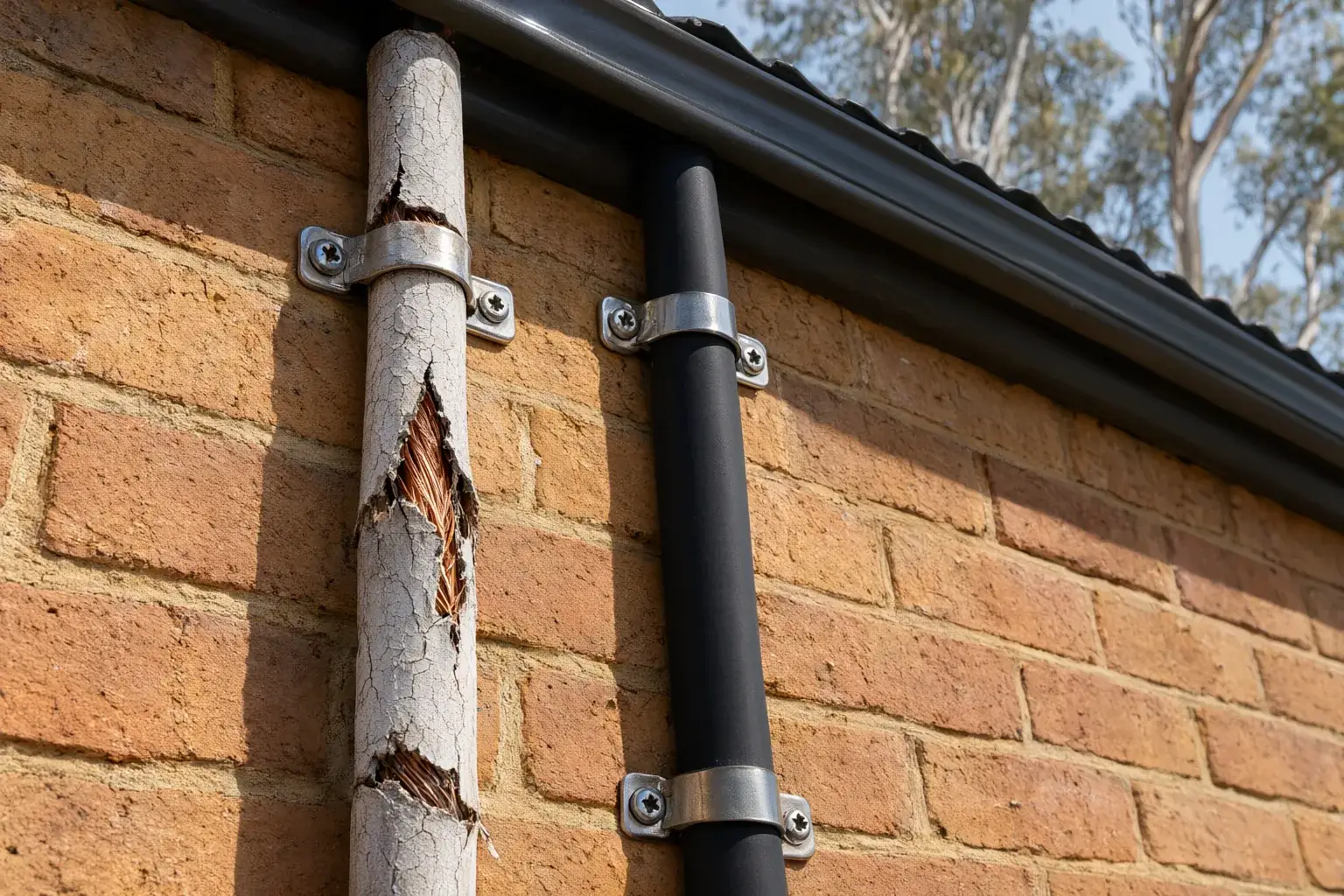
The short answer is that standard indoor-grade PVC cable is not built for Australian conditions — under our extreme UV levels it typically cracks within two to four years when routed along eaves, brick walls or roofs. Once the jacket splits, moisture wicks into the conductors and your cameras start dropping out. Investing in UV resistant CCTV cable from day one costs a little more per metre but saves you hundreds in repairs.
Once the jacket cracks, rain and dew penetrate the cable, moisture travels along it by capillary action, and corrosion attacks the copper conductors and connectors. For PoE-based IP cameras this means voltage drop and intermittent dropouts; for analogue coax systems it means signal noise and picture degradation. The fix is simple at installation time: use UV-rated cable, protect runs in UV-stabilised conduit, or route cable through roof and wall cavities so it never sees direct sun.
What Makes Australia's UV Levels Among the World's Most Extreme?
Australia sits under a hole in the ozone layer's protective influence during summer, and its latitude combines with clear skies to produce some of the most intense surface UV on the planet. In Sydney, summer UV index readings regularly reach the 'extreme' category of 11 or higher, and even overcast days deliver significant doses. Winter sun is weaker but still sufficient to degrade unprotected plastics over months and years.
This matters for [[installing-security-cameras-in-cyclone-prone-areas-what-you-need-to-know|security camera]] installations because external cable runs are often placed in the worst possible positions: along sun-facing walls, across dark Colorbond roofing, under eaves that only partially shade the run, or clipped along fences with no cover at all. A cable rated for indoor use in Europe may survive a decade there; the same cable in full Australian sun can be failing within two summers.
Why Does UV Radiation Break Down a Cable Jacket Chemically?
Ultraviolet light carries enough energy to break the chemical bonds in polymer materials. Standard PVC used for indoor Cat5e, Cat6 and coaxial cable has no carbon black or other UV inhibitors mixed into the compound, so nothing absorbs or dissipates that energy before it damages the plastic.
The degradation follows a predictable sequence. First the jacket loses its colour and surface sheen. Next it loses flexibility as the polymer chains shorten and cross-link. Then micro-cracks form, usually starting on the upper surface where exposure is greatest, before spreading into visible splits and a crazed pattern. At that point the cable is no longer [[weatherproofing-your-cctv-system-for-harsh-australian-summers|weatherproof]], and water can enter freely.
Can a Cracked Cable Jacket Really Kill Your Security Cameras?
Moisture entering through UV cracks does not stay where it enters. It wicks along the cable between the jacket and the conductors, eventually reaching connector joints and termination points. Corrosion then increases resistance on the affected pairs.
On a Power over Ethernet system, that added resistance causes voltage drop at the camera end. Early symptoms include cameras rebooting intermittently, dropping off the network in wet weather, or infrared mode causing brownouts at night when power draw peaks. On analogue coaxial runs, water in the braid shield degrades the signal, producing ghosting, snow and progressive picture loss.
By the time a camera fails completely, the damage is rarely confined to one spot. Moisture typically affects multiple metres of run, which is why a failed cheap cable almost always means a full re-cable rather than a simple repair.
Is Your Outdoor CCTV Cable Showing These UV Damage Warning Signs?
If your system is more than a couple of years old and cameras are behaving erratically, inspect any externally routed cable. The following signs indicate UV degradation:
- Fading or discolouration — black cable turning grey, white cable turning yellow
- A chalky or powdery residue on the jacket surface
- Visible cracks, splits or crazing, especially on the sun-facing side
- Cable that feels stiff and brittle instead of pliable when bent gently
- Green corrosion or oxidation on plugs, sockets and junction points
- Dropouts and faults that worsen after rain or heavy morning dew
Should You Pay More for UV-Rated vs Standard Indoor Cable?
UV-rated outdoor cable uses a jacket formulated specifically to resist ultraviolet breakdown — typically polyethylene (PE) or a UV-stabilised PVC compound containing carbon black or equivalent inhibitors. These additives absorb UV energy and dissipate it as negligible heat, protecting the polymer structure underneath.
The price difference is modest. UV-rated outdoor Cat6 generally costs around $1.50 to $3.00 per metre against roughly $0.80 to $1.50 for standard indoor cable, so a typical residential job might cost an extra $50 to $100 all up. Over a five-to-ten-year horizon, that premium buys intact waterproofing, retained flexibility and stable electrical performance — while standard cable will likely have been replaced once already at far greater cost.
Do Heat, Salt Air and Colorbond Roofs Speed Up Cable Failure?
UV is the primary destroyer, but it rarely works alone. Roof cavities and dark metal roofing such as Colorbond can exceed 70°C in summer, softening PVC and accelerating the chemical breakdown UV initiates. Daily thermal cycling between hot afternoons and cool nights forces repeated expansion and contraction that widens existing cracks.
Coastal properties add salt air to the mix, which corrodes both cable jackets and exposed metal connectors. In bushfire-prone regions, radiant heat and ember attack can destroy unprotected cabling in minutes during a fire event. Rural and regional properties often have longer runs between buildings — sheds, gates, paddocks — multiplying the total length of exposed cable at risk.
Which Protection Methods Do Professional Installers Use Outdoors?
A licensed installer will never leave indoor-grade cable exposed to the elements. Standard protective practice includes one or more of the following measures:
- UV-rated PE-jacketed Cat6 or RG59 coax for every exposed run
- UV-stabilised conduit or corrugated sleeving along walls, fences and eaves
- Routing cable through roof and wall cavities wherever possible to eliminate exposure
- IP66-or-better weatherproof junction boxes and connectors at all terminations
- Drip loops at camera entry points so water cannot track into housings
- Correctly sized clips and saddles that secure the run without pinching the jacket
Are the Savings on Cheap Cable Worth the Re-Cabling Repair Bill?
Saving money on cable might trim $50 to $100 from an [[bushfire-area-cctv-choosing-cameras-and-cabling-that-can-handle-extreme-heat|installation]] quote. But when that cable fails two or three summers later, the repair bill tells a different story: diagnosing the fault, accessing the cable route (often involving roof or ladder work), removing the degraded run and installing proper replacement cable routinely costs several hundred dollars — sometimes more than the original installation itself.
This is among the most common faults encountered when servicing DIY installations or work done by inexperienced operators. In many cases the cameras themselves are perfectly functional; it is the cabling that lets the whole system down.
What Should You Ask Before Signing Off on CCTV Cabling Specs?
Before accepting any quote, put direct questions to your installer about the cabling specification. A reputable operator will answer confidently. Ask whether the cable is UV-rated for outdoor use, whether exposed sections will be housed in conduit, what IP rating the junction boxes carry, and whether the conductor is solid copper rather than copper-clad aluminium, which has higher resistance and degrades faster.
At Aussie CCTV Cams, every outdoor run uses UV-rated cable as standard, matched to professional-grade Hikvision, Dahua, Uniview and Axis hardware. Each installation includes a full handover detailing exactly what was installed and where, backed by lifetime support if issues ever arise.
For homeowners in [[/newcastle|Newcastle]] NSW, the coastal combination of high UV index, salt air and summer humidity makes cable selection even more critical than in inland areas. A camera mounted under the eaves of a north-facing brick wall can see jacket surface temperatures well above 60°C while absorbing direct ultraviolet exposure for most of the day. Installers who routinely work across the Hunter region specify UV-stabilised polyethylene jackets as standard because they have seen too many two-year-old systems fail after cheap cable was used to trim the quote.
[[/adelaide|Adelaide]] SA presents its own challenges. South Australia regularly records some of the highest UV readings in the world during summer, and dry heat combined with hot north-easterly winds bakes exposed cabling on rooftops and fences. For commercial properties such as warehouses and retail sites in Adelaide's western suburbs, long external cable runs are common, which means every extra metre of unprotected jacket is another potential failure point. Professional installers factor this into every outdoor security camera cabling plan.
There is also a legal dimension worth understanding. Under Australian Consumer Law, products must be fit for purpose, so if an installer supplied indoor cable for an outdoor run and it failed prematurely, you may have grounds for a remedy. Additionally, security camera installations at workplaces may intersect with workplace surveillance laws, and any installer performing structured cabling work should hold an appropriate ACMA open cabler registration. Asking about licensing and compliance before signing a quote protects both your property and your legal position.
When budgeting, expect quality UV resistant CCTV cable to cost roughly $2–$5 per metre supplied, compared with $0.80–$2 per metre for standard indoor Cat5e or RG59 coaxial. On a typical four-camera home system with 30 metres of external run, the difference is often less than $100 — trivial against the $300–$900 cost of tracing and replacing failed cable later. Always get a quote that itemises the exact cable specification rather than accepting a vague 'outdoor rated' claim.
Installation technique matters as much as cable choice. Even UV-rated cable lasts longer when routed under eaves, through roof cavities where possible, or inside UV-stabilised conduit on exposed runs. Avoid draping cable across metal fencing that reaches extreme temperatures, keep runs clear of sharp brick edges, and use drip loops at every entry point so water cannot track inside. In bushfire-prone fringe areas of both cities, flame-retardant jacket options add another layer of resilience.
Finally, document everything. Ask your installer for the cable brand, jacket type and rating in writing, photograph the routing before walls are closed up, and keep warranty details. If a storm or heatwave damages the system years later, having proof that compliant UV-rated cable was installed makes insurance claims and warranty disputes far simpler — and gives you confidence your security investment will actually last.
Outdoor CCTV cable options compared for Australian conditions
| Cable Type | Typical Cost (AUD/m) | Expected Outdoor Life |
|---|---|---|
| Standard indoor PVC Cat5e/RG59 | $0.80 – $2.00 | 2 – 4 years before UV cracking |
| UV-stabilised PVC outdoor cable | $2.00 – $3.50 | 7 – 10 years with sheltered routing |
| Polyethylene (PE) jacketed outdoor cable | $3.00 – $5.00 | 10 – 15+ years, ideal for coastal exposure |
| Any cable in UV-rated conduit | Adds $4 – $8/m installed | 15+ years, best all-round protection |