
Key Takeaways
- Residential CCTV monitoring cost in Australia typically falls between $30 and $150 per month, depending on camera count and response level.
- Back-to-base monitoring with video verification commands higher fees but is often required for genuine police attendance.
- AI-capable cameras such as AcuSense or WizSense reduce false activations and can lower your monthly monitoring bill.
- Australian insurers frequently reward professionally monitored systems with premium discounts on home and business policies.
- Choose a monitoring centre graded to AS/NZS 2201 standards and located in Australia for reliability and compliance.
What Does CCTV Monitoring Cost Each Month in Australia?
The short answer: professional CCTV monitoring cost in Australia typically sits between $30 and $150 per month for a residential property with four to eight cameras. Commercial sites, warehouses and retail premises generally pay more because of higher camera counts and guaranteed guard response. Below we break down exactly what you get at each price point across Newcastle NSW, Adelaide SA and the rest of the country.
If you are willing to monitor your own cameras through an app such as Hik-Connect or DMSS, the ongoing cost is effectively zero. The trade-off is that nobody else is watching: if an alert arrives at 3am while you are asleep, on a flight or overseas, it goes unanswered. This guide breaks down exactly what each price tier buys, which factors push your monthly fee up or down, and how to choose a monitoring provider that suits your property and budget.
What Is Professional Back-to-Base CCTV Monitoring and What Do You Get?
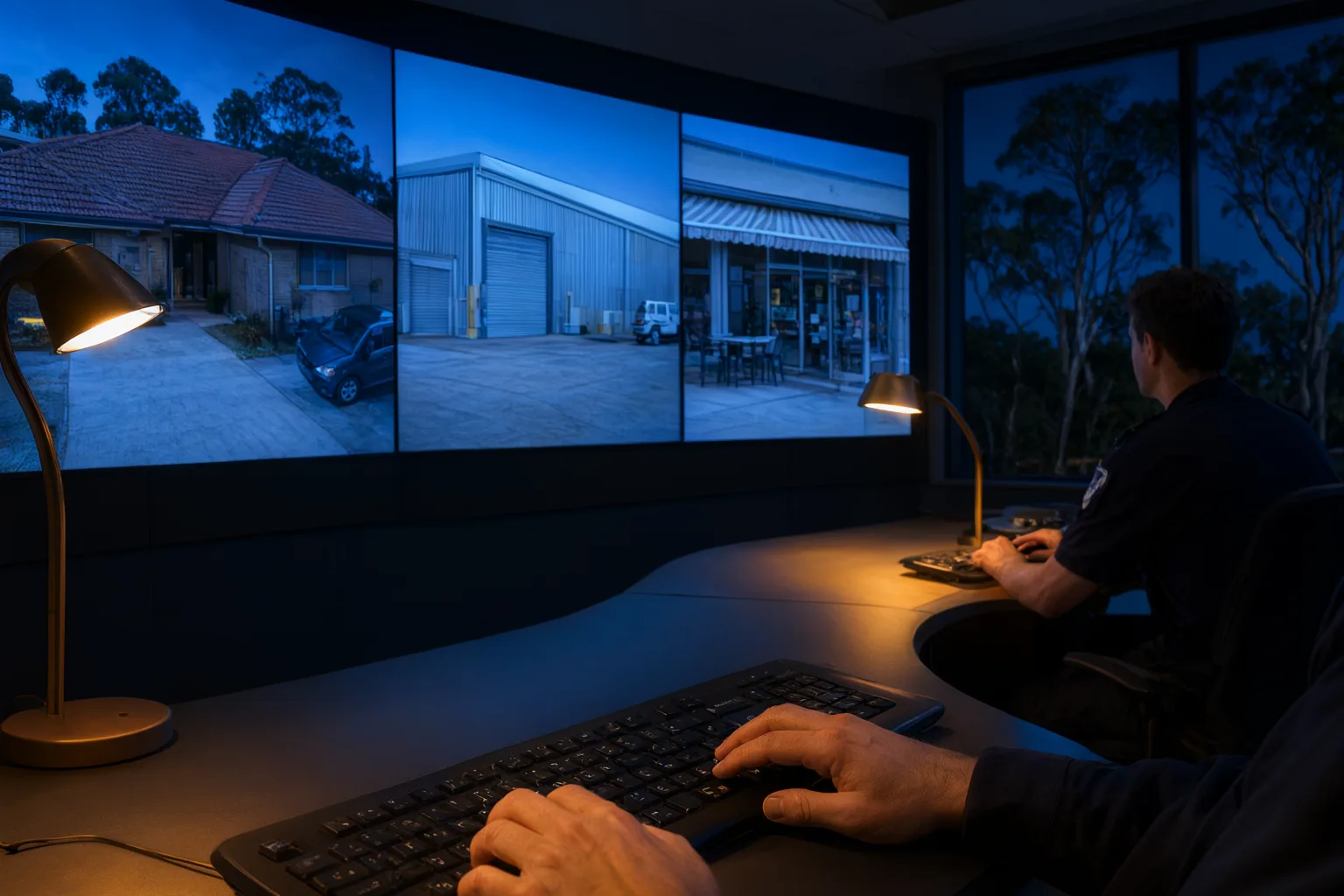
Professional CCTV monitoring means a licensed Australian security monitoring centre takes responsibility for watching your cameras or responding to triggered events around the clock. Rather than checking your own phone every time a motion alert fires, trained operators assess what caused the activation and follow a pre-agreed response plan: calling you, sending a mobile patrol guard, or contacting police on your behalf.
There are three broad service tiers. Self-monitoring is free and relies on apps like Hik-Connect or DMSS pushing alerts straight to your handset. Event-based monitoring means operators only review footage when something specific triggers — an alarm, an AI detection event or a video analytics rule. Live video monitoring, sometimes marketed as virtual guarding, involves operators actively viewing your feeds during nominated hours; this suits construction sites, warehouses and retail stores after closing time.
Modern [[the-hidden-costs-of-cheap-wireless-cameras-vs-professional-poe-systems|camera]] technology has made professional monitoring far more affordable than it once was. Systems built on Hikvision AcuSense or Dahua WizSense AI can distinguish a person or vehicle from a cat, a possum or a swaying gum tree. Because the monitoring centre receives dramatically fewer false triggers, operators spend less time chasing noise — and that saving flows directly into lower monthly fees for you.
How Much Are Average Monthly CCTV Monitoring Prices Across Australia?
For a typical Australian home running four to eight cameras, expect to pay roughly $30 to $150 per month for event-based professional monitoring. Entry-level plans cover alarm and video verification with a phone call response when something is confirmed. Premium residential plans add mobile patrol dispatch, priority response queues and integration with your burglar alarm system.
Small businesses — cafes, shops, offices and medical practices — usually sit in the $150 to $300 per month bracket. Larger commercial sites such as warehouses, construction projects, car yards and strata complexes commonly pay $300 to $600 or more, especially where after-hours virtual guarding, ANPR (automatic number plate recognition) at gates, or multiple buildings under one account are involved.
Budget separately for setup. One-off connection fees of $100 to $500 may apply to link your NVR to the monitoring centre, configure analytics rules and test response procedures. Some providers waive this fee on 24 or 36-month agreements. Treat contracts longer than three years with caution, and always confirm whether quoted rates are ex-GST or inc-GST before comparing offers.
Why Do Four Factors Change Your CCTV Monitoring Price?
Camera count is the most visible driver of cost — more cameras means more potential events for operators to review. But detection quality matters just as much as quantity. A site using AI person-and-vehicle filtering generates only a fraction of the alerts produced by an older motion-only system, so upgrading cameras can genuinely reduce your ongoing monitoring bill rather than increase it.
Response level is the second major factor. A plan that ends with a phone call to you is cheaper than one including mobile patrol dispatch, which in turn is cheaper than live operators watching feeds in real time. Match the response to genuine need: a family home rarely requires virtual guarding, but a construction site holding $200,000 worth of copper cabling and machinery almost certainly does.
Several secondary influences also shape pricing. Site risk rating matters — a jewellery store pays more than a suburban house. Internet reliability plays a role too, particularly NBN connections versus 4G failover on rural properties. Bundling alarm and access control monitoring into one account often lowers the per-service rate, while longer contracts can reduce the headline monthly figure. Rural and farm customers on 4G links should also account for data costs when transmitting video clips to the monitoring centre.
Should You Choose Self-Monitoring or Back-to-Base Monitoring?
Self-monitoring costs nothing beyond your existing internet plan, and for many households it is genuinely sufficient. If a ColorVu camera sends you a full-colour clip of someone at your front gate and you are awake, nearby and able to act, a monitoring centre adds little. The catch is availability: you must be reachable and responsive every single time an alert fires — during holidays, flights, meetings and at 3am.
Professional monitoring earns its keep precisely when you cannot respond yourself, when your insurer demands back-to-base coverage, or when the cost of a single incident dwarfs the annual fee. A $50-per-month plan totals $600 a year; one prevented break-in, one verified police dispatch or one avoided insurance excess frequently covers several years of fees on its own.
A popular middle path is hybrid monitoring: handle alerts yourself day to day, with professional back-to-base coverage overnight or whenever you travel. Many clients pair this arrangement with a serviced NVR and scheduled maintenance visits, because a monitored camera that has silently gone offline protects nobody. Regular health checks ensure the whole chain — cameras, recorder, internet link and monitoring centre — stays functional.
Is Video Verification Required for Police Response in Australia?
Video verification is the process by which a monitoring operator views a live clip or snapshot the moment an alarm activates, confirming whether a genuine threat exists before anyone is dispatched. This single step transforms the economics of monitoring: false alarm call-outs plummet, patrol resources are used efficiently, and police treat verified incidents as crimes in progress rather than unconfirmed reports.
In practice, verified events attract faster police attendance across Australia because attending officers know the activation has been visually confirmed. Many jurisdictions and insurers now expect some form of verification — whether audio, video or two-signal alarm confirmation — before granting priority response. When comparing quotes, ask specifically whether video verification is included in the base monthly fee or charged per event, as this varies significantly between providers.
Do Insurers Reward Professionally Monitored CCTV?
Many Australian insurers offer premium discounts for professionally monitored security systems, and certain commercial policies make back-to-base monitoring a condition of cover rather than an optional extra. For businesses storing high-value stock or equipment, documented monitoring can also strengthen claims evidence, since timestamped footage held off-site is harder to dispute than a local recorder that could be stolen alongside the stock.
Before signing any monitoring agreement, contact your insurer and ask exactly what they recognise: the required monitoring grade, whether video verification counts, and which certifications they accept. Getting this answer first ensures the plan you buy actually delivers the premium benefit you are counting on, rather than falling short of policy conditions.
Which Standards Make a Monitoring Provider Reputable?
Start by confirming the monitoring centre is physically located in Australia and graded to AS/NZS 2201 standards, with redundancy for both power and communications. Ask direct questions: where are operators based, what is the average response time, and is video verification included in the monthly fee or billed per event? A confident provider answers these without hesitation.
Next, check hardware compatibility. Professional-grade systems from Hikvision, Dahua, Uniview and Axis integrate cleanly with the major Australian monitoring platforms, while cheap consumer DIY kits frequently do not. If your current recorder is locked to a consumer cloud service, an NVR upgrade may be needed before monitoring is even technically possible — factor that cost into any comparison.
Finally, read the contract line by line. Look for [[hidden-costs-of-cctv-installation-that-australian-installers-dont-always-mention|hidden]] per-event charges, guard dispatch fees, annual price-rise clauses and early exit penalties. A reputable installer will provide a plain-English breakdown showing exactly what each dollar per month buys, and will design a monitoring plan matched to your actual risk profile rather than pushing a one-size-fits-all package.
How Can You Keep Your Monthly Monitoring Costs Down?
Upgrade to AI-capable cameras before anything else. Person-and-vehicle classification from AcuSense or WizSense devices cuts false activations sharply, and fewer events means cheaper monitoring tiers become viable. Position cameras to cover genuine entry points rather than trees, roads and neighbouring yards that generate constant irrelevant motion.
Bundle services where possible. Combining CCTV monitoring with alarm monitoring and access control on a single account typically lowers the per-service monthly rate compared to buying each separately. Longer terms of 24 or 36 months often waive the $100–$500 setup fee, though weigh that against the flexibility you give up.
Lastly, maintain the system. A quarterly health check on the NVR, firmware and network link prevents silent failures that leave you paying for monitoring that cannot see anything. An offline camera delivers zero protection regardless of how good the monitoring plan is.
Coastal conditions matter more than most pricing guides admit. In [[/newcastle|Newcastle]] NSW, salt-laden sea air corrodes cheap camera housings mounted under eaves or on exposed rooflines within a few seasons, so budget for marine-grade enclosures if your property sits near the coast. In [[/adelaide|Adelaide]] SA, summer heat regularly pushes roof-mounted equipment past 60°C, and cameras without adequate heat ratings will drop frames or fail entirely during heatwaves — a hidden cost that never appears on the monitoring quote itself.
The Surveillance Devices Act governs how recorded footage may be used in both New South Wales and South Australia, and the federal Privacy Act adds obligations for businesses capturing footage beyond their own boundaries. If your cameras overlook a neighbour's property or a public footpath, a reputable monitoring provider will flag this during [[how-much-does-professional-cctv-installation-cost-in-australia|installation]] rather than after a complaint. Workplace surveillance laws add further requirements for commercial premises, including employee notification signage.
For strata-titled properties, getting committee approval before running cabling through common-property walls or roof cavities saves expensive rework later. Many Newcastle apartment blocks now require that any monitored system be installed by a licensed security installer, and insurers increasingly ask for proof of licence when assessing claims tied to alarm activation events.
Storm season along the Hunter coast and bushfire risk in Adelaide's hills fringe both argue for battery-backed NVRs and surge protection on every monitored circuit. A monitoring plan is worthless if a single storm cuts power to your recorder — ask prospective providers whether their monthly fee includes failover connectivity over the mobile network, which typically adds $5 to $15 per month but keeps event alerts flowing during outages.
Finally, remember that consumer law protections apply to monitoring contracts just as they do to any other service. Lock-in agreements longer than three years, unclear cancellation terms or automatic rollover clauses should be negotiated before signing. Get a quote from at least two licensed providers in your area and compare not just the headline monthly price but what happens when an alarm actually activates at 3am.
Monthly CCTV Monitoring Options Compared (AUD, 2025)
| Monitoring Type | Typical Monthly Cost | Best Suited To |
|---|---|---|
| Self-monitoring via app | $0 – $15 | Low-risk homes comfortable checking alerts themselves |
| Event-based back-to-base | $30 – $80 | Residential homes in Newcastle NSW and Adelaide SA |
| Video-verified monitoring | $70 – $120 | Retail shops and offices needing police attendance |
| 24/7 live monitoring + guard dispatch | $120 – $250+ | Warehouses, farms and high-value commercial sites |