
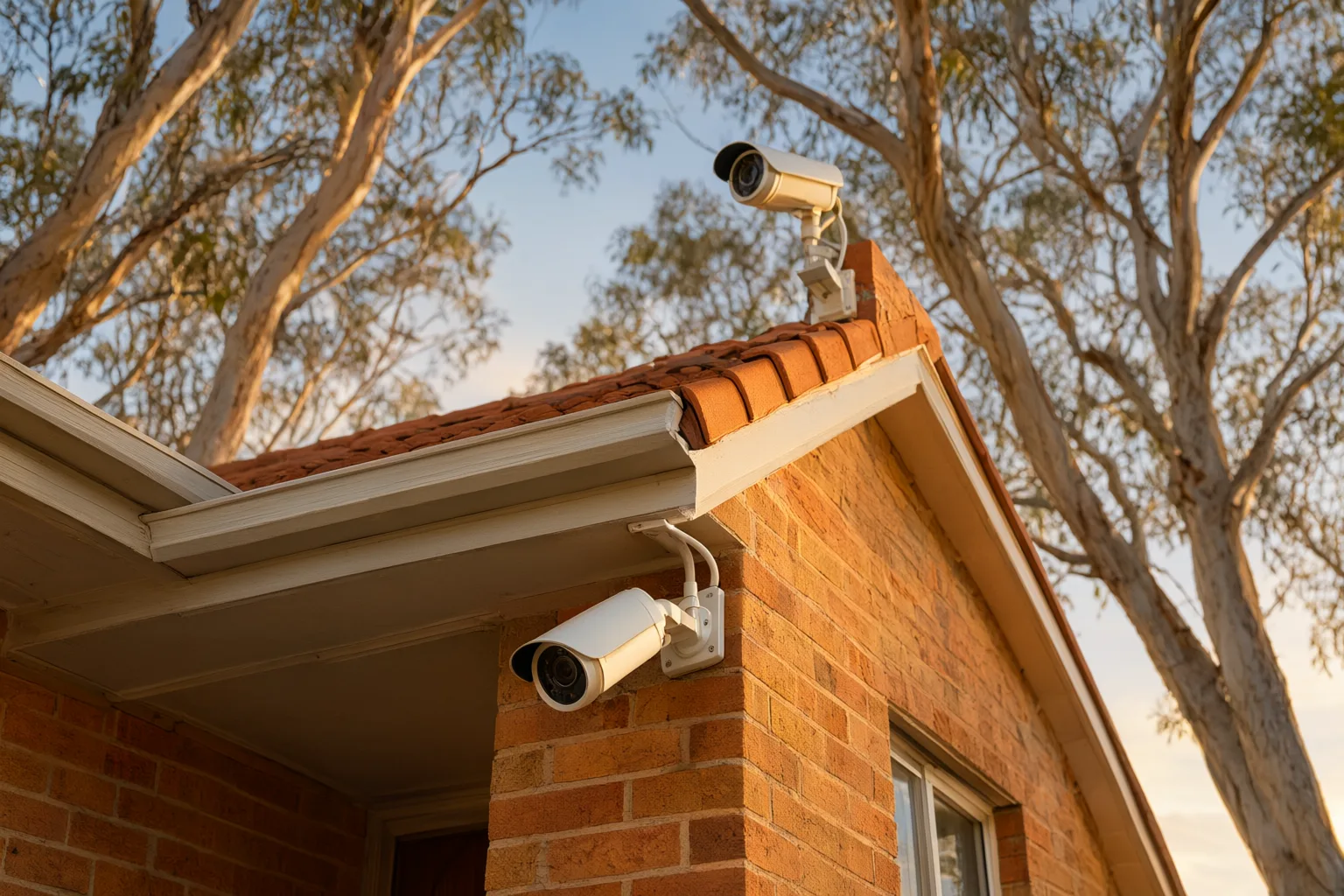
Key Takeaways
- Mount identification cameras at 2.4–3 metres to capture clear faces at entry points like front doors and gates.
- Use 3.5–4.5 metre mounting heights where vandal resistance is the priority, paired with IK10-rated housings.
- Above 5 metres, even a 4K camera records only heads, so reserve high mounts for perimeter overview.
- IK10 housings withstand 5-joule impacts, letting Newcastle NSW homes mount lower without vandalism risk.
- Coastal salt air around Adelaide SA demands marine-grade mounts and sheltered eave positions above 3 metres.
- Layered designs mix 2.5–3m ID cameras with 4–5m overview cameras for evidence-quality footage.
What Height Should Your CCTV Cameras Be Mounted At?
For most Australian properties, the right CCTV camera mounting height is 2.4 to 3 metres if you need to identify faces, or 3.5 to 4.5 metres if vandal protection is the priority. Above 5 metres, even a 4K camera captures mostly the tops of heads, so high mounts should be reserved for perimeter overview rather than identification.
This guide explains why that trade-off exists, how to work around it with modern vandal-resistant hardware and layered camera placement, and how Australian conditions — coastal salt air, Western Sydney heat, storms and bushfire zones — should shape your mounting decisions.
Why Is Mounting Height the Most Overlooked CCTV Design Decision?
[[what-is-the-ideal-mounting-height-for-home-security-cameras-in-australia|Mounting height]] is one of the first decisions a professional installer makes when designing a CCTV system, and for good reason. It sits at the centre of a genuine conflict: a camera mounted low enough to capture clear faces is also low enough to be reached with a broom handle, a spray can or a well-aimed rock. Mount it high enough to be untouchable, and you lose the very detail that makes footage useful as evidence.
We regularly see DIY installations where homeowners have mounted [[eaves-mounting-vs-wall-mounting-pros-and-cons-for-cctv-cameras|cameras]] at 5 or 6 metres in the belief that higher automatically means safer. The result is expensive equipment recording footage that is effectively worthless. When police request facial identification after a break-in, a camera mounted too high delivers nothing but the crown of a head and a pair of shoulders.
The physics behind this is simple and unforgiving. Every additional metre of height increases the downward angle between the lens and a person's face. At 2.5 metres, you capture faces nearly front-on — eyes, nose and mouth all visible. At 5 metres, the camera looks down at roughly a 60-degree angle, recording mostly forehead, hair and shoulders. No amount of resolution or digital zoom can recover detail that was never captured in the first place.
Is Vandal-Proofing Worth Sacrificing Image Quality?
Vandalism is a legitimate concern for Australian property owners, particularly for ground-floor commercial premises, schools, construction sites and homes in high-traffic areas. A camera mounted at 2 metres is well within reach of anyone determined to damage, obscure or steal it. Installers replace damaged cameras often enough to understand the temptation to mount everything as high as possible.
Modern vandal-resistant housings, however, have changed the equation entirely. Professional-grade cameras from manufacturers such as Hikvision, Dahua and Axis are available with IK10-rated housings that withstand serious impact. An IK10 rating means the housing can survive a 5-joule impact — equivalent to a 1.7kg mass dropped from 300mm directly onto the housing. These are a world away from the flimsy plastic domes bundled with consumer DIY kits.
The smarter strategy combines moderate height with vandal-resistant hardware and thoughtful positioning. Mount the camera at 2.8 to 3.2 metres in a location that is difficult to approach without being seen — under an eave, behind a downpipe, or in a corner where an intruder would need a ladder. Add an IK10-rated dome or reinforced bullet housing, and you achieve genuine vandal protection without sacrificing the image quality that makes footage evidentially valuable. All installations comply with Australia's Privacy Act 1988 and applicable state surveillance licensing requirements.
Which Mounting Height Suits Each Surveillance Goal?
There is no single 'best' mounting height, because different cameras serve different purposes. A camera watching your front door for identification does a completely different job from one monitoring your back fence line for intruders.
For facial recognition and identification, mount cameras between 2.4 and 3 metres. At this height, faces are captured at a shallow enough angle to clearly show eyes, nose and mouth. It is ideal for front doors, driveways, entry gates and any location where identifying individuals matters. Yes, the camera is within reach of a determined vandal — which is exactly where IK10 housings and visible deterrent signage earn their keep.
For general property surveillance and behavioural monitoring, 3.5 to 4.5 metres hits the sweet spot. You will capture excellent detail of clothing, build, gait and actions while keeping the camera out of casual reach. This range works well for backyards, side passages, garage exteriors and retail floor coverage. You may not get a perfect facial shot, but you will see exactly what happened and when.
For wide-area overview and perimeter monitoring, 4.5 to 6 metres makes sense. These cameras provide context and track movement across the property — ideal for fence lines, car parks, loading docks and large outdoor areas. They should always work in tandem with lower cameras positioned at choke points where identification matters.
How Does Lens Focal Length Change the Height Equation?
Mounting height never exists in isolation — the lens focal length dramatically affects what height will work for your specific situation. A 2.8mm wide-angle lens mounted at 3 metres captures a broad field of view but limited detail at distance. A 12mm telephoto lens at the same height captures a narrow corridor with exceptional detail 15 metres away.
This is where professional system design earns its fee. During a proper consultation, the installer calculates the pixel density required for identification at each specific mounting location, treating distance to target, lens focal length, camera resolution and mounting height as one integrated system.
A practical example: if you want to identify faces at your front gate, 8 metres from the house, a camera mounted at 3 metres with an 8mm lens delivers sufficient pixel density for identification at that distance. Fit the same camera with a 2.8mm lens instead, and you would need the subject to be within roughly 3 metres for identification-quality footage.
Varifocal cameras add valuable flexibility here. Models with motorised 2.7-13.5mm lenses allow the field of view to be fine-tuned after [[installing-security-cameras-in-cyclone-prone-areas-what-you-need-to-know|installation]], optimising the balance between coverage area and detail capture. It is one of the key reasons professional-grade equipment outperforms fixed-lens consumer cameras in real installations.
Can You Beat the Vandal-Proofing Versus Image Quality Trade-Off?
You do not have to choose between vandal-proofing and image quality. Smart system design delivers both through layered camera placement and modern technology.
The layered approach uses cameras at different heights working together. Mount an overview camera at 4.5 metres to monitor the entire front yard and detect movement, then add a second camera at 2.8 metres focused specifically on the front door or gate. The high camera provides context and early warning; the low camera captures faces. Together, they deliver complete coverage without compromise.
Strategic positioning makes cameras harder to reach without excessive height. Corners where two walls meet make approach difficult. Architectural features such as downpipes, decorative columns and roof eaves provide natural shielding. Landscaping helps too: a camera mounted 3 metres up on a wall behind a garden bed is far harder to reach than one on an open wall.
Modern camera technology defends itself. Hikvision's AcuSense and Dahua's WizSense ranges include built-in deterrent features such as strobe lights and audio warnings that activate when someone approaches — the camera discourages the vandal before they get close. Dahua's ColorVu technology captures full-colour detail around the clock, extracting maximum information from every frame regardless of mounting height.
Finally, vandal-resistant housings have improved dramatically. IK10-rated domes withstand hammer strikes, and bullet cameras in reinforced housings shrug off impacts. They cost more upfront, but they are far cheaper than repeatedly replacing damaged cameras.
Do Australian Conditions Affect CCTV Mounting Height Decisions?
Australian conditions add layers of complexity that generic overseas advice ignores. Harsh sun, coastal salt air and severe storms all influence where — and how high — cameras should be mounted.
In coastal areas from Wollongong to [[/newcastle|Newcastle]], salt air corrodes camera housings and mounting brackets. Marine-grade stainless steel mounts are essential, and cameras should be positioned to minimise direct salt spray exposure. Sometimes that means mounting slightly lower under protective eaves rather than higher on exposed walls.
Western Sydney's summer heat affects both camera performance and longevity. Cameras mounted in full sun on dark Colorbond roofs can exceed their operating temperature ratings. Mounting lower on north-facing walls or under eaves to provide shade is often the better engineering decision, even if it means accepting slightly less vandal resistance.
Storm season brings wind loads that increase with mounting height. A camera on a 5-metre pole experiences significantly more wind stress than one at 3 metres on a solid wall. In cyclone-prone regions and on exposed rural properties, the desire for height must be balanced against structural mounting requirements.
Bushfire zones present their own challenges. Cameras need to survive radiant heat and ember attack, so they should be mounted under metal eaves rather than timber, run on fire-rated cable, and sometimes positioned lower where the building itself offers better protection from fire exposure.
Should You Ever Mount CCTV Cameras Above 5 Metres?
Despite everything above, there are legitimate scenarios where mounting at 5 metres or higher is the right call. Knowing these exceptions helps you design a system that actually works.
ANPR (Automatic Number Plate Recognition) cameras often mount higher to capture plates at the correct angle. For driveway entry monitoring, an ANPR camera might be mounted at 4 to 5 metres angled down at 30 to 45 degrees — capturing plates clearly while staying safe from vehicle strikes and vandalism. Pair it with a lower camera for facial capture.
Warehouses and industrial facilities with high ceilings require elevated mounting. A camera monitoring a warehouse floor from 6 metres provides excellent overview coverage, supplemented by lower cameras at entry points, loading docks and high-value storage areas where identification matters.
Construction sites benefit from high mounting on temporary poles or existing structures, where the goal is site-wide monitoring and deterrence rather than facial identification. Time-lapse cameras documenting construction progress mount high intentionally to capture the entire site.
Retail environments use height strategically as well. Ceiling-mounted cameras at 4 to 5 metres monitor overall store activity and detect suspicious behaviour, while lower cameras at entry points and high-theft areas capture faces. It is the layered approach applied to commercial security.
Are You Following the Right Mounting Height Checklist?
Before finalising any camera position, work through these questions. First, what is the camera's primary job — identification, detection or overview? Second, what lens focal length is fitted, and does the pixel density at the target distance support that job? Third, can the camera be approached without a ladder, and if so, is the housing IK10-rated? Fourth, does the mounting position protect the camera from sun, salt, wind and fire exposure relevant to your area?
If a camera needs to identify people but sits in a vulnerable spot, the answer is never simply 'mount it higher'. The answer is a combination of moderate height, vandal-resistant hardware, deterrent technology and positioning that makes approach difficult. Get that combination right, and your footage will be worth far more than the camera that captured it.
CCTV Mounting Height Comparison: Security vs Image Quality
| Mounting Height | Vandal Resistance | Facial Recognition | Best Applications | Recommended Housing |
|---|---|---|---|---|
| 2.4-3 metres | Low to Moderate | Excellent | Front doors, entry gates, driveways | IK10 vandal-resistant dome |
| 3-3.5 metres | Moderate | Very Good | Side passages, garage exteriors, retail entries | Vandal-resistant bullet or dome |
| 3.5-4.5 metres | Good | Good (behavioural detail) | Backyards, car parks, general surveillance | Standard weatherproof housing |
| 4.5-6 metres | Very Good | Limited (overview only) | Perimeter monitoring, wide-area coverage, ANPR | Standard housing with secure mounting |
| 6+ metres | Excellent | Poor (context only) | Warehouse ceilings, construction sites, large open areas | Heavy-duty housing with pole mount |