
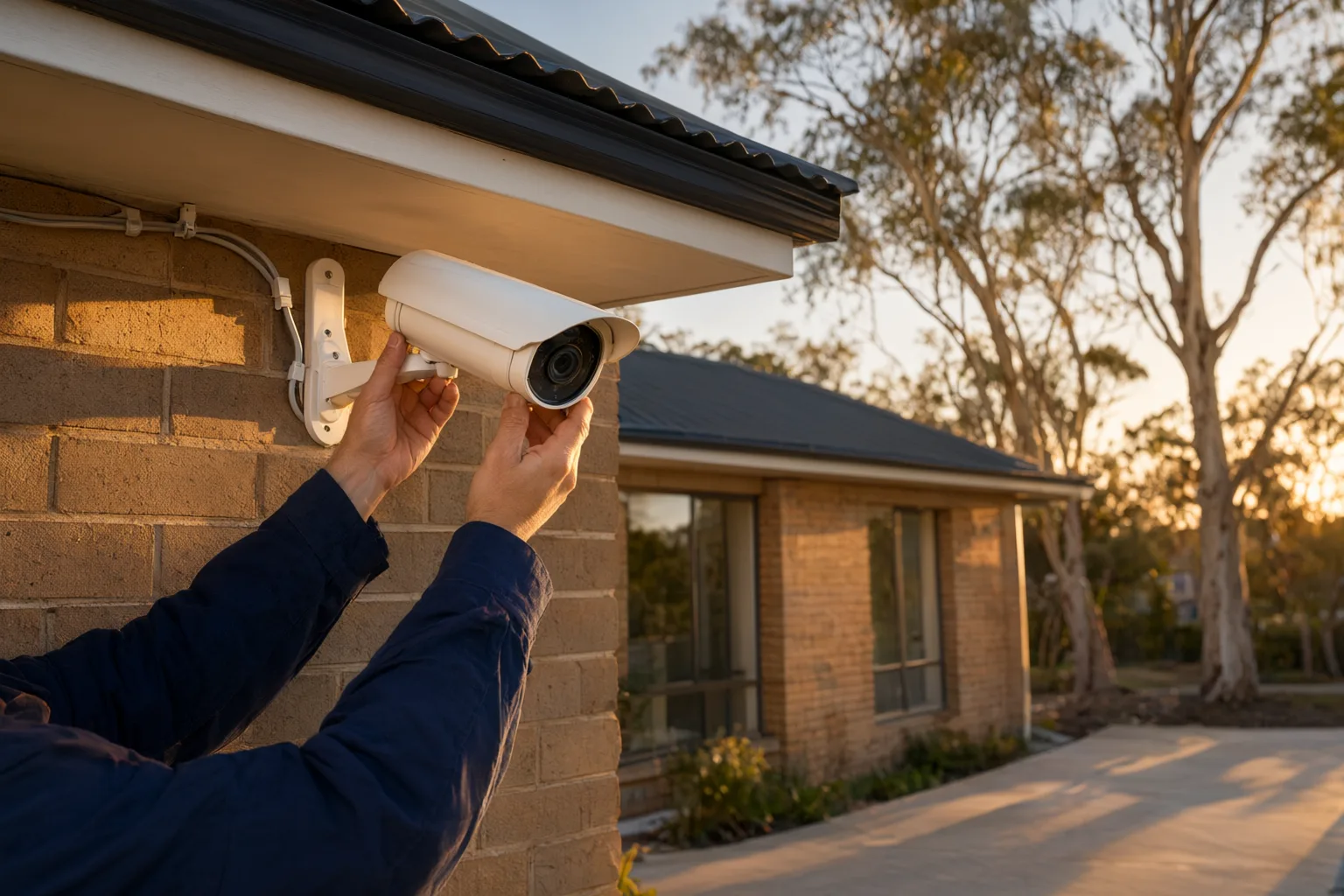
Key Takeaways
- PoE cameras cost more upfront ($1,800–$4,500 installed) but offer superior reliability, no subscription fees, and lower total cost of ownership over 5+ years.
- Wi-Fi cameras suit renters and temporary setups at $150–$600 per unit, but double-brick walls and foil insulation common in Australian homes degrade signal quality.
- Australian heat above 40°C throttles Wi-Fi routers and drains batteries; PoE hardware handles coastal salt air in Newcastle and dry Adelaide summers better.
- Wired PoE networks are significantly harder to hack than Wi-Fi broadcasts, an important consideration under the Privacy Act 1988 for businesses recording customers or staff.
- Professional installation by a licensed security installer ensures compliance with state surveillance laws in NSW and South Australia.
Which Camera Type Wins for Most Australian Homes?
The short answer: for most Australian homeowners, PoE cameras are the better long-term investment despite higher upfront costs. A professionally installed 4-camera PoE system typically costs $1,800–$4,500 in Newcastle NSW or Adelaide SA, while quality Wi-Fi cameras run $150–$600 each with no cabling required. However, Wi-Fi reliability suffers badly in double-brick Australian homes, and hidden subscription fees erode the initial savings within two years.
This guide walks through exactly how each technology works, how both cope with distinctly Australian building styles and climate conditions, what each costs to install and maintain, and which situations suit each option best. By the end, you'll know whether a fully wired system, a wireless setup, or a hybrid of the two is right for your property.
How Do PoE Cameras Actually Work?
Power over Ethernet is a technology standard (IEEE 802.3af/at) that sends electrical power and video data down one Cat6 Ethernet cable. Each camera connects back to a Network Video Recorder (NVR) or PoE switch, usually housed in a garage, study, or dedicated cabinet. Because power arrives through the same cable as data, there's no need for an electrician to fit a power point at every camera location.
The result is a closed, dedicated surveillance network. Your [[weatherproofing-your-cctv-system-for-harsh-australian-summers|cameras]] never compete with streaming services, gaming consoles, or smart home devices for bandwidth, and they don't depend on your router staying online to keep recording. Professional-grade brands such as Hikvision, Dahua, Uniview, and Axis build their commercial and residential ranges around PoE architecture precisely because it delivers consistent, always-on performance.
What Makes Wi-Fi Cameras Convenient—and Where Do They Fall Short?
Wi-Fi cameras transmit video wirelessly to your home router, drawing power either from a nearby outlet, a rechargeable battery, or a small solar panel. Setup is genuinely quick: mount the camera, pair it with an app, and you're recording within minutes. Consumer brands dominate this market, though professional wireless options exist for specific scenarios.
The compromise is shared infrastructure. A Wi-Fi camera broadcasts over the same 2.4GHz or 5GHz spectrum as every other device in your home, and its signal must penetrate whatever stands between it and the router. In Australian homes, that often means double-brick veneer walls, foil-backed insulation, and Colorbond roofing—all of which dramatically attenuate wireless signals. Effective indoor range can shrink to under 15 metres, and video quality frequently drops as cameras compress footage to squeeze through constrained bandwidth.
Are Wi-Fi Cameras Reliable Under Australian Building Conditions?
Australian construction is uniquely hostile to wireless signals. Double-brick construction common across much of the country, reflective foil insulation mandated for energy efficiency, and metal Colorbond fencing and roofing all block or degrade Wi-Fi. Add in neighbouring networks, NBN congestion during evening peak hours, and interference from cordless phones and baby monitors, and a wireless camera's connection becomes far less predictable than its product page suggests.
PoE sidesteps all of this. A Cat6 run through roof cavities or wall conduits delivers consistent gigabit connectivity regardless of wall density, weather, or network traffic. That stability matters most when you're running feature-rich cameras: Hikvision ColorVu models capture full-colour night vision, while AcuSense AI distinguishes humans and vehicles from animals and shadows. These capabilities demand steady bandwidth—a compressed, stuttering Wi-Fi feed undermines the very features you paid for.
Can PoE and Wi-Fi Cameras Survive Australian Heat, Salt Air and Storms?
Australian summers push equipment hard. When outdoor temperatures exceed 40°C, Wi-Fi routers and battery-powered cameras can throttle performance, drain batteries faster, or drop connections entirely—precisely when long daylight hours and holiday absences make coverage most valuable. PoE cameras, powered continuously through their cabling and typically rated for wider temperature ranges, keep recording through the hottest afternoons without intervention.
Coastal properties face a further challenge: salt-laden air corrodes exposed Wi-Fi antennas and external connectors, steadily degrading wireless performance over months and years. PoE cameras use sealed Ethernet connections with no protruding antennas, making them markedly more durable in beachside suburbs from Byron Bay to Wollongong. Severe coastal storms also favour hardwired systems, which aren't susceptible to the signal disruption heavy rain can cause on wireless links.
Should You Choose Speed or Permanence When Installing Security Cameras?
Wi-Fi cameras win decisively on initial setup speed. If you're renting a townhouse in Parramatta, monitoring a renovation site, or simply want coverage this weekend, battery-powered Wi-Fi units offer tool-free mounting with no drilling or cable runs. The catch: you need strong Wi-Fi at each camera position, accessible power points or a willingness to climb ladders for regular recharging, and patience with app-based configuration.
PoE [[the-real-cost-of-a-4-camera-poe-system-installed-in-australia|installation]] demands more planning but rewards you with permanent, maintenance-free operation. Licensed technicians run cables through roof spaces or conduits, terminating at a central NVR location. Upfront labour is higher, but there are no batteries to swap, no visible wires, and no climbing up to cameras for maintenance. Critically, PoE supports cable runs up to 100 metres without signal loss—enough to cover two-storey brick homes, detached sheds, pool areas, and long driveways where Wi-Fi simply cannot reach.
Why Are Wired Networks Harder to Hack Than Wi-Fi Cameras?
Every connected camera is a potential entry point into your home network, and Wi-Fi cameras broadcast continuously over the air. Cheap consumer models often ship with weak default passwords, infrequent firmware updates, and cloud connections routed through overseas servers—creating real vulnerabilities. Even quality wireless cameras require diligent WPA3 encryption, unique passwords, and regular updates to stay secure.
PoE systems operate on a physically isolated network. Cameras connect directly to the NVR via dedicated cabling and never touch your home Wi-Fi unless you deliberately configure remote viewing. Combined with professional-grade hardware from Axis or Uniview, this architecture delivers enterprise-level protection. You also retain full control over footage storage—no mandatory cloud subscriptions, no third-party data harvesting, and no monthly fees just to review yesterday's recordings.
Is the Upfront Cost of PoE Worth It Compared to Wi-Fi Cameras?
Be honest about total cost of ownership rather than sticker price alone. Wi-Fi cameras look cheaper initially—many quality units cost well under $200 each with DIY installation. But factor in battery replacements, potential cloud subscription fees, earlier hardware replacement cycles, and the frustration of missed footage, and the gap narrows considerably.
PoE systems carry higher upfront costs: quality cameras, an NVR, Cat6 cabling, and professional labour. However, once installed, running costs are essentially zero—footage stores locally, there are no batteries to buy, and well-maintained professional hardware routinely serves for many years. For homeowners intending to stay put, PoE almost always represents better long-term value. Renters and short-term residents, by contrast, recover little of that investment and are better served by portable Wi-Fi gear they can take to their next address.
Do Different Property Types Suit PoE or Wi-Fi Security Cameras?
Choose PoE if you own your home and want a permanent, high-performance solution. It excels at monitoring driveways with ANPR (Automatic Number Plate Recognition), covering large backyards with Starlight low-light cameras, and protecting home businesses that need genuine 24/7 recording. Large blocks, acreage, and multi-building properties particularly benefit from PoE's 100-metre cable reach.
Opt for Wi-Fi if you're renting, need immediate temporary coverage, or live in a heritage-listed property where cabling through original walls isn't permitted. Apartments and townhouses with good internal Wi-Fi coverage can achieve solid results wirelessly.
Many Australian households land on a hybrid approach: PoE cameras guarding the main house perimeter and critical entry points, supplemented by solar-powered Wi-Fi cameras at the back gate, granny flat, boat shed, or front fence line where trenching cable would be impractical or prohibitively expensive. Modern NVRs can manage both camera types in a single interface.
How Does Professional Installation Protect Either System?
Whichever technology you choose, professional installation protects your investment. Correct [[camera-placement-101-covering-entry-points-without-wasting-cameras|camera placement]]—covering approach paths rather than empty sky, avoiding backlighting from low sun, positioning lenses above tamper height—makes the difference between usable evidence and useless footage. Network configuration matters too: properly segmented VLANs, strong passwords, and current firmware keep your system secure.
Licensed NSW installers also ensure compliance with state privacy laws governing where cameras may point and how footage is stored. A typical engagement follows five steps: consultation, design, installation, configuration, and handover training—so you finish knowing exactly how to retrieve footage, adjust settings, and expand the system later, backed by ongoing support.
PoE vs Wi-Fi Security Cameras: Cost & Performance Comparison for Australian Homes
| Factor | PoE Cameras | Wi-Fi Cameras |
|---|---|---|
| Upfront cost (installed) | $1,800–$4,500 for 4 cameras + NVR | $700–$1,600 for 4 cameras |
| Ongoing fees | None — local NVR storage | $10–$30/month cloud subscriptions |
| Reliability in AU conditions | Excellent — unaffected by brick walls, foil insulation, 40°C+ heat | Variable — dropouts in double-brick homes; heat throttling |
| Security | Harder to hack — wired, closed network | Broadcasts over air — needs WPA3, strong passwords |
| Best suited for | Owned homes, businesses, warehouses, farms — permanent installs | Renters, rentals, temporary sites, quick DIY setups |