
Key Takeaways
- Council approval is almost never needed for residential CCTV on detached homes in Newcastle or Adelaide.
- NSW installers must hold a Security Industry Act 1997 licence; SA has equivalent licensing under the Security and Investigation Industry Act 1995.
- Privacy law, not planning law, is where most homeowners breach CCTV rules — avoid recording neighbours' land or public footpaths.
- Businesses must comply with the Workplace Surveillance Act 2005 (NSW) and notify staff before monitoring.
- Unlicensed installations can void insurance claims and attract penalties.
Is Council Approval Actually Required Under CCTV Laws in Australia?
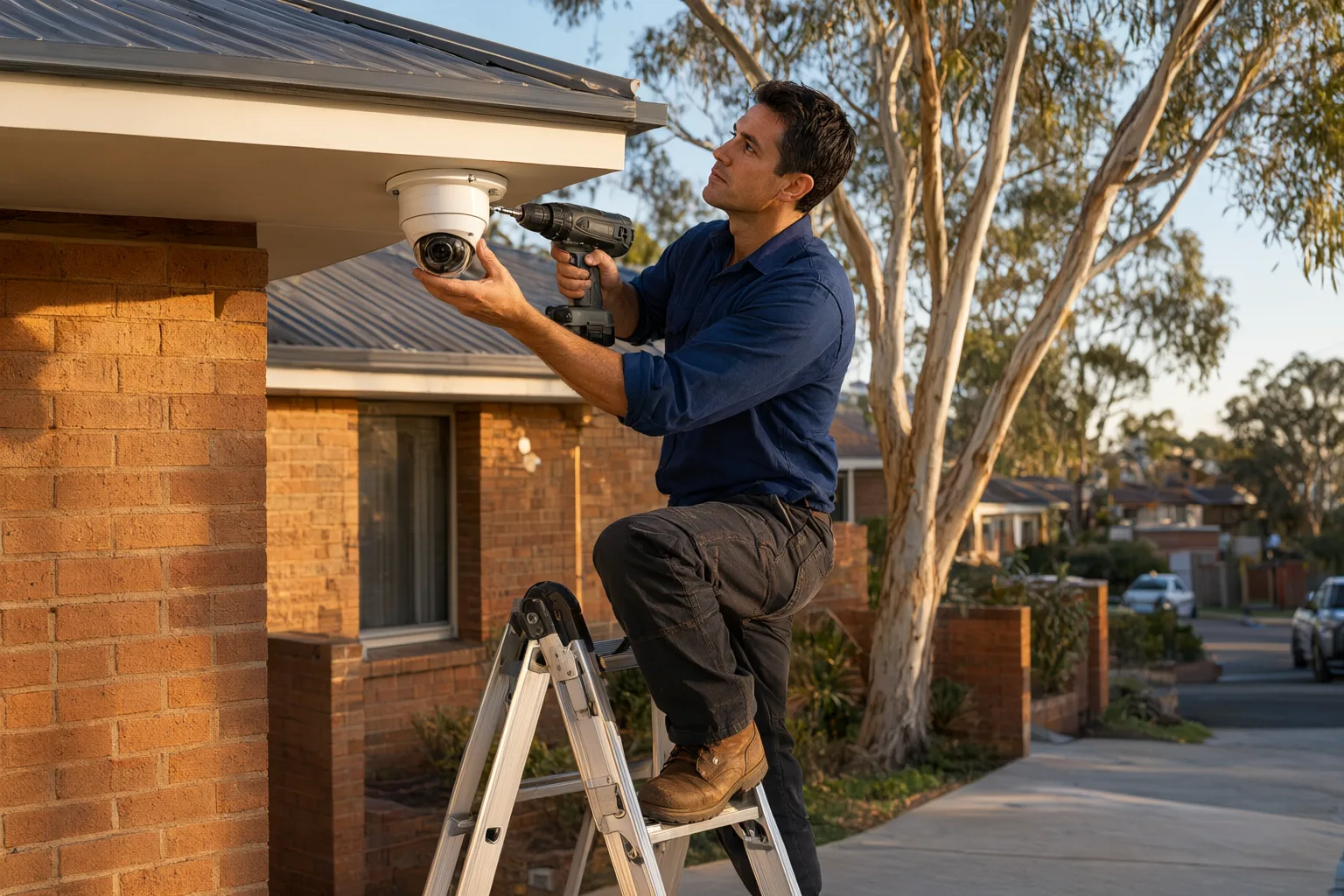
The short answer is that CCTV laws in Australia almost never require council approval for residential security cameras — but they do require licensed installation in most cases. Whether you're mounting cameras under the eaves of a Newcastle brick home or covering a coastal Adelaide property, the real legal hurdles are privacy boundaries and installer licensing, not planning permits. Understanding which rules apply to your property type saves money, avoids penalties and keeps your footage legally usable if an insurer or police ever request it.
Licensing is a different story entirely. The moment a system is hardwired into your home's structure, New South Wales law steps in with specific requirements around who can do the work. And while privacy law doesn't ban home CCTV outright, it draws firm lines about where cameras can point and what they can record. This guide walks through each of those layers so you know exactly what applies to your property.
Do Home Security Cameras Ever Need Council Approval?
For the overwhelming majority of detached houses, it simply doesn't. Installing cameras on your own dwelling is classified as a minor attachment, comparable to mounting an antenna, and no DA or council permit is needed across most NSW local government areas.
A small number of situations change that picture. Properties that are heritage-listed, or located within a heritage conservation area, may need external fixtures assessed by council to protect the streetscape. Strata-titled homes operate under their own by-laws, which often restrict drilling into common property or altering the building's exterior. And commercial premises in certain zones may require approval when cameras and cabling form part of a broader fit-out application.
If any of those apply to you, one phone call to your council's planning desk settles the question in minutes. Across hundreds of residential installations throughout NSW, we've found fewer than one job in fifty ever needs any form of council involvement at all.
What Licence Must a CCTV Installer Hold in NSW?
This is where the legal requirements become non-negotiable. Under the [[what-is-the-ideal-mounting-height-for-home-security-cameras-in-australia|Security]] Industry Act 1997, anyone in New South Wales who installs, maintains or repairs security equipment for payment must hold a Class 2 security licence issued by NSW Police. For camera work specifically, the relevant subclass is 2C — the security equipment installer category. Working without this licence is an offence carrying significant penalties.
Two further credentials often apply alongside it. Any cabling routed through walls, ceilings or conduits — including the Cat6 runs used in PoE (Power over Ethernet) IP camera systems — must be performed by a cabler registered with the ACMA (Australian Communications and Media Authority). Low voltage doesn't exempt PoE cabling from this rule. Separately, if the [[the-real-cost-of-a-4-camera-poe-system-installed-in-australia|installation]] involves connecting anything to your 240V mains supply, that portion must be done by a licensed electrician.
Before anyone sets foot on your property, ask to see their Class 2C licence and ACMA registration. A legitimate installer will produce both without hesitation.
Can You Legally Install DIY Cameras Yourself?
Yes — within limits. Battery-powered and plug-in cameras, such as wireless video doorbells, sit outside the licensing framework because they involve no structural wiring. You can mount and set these up yourself without breaching any law.
The line is drawn at hardwiring. Once cables pass through your walls, ceilings or roof space, DIY [[how-much-does-professional-cctv-installation-cost-in-australia|installation]] becomes unlawful in NSW, regardless of how confident you are with a drill. Beyond the legal risk, self-installed hardwired systems create practical problems: insurers can decline burglary claims where the security system was installed unlawfully, and there's no public liability cover if something goes wrong mid-installation.
Plug-and-play cameras suit renters and small apartments well. For anything integrated into the building, engaging a licensed professional is both the lawful and the financially safer path.
How Should You Position Cameras to Comply With Australian Privacy Laws?
Privacy law — not council approval — is where most homeowners actually strike trouble. NSW has no single statute banning residential CCTV, but three mechanisms combine to police camera placement: the common law of nuisance, the Surveillance Devices Act 2007 (NSW), and council complaint processes triggered by unhappy neighbours.
The guiding principle is simple: film your own property. Driveways, entry points, side access paths and your front fence line are all fair game. Incidental capture of the street or footpath is generally accepted. What crosses the line is deliberately recording into a neighbour's windows, backyard, pool area or anywhere else they hold a reasonable expectation of privacy.
Audio deserves special caution. Recording a private conversation you're not party to is an offence in NSW, which is why reputable installers configure residential cameras with audio disabled as standard. Getting placement right on day one prevents disputes, complaints and potential orders to reposition or remove equipment later.
Which Camera Features Keep Your System Privacy-Compliant?
Modern camera platforms make it easy to respect boundaries without sacrificing coverage. Hikvision AcuSense and Dahua WizSense models support precise privacy masks and adjustable motion detection zones, allowing a camera to monitor your boundary line while digitally excluding next door's yard from both recording and alerts.
This technology matters because compliance isn't just about avoiding fines — it's about preventing the neighbour disputes that lead to formal complaints in the first place. A camera angled slightly too wide today can become a months-long conflict tomorrow. Configuring masks and zones correctly during installation costs nothing extra and eliminates the problem entirely.
It's also worth documenting your setup. If a complaint ever arises, being able to show that your system was professionally configured with privacy masking demonstrates good faith and typically resolves matters quickly.
Are There Different CCTV Rules for Businesses, Strata and Rentals?
Business owners face a defined legal framework rather than grey areas. The Workplace Surveillance Act 2005 (NSW) requires employers to notify staff in writing before camera surveillance begins, mandates that cameras be clearly visible rather than hidden, and requires signage at entrances. Covert surveillance is lawful only with a magistrate's authority. Businesses operating across multiple states should verify each jurisdiction's notification rules, as similar obligations exist elsewhere.
Strata residents need owners corporation consent before fixing cameras to common property — external walls, eaves or shared entryways all qualify. Renters should secure written landlord approval before drilling, or choose non-permanent battery-powered options instead.
Landlords carry their own duties: cameras at rental properties must never be placed inside the home or in any area where tenants reasonably expect privacy. Breaching that expectation is treated as a serious offence, not a technicality.
Why Does a Licensed Installer Protect More Than Just Compliance?
The case for licensing extends well beyond staying on the right side of the law. Insurers can and do reject burglary claims where a hardwired security system was installed by an unlicensed operator, because the underlying work was technically unlawful — meaning your entire investment in the system could count for nothing at claim time. Licensed installers also carry public liability insurance, so if a ladder damages your Colorbond roof or a drill strikes hidden wiring, the cost doesn't land on you.
A professional engagement follows a proper sequence: site consultation, camera and NVR design matched to your property, compliant cabling, secure network configuration with remote viewing, and a full handover including training. At Aussie CCTV Cams we back installations with lifetime support and professional-grade Hikvision, Dahua, Uniview and Axis hardware selected for Australian conditions — heat, coastal salt air and storm exposure included — delivering footage quality that holds up when NSW Police request evidence.
An unlicensed cash-job operator offers none of those protections. The modest saving upfront rarely survives contact with a denied insurance claim or a botched cable run.
CCTV compliance options compared for Australian properties
| Option | Typical Cost (AUD) | Key Compliance Notes |
|---|---|---|
| DIY wireless doorbell/indoor cams | $100–$500 | No licence needed; still bound by privacy laws |
| Licensed 4-camera home package | $1,800–$3,500 installed | Installer holds NSW Class 2C or SA CBS licence |
| 8-camera business/warehouse system | $4,000–$9,000 installed | Requires workplace surveillance notices and signage |
| Pole-mounted or heritage-property install | $3,000+ plus council application | Development application may be required |