
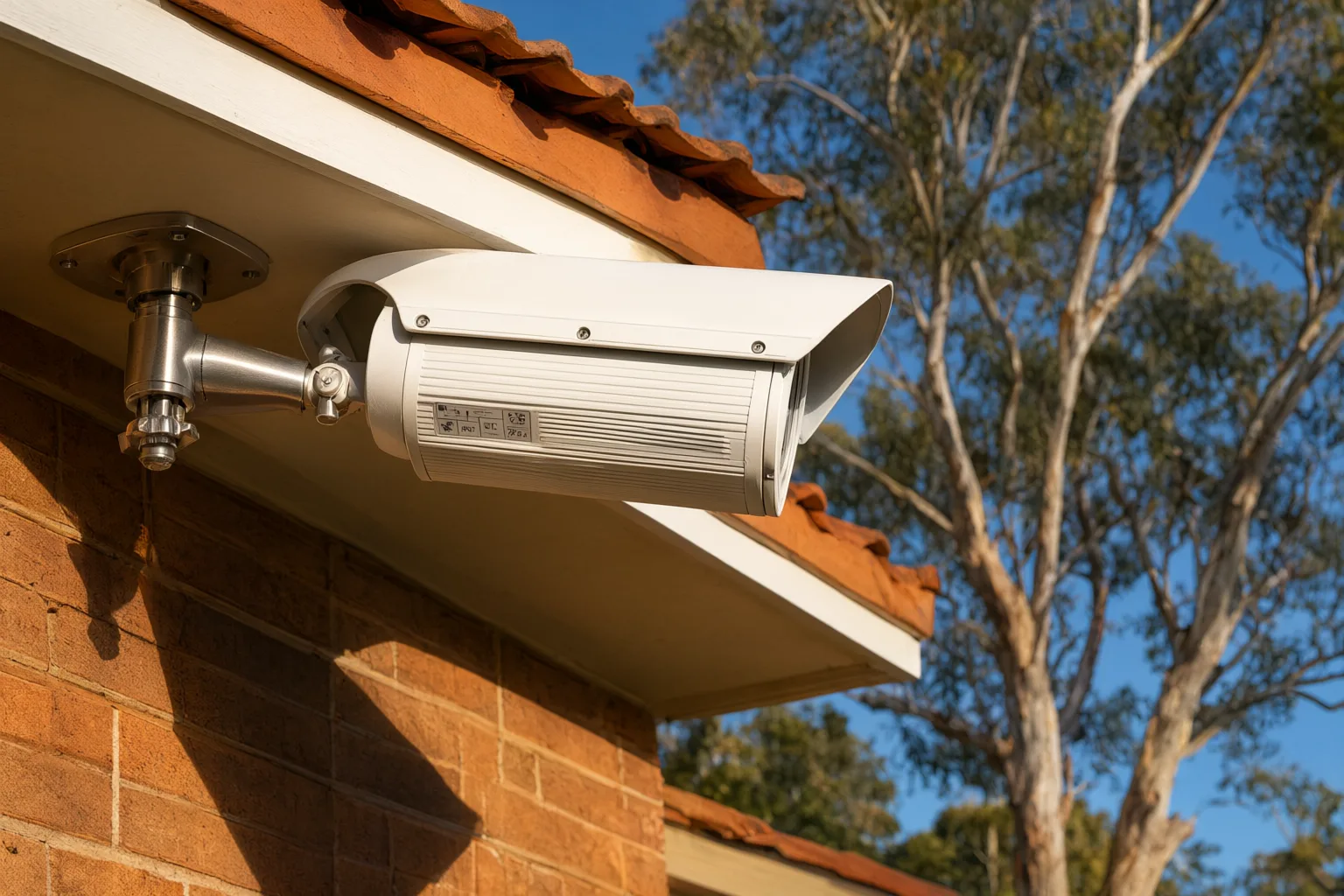
Key Takeaways
- Heat-proof CCTV cameras need an operating rating of at least 55-60°C for Australian conditions
- Camera housings in direct sun can run 15-20°C hotter than the Bureau of Meteorology forecast
- Budget kits failing every 18-24 months cost more over five years than one professional heat-rated system
- Coastal Newcastle installations face salt air plus heat; inland South Australia adds dry 45°C extremes
- Professional installation under an ACMA-registered cabler protects warranty and complies with the Privacy Act
What Temperature Can CCTV Cameras Handle in Australia?
The short answer is that heat-proof CCTV cameras are outdoor security cameras engineered to operate reliably at 55-60°C and above — temperatures common across Australia every summer. For homes and businesses in Newcastle NSW and Adelaide SA, choosing cameras with the right temperature rating typically means the difference between footage that lasts five years and hardware that fails within two summers on a sun-exposed wall.
The critical point most buyers miss is that the rating on the box refers to ambient air temperature, not the temperature inside the camera. A black housing mounted on a western-facing wall in full sun can run 30-35°C hotter than the surrounding air. On a 40°C day in Adelaide or Brisbane, that camera's internals can hit 75°C — well past the point where consumer-grade sensors, capacitors and plastics begin to fail.
Why the Temperature Inside Your Camera Exceeds the Weather Report
When the Bureau of Meteorology reports 38°C in Sydney or 42°C in Perth, a poorly ventilated camera housing mounted in direct sunlight can exceed 70°C internally. Thermal imaging of black camera housings on western-facing walls shows internal temperatures running 30-35°C above ambient during peak afternoon heat.
That 45°C rating printed on a budget camera's specification sheet assumes shaded [[installing-security-cameras-in-cyclone-prone-areas-what-you-need-to-know|installation]] with free airflow. Mount the same camera under a Colorbond eave copping full afternoon sun and you have built a thermal death trap. The CMOS image sensor starts degrading, footage turns noisy and colours shift. Capacitors dry out. Plastic housings warp and compromise weather seals. Within roughly 18 months, the camera either dies outright or produces footage too degraded to identify faces or number plates.
This pattern shows up constantly when clients call us to replace failed DIY systems: the camera performed fine through autumn and winter, then failed during the first serious heatwave. The warranty claim gets knocked back because the installation environment exceeded the manufacturer's rated specifications.
How Heat Destroys Image Sensors and Footage Quality
Image sensors fail first. CMOS sensors generate their own heat while operating, and when ambient temperature is already extreme they cannot shed that load effectively. The result is increased dark current noise, hot pixels and eventually permanent sensor damage. Footage becomes grainy and unusable — precisely when you need it to identify an intruder.
Electrolytic capacitors in the power supply circuitry have defined temperature-dependent lifespans. A capacitor rated for 2,000 hours at 85°C might last around 10,000 hours at 65°C but only about 500 hours at 95°C. Cheap cameras use low-grade capacitors to hit a price point, and sustained heat accelerates electrolyte evaporation until the power supply fails entirely.
Plastic housings and mounting brackets become brittle through UV exposure and repeated thermal cycling. We have pulled cameras off walls where the housing crumbled at a touch after just two summers. Once the housing cracks, moisture ingress follows, corroding circuit boards and connectors. The IP65 rating on the box means nothing once the enclosure itself has disintegrated.
Which Engineering Features Make Heat-Proof CCTV Cameras Last?
Professional surveillance cameras from Hikvision, Dahua, Uniview and Axis are designed for hostile environments rather than repackaged consumer products. They combine industrial-grade components, metal enclosures and active thermal management.
Hikvision's Pro series cameras are rated to 60°C as standard, with some models handling 65°C. Their aluminium alloy housings dissipate heat instead of trapping it, and internal thermal pads conduct heat away from the sensor into the housing body, which acts as a heatsink. Dahua's Starlight range operates to 60°C and adds conformal coating on circuit boards to resist moisture and corrosion in humid coastal environments.
Axis cameras, manufactured in Sweden and deployed worldwide in extreme climates, are rated to 60-65°C depending on model and undergo accelerated life testing at elevated temperatures to validate component selection. That engineering gap explains why an $89 hardware store camera and a $450 Hikvision AcuSense camera occupy completely different categories.
- Minimum 60°C operating temperature rating for Australian outdoor installations
- Aluminium alloy housing for thermal dissipation rather than plastic
- IP66 or IP67 weatherproof rating with UV-stabilised seals and gaskets
- Industrial-grade capacitors rated at 105°C with 5,000+ hour lifespan
- Conformal-coated PCBs for humidity and coastal salt-air protection
- Three-year manufacturer warranty covering Australian conditions
Should You Change Where Your Cameras Are Mounted to Reduce Heat?
Even the best camera will fail early if installed badly. Every installation we design aims to minimise thermal load: avoiding western-facing walls in full afternoon sun where possible, fitting sunshields to exposed cameras, and leaving adequate clearance around each housing for airflow.
Mounting position matters enormously. A camera under an eave with 100mm clearance above will run 8-12°C cooler than the identical camera hard-mounted against a dark Colorbond surface. We use stainless steel mounting arms that create an air gap between camera and wall, cutting conductive heat transfer.
Cable management affects reliability too. Heat degrades cheap cable insulation, causing shorts and signal loss. All exposed runs should use UV-rated outdoor cable in conduit, with connections terminated inside [[weatherproofing-your-cctv-system-for-harsh-australian-summers|weatherproof]] junction boxes rather than twisted together with electrical tape. These details stay invisible until something fails — which is exactly the point.
Can Budget Camera Kits Really Save Money Over Five Years?
A budget four-camera kit costs $300-400. If those cameras fail every 18-24 months from heat stress, you will replace the entire system two or three times across five years. Add your own time spent troubleshooting, reinstalling and coping with footage gaps while the system is down, and the real cost climbs past $1,200 — with nothing durable to show for it.
A professional four-camera Hikvision or Dahua system installed by licensed technicians costs $2,200-2,800 depending on camera models and cable runs. That system remains reliable after five years, backed by manufacturer warranty and ongoing support. Image quality stays consistent because the sensors have not degraded. You get genuine security rather than a false sense of it.
Not everyone needs $2,000 of cameras on a garden shed. But if your CCTV protects your home, business or family, the equipment must survive its environment — and across most of Australia, that means professional hardware rated for sustained high temperatures.
Do You Need a Different Temperature Rating for Newcastle vs Inland Australia?
Australia spans dramatically different climates, and your camera specification should reflect yours. For coastal NSW and Victoria, cameras rated to 55-60°C are generally adequate. For inland areas, Queensland, WA, and any site with significant western sun exposure, specify 60°C minimum.
Coastal buyers should also weigh corrosion resistance: conformal-coated circuit boards and marine-grade fixings matter in salt air, particularly within a few kilometres of the ocean. Tropical northern locations add humidity to the heat equation, making IP67 ratings and quality gaskets non-negotiable.
A proper installer assesses each individual camera position during the design phase — orientation, shading, mounting surface colour and airflow — then matches cameras with appropriate thermal ratings to each location rather than applying one blanket specification.
Is Your Existing CCTV Already Suffering Heat Damage?
Heat damage announces itself gradually before total failure. Early indicators include rising image noise (graininess), colour shifts toward purple or green tints, intermittent dropouts during hot afternoons, and complete shutdown during heatwaves.
If footage quality degrades noticeably as summer progresses, the sensor is almost certainly heat-damaged and heading for outright failure. Check whether dropouts correlate with peak afternoon temperatures — that correlation is the clearest diagnostic signal.
Acting on these signs early lets you plan a staged upgrade rather than discovering during a break-in that half your cameras died in February. Reviewing recorded footage quality at the end of each summer is a simple habit that catches degradation before it becomes a security hole.
Installation location matters as much as specification. A camera mounted under eaves on the shaded southern side of a brick home in [[/newcastle|Newcastle]] will run dramatically cooler than the identical model bolted to a western-facing Colorbond fence line absorbing afternoon sun. Our installers map sun exposure across the day before recommending mounting points, because a $150 reposition often extends camera life by years.
Australian consumer law also offers protection most buyers never use. Under the Australian Consumer Law, products must be fit for purpose — if a retailer sells a camera marketed for '[[uv-damage-to-cctv-cabling-why-cheap-cable-fails-in-the-australian-sun|outdoor]] security' that fails repeatedly in normal summer conditions, you may be entitled to repair, replacement or refund regardless of the manufacturer's warranty terms. Keep your invoices and failure records.
For commercial properties, warehouses and retail sites, heat resilience compounds with duty-of-care obligations. Business owners installing surveillance should also review the Privacy Act 1988 and, in NSW, the Workplace Surveillance Act requirements around notifying staff and visitors. A properly specified, professionally installed system keeps you compliant while surviving the climate.
Finally, coastal corrosion is the silent partner of heat damage. Salt-laden air off the Hunter coastline attacks connectors and housings almost as aggressively as thermal cycling, so we specify marine-grade mounts and dielectric grease on terminations for beachside installs — a small cost that prevents the most common callout we attend in summer.
Comparing CCTV options for Australian summer heat
| Option | Typical Cost (AUD) | Heat Performance |
|---|---|---|
| Budget DIY kit (50°C rated) | $300-400 per kit | Fails every 18-24 months in direct sun; frequent replacement |
| Mid-range pro camera (55°C rated) | $250-450 per camera | Reliable in shade or eave-mounted coastal installs like Newcastle |
| Commercial heat-rated (60°C rated) | $500-900 per camera | Survives full-sun exposure and 40°C+ Adelaide summer days |
| Professional installation package | $2,500-4,500 (4-camera system) | Correct placement, cabling and warranty support included |