
Key Takeaways
- Professional home CCTV installation typically costs $1,500–$3,000 for a four-camera system in Newcastle and Adelaide.
- Commercial CCTV projects start around $3,000 and can exceed $15,000 for warehouses and multi-site operations.
- Camera grade is the biggest price driver—consumer WiFi cameras fail within 2–3 years under Australian heat and coastal conditions.
- NSW installers need a Class 2C security licence; SA installers must be licensed under the Security and Investigation Industry Act.
- Always collect two to three written quotes and verify licence numbers before signing.
How Much Does Professional CCTV Installation Cost in Newcastle & Adelaide?
The short answer: professional CCTV installation cost in Newcastle and Adelaide typically ranges from $800 to $5,000 for homes, with most households paying $1,500–$3,000 for a quality four-camera system including NVR recording and smartphone viewing. Commercial installations start near $3,000 and climb past $15,000 for warehouses. Final pricing depends on camera grade, cable runs, roof access and storage capacity.
That price covers everything: commercial-grade cameras, a network video recorder (NVR), hard drive storage, all cabling, mounting hardware, configuration and a handover session teaching you to use the system. It's a fundamentally different product from a shelf-mounted DIY kit—professional installers fit Hikvision, Dahua, Uniview or Axis cameras engineered to withstand Australian heat, coastal salt air, storms and bushfire conditions.
Why is the range so wide? Because no two properties are alike. A single-storey brick veneer home with open roof access is a straightforward half-day job. A two-storey home requiring conduit runs, or a rural property wanting sixteen cameras linked over 4G, is an entirely different proposition. Add-ons such as ColorVu 24/7 colour night vision, AcuSense AI human and vehicle detection, and ANPR number plate recognition each shift the final figure as well.
What Should You Budget for Home CCTV Installation Prices in 2025?
The average Australian home needs four to six cameras to properly cover the front entry, driveway, side access points and backyard. Pricing falls into three common tiers.
Entry-level: $1,500-$2,200 buys four quality 6MP cameras from Hikvision or Dahua with ColorVu night vision, a 2TB NVR and smartphone remote viewing, fully installed. This tier suits single-storey homes under 200m² where the roof cavity is easy to work in.
Mid-range: $2,200-$3,200 delivers six cameras with AcuSense AI detection—which filters out false alarms triggered by pets and moving trees—plus 4TB of storage and Starlight low-light sensors. For most family homes this is the value sweet spot, covering the front door, driveway, side gates, backyard and garage.
Premium: $3,200-$5,000+ gets you eight cameras at 4K resolution, ANPR vehicle tracking, motorised varifocal lenses and 8TB of storage for extended retention. Larger properties, acreage and owners wanting maximum image detail belong here.
One catch that surprises people: two-storey homes typically add $300-$800 to any package. The extra covers longer cable runs, conduit, ladder work and safety equipment. Colorbond roofs, tight roof access and double-brick walls needing core drilling push labour costs higher still.
How Much Do Adelaide & Newcastle Businesses Pay for Commercial CCTV Installation?
Commercial pricing starts at roughly $3,000 for a small retail shop or office with four to six cameras, and climbs beyond $15,000—occasionally past $50,000—for warehouses, construction sites and multi-building facilities.
A café, retail shop or medical practice usually spends $3,000-$6,000 on six to eight cameras covering entrances, till areas, stockrooms and back doors, often with POS integration matching transactions to footage, plus remote viewing for the owner.
Mid-sized sites—warehouses under 1,000m², car yards, small manufacturing operations—typically invest $6,000-$12,000 across 12 to 16 cameras. At this level you're paying for ANPR at gates, long-range varifocal lenses for perimeter monitoring and redundant NVR storage so footage survives a hardware failure.
Large industrial facilities, construction projects and multi-tenancy buildings spend $12,000-$30,000 or more on 20 to 40+ cameras, solar-powered remote units, 4G connectivity where NBN doesn't reach, thermal imaging in bushfire-prone areas, and integration with access control and alarm systems.
Commercial quotes should also include a site survey, cable management to Australian standards, UPS battery backup and frequently an ongoing maintenance contract. A licensed installer provides the compliance certificates your insurer and workplace health and safety obligations demand.
Which Five Factors Change Your CCTV Installation Quote the Most?
Camera grade is the single biggest driver. Consumer-grade DIY cameras retail for $50-$150 each but commonly die within two to three years under Australian conditions. Professional cameras from Hikvision, Dahua or Axis run $200-$800 each yet deliver seven to ten-plus years of service, with IP66/IP67 weatherproofing, wide dynamic range for harsh sunlight, and operating tolerances from -30°C to 60°C.
Cabling difficulty comes next. Labour scales with how hard your property is to cable. Easy roof cavity access keeps costs down; conduit runs, core drilling through double brick, or trenching out to a detached garage or granny flat push them up. Budget $150-$300 per camera point for difficult routes.
Storage capacity matters too. A basic 2TB drive holds roughly two to three weeks of footage from four cameras. Stepping up to 4TB (about $150 extra) or 8TB (about $300 extra) stretches retention to four to eight weeks—worthwhile for businesses with evidence-retention obligations and homeowners who travel.
Smart features add measurable value. ColorVu adds $50-$100 per camera and gives full-colour night footage instead of grainy black-and-white infrared. AcuSense AI costs $80-$150 per camera and cuts false alarms by around 90%. ANPR cameras add $400-$800 but automatically log every vehicle entering your property.
Finally, connectivity and power. Sites without NBN need a 4G router ($200-$400). Locations without mains power—farms, construction sites, rural blocks—need solar panels with battery backup at $800-$1,500 per camera location.
Is DIY or Professional CCTV Installation Cheaper Long-Term?
Hardware store DIY kits cost $400-$1,200, which looks like a bargain on paper. The catch is what you actually get. Most DIY cameras run on WiFi, which struggles to penetrate the brick veneer construction and Colorbond roofing common in Australian homes. Battery-powered models need recharging every two to four months and frequently fail in summer heat.
A professionally installed system uses PoE (Power over Ethernet) cabling—one cable delivering both power and data, immune to WiFi dropouts and interference. Just as valuable is the installer's experience: placing cameras to eliminate blind spots, avoid backlighting problems, and stay on the right side of privacy laws covering neighbouring properties.
DIY systems also tend to skimp on storage, funnelling you into ongoing cloud subscription fees. There's no workmanship warranty, and insurers can reject claims if footage quality is inadequate or cameras weren't fitted to manufacturer specifications.
Run the honest maths: a competent DIYer will spend 8-12 hours on the job, plus tools, cables and the risk of getting placement wrong and redoing it. Professional [[the-real-cost-of-a-4-camera-poe-system-installed-in-australia|installation]] often ends up costing only $500-$800 more in net terms—while delivering far better reliability, image quality and equipment lifespan.
What Does a Professional CCTV Installation Include?
A reputable installer works through five defined stages. It starts with an on-site consultation: walking the property, identifying vulnerable entry points, understanding your specific concerns—break-ins, package theft, keeping an eye on kids or elderly parents—and recommending camera types and positions to match.
Next comes a detailed written quote itemising cameras, NVR, storage, cabling, labour and optional extras. This itemisation matters because it lets you compare competing quotes like-for-like.
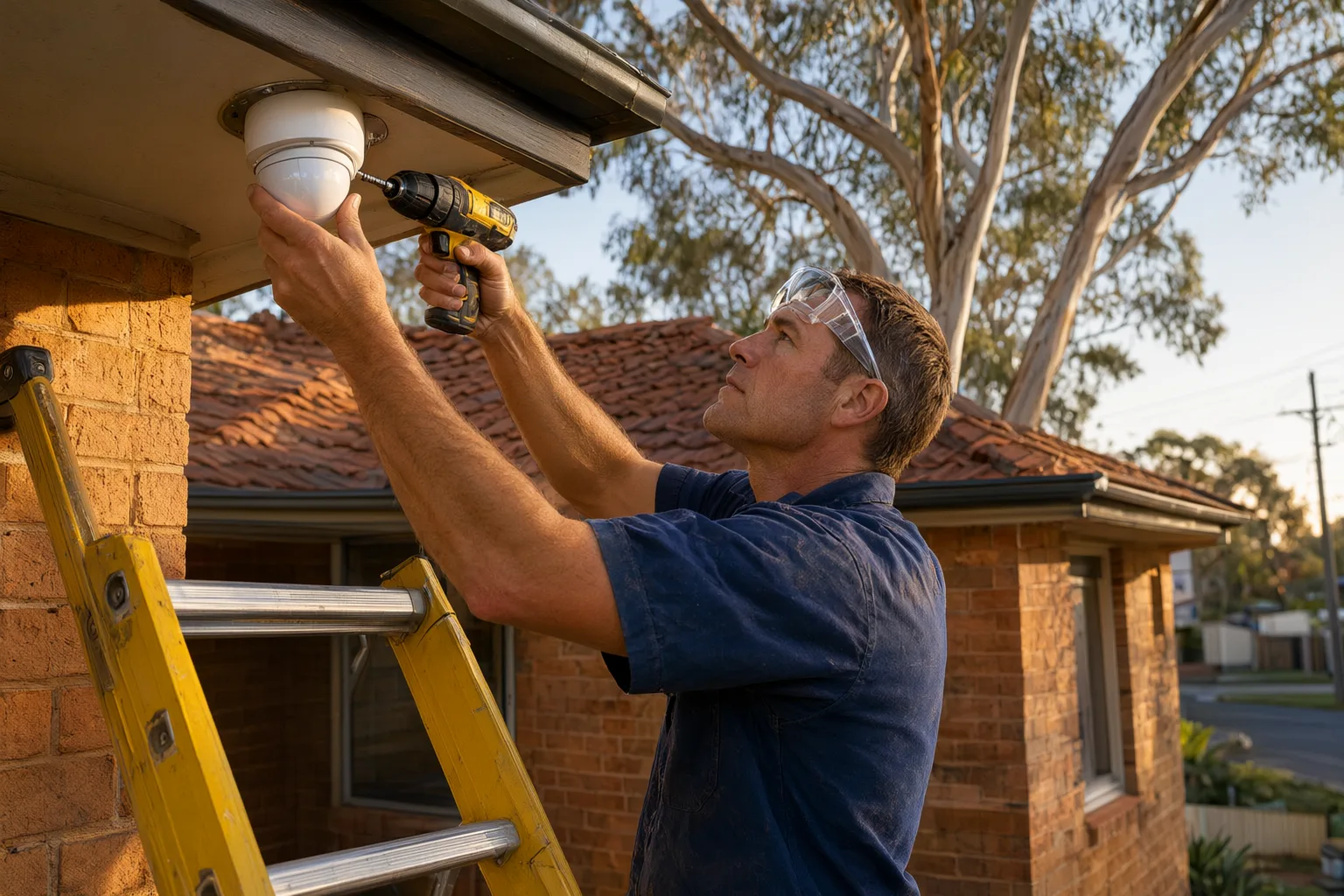
The installation itself is handled by licensed technicians who mount cameras, run cabling through roof cavities or conduit, secure the NVR in a protected spot, and complete all work to Australian electrical standards. Quality operators use cable clips, conduit and weatherproof junction boxes—not cable ties and optimism.
Stage four is configuration: recording schedules, motion detection zones, remote viewing on your smartphone, and integration with any existing alarm or intercom system.
The final stage is training. You should be shown how to watch live footage, play back recordings, export evidence for police and adjust settings yourself. You'll also receive all passwords, warranty paperwork and support contact details.
Should You Compare Multiple Quotes Before Booking an Installer?
Always collect two to three written quotes from licensed, insured installers. In NSW, [[poe-vs-wi-fi-cameras-which-is-better-for-australian-homes|security]] installers must hold a Class 2C security licence and carry public liability insurance. Ask for licence numbers and check them through NSW Fair Trading before committing.
A trustworthy quote names equipment by brand and model number—not just "4 cameras"—states storage capacity, maps out cabling routes, and spells out warranty terms. Expect a minimum of two years on equipment and 12 months on workmanship.
Treat any quote dramatically cheaper than the rest with suspicion. Lowball pricing usually means grey-import cameras with no Australian warranty, sloppy cabling clipped along gutters, or no insurance cover. If one quote sits 40% or more below the others, ask the installer to explain the gap.
The best installers quote on-site for free, explain things in plain English, provide recent local jobs as references, and won't pressure you into signing on the spot. They'll also plan ahead—ensuring your NVR has spare channels and your cabling layout allows extra cameras to be added cheaply later.
Which Security Camera Placement Delivers Maximum Coverage Value?
Even the most expensive camera is wasted money if it points at the wrong thing. Experienced installers prioritise the front door first—it features in the majority of residential break-ins nationally—followed by the driveway, rear doors and ground-floor windows. Side gates deserve attention too, offering concealed backyard access away from street view.
[[what-is-the-ideal-mounting-height-for-home-security-cameras-in-australia|Mounting height]] matters more than most homeowners realise. Cameras positioned around 2.5 to 3 metres capture usable facial detail while staying out of easy reach. Higher and you mostly film the tops of heads; lower and you invite tampering. A professional will also angle lenses away from direct morning and afternoon sun, which is punishing during an Australian summer and can wash out footage entirely.
Avoid pointing cameras directly at neighbouring properties, bathroom windows or public footpaths beyond your boundary. Beyond being poor form, it can breach state privacy expectations and give neighbours legitimate grounds to complain. A licensed installer knows these boundaries and designs coverage accordingly.
Think about lighting as well. A camera facing a porch light records silhouettes at night; a camera with the light behind it captures clear faces. If budget allows, pairing cameras with motion-activated floodlights dramatically improves night-time image quality without premium low-light hardware everywhere.
Do CCTV Storage Costs Affect Your Total Installation Price?
Retention depends almost entirely on hard drive capacity, recording settings and camera count. As a rule of thumb, a 2TB drive stores roughly two to three weeks of motion-triggered recording from four cameras. Doubling to 4TB extends that to around four to six weeks, and 8TB reaches eight weeks or more for a typical home setup.
Resolution choices affect storage too. A 6MP camera produces sharper images than 1080p but consumes noticeably more drive space. Modern H.265 compression mitigates this significantly, squeezing high-resolution video into far less storage than older codecs managed—which is why today's systems retain footage much longer than equivalents from five years ago.
For evidence purposes, clarity beats quantity. Police and insurers want footage where faces and number plates are identifiable, meaning adequate resolution, sensible frame rates and clean lens placement matter more than months of archived grain. Most Australian insurers expect retention of at least 30 days for commercial claims, so businesses should size drives accordingly.
Don't forget redundancy. An NVR tucked in a ceiling space or locked cupboard protects footage from opportunistic thieves who smash visible recorders. Some setups add offsite or cloud backup of critical clips, giving you evidence even if the recorder itself is stolen—a worthwhile consideration for shops and offices holding cash.
Are There Hidden Ongoing Costs After Your CCTV Installation?
Security installation is a licensed trade in Australia, and requirements vary by state. In NSW, installers must hold a Class 2C security licence issued under the Security Industry Act and carry public liability insurance. Victoria, Queensland and other states run comparable schemes, so always verify credentials through the relevant regulator—NSW Fair Trading, the Victorian Police Licensing & Regulation Division, or your state equivalent—before signing anything.
On privacy, homeowners generally have wide latitude to film their own property, but obligations kick in at the boundary. Recording conversations raises separate issues under state surveillance device legislation, so audio recording should be avoided unless you've taken specific advice. Businesses face stricter duties: signage notifying customers of surveillance is expected, and footage handling must respect the Australian Privacy Principles where personal information is collected.
Workplace health and safety rules also shape commercial installations. Cabling near switchboards, working at heights and drilling into structural elements all fall under WHS obligations—another reason unlicensed or uninsured operators are a false economy. If something goes wrong on your site, liability can land on you.
Keep records of what was installed, when, and by whom. Warranty paperwork, compliance certificates and the installer's licence number all become valuable if you ever need to make an insurance claim or sell the property with the system included.
Can You Legally Install CCTV Yourself Under NSW & SA Surveillance Laws?
Budgeting shouldn't stop at installation day. A well-built system needs surprisingly little ongoing spend, but a few items recur. Hard drives in continuous-use NVRs typically last three to five years before replacement, at roughly $100-$250 depending on capacity. Firmware updates keep cameras secure against vulnerabilities, and reputable installers either handle these remotely or show you how during handover.
Many commercial clients take a maintenance contract—commonly a few hundred dollars annually—for scheduled inspections, lens cleaning, firmware patching and priority callouts. For a business relying on footage for insurance and staff safety, that peace of mind usually pays for itself the first time a camera fault is caught before it matters.
Homeowners can handle most upkeep themselves: gently wiping lenses a couple of times a year (coastal salt spray makes this essential), checking that spider webs and foliage aren't blocking views, and confirming recordings are actually saving. A surprising number of failed claims trace back to a full hard drive or a disconnected cable nobody noticed for months.
Plan for expansion early. Choosing an NVR with spare channels—say an eight-channel unit even if you install four cameras now—costs little extra upfront and lets you add coverage later without replacing core equipment. Running conduit to likely future camera positions during the initial install costs a fraction of retrofitting later.
Why Does Camera Grade Matter Most in Your CCTV Price Guide?
Camera grade matters because Australian conditions are unforgiving. Coastal salt air in [[/newcastle|Newcastle]] suburbs like Merewether corrodes cheap housings, while summer roof temperatures across [[/adelaide|Adelaide]]'s western suburbs regularly exceed 60°C, cooking budget electronics until sensors fail or images wash out. Professional-grade cameras rated IP67 with metal housings and wide operating temperature ranges routinely deliver eight to ten years of reliable service, which is why we specify them by default.
For most Newcastle and Adelaide properties, the sweet spot sits between the bargain bin and the premium tier. A four-camera professional system with a quality NVR, Cat6 cabling through ceiling cavities and eaves-mounted vandal domes delivers sharp 4MP–8MP footage that police actually accept as evidence. Spending less usually means replacing hardware within three years; spending far more rarely adds value unless you operate a high-risk commercial site requiring analytics, number-plate recognition or 24/7 monitoring integration.
2025 CCTV Installation Options Compared – Newcastle & Adelaide Pricing
| Option | Typical Cost (AUD) | Best For | Expected Lifespan |
|---|---|---|---|
| DIY WiFi kit (self-install) | $400–$1,200 | Renters, small units | 2–3 years |
| Professional 4-camera home system | $1,500–$3,000 | Family homes, driveways | 8–10 years |
| Premium 6–8 camera system + NVR upgrade | $3,000–$5,000 | Large homes, acreage | 10+ years |
| Commercial retail/office package | $3,000–$10,000 | Shops, cafes, offices | 8–12 years |
| Warehouse/multi-site deployment | $15,000–$50,000+ | Logistics, construction | 10+ years |