
Key Takeaways
- IP66 is the minimum ingress protection rating for any weatherproof CCTV camera installed outdoors in Australia.
- Camera housings in direct Australian sun can exceed 70°C internally, so professional models rated to 60°C ambient are essential.
- Australia's extreme UV degrades standard cable insulation within 2-3 years; UV-rated cable in conduit lasts far longer.
- Summer storm surges destroy unprotected NVRs and cameras; multi-point surge protection costs $150-$400 per system.
- Coastal properties near Newcastle beaches need 316 stainless fixings to prevent corrosion within months of installation.
- CCTV cabling in NSW and SA must be installed by an ACMA Open Cabler registered technician under AS/CA S009 rules.
What Does It Take to Weatherproof a CCTV System in Australia?
The short answer is: weatherproofing a CCTV system for an Australian summer comes down to four things: choosing cameras with an IP66 rating or better, mounting them out of direct sun where possible, protecting every cable from UV and moisture, and installing surge protection against summer storms. Get these right and a quality system will run reliably for eight to twelve years; get them wrong and even expensive equipment can fail within a couple of seasons.
This guide explains exactly how heat, ultraviolet radiation, storms, salt air and bushfire conditions affect security cameras across Australia, and what professional installers do differently to keep systems alive through decades of harsh conditions.
Why Do Australian Summers Destroy Poorly Protected Cameras?
Australian summers attack security equipment from every direction. Across much of NSW and the rest of the continent, ambient temperatures regularly push past 40°C — and that is only the starting point. A camera bolted to a north-facing wall in full sun can reach internal temperatures of 70°C or more, far beyond the operating range of consumer-grade gear.
Then there is the sun itself. Australia experiences some of the most intense ultraviolet radiation on the planet, and UV steadily breaks down plastic housings, rubber seals and cable insulation. What begins as slight discolouration turns into brittleness, cracking and eventually water ingress. Layer on sudden summer storms, dust infiltration and the occasional hailstorm, and inadequately protected equipment simply does not survive.
At Aussie CCTV Cams we have replaced hundreds of failed DIY systems that were never built for these conditions. Professional-grade [[why-australian-heat-kills-cheap-cctv-cameras-and-what-to-buy-instead|cameras]] from Hikvision, Dahua, Uniview and Axis are engineered to a different standard — but even they depend on correct installation to deliver their full lifespan.
How Much Ingress Protection Does Your Camera Need?
The IP (Ingress Protection) rating on a camera tells you precisely how well it resists dust and water. The first digit covers solid particles; the second covers liquids. For [[uv-damage-to-cctv-cabling-why-cheap-cable-fails-in-the-australian-sun|outdoor]] installations anywhere in Australia, IP66 should be treated as the floor, not the ceiling.
IP66 means the camera is completely dust-tight and can withstand powerful water jets from any direction — enough to handle driving rain, hose-down cleaning and dust storms. IP67 adds protection against temporary immersion up to one metre, which matters in flood-prone locations or spots where water pools during extreme weather.
Cheaper cameras frequently carry IP65 or lower. IP65 handles only low-pressure water jets and can fail under sustained driving rain. We have seen IP65 cameras die within eighteen months when mounted on exposed eaves facing the prevailing weather. The small upfront saving quickly becomes an expensive replacement. Every [[installing-security-cameras-in-cyclone-prone-areas-what-you-need-to-know|installation]] meets the Privacy Act 1988 and the relevant state Security Industry Act licensing obligations.
- IP65: dust-tight, resists low-pressure water jets — sheltered positions only
- IP66: dust-tight, resists powerful water jets — the minimum for exposed Australian installations
- IP67: dust-tight, survives temporary immersion up to 1 metre — ideal for flood-prone areas
- IP68: dust-tight, handles continuous immersion — generally reserved for specialised applications
Can Camera Positioning and Housing Colour Reduce Heat Damage?
Every camera has a specified operating temperature range. Professional models typically cope with -30°C to 60°C, while consumer units often max out at 50°C or less. Critically, those ratings assume ambient air temperature — not the superheated microclimate inside a housing baking in full sun.
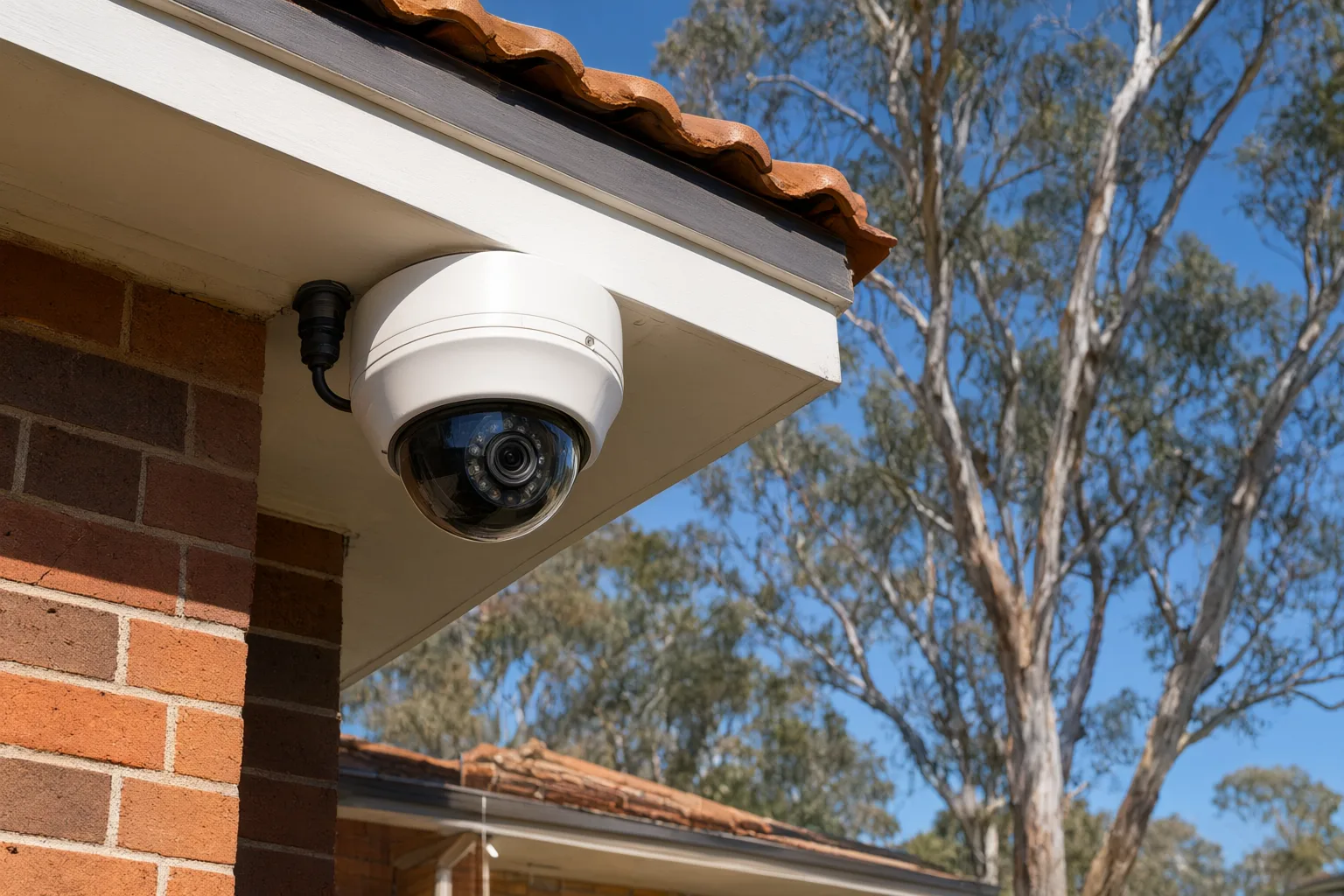
Housing colour makes a measurable difference. Dark housings absorb far more solar radiation: a black camera mounted near a Colorbond roof in western Sydney can exceed its rated limits even on a 38°C day. White or light-grey housings reflect heat and run significantly cooler.
Positioning matters just as much. Mounting under eaves shades the camera through the harshest midday sun while preserving clear sightlines. Where eave mounting is not possible, installers fit sun shields — small metal canopies that cast shade without blocking the lens. For cameras that must face north or west, we select models with extended temperature ratings and make sure there is adequate airflow around the housing.
Are Your Housings and Cables Safe from UV Damage?
Australia's UV levels are among the highest recorded anywhere on Earth, and standard plastics and rubber compounds deteriorate rapidly under that assault. Housings turn chalky and brittle, rubber gaskets shrink and crack, and cable insulation perishes until conductors are exposed to moisture.
Professional-grade cameras use UV-stabilised polycarbonate housings rated for decades of sun exposure. The difference is obvious after only a few years — a quality Axis or Hikvision housing still looks nearly new while a budget alternative has yellowed and split.
Cabling deserves equal attention. We specify UV-rated cable for every outdoor run and, wherever practical, route it inside conduit or along protected paths. Exposed cable on a north-facing wall might last five years; the same cable in conduit will outlast the camera it feeds.
Do You Need Surge Protection Against Summer Storms?
Summer storms bring lightning, and lightning brings power surges. These surges travel through power lines, data cables and even the ground itself. A strike nearby can destroy cameras, NVRs and network equipment instantly — and a standard power board offers almost no defence.
Professional installations include surge protection at multiple points. The NVR and network gear connect through quality surge-protected outlets, while outdoor cameras on long cable runs get inline surge protectors that divert voltage spikes before they reach sensitive electronics.
For properties in lightning-prone locations — elevated sites, rural properties, anywhere with a strike history — dedicated lightning protection is warranted. That means proper earthing, gas discharge tubes on camera lines and electrical isolation between outdoor and indoor equipment. It is an investment that pays for itself the first time a serious storm rolls through.
Should Coastal and Bushfire Zone Properties Use Special Equipment?
Salt air dramatically accelerates corrosion. Properties within a few kilometres of the coast need marine-grade equipment and fixings — standard steel screws and brackets rust within months, staining walls before eventually failing. We use 316-grade stainless steel fixings and ensure every housing carries an appropriate corrosion resistance rating.
Bushfire zones pose a different set of threats. Cameras and cabling must tolerate extreme radiant heat during fire events, and ember attack can ignite debris that has accumulated around equipment. We position cameras to minimise ember build-up, run cable in metal conduit rather than plastic, and seal every external cable entry against ember penetration.
Both environments reward regular maintenance. Coastal cameras need periodic cleaning to remove salt build-up that etches lenses and corrodes connections, while bushfire zone systems should be inspected before each fire season to clear debris and confirm all seals remain intact.
Which Camera Specifications Match Your Environment?
There is no single weatherproofing formula that suits every Australian property. A suburban home in the inner west faces very different conditions from a beachside house on the Central Coast or a farm in the state's northwest. The table below summarises the minimum specifications we recommend for the most common environments.
Use it as a starting point for conversations with your installer — a licensed professional will assess your exact sun angles, prevailing weather, salt exposure and lightning risk before recommending equipment.
Is Professional Installation Worth It for Long-Term Reliability?
Weatherproofing is not a single product you buy off the shelf — it is a series of design decisions made during installation. Camera selection, positioning, mounting hardware, cable routing, sealing and surge protection all work together, and missing any one element creates a failure point.
Our licensed installers assess your property's specific exposure conditions during the initial consultation: sun angles throughout the day, prevailing weather direction, proximity to salt air, lightning risk and dozens of other factors. The result is a system designed for your environment rather than a generic package installed the same way everywhere.
Every Aussie CCTV Cams installation includes our lifetime support commitment. If a camera fails due to environmental factors, we diagnose the cause and fix the root problem — not just swap the unit and hope for the best. Contact us for a free quote on a CCTV system built to handle everything an Australian summer can deliver.
Recommended Camera Specifications by Australian Environment
| Environment | Minimum IP Rating | Housing Material | Special Requirements |
|---|---|---|---|
| Standard suburban | IP66 | UV-stabilised polycarbonate | Sun shield for north/west facing |
| Coastal (within 5km of ocean) | IP66 | Marine-grade with corrosion coating | 316 stainless fixings, regular cleaning |
| Rural/inland (extreme heat) | IP66 | Metal housing, light colour | Extended temp rating (-40°C to 70°C) |
| Bushfire zone | IP66 | Metal housing | Metal conduit, ember-sealed entries |
| High lightning risk | IP67 | Any professional grade | Dedicated surge protection, proper earthing |