
Key Takeaways
- Professionally installed construction time-lapse cameras cost $800–$2,500 across Australia.
- Solar-powered 4G units run autonomously for months on remote sites without mains power.
- Timestamped footage supports claims under the Security of Payment Act in NSW and SA disputes.
- Time-lapse documentation is strongest when installed before groundbreaking at bare earth stage.
- Standard CCTV handles live security while time-lapse captures long-term project records.
- Cloud platforms let builders share progress updates with clients anywhere in Australia.
What Is a Construction Time-Lapse Camera and Why Does It Matter?
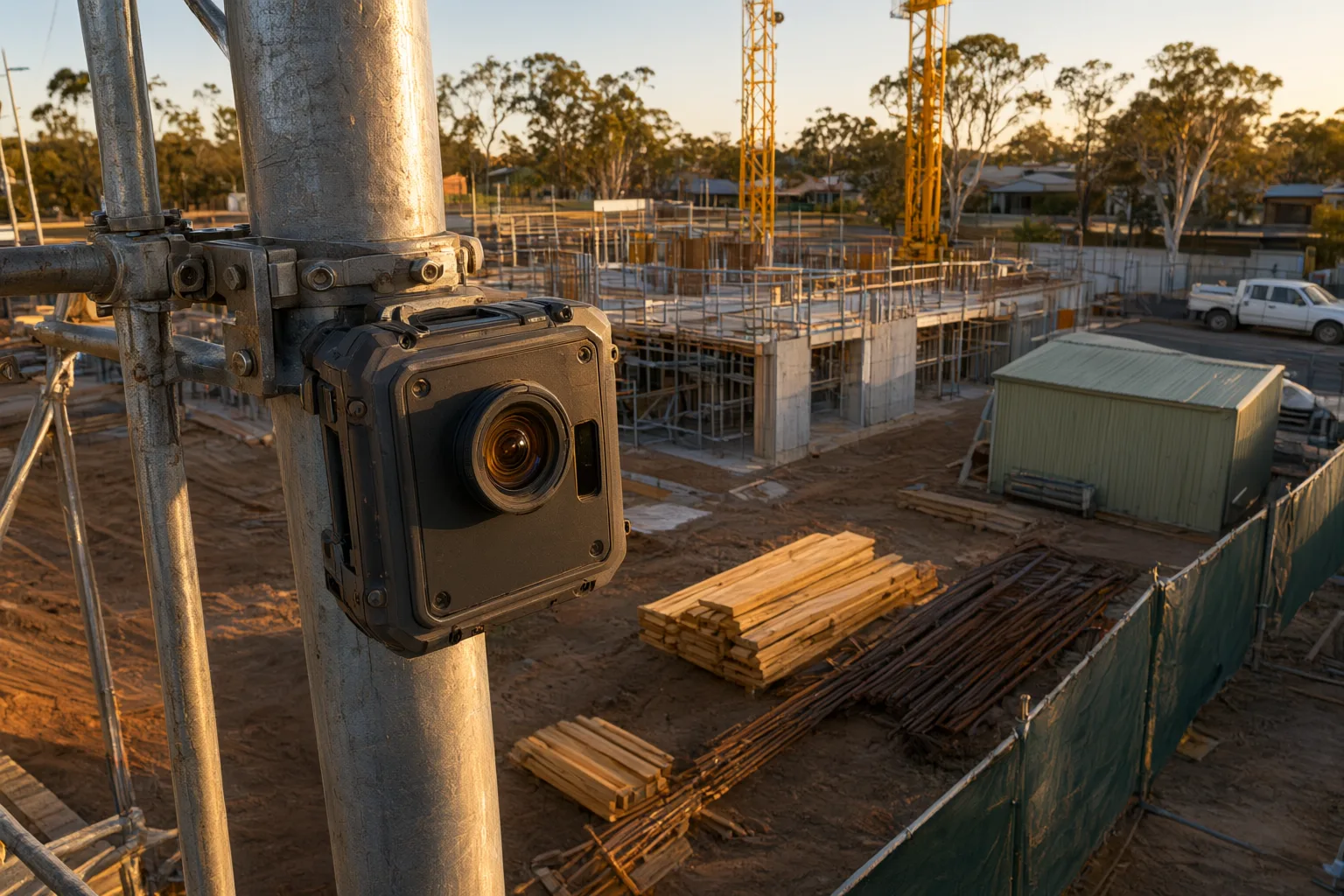
A construction time-lapse camera is a ruggedised unit that photographs your site every 5–15 minutes, stitching frames into video that doubles as marketing content and legal-grade evidence. For Australian builders, a professionally installed system typically costs $800–$2,500 and delivers dispute-proof documentation plus client-winning promotional footage from groundbreaking to handover.
For Australian builders, developers and project managers, this single device answers three pressures at once. Clients want transparency about progress. Stakeholders want updates they can actually digest. And when disagreements emerge over delays, damage or workmanship, everyone wants proof rather than competing versions of events.
That dual function — compelling marketing asset and objective evidentiary record — is why time-lapse has moved from novelty to near-standard specification on commercial projects across New South Wales and beyond. It is affordable, low-maintenance, and continues working quietly in the background from groundbreaking through to handover.
Why Does Time-Lapse Footage Turn Construction Into Marketing Gold?
In a crowded [[construction-site-cctv-protecting-plant-tools-and-materials-after-hours|construction]] market, showing what your team delivers beats telling people about it every time. A professionally produced time-lapse video of a finished project is among the most persuasive marketing assets a builder or developer can own, demonstrating capability, scale and professionalism in a format anyone can consume in under two minutes.
These videos earn their keep across multiple channels. They perform strongly on websites and social media, add weight to tender submissions, and give developers marketing off-the-plan apartments or commercial tenancies a way to build buyer confidence by showing genuine, verifiable progress rather than renders alone.
Project managers put the same footage to work internally. A short clip communicates progress in stakeholder reports and board presentations far more memorably than written updates or static photographs. Some builders go further and embed live time-lapse feeds on project websites, letting clients and investors check in whenever they like — a transparency feature that immediately separates them from competitors who offer nothing comparable.
Can Time-Lapse Cameras Resolve Australian Construction Disputes?
Disputes are an unfortunate fixture of the Australian building industry. Arguments over programme delays, damage to fencing or neighbouring property, missed material deliveries, subcontractor attendance and workmanship quality can escalate quickly — and without hard evidence they often collapse into one party's word against another's.
A continuous, timestamped visual record changes that dynamic completely. The footage shows exactly what happened, when it happened and who was present. If a subcontractor claims three days on site but the frames show otherwise, the argument ends there. If a delivery driver clips a hoarding panel or damages an adjoining property, the moment is captured.
This kind of evidence is increasingly accepted in adjudication proceedings under the [[solar-powered-vs-hardwired-cameras-for-construction-sites-which-wins|Security]] of Payment Act, in insurance claims, and in tribunal hearings. It does not replace proper contracts, daily diaries and site records — but as a supplement it can save tens of thousands of dollars in legal fees and lost programme time.
There is also a natural-disaster dimension. For builders operating in bushfire-prone or flood-affected areas of NSW, time-lapse imagery documenting site conditions before and after a weather event can be critical supporting evidence for insurance claims and compliance reporting. Every installation meets the Privacy Act 1988 and the relevant state Security Industry Act licensing obligations.
Which Time-Lapse System Suits Your Site: Power, Connectivity and Image Quality?
Not all time-lapse cameras are equal, and the right choice depends on your site conditions, project duration and whether you also need live security monitoring. Power and connectivity come first. Many sites — particularly in early stages or rural locations — have no mains power and no fixed internet. Solar-powered cameras with 4G connectivity solve both problems, running fully autonomously for months at a time.
Australian conditions are unforgiving, so look for purpose-built hardware with weatherproof housings rated for extreme heat, dust, driving rain and coastal salt air. Consumer-grade equipment rarely survives a full project duration outdoors.
Image quality matters for both purposes. Cameras capturing at least 4K resolution stills, with wide dynamic range to handle harsh midday sunlight and deep shadow, produce footage sharp enough for marketing use and detailed enough for evidentiary review. Professional platforms built on Hikvision or Dahua hardware can combine time-lapse capture with live CCTV monitoring from a single device.
Finally, consider storage and retrieval. Cloud-based platforms let you view images, download compiled videos, share progress clips with clients and pull evidence files on demand from anywhere. Local SD card storage is a useful backup, but cloud access is the practical choice for most commercial projects.
Is Time-Lapse Better Than Standard CCTV for Your Building Site?
Time-lapse cameras and standard CCTV serve different — but complementary — purposes, and understanding the distinction helps you spend wisely. Standard CCTV cameras such as Hikvision AcuSense or Dahua TiOC models are built for real-time security: continuous or motion-triggered video recording, motion detection, instant alerts and close-range detail. They are essential for deterring theft, vandalism and unauthorised access after hours and on weekends.
Time-lapse cameras work differently. They capture individual frames at intervals rather than continuous video, which means dramatically lower power consumption and storage requirements. That makes them ideal for documenting progress over weeks and months — but they are not a substitute for live security monitoring when an incident is happening now.
The strongest setup for many Australian sites combines both: a time-lapse camera for documentation and marketing alongside a CCTV system for security. Some professional platforms deliver both functions in one unit, reducing hardware costs and simplifying installation. A licensed security installer can assess your site and recommend the right mix for your project scope and budget.
Do You Know What Time-Lapse Systems Cost in Australia?
Budgeting accurately helps you justify the investment to clients and stakeholders. A professionally installed single-camera time-lapse system typically costs between $800 and $2,500 in Australia, depending on the power source, connectivity method, camera quality and expected project duration. Solar-powered 4G units suited to remote sites generally sit toward the higher end of that range because of the additional solar, battery and cellular hardware involved.
By comparison, a multi-camera CCTV security system for a [[construction-site-theft-in-australia-statistics-hotspots-and-prevention|construction site]] typically starts around $1,500 and can exceed $5,000 installed, depending on camera count, recording infrastructure and monitoring requirements. Where budget allows, combining both functions delivers documentation and protection in one coordinated package.
Against those figures, consider the return: a single avoided dispute, successful insurance claim or won tender can repay the entire system cost many times over. Add the ongoing marketing value of finished-project footage, and the business case becomes straightforward for most commercial builders.
Should You Hire a Professional Installer for Site Time-Lapse Cameras?
Bolting a camera to a fence post is not a professional time-lapse deployment. Positioning, height, angle, weatherproofing, power management and network configuration all determine whether the footage you capture is usable — and whether the system survives the full project duration outdoors.
A licensed installer will assess your site layout, identify the best vantage point — often a neighbouring structure, temporary pole or site shed — and ensure the camera captures the full scope of works without obstruction as the build rises. They will configure capture intervals, cloud uploads and remote access so everything runs reliably from day one to handover, then train your team on retrieving footage and compiling videos.
At Aussie CCTV Cams, our licensed and insured NSW installers follow a proven five-step process: consult, design, install, configure, and handover with training. We install professional-grade hardware from Hikvision, Dahua, Uniview and Axis — not consumer DIY kits — and back every installation with lifetime support. Whether your project is a suburban residential build, a CBD high-rise or a remote rural site running on 4G, we design a time-lapse and security solution engineered for real Australian conditions.
Are You Ready to Start Time-Lapse Documentation on Your Next Project?
The best time to install a time-lapse camera is before work begins — the opening frames of a video that starts at bare earth are the most dramatic, and the evidentiary record is only complete if it covers the entire programme. Retrofitting partway through leaves gaps that weaken both the marketing story and any future dispute position.
Start by defining your objectives: is marketing the priority, dispute protection, stakeholder reporting, or all three? Your answer shapes camera placement, image quality requirements and whether live CCTV should be included. Then engage a licensed installer for a site assessment covering power, connectivity, vantage points and mounting options.
Builders, developers and project managers across Australia increasingly specify time-lapse as a standard requirement on commercial projects. Getting a free quote early means your system is capturing from day one — protecting your project, promoting your brand and giving you evidence you hope you never need but will be glad to have.
Time-Lapse vs Standard CCTV for Building Sites
| Feature | Time-Lapse Camera | Standard CCTV Camera |
|---|---|---|
| Primary purpose | Long-term project documentation and marketing | Real-time security monitoring and threat detection |
| Recording method | Still images at set intervals (e.g. every 5–15 min) | Continuous or motion-triggered video |
| Power consumption | Very low — suits solar-powered setups | Higher — typically requires mains or PoE |
| Storage requirements | Low — individual frames use minimal space | High — continuous video requires large NVR storage |
| Marketing value | Excellent — produces shareable progress videos | Limited — raw footage is not presentation-ready |
| Dispute evidence | Strong — timestamped visual record over weeks/months | Strong — detailed video of specific incidents |
| Best for | Progress documentation, stakeholder updates, marketing | Theft prevention, after-hours alerts, incident capture |
| Typical cost (installed) | $800–$2,500 depending on power and connectivity | $1,500–$5,000+ for a multi-camera site system |