
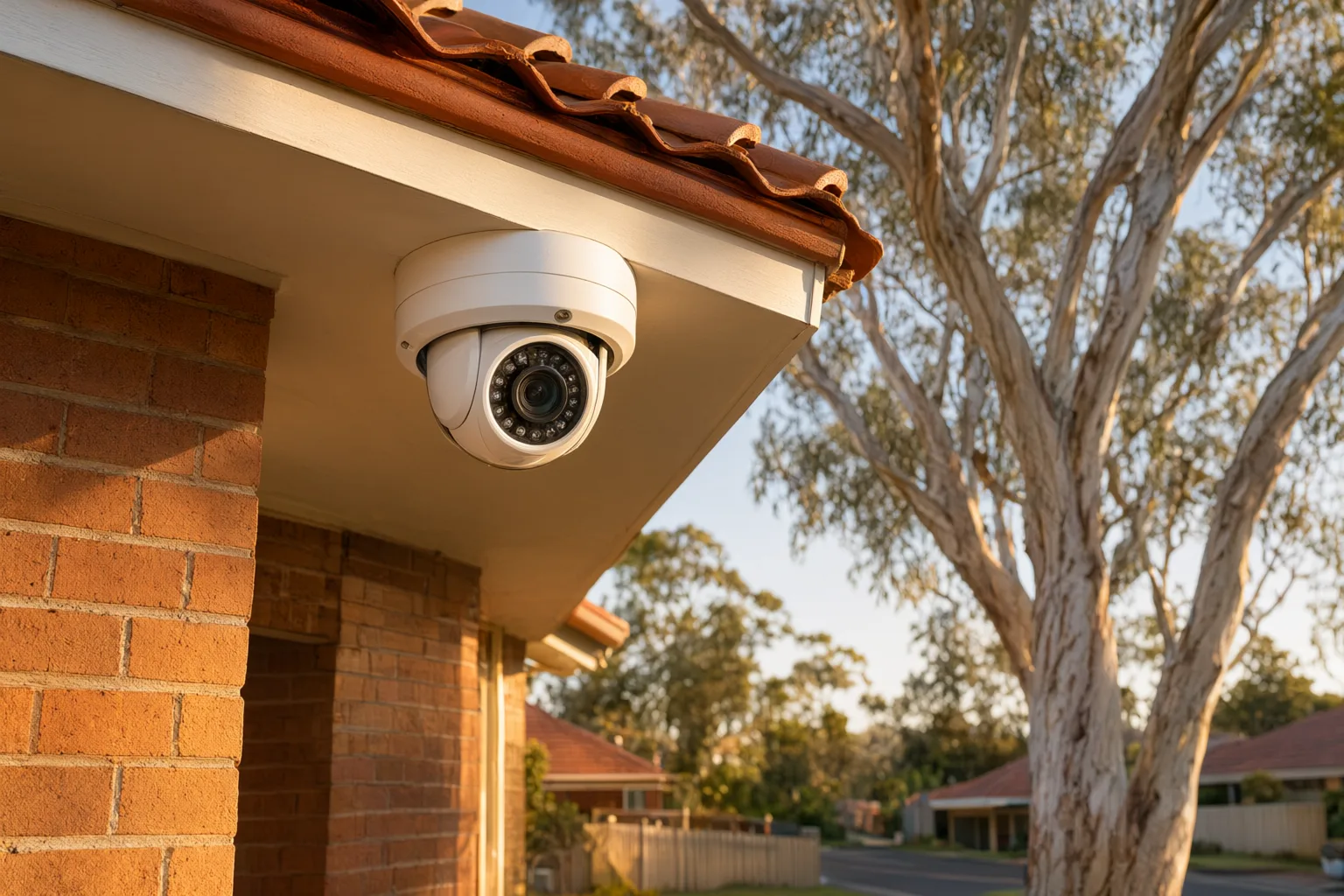
Key Takeaways
- Reliable budget CCTV cameras in Australia start at $150–$180 per unit for 4MP hardware; anything under $100 is usually a false economy.
- IP66 weatherproofing is non-negotiable for Australian roofs, eaves and coastal conditions in NSW and South Australia.
- A four-camera budget system installed professionally in Newcastle or Adelaide typically costs $1,800–$2,800 including cabling and setup.
- Placement beats quantity: four well-positioned cameras outperform eight poorly aimed ones on any property type.
- NSW and SA surveillance laws restrict where cameras can point, even on cheap home systems.
What Is the Cheapest CCTV Camera Worth Buying in Australia?
The cheapest CCTV cameras worth buying in Australia typically cost between $150 and $180 per camera for reliable 4MP hardware. The short answer: skip the $50 marketplace specials and buy from established brands like Hikvision, Dahua or Reolink, because sub-$100 units routinely fail within 12 months of Australian sun, storms and humidity. For homes and businesses in Newcastle and Adelaide, a properly installed four-camera budget system runs $1,800–$2,800 all-in.
This figure surprises many buyers who have seen $50 cameras advertised online or four-camera kits stacked at the front of electronics stores. The difference is not marketing fluff; it comes down to sensor quality, housing materials, firmware support and warranty backing. A $160 Dahua turret with a Starlight sensor will still be recording clear footage in year five, while a bargain-bin import is usually landfill by month eighteen.
It is also important to separate hardware cost from total system cost. A single worthwhile camera still needs an NVR or recorder, cabling, power and configuration. When you add those elements together through a licensed installer, a realistic entry point for a complete two-camera professionally installed system sits around $900-$1,200, while a well-planned four-camera setup generally lands between $1,500 and $2,500.
Why Do So-Called 'Cheap' CCTV Cameras Fail in Australian Conditions?
Australia is one of the harshest environments on earth for outdoor electronics. Roof-mounted cameras in Western Sydney or [[/adelaide|Adelaide]] can easily see surface temperatures above 60°C in January, while the same camera may face frost, driving rain and hail in winter. Coastal properties from Wollongong to Cairns add salt spray into the mix, which corrodes cheap connectors and housings remarkably quickly.
Consumer-grade cameras sold through marketplaces and discount retailers are typically built to a price point that assumes temperate European conditions. Their plastic housings become brittle under intense UV exposure, their gaskets degrade, and moisture eventually creeps into the lens assembly, producing foggy or water-damaged footage.
There is also a security dimension that many buyers overlook. Cheap cameras frequently ship with default passwords, unpatched firmware and cloud connections routed through overseas servers. A compromised camera is worse than no camera — it gives an intruder a view of your property and potentially access to your home network. Professional-grade equipment from authorised Australian dealers receives regular firmware updates and can be configured to operate entirely on your local network.
Which Budget CCTV Camera Brands Are Best Value in Australia?
Three manufacturers dominate the affordable-but-reliable segment of the Australian market, and each offers entry-level lines that punch well above their price point.
Hikvision's budget range includes their 4MP AcuSense turret cameras, which use onboard AI to filter out false alarms triggered by animals, swaying vegetation and headlights — a feature previously reserved for premium models. These typically retail between $180 and $280 per camera before installation, and their IP67-rated housings handle everything from tropical humidity to dusty outback conditions.
Dahua's entry-level WizSense series offers similar AI capabilities at comparable prices, with excellent low-light performance through their Starlight sensor technology. Their 4MP models start around $160 and are particularly popular with installers in hot climates because they tolerate sustained high temperatures exceptionally well.
Uniview rounds out the value leaders with their Easy series, offering straightforward 4MP cameras from $150. While they lack some of the smarter AI features of their competitors, their build quality, straightforward menu systems and 3-year warranty make them a solid choice for basic coverage where budget is the primary driver.
All three brands are widely stocked by Australian security wholesalers, which matters more than most buyers realise. Local stock means fast replacement under warranty, compatible accessories off the shelf, and installers who know the product range intimately.
Are Marketplace CCTV Cameras Under $100 a False Economy?
The temptation to grab a $50 camera from an online marketplace is understandable, but these false economies cost more in the long run. Consumer-grade cameras from unknown brands typically fail within 12-24 months when exposed to Australian UV levels and temperature extremes — often just after any limited warranty expires.
Supermarket and electronics store DIY kits under $400 for four cameras might seem attractive, but they use plastic housings that become brittle, sensors that wash out in bright sunlight, and apps that stop receiving security updates. When they fail, there is no warranty support and no repair pathway. You end up replacing the entire kit rather than a single component.
Wireless cameras under $100 present additional problems. They rely on your home WiFi, creating security vulnerabilities and reliability issues — especially on larger blocks or homes with brick construction that attenuates signal. Battery-powered models need constant recharging and often miss critical moments while conserving power in sleep mode, which defeats the purpose of a security camera entirely.
Finally, be wary of cameras locked into subscription-based cloud storage. The advertised hardware price looks low, but ongoing fees of $10-$30 per month can exceed the cost of a quality NVR-based system within two years, and your footage lives on someone else's servers rather than your own recorder.
What Features Must Every Budget CCTV Camera Have?
Regardless of budget, certain features are non-negotiable for Australian installations. Weatherproofing rated IP66 or higher protects against dust ingress and powerful water jets — essential for storm season along the east coast and dusty conditions inland. IP67 goes further and survives temporary immersion, which is worth having for exposed eave or gutter-line mounting positions.
Infrared [[colour-night-vision-vs-infrared-cost-differences-in-australian-cctv-systems|night vision]] should reach at least 20 metres for effective perimeter coverage. Cheaper cameras often quote impressive IR distances on the box but deliver grainy, unusable footage beyond 10 metres. Look for models with smart IR that adjusts illumination intensity to avoid washing out close subjects.
PoE (Power over Ethernet) connectivity eliminates the need for separate power cables at each camera and provides far more reliable transmission than WiFi. Even budget IP camera systems should use PoE for outdoor installations — it means one cable per camera carrying both data and power, simplifying installation and removing a common failure point.
Resolution is the other critical specification. 4MP (2688×1520) is the practical minimum for identifying faces and number plates at typical residential distances. 1080p cameras look adequate on a phone screen but lack the pixel density to produce usable evidence beyond about five to eight metres from the camera.
Storage completes the picture. Ensure your budget system includes an NVR with adequate hard drive capacity — typically 1TB minimum for four cameras recording continuously at 4MP, though 2TB provides comfortable headroom for motion-triggered recording over several weeks.
How Should You Match Budget CCTV Kits to Your Property Type?
The right budget configuration depends heavily on your property. For a standard suburban home on a 400-600 square metre block, four cameras usually suffice: one covering the driveway and garage door, one at the front entrance, one covering the rear yard and entertaining area, and one internal or side-access camera watching the letterbox and side gate.
Townhouse and unit owners often only need two cameras — front entry and rear courtyard — because shared walls eliminate most approach vectors. This makes a two-camera PoE starter system the sweet spot, expandable later if circumstances change.
Rural and acreage properties face different challenges. Long driveways demand cameras with extended IR range such as the Dahua IPC-HFW2441S-S with its 50-metre infrared reach, and remote viewing over 4G becomes essential where NBN coverage is patchy. Solar-powered professional cameras are sometimes the pragmatic answer where trenching cable across hundreds of metres is impractical.
Small businesses — cafés, workshops, retail shops — should prioritise the cash register or counter position and all entry points, and consider a camera facing the street to capture vehicle movements before and after incidents. AcuSense-style AI detection earns its keep here by cutting false alerts during trading hours when foot traffic is constant.
Is Professional Installation Cheaper Than DIY Budget CCTV Kits Long-Term?
The true cost of cheap CCTV extends well beyond the sticker price. DIY kits seem economical until you factor in cable runs through roof cavities, weatherproof junction boxes, NVR configuration and the weekend you will spend balancing on a ladder. Add the risk of voided warranties from incorrect installation, and the savings shrink dramatically.
Professional installation from licensed installers includes proper cable management, optimal camera positioning, secure network configuration and mobile app setup. A structured process — consult, design, install, configure, handover with training — ensures a budget system performs like a premium one. In NSW and most other states, security equipment installation involving cabling must comply with Australian Wiring Rules, and working on mains-powered equipment legally requires appropriate licensing.
Warranty protection differs dramatically too. Professional-grade equipment installed by authorised technicians carries 3-year warranties with local support. DIY consumer kits typically offer 12 months with overseas call centres, if support exists at all.
Most importantly, professional installers understand Australian conditions. They position cameras to minimise sun glare during morning and afternoon hours, use UV-stable cabling rated for roof spaces that regularly exceed 70°C, seal every connection against moisture, and configure remote viewing to work reliably over NBN connections or 4G failover in regional areas.
Can You Maximise Value from an Affordable CCTV System?
Maximise your budget by prioritising camera placement over quantity. Four well-positioned 4MP cameras covering entry points and driveways outperform eight poorly located cameras. Think like an intruder: where would you approach, and what would you want recorded along the way?
Consider starting with a quality NVR and two cameras, then expanding later. Professional systems allow easy addition of cameras without replacing the entire setup — unlike consumer kits with proprietary limitations that lock you into a closed ecosystem. Choose an NVR with spare channels now, even if you only populate half of them initially.
Ask your installer about previous-generation models. When manufacturers release new lines, previous stock often sells at 20-30% discounts while still offering full warranty and performance that exceeds current consumer equipment. A last-generation 4MP Hikvision turret remains an excellent camera regardless of what has replaced it.
Bundle the work. If you are also considering an alarm system, intercom or network upgrades, combining projects into one visit reduces labour costs significantly compared to booking separate callouts.
Finally, factor in lifetime support. A slightly higher upfront cost with ongoing technical support, firmware updates and troubleshooting assistance delivers far better value than the cheapest possible hardware with no backup. Security is a decade-long investment, not a one-off purchase.
Do Buyers Make These Common Mistakes with Cheap CCTV Cameras?
The most frequent mistake is buying on megapixels alone. An 8MP camera with a tiny, poor-quality sensor produces worse real-world footage than a well-engineered 4MP model with a larger sensor and better lens. Sensor size and low-light performance matter more than headline resolution.
The second mistake is ignoring mounting height and angle. A camera mounted too high captures the tops of heads; mounted too low, it is easily reached and disabled. Professional installers typically mount turrets at 2.5-3 metres, angled to capture faces rather than hairlines.
Third, many buyers forget about lighting. Even the best IR footage degrades against reflective surfaces, and cameras pointed directly at west-facing walls struggle every afternoon. Positioning relative to the sun's path is a detail that separates usable evidence from frustrating silhouettes.
Lastly, buyers often neglect to test remote viewing before the installer leaves. Insist on a full walkthrough — live view, playback, notifications and app access on your own phone — as part of the handover, so issues are fixed on the spot rather than discovered during an actual incident.
When comparing CCTV camera prices across Australian retailers, always check whether the advertised figure includes GST, mounting brackets and power supplies. Many big-box stores advertise a headline price that balloons once you add a hard drive, which alone adds $90 to $150 for a reliable 1TB surveillance-grade unit. Budget an extra $60 to $120 per camera if your property needs long cable runs through roof cavities or brick walls, as standard 18-metre leads rarely reach corner eaves on larger blocks.
Climate matters more than most shoppers realise when choosing cheap [[budget-vs-premium-cctv-is-it-worth-spending-more-on-security-cameras|CCTV cameras]]. In Adelaide, summer temperatures regularly exceed 40°C, and cameras mounted under north-facing eaves can hit internal temperatures that degrade sensors and warp plastic housings within two seasons. Coastal suburbs like Glenelg or Newcastle's Stockton add salt-laden air into the mix, corroding connectors on units without marine-rated coatings. Spending an extra $40 upfront on a metal-bodied IP67 camera is almost always cheaper than a replacement cycle.
For business owners, the calculus shifts slightly. A retail shopfront in the [[/newcastle|Newcastle]] CBD or a small warehouse in Adelaide's northern suburbs benefits from cameras with wider dynamic range, since harsh sunlight through glass doors blows out footage on cheaper sensors. Commercial installations must also comply with workplace surveillance legislation — in NSW, the Workplace Surveillance Act 2005 requires signage and notification before monitoring employees, while South Australia applies its own surveillance device rules. Fines for non-compliance can dwarf any savings from cutting corners on equipment.
Warranty support separates genuine bargains from false economies. Reputable brands sold through Australian distributors offer three-year warranties honoured locally, meaning a faulty network video recorder is swapped in days rather than shipped back overseas at your expense. Before purchasing any budget CCTV system, confirm the seller lists an ABN and an Australian service address — grey imports frequently lack firmware updates, leaving known security vulnerabilities unpatched on your home network.
Finally, timing your purchase saves real money. Boxing Day sales, End of Financial Year promotions and Black Friday events routinely knock 15 to 25 percent off mid-range kits, effectively turning a $900 four-camera package into a $700 one. Pairing sale-priced hardware with a professional installation quote from Aussie CCTV Cams ensures you get compliant placement, tidy cable management and a system tuned to Newcastle's storm exposure or Adelaide's bushfire-prone fringes — without paying premium-brand prices.
Budget buyers often overlook storage costs when comparing CCTV camera prices. A cheap kit advertised at $199 frequently ships without a hard drive, and adding a surveillance-rated 2TB drive adds $120–$180 to the real price. Cloud subscription models look affordable at $10–$15 monthly but cost $360+ over three years — more than the camera itself. When comparing the cheapest CCTV cameras Australia-wide, always calculate the five-year total cost of ownership including storage, cables, mounts and any cloud fees before deciding what is genuinely affordable.
Warranty support separates genuine bargains from expensive mistakes. Established brands sold through Australian distributors typically carry three-year warranties honoured locally, while grey-import marketplace cameras offer no local warranty at all. If a $70 camera fails after eight months of Newcastle coastal salt air or Adelaide's 40°C summer heat, you are buying another one — and paying for a second install. Under Australian Consumer Law, goods must be fit for purpose, but enforcing that against overseas marketplace sellers is practically impossible for most consumers.
For commercial properties such as retail shops, warehouses and farms, cheap cameras create liability risks as well as performance risks. Footage captured by workplace surveillance systems in NSW falls under the Workplace Surveillance Act, and businesses must display clear signage. Poor-quality footage that cannot identify faces or number plates may also weaken insurance claims after break-ins. Spending an extra $400 upfront on quality sensors and correct placement across entry points, driveways and loading areas consistently delivers better returns than maximising camera count on the smallest possible budget.
Finally, remember that installation quality determines whether any budget system performs. Cables run correctly through roof cavities and brick walls, connectors sealed against humid summers and storm-driven rain, and cameras angled away from direct western sun will outlast premium hardware badly installed. Aussie CCTV Cams provides fixed-price quotes for professional budget [[dahua-cctv-cost-breakdown-from-entry-level-to-enterprise-in-australia|CCTV installation]] in Newcastle NSW and Adelaide SA, so you know the full cost before a single cable is clipped into place.
Budget CCTV Options Compared for Australian Homes and Businesses (2025)
| Option | Typical Cost (AUD) | Best For |
|---|---|---|
| Marketplace camera under $100 | $50–$99 each | Short-term indoor monitoring only |
| Brand-name 4MP budget camera | $150–$180 each | Homes, shops and coastal properties in NSW/SA |
| Four-camera brand kit + 2TB NVR | $500–$700 (hardware) | DIY-capable homeowners wanting expandability |
| Professional 4-camera install | $1,800–$2,800 installed | Newcastle and Adelaide homes and businesses wanting compliance |