
Key Takeaways
- Double-storey CCTV installation typically costs $1,800–$3,500 installed versus $1,200–$2,500 for single-storey homes in Australia
- Extra cable runs between floors add roughly $250–$600 to two-storey jobs in Newcastle and Adelaide
- Height safety requirements (harnesses, scaffolding or elevated work platforms) increase labour time by 30–50%
- Most Australian states require a licensed security installer; DIY work on a double-storey roof risks fines and voided insurance
- A six-camera system covering both levels offers the best value per camera for two-storey homes
How Does Your Home's Design Affect CCTV Installation Costs?
The short answer: a professionally installed double-storey CCTV system in Australia typically costs $1,800–$3,500, while an equivalent single-storey setup runs $1,200–$2,500. You can expect the extra $600–$1,000 to come from longer cable runs between floors, height safety equipment for working at elevation, and one or two additional cameras to cover upstairs windows, balconies and stairwells that single-storey homes simply don't have.
What Does CCTV Cost for Single vs Double-Storey Homes?
Before an installer quotes a single dollar, they need to understand your property. House design is one of the strongest predictors of CCTV installation cost in Australia because it determines almost everything about the job: how many cameras are required, where they can be mounted, how cables are routed and how long the work will take.
A single-storey brick veneer home in suburban Sydney is a very different proposition from a double-storey rendered house on the Central Coast or a split-level property in regional NSW. Height, roof access, wall construction and the number of entry points all feed into the final figure. A low-pitched roof with easy ceiling access makes cable runs straightforward; a steep roofline or restricted side access can add hours to the job.
Single-storey homes are generally simpler and cheaper to secure. Most entry points sit at ground level, roof cavities are easy to reach and cable runs are short. Double-storey homes introduce genuine complexity: upper-floor windows and balconies become potential entry points, external walls are taller, and running cables between floors demands more time, materials and technical skill. Understanding these differences upfront helps you budget accurately and, just as importantly, avoid under-securing your property by cutting cameras to save money.
Why Does House Layout Shape the Price of a CCTV System?
[[axis-cameras-why-premium-cctv-costs-more-and-when-its-worth-it|Camera]] quantity is the single biggest driver of equipment cost, and it varies significantly between home types.
A typical single-storey home with three or four bedrooms usually needs four to six cameras for comprehensive coverage. Standard positions include the front door, driveway, side gates, rear entertaining area and any vulnerable ground-floor windows hidden from street view. The objective is to eliminate blind spots along the perimeter and capture clear, identifiable footage at every entry point.
Double-storey homes often require six to eight cameras or more. Upper-floor windows, balconies and second-storey access points — such as drainpipes, flat roofs or adjoining structures that could be climbed — must all be monitored. Taller walls also mean a single camera may not capture both ground-level activity and upper-floor approaches in one field of view, so additional units are often needed.
Professional-grade cameras help here. Models with wide dynamic range handle harsh Australian sunlight and deep shadow, while motorised varifocal lenses allow the installer to fine-tune each camera's coverage during commissioning. That precision means you get maximum coverage from every camera, without paying for unnecessary extra units.
Which Home Type Needs More Cameras?
Cabling is where the price difference between single and double-storey installations becomes most obvious.
In a single-storey home, installers can usually run cables through the roof cavity with relative ease, dropping them down wall cavities to each camera location. It's a clean, efficient process that keeps materials and labour costs low.
In a double-storey home, cables must travel further and work harder. They often pass through multiple wall cavities, route around structural beams and fire-rated elements, and sometimes run in external conduit where internal access is limited. Every extra metre of cable, every length of conduit and every junction box adds to the material bill — and every obstacle adds to the labour time.
As a rule of thumb, wiring for a double-storey home adds roughly $150 to $300 compared with a single-storey equivalent, purely due to longer runs and more complex routing. This is one cost you should never try to shortcut: poorly routed or unprotected cabling is vulnerable to weather damage, tampering and premature failure.
Do Cable Runs Explain the Real Cost Gap Between Storeys?
Labour is the second major cost differentiator, and it's driven largely by safety requirements.
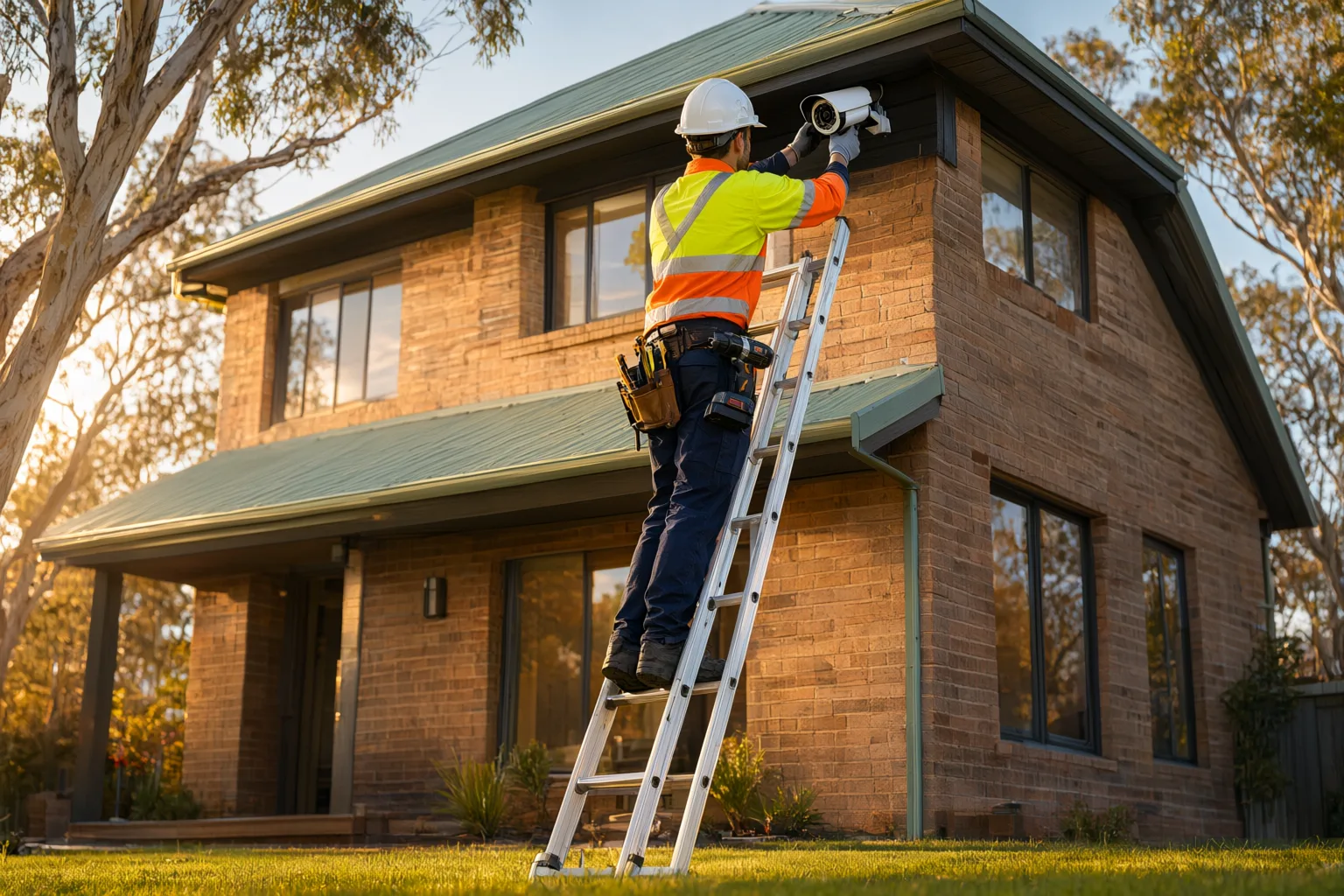
Mounting cameras at five to six metres — typical for upper-storey eaves on a double-storey home — requires extension ladders, roof harnesses or, in some cases, scaffolding. Working at height carries strict safety obligations in Australia, and a licensed, insured installer will factor compliance time into every quote. That's a good thing: it protects you from liability and ensures the job is done properly.
The time difference is significant. A single-storey installation might take four to six hours from start to finish. A double-storey job can extend to eight hours or more, particularly if the roof pitch is steep, access is restricted or the home has rendered or double-brick walls that are harder to penetrate. Steep-pitch roofs common in many established Australian suburbs are a classic example — safe access alone can add an hour or two.
When comparing quotes, be wary of installers who don't mention height access or safety equipment. A suspiciously cheap double-storey quote often means corners will be cut on either safety or cable quality.
Are Height Safety Requirements Hiding Labour Costs?
To give you a clear picture of how the numbers stack up, the table below compares typical costs for professionally installed four-camera and six-camera systems using Hikvision or Dahua hardware with ColorVu and AcuSense technology. Figures include cameras, NVR, cabling, labour and configuration by licensed NSW technicians. Your final quote will vary based on camera brand, property access and specific site conditions.
Is There a Full Cost Breakdown for Single vs Double-Storey Systems?
Whether your home is single or double-storey, smart planning stretches every dollar further.
Start with a professional site assessment rather than guessing camera locations. An experienced installer will identify your genuine vulnerabilities — the side gate hidden behind the garage, the rear sliding door shielded from the street — and design coverage around actual risk, not guesswork.
Prioritise entry points first, then fill in perimeter gaps. Choose cameras with built-in analytics such as AcuSense, which filters out false triggers from pets, swaying trees and passing cars so you only get alerted to genuine human or vehicle movement.
Plan for the future. Installing an NVR with spare channels and running extra cable during the initial install costs very little upfront but saves hundreds of dollars if you add cameras later — a common scenario for growing families or homeowners who extend or renovate.
For double-storey homes specifically, make sure upper-floor cameras have quality infrared or ColorVu night vision so footage remains usable in low light. And finally, choose a licensed installer who provides lifetime support and training, so you and your family actually know how to use the system long after the installation van leaves the driveway.
Can You Maximise Coverage and Value at Any Storey Height?
It's tempting to buy a DIY camera kit from a hardware store, but in Australia [[price-per-camera-explained-what-australian-homeowners-should-expect-to-pay|security]] equipment installation is a licensed activity in most states and territories. Installing your own system — particularly on a double-storey home — carries real risks: working at height without proper safety equipment, voiding equipment warranties, and potentially breaching state security licensing laws.
A professional installation delivers three things a DIY kit can't: compliance with Australian standards and licensing requirements, optimal camera placement based on experience with hundreds of homes, and warranty protection on both equipment and workmanship. Given that a professionally installed system starts at around $1,200, the value gap compared with a quality DIY kit is smaller than most homeowners expect — and the footage quality, reliability and insurer acceptance are typically far better.
Should You Choose DIY or Professional Installation Under Australian Licensing Laws?
A professionally installed [[how-much-does-a-4-camera-cctv-system-cost-in-australia|CCTV system]] can do more than deter intruders. Many Australian insurers offer premium discounts for homes with professionally installed security systems, and some require evidence of a licensed installation before applying any discount. A DIY setup is far less likely to qualify, so check with your insurer before deciding which route to take.
Compliance also extends to privacy. In NSW and most other states, your cameras should not record neighbouring properties or public footpaths beyond what's necessary to secure your own boundary. A licensed installer will position cameras to capture your property without creating privacy disputes with neighbours.
Finally, treat your CCTV system as a long-term investment. Quality hardware with local support, regular firmware updates and a documented configuration will serve your home for many years — and if you ever sell, a professionally installed security system is a genuine selling point in the Australian property market.
For [[/newcastle|Newcastle]] homeowners, coastal conditions add another layer of planning. Salt-laden air off the Hunter coastline corrodes standard camera housings faster than inland installations, so we recommend marine-grade or IP66/IP67-rated units mounted under eaves rather than exposed on rooflines. On a double-storey home this matters even more, because upper-level cameras cop the full force of coastal weather and summer sun, degrading cheaper housings within two to three years. Budgeting an extra $80–$150 per camera for weather-rated equipment upfront saves a full replacement cycle later.
In [[/adelaide|Adelaide]], South Australia's hot dry summers and occasional severe storms create similar pressures. Brick veneer construction, common across Adelaide suburbs, actually makes cable routing easier than double brick, because installers can chase cavities between the brick skin and internal lining. Double brick homes, more common in older Adelaide properties, may require surface-mounted conduit on external walls, which adds $20–$40 per metre to the cabling bill but keeps everything neat and weatherproof.
Under the Surveillance Devices Act 2007 (NSW) and the Surveillance Devices Act 2016 (SA), you must not record private conversations or areas where people have a reasonable expectation of privacy, such as a neighbour's backyard or a shared strata hallway without consent. Cameras pointed at public footpaths are generally acceptable, but positioning matters on two-storey homes because elevated cameras naturally capture more of neighbouring properties. A licensed installer will angle lenses to stay compliant and protect you from complaints or penalties.
If your property is part of a strata scheme, check your bylaws before mounting anything on common walls or the building exterior. Many schemes require written approval for external fixtures, and unauthorised installations can be ordered removed at your expense. For businesses, the Workplace Surveillance Act 2005 (NSW) requires signage and notification when monitoring employees, so retail shops and warehouses need compliant signage alongside their camera coverage.
Finally, think about future-proofing. Running Cat6 cable to every likely camera position during the initial install costs marginally more than a four-camera run, but adding positions later on a double-storey home means another round of height access costs. Most of our Newcastle and Adelaide clients who plan for eight positions but install six initially save $400–$700 compared with two separate callouts.
Typical professionally installed CCTV costs by home type, Australia 2025 (AUD)
| System Option | Single-Storey Cost | Double-Storey Cost |
|---|---|---|
| 4-camera wired system | $1,200–$1,900 | $1,800–$2,600 |
| 6-camera wired system | $1,700–$2,500 | $2,400–$3,500 |
| 8-camera commercial-grade | $2,500–$3,800 | $3,200–$4,800 |
| DIY wireless kit (self-installed) | $500–$1,200 | $700–$1,500 |