
Key Takeaways
- Full-time guarding costs $8,000–$15,000/month per entry point; remote CCTV monitoring typically runs $1,500–$4,000/month for an entire site.
- Monitored cameras detect intruders in seconds via AI analytics and trigger voice-down warnings, lights and patrol dispatch.
- Guards still win where physical intervention, gatehouse ID checks or staff escorts are required.
- A hybrid model — monitoring plus scheduled patrols — is the most common choice for Newcastle and Adelaide businesses.
- Monitoring companies must hold a master licence under the Security Industry Act (NSW) and equivalent SA licensing laws.
How Much Does Site Protection Really Cost NSW Owners Each Month?
The short answer: remote CCTV monitoring typically costs $1,500–$4,000 per month for a whole commercial site, while a full-time security guard costs $8,000–$15,000 per month per entry point across NSW. For most warehouses, yards and construction sites, you can protect more ground for less money with professionally monitored cameras — backed by voice-down deterrence and mobile patrol response when needed.
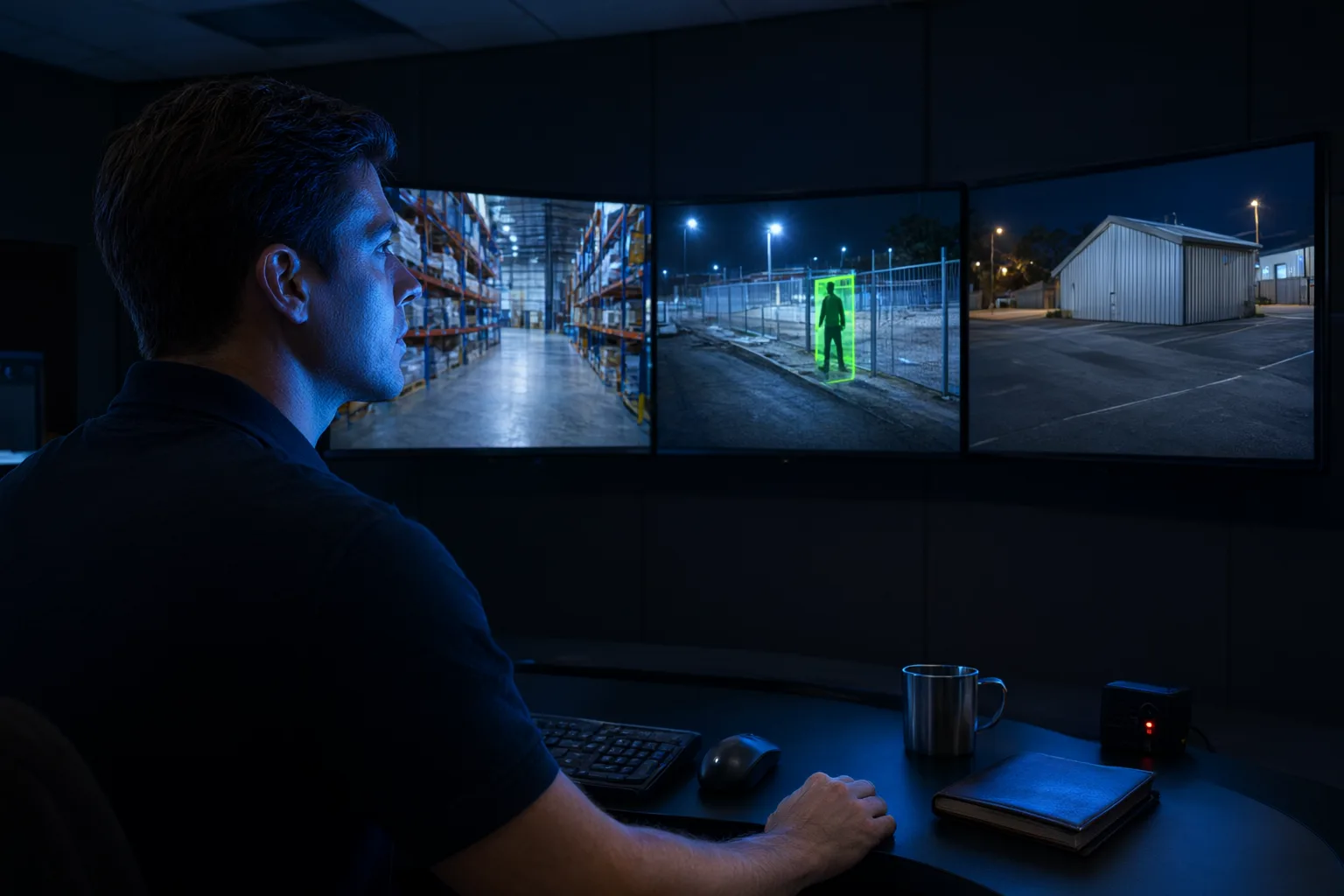
Remote video monitoring has changed that equation over the past five years. A modern IP camera system with AI analytics can spot a person scaling a fence at 2am, tell them apart from a possum or a moving gum branch, and push a live alert to a trained operator within seconds. The operator can challenge the intruder through the camera's speaker, fire up strobe lights, call your keyholder or dispatch police — all without anyone physically stationed on your property. Businesses making this switch commonly cut security spending by 70 to 90 per cent while putting more of their site under observation than guards ever could.
What Happens When a Monitored Camera Detects an Intruder?
A monitored system links your cameras to a professional monitoring centre over NBN or 4G. When analytics on the [[the-hidden-costs-of-cheap-wireless-cameras-vs-professional-poe-systems|camera]] or recorder detect something you've defined as important — a person entering a restricted zone after hours, a vehicle idling too long at a gate, movement along a perimeter — the operator receives live video, confirms whether it's a genuine threat, then follows your pre-agreed response plan: an audio challenge through the camera speaker, a phone call to your keyholder, or police dispatch backed by verified footage. Verification matters more than most people realise; police treat video-confirmed alarms as higher priority than unverified triggers.
The hardware doing the detection has improved just as much as the service behind it. Hikvision's AcuSense range applies deep-learning algorithms to classify humans and vehicles separately from animals, weather and vegetation, eliminating most of the false alarms that made older motion detection unusable. ColorVu models record full-colour footage around the clock, so an operator can describe an intruder's red hi-vis shirt instead of vaguely reporting 'dark clothing'. Dahua's TiOC (Three-in-One Camera) units build active deterrence directly into the device — flashing lights, a siren and two-way audio — effectively giving the operator a voice and a visible presence on your site. Axis and Uniview offer comparable analytics platforms for larger or more complex installations.
Where Do On-Site Guards Still Outperform Cameras?
Guards aren't obsolete — far from it. They can physically stop a trespasser, check identification at a gatehouse, coordinate deliveries, walk staff to their cars after dark, and handle situations that need hands rather than eyes: a burst water main, a fire panel fault, an aggressive customer. For licensed venues, shopping centres and anywhere with heavy public interaction, a trained human presence does things no camera can.
But the limitations are structural, not fixable with training. One guard covers one location. A 10,000-square-metre industrial site might present four separate vulnerable points; staffing all of them continuously costs more than most small businesses turn over. Guards fatigue — attention measurably drops across long night shifts — and they're a single point of failure: occupied with an incident at the front gate, they can't see someone cutting through the rear fence. And unless they wear a body camera, there's no independent visual record of what happened, leaving you reliant on written reports when insurance or police need evidence.
Which Option Is Cheaper in 2025: Guards or Monitoring?
The comparison table below sets out realistic 2025 pricing for NSW commercial sites. Guard figures assume award wages including night and weekend penalties; monitoring figures assume a professionally installed AI camera system connected to an Australian monitoring centre.
Don't overlook the upfront picture either. A monitored camera system requires an [[how-much-does-professional-cctv-installation-cost-in-australia|installation]] investment — typically $4,000 to $15,000 for a small-to-medium commercial site depending on camera count and cabling — but that asset serves you for seven to ten years with proper maintenance. Guarding carries no setup cost but no residual value either: it's a pure ongoing expense that climbs with every annual award wage increase.
Can Cameras Cover an Entire Site Better Than One Guard?
This is where the two models genuinely diverge. A camera doesn't blink, doesn't take a meal break, and records everything within its field of view in 4K detail. A properly designed system — cameras on every entry point, fence line and high-value area — gives you simultaneous coverage of the entire site plus an evidential recording of every event. If an operator is busy verifying an alarm at the front gate, the rear cameras are still recording and still raising their own alerts independently.
A guard offers depth rather than breadth: they can investigate something unusual, exercise judgement, and physically act. But their attention is serial — one location at a time — and without a body camera there's no independent record of events. For insurance claims and police investigations, continuous recorded footage is frequently what separates an approved claim from a disputed one. The strongest security setups use cameras for breadth and verification, then deploy humans — guards, patrols or your own staff — only where physical presence genuinely adds value.
Why Do Most NSW Businesses Choose a Hybrid Model?
In practice, few of the commercial clients we work with pick one extreme. The most common configuration we install uses remote monitoring as the backbone, layered with mobile patrols or part-time guarding. A typical arrangement looks like this: AI cameras watch the site 24/7, the monitoring centre verifies and responds to overnight events, and a patrol vehicle performs two or three physical drive-throughs each night at $30 to $60 per visit. Total monthly cost usually lands between $500 and $1,500 — a fraction of full-time guarding, with wider coverage and a complete video record on top.
High-risk sites invert the ratio. A cash-handling business, or a location with a history of aggressive incidents, might keep a guard on during trading hours for deterrence and customer management, then hand over to remote monitoring from 6pm to 6am. That 'guard by day, cameras by night' split plays to each option's strengths. And because our systems include remote viewing apps, owners and managers can check in live from their phone whenever they like — something no guard contract can offer.
Should Your Property Use Monitoring, Guards or Both?
As a rule of thumb: [[construction-site-cctv-protecting-plant-tools-and-materials-after-hours|construction]] sites, vacant land, plant yards, farms and warehouses almost always get better value from monitored cameras — particularly where solar panels and 4G connectivity replace mains power and fixed-line internet. Retail and hospitality venues facing public-facing risk generally need some human presence, supplemented by cameras. Strata and commercial buildings commonly pair intercom and access control integration with monitoring to manage after-hours entry without employing a concierge.
None of it works without sound system design, though. Monitoring is only as good as the camera placement, lighting, analytics configuration and network reliability behind it — which is where a licensed installer earns their fee. Our five-step process (consult, design, install, configure, handover with training) ensures analytics are tuned to your site's actual risks, false alarms are minimised from day one, and your monitoring centre receives footage it can act on immediately. We install professional-grade Hikvision, Dahua, Uniview and Axis hardware built for Australian conditions, backed by lifetime support. If you're weighing guards against monitoring, start with a free site assessment — we'll give you a straight answer on what your property genuinely needs.
Is Remote CCTV Monitoring Legal and Licensed in NSW and SA?
Weather matters too: coastal salt air in [[/newcastle|Newcastle]] corrodes cheap housings within two years, while [[/adelaide|Adelaide]]'s summer heat regularly pushes roof-mounted cameras past 60°C. We specify marine-grade brackets near the coast and shaded eaves mounts inland, and every camera we install carries an IP66 rating so storm-driven rain and dust never interrupt your monitoring feed.
Finally, factor in the hidden costs of guards beyond wages: superannuation, workers compensation insurance, uniforming, rostering software and sick-day cover can add 25–30% on top of the base hourly rate. Monitored CCTV pricing is flat and predictable, which makes budgeting far easier for property managers reporting to owners or strata committees.
2025 Monthly Security Costs for Commercial Sites (AUD)
| Option | Typical Monthly Cost | Best Suited To |
|---|---|---|
| 24/7 remote CCTV monitoring | $1,500–$4,000 | Warehouses, vacant land, farms, construction sites |
| Static security guard (per post) | $8,000–$15,000 | Gatehouses, retail front-of-house, high-risk sites |
| Hybrid: monitoring + mobile patrols | $2,000–$3,500 | Industrial estates, yards, multi-site portfolios |
| Guard + monitored CCTV combined | $9,000–$17,000 | Critical infrastructure, cash-handling premises |