
Key Takeaways
- A single PTZ records only where it points, so side gates and rear yards go unrecorded during zooms.
- Professional-grade PTZ units typically cost two to four times more than a quality fixed camera in Australia.
- One installed PTZ often lands in the same price bracket as a three- or four-camera fixed system in Newcastle NSW.
- Fixed cameras have no moving parts, cutting maintenance costs versus PTZ motors that wear faster in coastal salt air.
- Hybrid designs combining fixed cameras plus one auto-tracking PTZ suit large Adelaide yards and commercial sites best.
- Under Australian privacy laws such as the Surveillance Devices Act 2007 (NSW), continuous recording of entry points strengthens lawful evidence.
Is One PTZ Camera Better Than Multiple Fixed Cameras?
Multiple fixed cameras almost always cover more for less than a single PTZ camera. A PTZ can pan, tilt and zoom across an entire site, but it records only one direction at a time — so while it watches your front gate, your side gate goes completely unrecorded. Three or four well-placed fixed cameras eliminate that blind-spot problem entirely, and they typically cost about the same as one quality PTZ once installation is factored in across Australia.
That said, PTZ cameras aren't a gimmick. On large open sites — farms, construction yards, warehouse hardstands — where running cable to five camera points isn't practical, or where an operator actively monitors alerts, a PTZ delivers detail no fixed camera can match. This guide breaks down exactly how the two approaches compare on cost, coverage, reliability and suitability for typical NSW homes and businesses.
How Do PTZ Cameras Work: Pan, Tilt and Zoom Explained
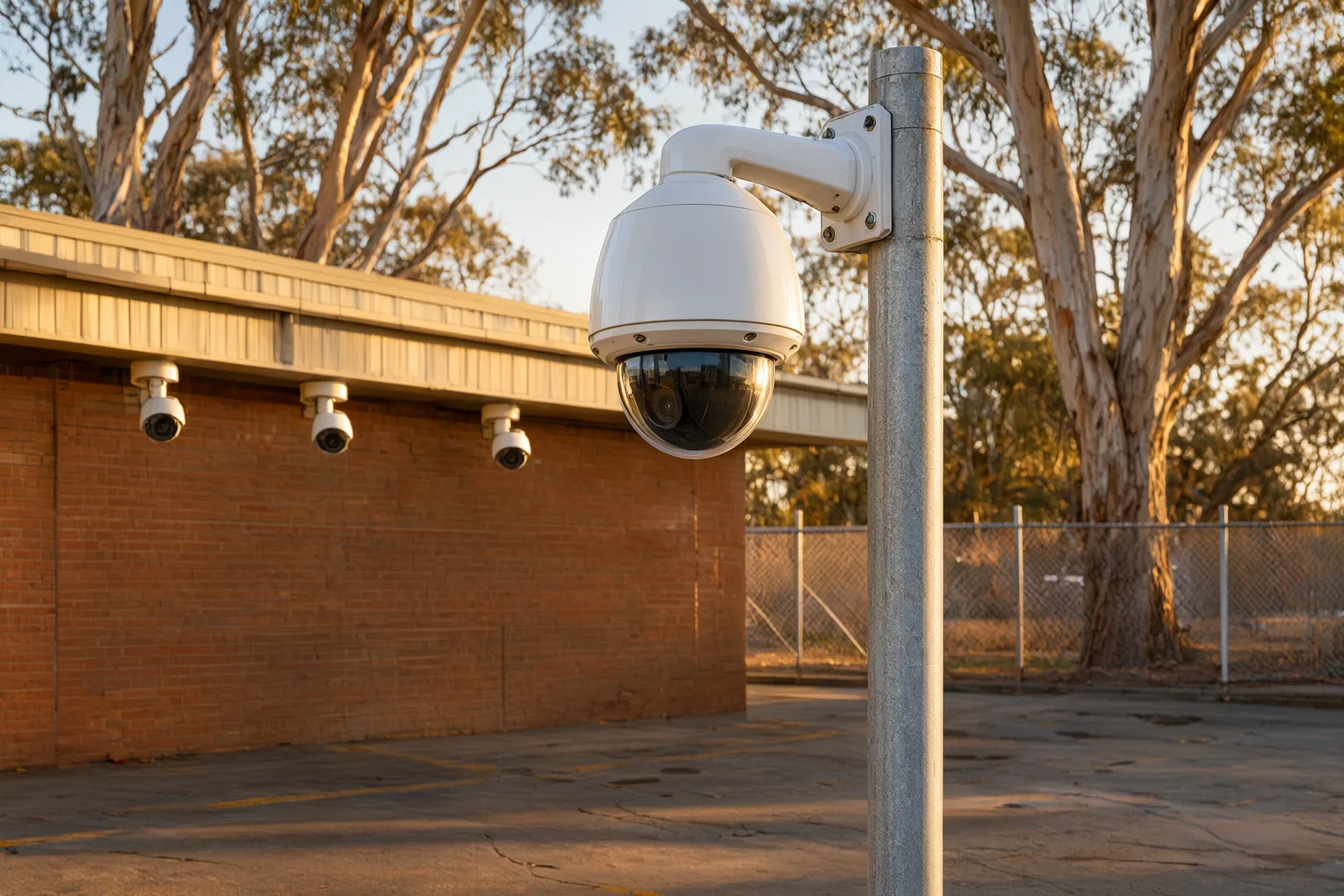
PTZ stands for pan, tilt and zoom. Instead of staring at one fixed scene like a standard turret or bullet [[the-hidden-costs-of-cheap-wireless-cameras-vs-professional-poe-systems|camera]], a PTZ sits on a motorised mount that rotates up to 360 degrees horizontally, tilts vertically, and zooms optically — professional models commonly offer 25x optical zoom or more. Many units run automated 'tours' between preset positions, automatically track moving people or vehicles, or can be steered live by an operator through an NVR interface or mobile app.
Brands like Hikvision, Dahua and Uniview pack serious technology into their PTZ ranges: Starlight low-light sensors for colour images at night, smart motion tracking, long-range infrared illuminators and weather-rated housings. They're genuinely impressive pieces of engineering. But all that motorised flexibility comes with trade-offs in price, ongoing servicing and — most critically — what actually ends up recorded when something goes wrong.
Why Does a Single PTZ Camera Still Leave Blind Spots?
The most common misconception we hear from property owners across NSW is that one PTZ equals total coverage. It doesn't. A PTZ records only the direction it's pointing at any given second. If it's zoomed in on a vehicle at the front gate, everything behind it — side access, rear yard, shed row — goes unrecorded until the camera swings back.
Even automated patrol tours don't solve this. Each zone might be captured for just a few seconds per cycle, and opportunistic intruders quickly learn to time their approach for when the camera has moved on. In practice, a touring PTZ produces patchy, fragmented footage rather than the continuous record police and insurers rely on after a break-in.
Fixed [[wireless-camera-batteries-vs-solar-keeping-unpowered-cameras-running|cameras]] work differently. Four properly positioned units covering your driveway, front entry, side access and backyard record their full field of view every second of every day. There's no 'wrong direction' and no waiting for the camera to come back around — every approach to the building is captured simultaneously, which is precisely what you need when reviewing footage or handing evidence over.
What Does a PTZ vs Multi-Camera Fixed Setup Cost in Australia?
On hardware alone, a professional-grade PTZ typically costs two to four times more than a quality fixed camera. Add heavier mounting brackets, extra cabling runs and longer configuration time, and a single installed PTZ frequently lands in the same price bracket as a three- or four-camera fixed system. Fixed cameras also draw less power, run happily on standard PoE (Power over Ethernet) cabling, and place lighter demands on NVR storage per channel.
Ongoing costs widen the gap further. PTZ cameras contain motors, gears and drive belts that wear out — and Australian conditions accelerate that wear. Coastal salt air corrodes housings, summer heat stresses electronics, and dust chews through moving parts on rural sites. A sealed fixed turret or bullet camera has no moving parts whatsoever, which is why they routinely deliver a decade of service with nothing more than the occasional lens clean.
There's also a hidden cost angle worth considering: because fixed cameras are cheaper per unit, spreading budget across more channels gives you redundancy. If one fixed camera fails, three others keep recording. If your lone PTZ fails, you have nothing.
When Should You Choose a PTZ Camera Over Fixed Cameras?
PTZ isn't bad technology — it's just frequently misapplied. Where it truly shines is on large, open sites that are too big to cover economically with fixed cameras, especially where someone or some automation is actively watching. Think construction sites, farm yards, warehouse hardstands, car dealerships and sports grounds.
Modern auto-tracking models such as Hikvision's AcuSense PTZ range can lock onto a person or vehicle and follow them across a site, zooming in for facial or number plate detail that a fixed camera positioned 60 metres away could never resolve. That tracking capability turns a wide, sparsely monitored area into something approaching close surveillance.
Rural and remote properties present another strong case. Where power and data run over solar panels and 4G links, mounting one PTZ high on a pole can be far more practical than trenching cable to five separate camera points across acreage. The trade-off remains the same — you're accepting gaps in coverage in exchange for reach and detail.
Are Multiple Fixed Cameras Better for Homes, Shops and Offices?
For the overwhelming majority of homes, retail shops, offices and strata buildings, fixed cameras are the smarter investment. Entrances, driveways, hallways, loading docks and cash-wrap areas are predictable zones — people must pass through them, so a fixed camera aimed at each choke point captures everyone who comes and goes, every single time.
Fixed cameras also deliver better image quality per dollar. A fixed 4K turret with ColorVu-style full-colour night vision will produce sharper, more usable footage of a doorway at 2am than a PTZ that happened to be pointed somewhere else. Because each camera's view never changes, reviewing footage is faster too — you always know which camera covers which area and exactly what it's looking at.
Reliability seals the argument. With no motors or presets to recalibrate, fixed cameras simply sit there and record, year after year, through heatwaves, storms and coastal humidity. For evidence-gathering purposes, that dependability matters more than any amount of motorised flexibility.
Can a Hybrid PTZ and Fixed Camera Setup Cover More for Less?
The strongest designs we install across Sydney and regional NSW usually blend both technologies. Fixed cameras blanket every entry point and critical zone with continuous recording, while a single PTZ watches the open yard or car park, set to auto-track or respond to triggers from the fixed cameras. When the driveway camera detects a person after hours, the PTZ swings to that preset and zooms in automatically.
This layered setup gives you unbreakable evidence coverage plus the ability to grab fine detail — faces, plates, clothing descriptions — across a large area. It's a common configuration for warehouses, schools and acreage properties, and it generally costs less than clients expect, because the affordable fixed cameras do the heavy lifting while the PTZ adds targeted capability rather than carrying the whole system alone.
Which CCTV Setup Should You Choose for Your Property?
Start with three questions. First, what do you actually need to record — continuous evidence of specific zones, which favours fixed cameras, or periodic sweeps of a huge open area, where PTZ becomes a contender? Second, will anyone actively monitor or respond to alerts? PTZ value multiplies with active use; without it, you're paying for motors that mostly sit idle. Third, what's the environment? Coastal salt spray, extreme heat and dust all shorten PTZ service life compared to sealed fixed cameras.
For most properties, the honest answer is fixed cameras first, with a PTZ added only where its strengths are genuinely needed. A licensed [[dome-vs-bullet-cameras-which-style-suits-your-australian-property-best|security]] installer can map your sightlines, model both options against your budget and design a layout with no blind spots — which is exactly what our free consultation and system design step covers before any commitment.
PTZ vs Multiple Fixed Cameras at a Glance
| Factor | Single PTZ Camera | 3–4 Fixed Cameras |
|---|---|---|
| Coverage | Wide area, but one direction at a time | Every zone recorded simultaneously |
| Installed cost | $$$ (comparable to a multi-camera setup) | $$$ (similar total, spread across channels) |
| Image detail | Excellent when zoomed; average during tours | Consistently sharp on fixed zones |
| Moving parts | Motors and gears that wear over time | None — sealed solid-state design |
| Maintenance | Higher; presets and motors need checking | Minimal; occasional lens clean |
| Best suited to | Large open yards, farms, active monitoring | Homes, shops, entries and choke points |