
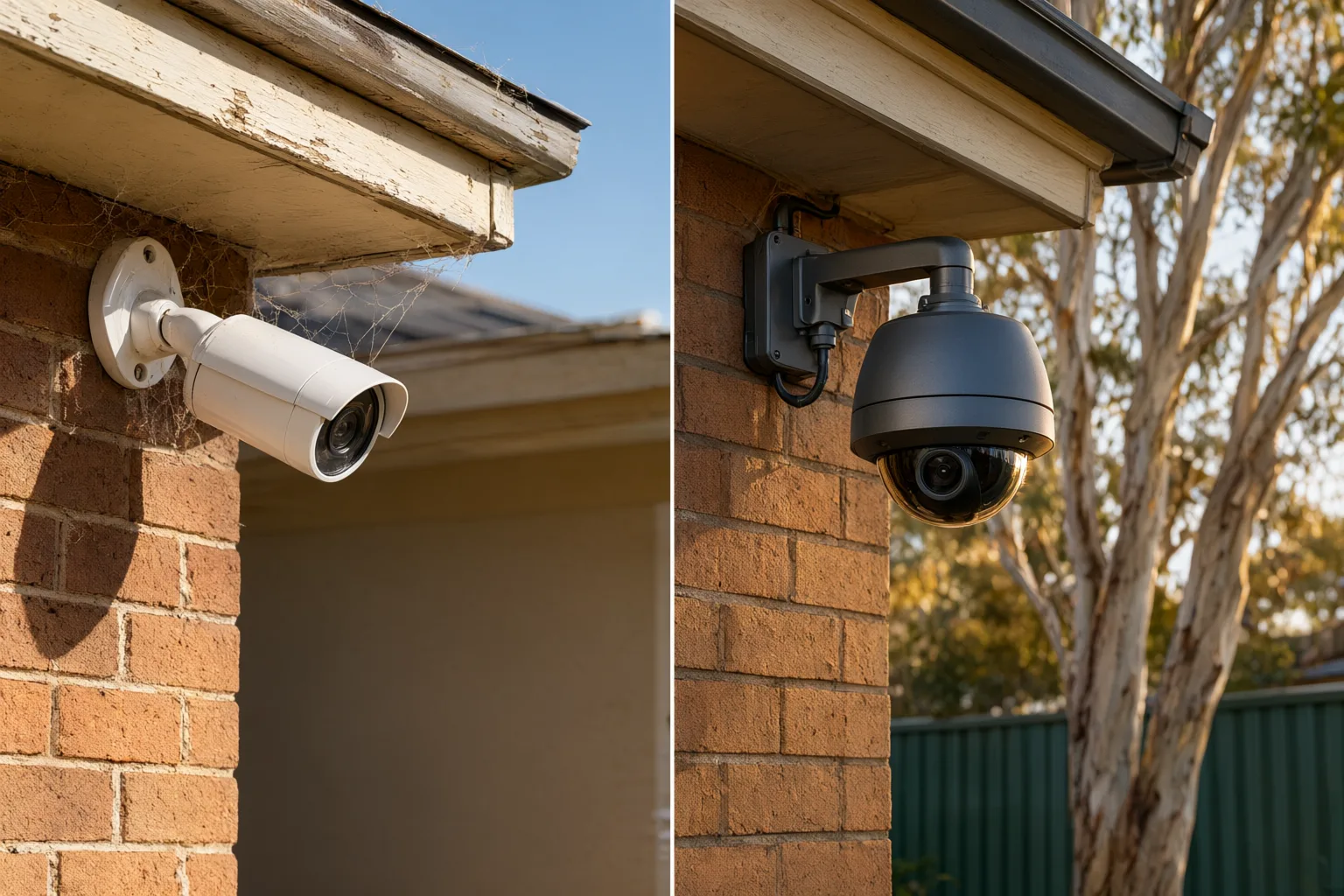
Key Takeaways
- A $300–$600 Bunnings CCTV kit often costs $1,500+ over three years after replacements, upgrades and your time.
- Professional CCTV installation in Newcastle NSW or Adelaide SA typically runs $1,800–$3,500 installed with 3–5 year warranties.
- Australian heat, coastal salt air and storms kill consumer cameras far faster than pro-grade Hikvision, Dahua or Axis gear.
- Security licensing laws in NSW and South Australia mean some installation work legally requires a licensed installer.
- DIY kits suit short-term rentals and pet monitoring; homes and businesses wanting reliable evidence should get a quote.
Why Is the Shelf Price of a Bunnings CCTV Kit a Trap?
The short answer is that a Bunnings CCTV kit typically costs about the same as professional installation once you count three full years of ownership. A $300–$600 DIY security camera kit from Bunnings usually ends up costing roughly $1,500 over three years in Australia, while a professionally installed system in Newcastle NSW or Adelaide SA runs about $1,800–$2,500 — but delivers better footage, longer life and warranty-backed support.
On paper, the specs sound reasonable: 1080p resolution, infrared night vision out to 20-30 metres, and either an SD card or small hard drive for storage. Wireless models piggyback on your home Wi-Fi; wired kits use analogue or entry-level IP connections.
The problem only reveals itself when you actually need the footage. Try identifying a face at 15 metres, reading a plate after dark, or handing something usable to police or your insurer, and the gap between 'records video' and 'captures evidence' becomes painfully clear.
What Does a Cheap Security Camera Really Cost Over Three Years?
Consumer cameras are engineered down to a price point, and the compromises show up fast in Australian conditions. Across NSW we repair and rip out DIY systems constantly, and the failure pattern is remarkably consistent.
Cameras typically survive two to three summers before giving up. Infrared LEDs fade until night footage is a grainy monochrome blur. UV exposure turns plastic housings brittle until they crack, and the next storm pushes moisture straight into the electronics.
Then there's your labour. Fishing cable through roof cavities, mounting cameras on a ladder, configuring network settings and chasing dropouts can swallow an entire weekend. Value your time at a modest $50 an hour and a 12-hour install quietly adds $600 to the bill.
Stack on replacement cameras, a bigger hard drive once you discover the bundled storage only holds about a week of footage, and possibly an electrician to sort out Power over Ethernet properly — and that $500 kit has become a $1,200 investment by year three.
Which Professional CCTV Brands Are Worth Installing in Newcastle?
Professional-grade systems from Hikvision, Dahua, Uniview and Axis are built for continuous duty in hostile environments. These aren't rebadged consumer products — they're the same hardware councils, shopping centres and industrial sites depend on.
A standard professional install delivers 4K cameras with ColorVu full-colour night vision, AcuSense AI that tells the difference between a person, a vehicle and a swaying tree branch, and IP66 or IP67 weatherproofing built for Australian conditions.
The NVR is set up properly: motion zones tuned to your property, remote viewing on your phone, and storage sized to hold 30 days or more of footage. Licensed installers run cabling through roof and wall cavities with proper conduit and weatherproof junction boxes.
The real payoff is evidence quality. Faces stay identifiable at 20 metres, ANPR-optimised cameras read plates at night, and accurate timestamps hold up for police and insurance claims.
How Much Does Professional CCTV Installation Cost Over Three Years?
Below is what each path realistically costs over three years once replacements, upgrades and your own time are counted — not just the receipt total.
When Is a $300 Officeworks Camera Kit Genuinely Good Enough?
We won't pretend DIY is always a mistake. Watching a rental property for a few months, checking on the dog while you're at the office, or adding a visible deterrent to a low-risk corner of the yard — a $300 wireless camera from Bunnings handles all of that fine.
DIY also suits technically confident homeowners with easy cable runs who genuinely don't need court-ready footage. Some of our own clients run consumer cameras indoors while the professional [[how-much-does-a-4-camera-cctv-system-cost-in-australia|system]] guards the perimeter.
Where DIY falls apart is protecting a family home, a business holding stock and equipment, or any property in a break-in hotspot. We've been called out too many times after a burglary, only to find footage too grainy to identify anyone.
Can Australian Weather Really Kill Consumer CCTV Cameras?
Our climate punishes electronics. Roof cavities regularly push past 60°C in summer, coastal salt air corrodes connectors and housings, and storm-driven rain exploits every weak seal.
Professional cameras are rated for exactly this. The Hikvision and Dahua units we install carry IP66 or IP67 ratings, operate from -40°C to 60°C, and use metal housings with proper gaskets. Consumer cameras top out around IP65, in plastic shells that go brittle under UV.
Bushfire zones raise the stakes further — embers and radiant heat will destroy a consumer camera outright. Professional systems can be specified with suitable housings and positioning to give them the best chance of surviving.
Do You Get More Than Cameras With a Professional CCTV Installer?
A professional quote isn't just cameras on a wall. You're paying for a system designed around your property's actual weak points, installed to Australian standards, and backed for the long haul.
Our process starts with a consultation about your specific worries — the side gate, the unlit driveway, the back fence that's been scaled before. Camera positions are planned to kill blind spots and capture faces rather than the tops of heads.
The install itself covers tidy cable runs through cavities, weatherproof junction boxes and surge protection. Configuration includes motion zones that ignore passing traffic but alert when someone walks up your path, plus remote viewing set up on your devices.
Handover means training until you're confident using the system, and lifetime support means there's someone to ring when you can't remember how to export footage for the police.
Should You Buy a DIY CCTV Kit or Book Professional Installation in Adelaide?
If money is genuinely tight and you accept the limitations, a wired kit beats wireless for reliability, buy the biggest hard drive you can afford, and plan on replacing cameras within three years.
If you want footage that actually identifies people, hardware that survives Australian summers, and zero ladder-climbing or roof-crawling on your part, professional [[diy-vs-professional-cctv-installation-real-cost-comparison-for-australians|installation]] earns its price.
For most homeowners, the sweet spot is an entry-level professional system: four 4K cameras, an NVR with 2TB of storage, remote viewing configured and lifetime support — typically $1,800 to $2,500 depending on cable runs and camera positions.
Is a Licensed CCTV Installer Required Under Australian Law?
Hidden labour is the biggest line item DIY buyers forget. A typical [[/newcastle|Newcastle]] homeowner spends eight to twelve hours mounting cameras, running cable through roof cavities, configuring NVR settings and troubleshooting app connectivity — time worth $400-$800 at even modest hourly rates. Add a second weekend when the first install fails, and your 'cheap' Bunnings CCTV kit has quietly consumed a full working week. Professional crews complete the same job in a single day because they arrive with the right cabling, connectors and testing gear the first time.
Warranty structure matters more than most buyers realise. Consumer kits from Bunnings carry 12-month retailer warranties that exclude weather damage — precisely what kills them in Australian conditions. By contrast, Aussie CCTV Cams backs professionally installed systems with multi-year workmanship warranties alongside manufacturer hardware cover of three to five years on brands like Hikvision and Dahua. If a camera fails in year two, a DIY owner buys another; our [[/adelaide|Adelaide]] and Newcastle clients get a replacement fitted under warranty at no cost.
Let's break down where that hidden $1,500 actually goes. The kit itself is only the beginning: most buyers add a larger hard drive ($100–$150), replacement cameras killed by summer heat ($80–$150 each), better cabling because the supplied leads are too short for a typical Australian roof run ($60–$120), and occasionally a new NVR when the original fails just outside its 12-month warranty. Add eight to twelve hours of your own weekend labour climbing ladders and drilling brick, and the 'bargain' maths gets uncomfortable fast.
By contrast, a licensed installer quotes one number that covers design, cabling, mounting under eaves, configuration, remote access setup and a workmanship warranty of three to five years. In Newcastle NSW, a four-camera professional system on a single-storey brick home typically lands between $1,800 and $2,800 installed; Adelaide SA pricing is similar, with two-storey or commercial jobs ranging higher. Because the equipment is commercial grade, you're also far less likely to be buying replacements in year two.
There's also the evidence question that most DIY buyers never consider until it's too late. South Australian and NSW police routinely reject consumer camera footage in investigations because timestamps drift, frame rates drop, and compression smears faces into unidentifiable blobs. A professionally commissioned system is calibrated, time-synced and positioned to capture usable identification shots at your gate, driveway or till — which is the entire point of spending money on [[price-per-camera-explained-what-australian-homeowners-should-expect-to-pay|security]] cameras in the first place.
Finally, think about compliance. If you're a business owner, workplace surveillance rules and the Privacy Act apply to how you install, signpost and store footage, and strata or council requirements can affect where cameras sit on shared property. A licensed installer handles that paperwork as part of the job; a Bunnings box tells you nothing about it. For anything beyond a temporary pet cam, getting a quote from a professional is usually the smarter three-year investment.
Three-year cost comparison: Bunnings CCTV kit vs professional installation in Australia
| Option | Upfront Cost (AUD) | Realistic 3-Year Total |
|---|---|---|
| Bunnings/officeworks DIY kit (4 cams) | $300–$600 | ~$1,500 incl. replacements & your labour |
| Wired DIY kit + upgrades (bigger HDD, cabling) | $600–$900 | ~$1,700–$1,900 |
| Professional install, 4 cameras (Newcastle NSW) | $1,800–$2,800 | $1,800–$2,800 incl. 3–5 yr warranty |
| Professional install, 8 cameras commercial (Adelaide SA) | $3,500–$6,000 | $3,500–$6,000 + minimal maintenance |