
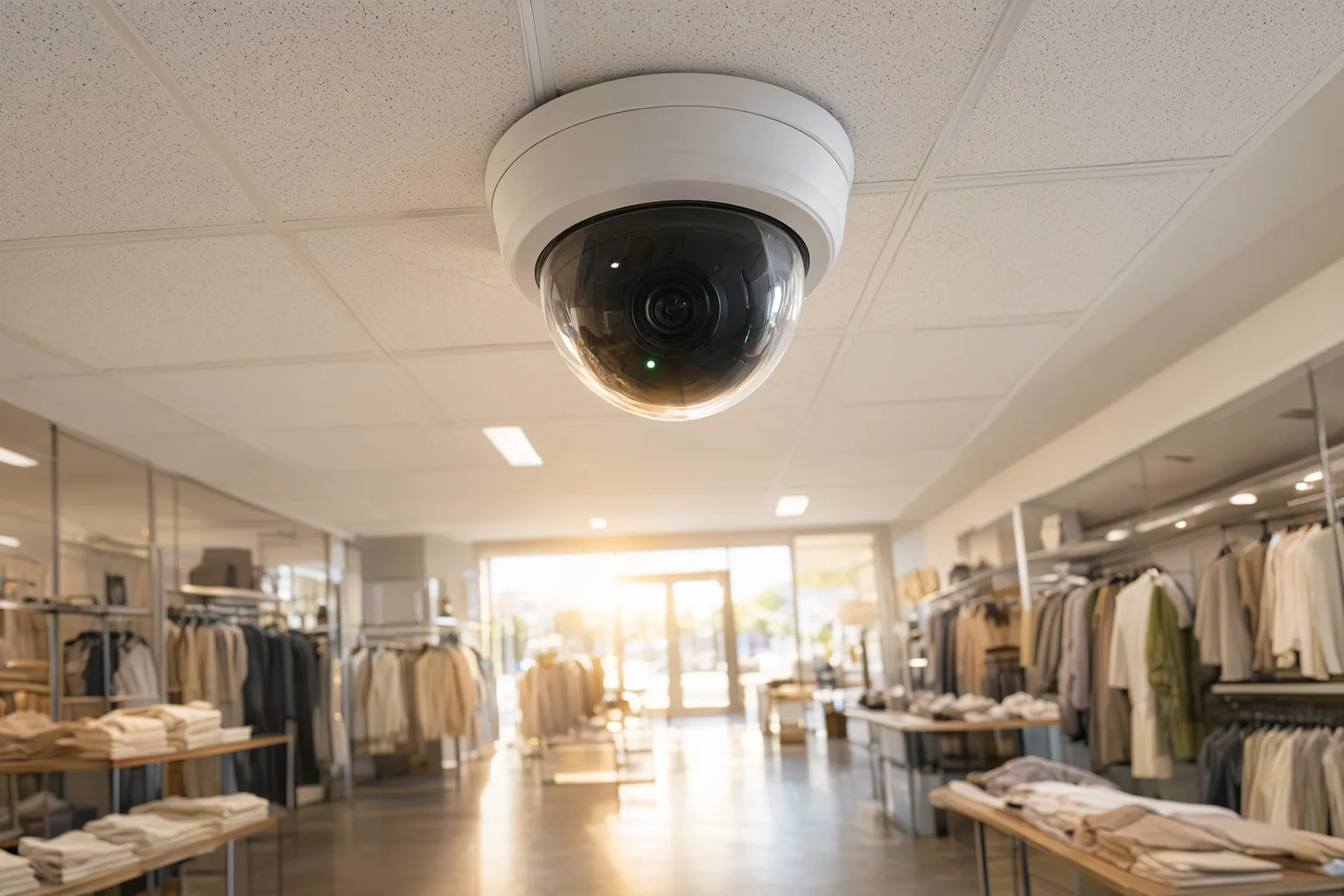
Key Takeaways
- Map critical zones on a floor plan before buying any cameras
- Overlap camera fields of view so shelving shadows never create gaps
- Use identification-grade cameras at entrances and registers
- Comply with the NSW Workplace Surveillance Act and South Australian surveillance laws
- Professional design typically costs $1,500–$4,000 AUD depending on store size
How Does a Retail CCTV Layout Achieve Zero Blind Spots?
The short answer is that effective retail CCTV camera placement means mapping your store's critical zones first — entrance, registers, high-value aisles and stockroom door — then overlapping each camera's field of view so every gap is covered twice. In Newcastle and Adelaide stores we audit, most blind spots come from single-camera aisle coverage and poor mounting heights, not cheap equipment. Fix the layout plan before you spend a dollar on hardware.
Get those three elements right and every part of your sales floor, entrance, point-of-sale area and stockroom appears in footage clear enough to act on. Get them wrong and you end up with expensive cameras recording gaps that experienced shoplifters find within days.
This guide walks through the full process used by professional installers across New South Wales: mapping your zones, choosing placement heights, matching camera types to each area, avoiding the layout mistakes that create hidden gaps, and understanding your legal obligations under NSW surveillance laws.
What Does Shrinkage Cost Australian Retailers Every Year?
Shrinkage costs Australian retailers billions of dollars annually, and a poorly planned CCTV layout is one of the most common contributing factors. The losses come from two directions: external theft by customers who have learned where the [[body-worn-cameras-vs-fixed-cctv-for-retail-security-teams|cameras]] can't see, and internal theft by staff who know exactly which corners of the stockroom are uncovered.
The frustrating part is that most retailers already own enough cameras. The problem is rarely the equipment — it's the plan behind it. A single camera aimed down an aisle looks fine on paper, but shelving units, promotional gondolas, pillars and seasonal displays carve shadows into that field of view where theft happens completely undetected.
We've designed layouts for hundreds of NSW retail stores, from small boutiques in Paddington to large-format stores across Western Sydney. Every floor plan is different, but the principles that eliminate blind spots never change: analyse sightlines physically, overlap every zone, and place cameras for the evidence you need rather than wherever it's convenient to drill.
Should You Map Critical Zones Before Buying Any Cameras?
Resist the urge to start shopping for cameras. Begin instead with a printed floor plan and a marker, and identify what you need to see and why. Cameras are the last decision, not the first.
Every retail store has non-negotiable coverage zones. Entrances and exits need identification-quality footage of every face coming in and going out. Point-of-sale terminals need clear views of transactions, cash handling and any sweethearting between staff and friends at the register. High-value merchandise displays need continuous monitoring. Stockrooms and goods-receiving areas are prime internal theft locations. Staff-only spaces such as break rooms need coverage balanced carefully against privacy obligations under NSW [[employee-monitoring-ethics-where-to-draw-the-line-with-workplace-cameras|workplace]] surveillance law.
Once the zones are marked, walk the floor. Stand inside each zone and look around honestly. Shelving bays, display stands, structural columns and even temporary Christmas stock create sightline obstructions that no floor plan reveals. Note where your view is blocked from each position — those obstructions are exactly where blind spots will form if your camera plan ignores them.
Which Placement Rules Eliminate Blind Spots in Retail Stores?
Professional layouts follow placement rules refined over decades of loss prevention work. They exist because footage quality determines whether an incident can be prosecuted or merely suspected.
Height is the first rule. Overview cameras mounted at 2.5–3 metres give context and track people moving through the store. But identification cameras must be lower — 1.5–1.8 metres at entrances captures faces rather than hats and shoulders. Mounting everything high is the single most common error we see; it produces footage that shows someone was present but can't prove who it was.
Overlap is the second rule, and it's non-negotiable. Each camera's field of view should overlap its neighbours by 15–20%. This creates continuous coverage as people move through the space and closes the seams between camera zones where blind spots traditionally hide.
Angle is the third rule. Cameras pointed toward windows and doorways face brutal backlighting — west-facing entrances in particular cop harsh afternoon sun through Australian summers. Without Wide Dynamic Range (WDR) processing, an entrance camera records silhouettes during peak trading hours precisely when you need faces most.
- Mount overview cameras at 2.5–3m for wide floor coverage and movement tracking
- Install identification cameras at 1.5–1.8m at entrances and POS terminals
- Maintain 15–20% field-of-view overlap between all adjacent cameras
- Angle cameras away from windows, glass doors and other bright light sources
- Use corner mounts to extract maximum coverage from each position
- Account for ceiling height — high ceilings may need pendant mounts or lower wall positions
Can One Camera Type Suit Every Zone in Your Store?
No single camera suits every location. The unit that performs brilliantly over your front door may be entirely wrong for a dim stockroom.
Entrances demand strong WDR performance plus enough resolution for facial identification at your actual mounting distance. Hikvision's AcuSense range handles difficult lighting well and adds person detection to cut false alarms. Dahua's WizMind series offers comparable capability with excellent low-light performance for early-morning and late-evening trading hours.
Sales floors generally suit varifocal dome cameras. The adjustable lens lets you fine-tune coverage after installation — invaluable when new shelving blocks an original sightline. Motorised varifocal models allow remote adjustment from your phone or NVR without anyone climbing a ladder.
POS terminals benefit from dedicated cameras focused tightly on the transaction area. These don't need breadth; they need detail. A 4MP or higher camera covering a two-metre zone resolves note denominations and hand movements clearly enough to investigate till discrepancies.
Stockrooms and loading docks present the hardest lighting: bright roller doors opening onto dark interiors. Starlight-technology cameras hold full-colour footage in low light, whereas standard cameras drop to black-and-white infrared and lose colour detail that often matters in investigations.
Do Shelving and Displays Create Hidden Blind Spots?
The most frequent mistake is relying on one camera per aisle. Shelving casts shadows down both sides, and anyone crouching to a bottom shelf or reaching low simply vanishes from frame. Two cameras per aisle, angled to cover opposite sides, removes this gap entirely.
Vertical blind spots are the second common oversight. Downward-angled cameras miss activity directly beneath them — a person standing close against the wall below a mounted camera is often invisible to it. Only overlapping coverage from neighbouring cameras solves this, and only if the layout was designed with it in mind.
Seasonal change catches many retailers out. A layout finalised in January can develop serious gaps by December once Christmas displays and overflow stock reshape the floor. Varifocal lenses help absorb minor changes, but major refits warrant a layout review.
Finally, retailers forget their own periphery. Staff car parks, rear laneways and bin areas are frequent sites for after-hours break-in attempts and stock walked out the back door. These zones belong on your map from day one.
Is Your Store Compliant With the NSW Surveillance Laws?
Camera placement in a retail store isn't just a technical exercise — it carries legal obligations. In New South Wales, the Workplace Surveillance Act governs monitoring of employees, and retailers must comply alongside general privacy expectations.
If you install cameras in staff areas such as break rooms, you must notify employees in writing before surveillance begins. Cameras must never be placed where privacy is reasonably expected — toilets, change rooms and similar facilities are off limits. Access to recorded footage should be restricted to authorised personnel and logged.
Signage matters too. Clear, visible notices at entrances inform both customers and staff that surveillance is operating, which strengthens the lawful basis for your system and acts as a deterrent in its own right. A licensed installer will design your layout to meet these requirements from the outset rather than forcing costly repositioning later.
Why Choose Professional Design Over DIY Camera Placement?
Designing a genuinely blind-spot-free layout requires more than buying cameras and fixing them wherever drilling is easy. It demands working knowledge of lens focal lengths, lighting behaviour, sightline analysis and loss prevention practice — skills that come from designing these systems daily.
Our five-step process begins with an on-site consultation: we walk your floor, identify critical zones and record lighting challenges. From there we design a layout specifying exact camera models, mounting positions and lens selections for every location. Installation includes precise positioning and angle adjustment, followed by configuration of recording settings, motion detection zones and remote access. Handover includes training so your team can retrieve footage confidently when an incident occurs.
We install commercial-grade Hikvision, Dahua, Uniview and Axis hardware — equipment built for the resolution, WDR performance and reliability retail environments demand. Every installation is fully licensed and insured, backed by lifetime support, and we offer free quotes so you know the full cost before committing.
Start at the front door. Your entrance camera should face inward, capturing full-body shots of everyone entering under natural light. Mount it high enough to avoid tampering but low enough to record faces clearly — around 2.4 to 2.7 metres works in most Australian retail fit-outs. Pair it with a second unit angled across the doorway to catch profiles that the first camera misses during peak-hour crowds.
Registers deserve two angles minimum: one overhead view of the counter surface to document transactions, and one customer-facing view showing who is paying. This combination resolves nearly every till dispute we see from [[/newcastle|Newcastle]] retailers, from short-change claims to disputed refunds. Position the overhead unit just behind the staff side, tilted about 45 degrees.
High-shrink zones — cosmetics, electronics, spirits, small accessories — need overlapping coverage down both sides of the aisle, not just one camera looking straight down the middle. A good rule of thumb: if a person can stand anywhere in your store and touch merchandise without appearing on two cameras simultaneously, you have a coverage gap worth fixing.
Consider your local environment too. Coastal salt air in Newcastle corrodes exposed fittings near open storefronts, while [[/adelaide|Adelaide]]'s summer heat regularly pushes ceiling cavities above 50°C, so check that indoor-rated cameras near skylights or west-facing glass carry adequate temperature ratings. Storm season along the Hunter also argues for surge protection on any external runs.
Finally, budget realistically. A professionally designed four-to-eight camera retail system in Newcastle or Adelaide typically lands between $2,500 and $6,500 installed, including NVR, cabling and commissioning. Larger supermarkets and [[warehouse-surveillance-systems-a-complete-guide-for-australian-operators|warehouse]]-style stores run higher, but every dollar spent on correct placement returns more than the same dollar spent on extra resolution nobody can use through a badly aimed lens.
Camera options by retail zone for Newcastle and Adelaide stores
| Zone | Recommended Camera | Typical Cost (AUD) |
|---|---|---|
| Entrance / frontage | 4K dome with WDR | $250–$550 per camera |
| Register / POS | Overhead mini bullet + customer-facing turret | $180–$400 per pair |
| Aisles / high-shrink | Compact turrets, staggered overlap | $150–$350 per camera |
| Stockroom / rear door | Vandal-resistant dome, continuous record | $200–$450 per camera |