
Key Takeaways
- Hidden CCTV installation costs typically add 40–60% to the advertised package price in Newcastle and Adelaide.
- Cabling runs through Colorbond roofs, double brick walls and two-storey homes are the biggest quote blowout drivers.
- Undersized NVR hard drives, missing power points and remote viewing setup are common paid extras.
- NSW and South Australia both require security installer licensing; unlicensed work risks voiding insurance.
- A written itemised quote covering cameras, cable metres, storage size and electrical work prevents surprises.
What Is the Real Cost of CCTV Installation in Australia?
The short answer: hidden CCTV installation costs in Australia typically add 40–60% to the advertised price of a security camera package. A '4-camera system from $1,899' headline rarely includes the cable runs through your ceiling space, the licensed electrician for a new power point, the larger NVR hard drive you actually need, or the remote viewing configuration that makes the system usable. For homeowners and business owners in Newcastle NSW and Adelaide SA, understanding these extras before signing a contract is the difference between a $2,000 project and a $3,500 surprise.
This isn't always deliberate deception — but it often is. Low headline prices exist to get installers through your door. Everything required to make the system genuinely work becomes a line item added after they've arrived. Knowing where these costs hide lets you compare quotes properly and negotiate from strength.
Why Does Cabling Blow Out CCTV Installation Quotes in Newcastle and Adelaide?
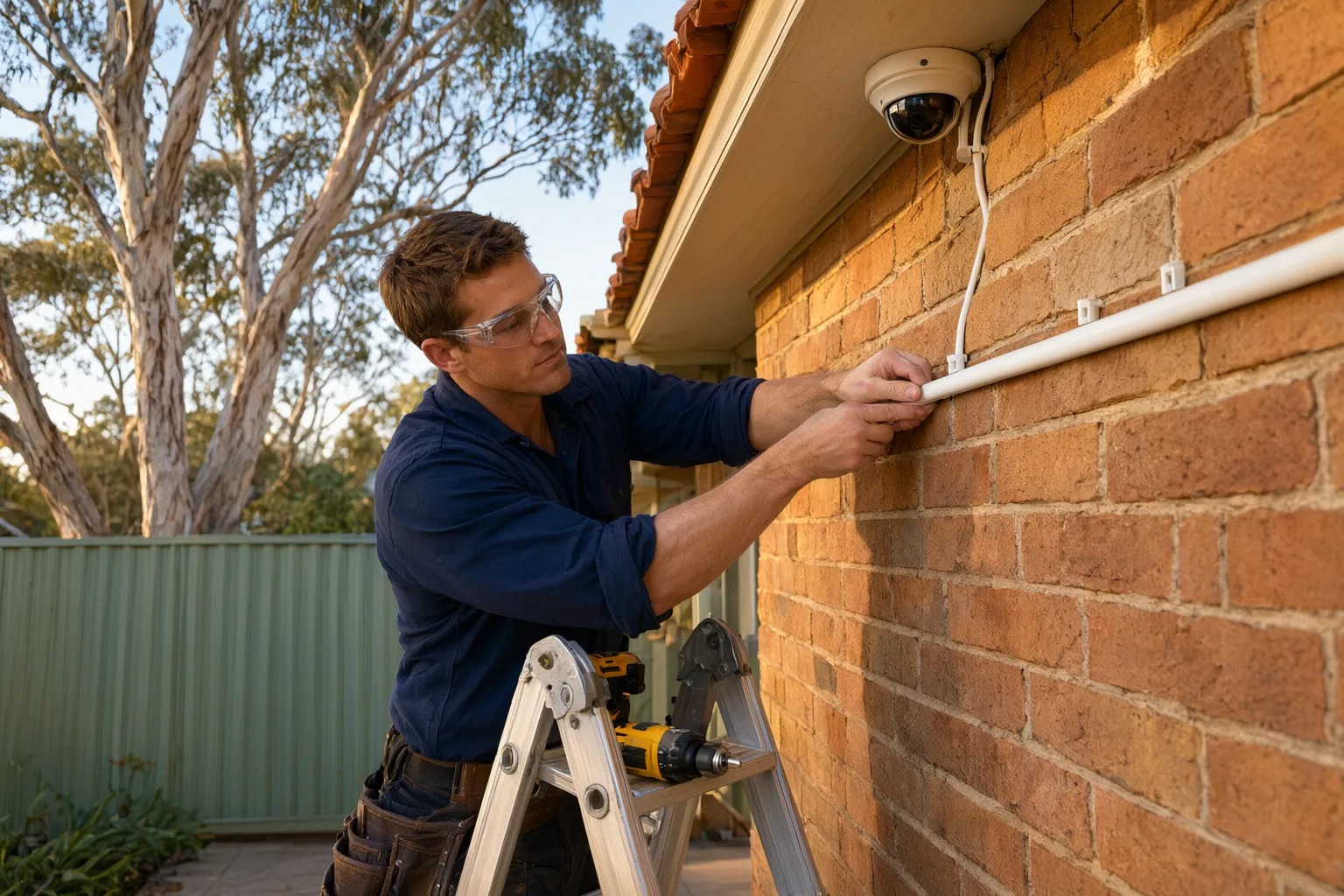
Running cable is the most labour-intensive part of any [[how-to-negotiate-a-better-cctv-installation-price-without-sacrificing-quality|installation]], and it's the first place budget quotes cut corners. Many quotes assume 'standard cabling conditions' — which conveniently excludes double-storey homes, flat or low-pitch Colorbond roofs, concrete slab construction, and any cable run beyond roughly 15 metres.
If your home falls outside that definition, expect surcharges of $150 to $400 per camera run. A single-storey brick veneer home with easy roof access might take two hours to cable; a double-storey with no crawl space can consume a full day.
External conduit is the second trap. Any cable run along an external wall should sit inside UV-stabilised conduit to protect against sun, moisture, and pests. Quality installers include this automatically; budget operators treat it as an optional extra at $20–$40 per metre.
Is Your NVR Hard Drive Deliberately Undersized?
One of the industry's most reliable upsells hides in the spec sheet. A competitive quote will include an NVR with a 1TB drive. For four cameras recording at 4K, that's roughly five to seven days of footage before overwriting begins — far short of the 14 to 30 days most homeowners actually want.
The upgrade path is profitable by design. A surveillance-grade 4TB or 6TB drive costs the installer $80–$120 in parts, but they'll charge $200–$350 for it — usually after [[what-affects-cctv-installation-prices-10-factors-australian-quotes-are-based-on|installation]], when you've discovered last weekend's footage has already vanished.
Ask one question before signing: what hard drive size is included, and how many days of recording does it deliver at my chosen resolution?
Should You Budget Extra for Electrical Work on Your CCTV System?
If your recorder needs to live somewhere without a nearby power point — a garage, hallway cupboard, or study — a licensed electrician must install one. In NSW, expect $150 to $300 depending on how complex the run is.
PoE (Power over Ethernet) systems minimise this cost because cameras draw power through the network cable itself. Analogue systems are different: each camera needs its own power point or a centralised power distribution box, adding $100 to $250.
Larger commercial jobs may also need switchboard modifications or a dedicated circuit. A competent installer identifies this during the site inspection — not halfway through drilling holes in your walls.
Can Remote Viewing Setup Cost Extra With Professional Installers?
Nearly every modern [[how-much-does-a-4-camera-cctv-system-cost-in-australia|system]] promises smartphone viewing. What's rarely mentioned is that doing it properly takes time: configuring port forwarding or P2P connectivity, testing on your specific NBN connection, and confirming it works on both Wi-Fi and mobile data.
Budget operators either skip it entirely, do a rushed five-minute setup that breaks the moment your router restarts, or charge $100–$200 as an 'optional add-on'. Rural properties on 4G connections face more complexity still — possibly requiring a static IP or a 4G router with a VPN tunnel.
A proper handover means remote viewing configured and tested on your phone before the installer packs up. Treat anything less as an incomplete job.
Do Maintenance and Warranty Gaps Add Costs After Installation?
Hidden costs don't end when the installer leaves. Systems need periodic maintenance: lens cleaning (critical in coastal areas where salt spray accumulates), firmware updates to patch security vulnerabilities, hard drive health checks, and re-aiming cameras shifted by wind or storms.
Many operators offer no after-sales support whatsoever. When a camera fails at month fourteen, you're facing a $150–$250 call-out fee — or worse, a company that no longer exists. Before signing, ask specifically whether the warranty covers parts only or parts and labour, and whether warranty call-outs attract a fee.
How Do You Get a Trustworthy CCTV Quote in Adelaide or Newcastle?
Insist on a written, itemised quote covering every element of the job. If an installer won't provide one, walk away. A legitimate quote lists camera models and specifications, the NVR model and hard drive size, total cable length and whether conduit is included, any electrical work, remote viewing setup, warranty terms, and the total price including GST.
Be suspicious of prices prefixed with 'from' or vague phrases like 'standard installation'. Ask directly: 'Is this the final price, or could charges be added on the day?' A trustworthy installer answers plainly.
Hardware brand matters too. Professional-grade equipment from Hikvision, Dahua, Uniview, or Axis costs more upfront than generic no-name cameras, but delivers dramatically better image quality, reliability, and warranty backing. Cheap cameras are themselves a hidden cost — plan on replacing them within two to three years.
Which CCTV Camera Brands Offer the Best Long-Term Value in Australia?
Are Hidden CCTV Costs Avoidable With the Right Checklist?
Cabling costs vary dramatically by construction type. In [[/newcastle|Newcastle]]'s established suburbs like Merewether and Hamilton, many homes are double brick, which means installers cannot simply drop cable down a wall cavity — every run requires surface-mounted conduit or careful external routing under eaves. In [[/adelaide|Adelaide]]'s western suburbs, older stone cottages present similar challenges. A quote assuming 'standard single-storey timber-frame access' can jump by $400–$900 once the installer sees brick walls, a tiled roof, or a second storey. Always ask how many metres of cable are included and what the per-metre rate is beyond that allowance.
Roof type matters more than most people expect. Colorbond roofing, common across South Australia, heats to over 70°C in summer, and cheap cable jackets degrade faster in that heat, pushing installers toward higher-grade UV-stable cabling that costs more per metre. Coastal Newcastle properties face salt corrosion on external mounts and connectors, so reputable installers specify marine-grade fittings. Neither upgrade is a scam — but neither should appear as a surprise line item after work begins. Ask upfront whether coastal or heat-rated hardware is included in the quoted price.
Storage maths exposes another hidden cost. Four 4MP cameras recording continuously at default settings consume roughly 40–60GB per day combined. The 1TB drive bundled in budget packages holds only about three weeks of footage. If you want 30 days of retention — often needed for insurance claims or business compliance under workplace surveillance requirements — you need a 4TB drive, typically a $150–$300 upsell. Some installers quietly reduce recording quality instead, which defeats the purpose of installing cameras at all. Specify resolution, frame rate and retention days in writing before you sign.
Electrical work is legally non-negotiable. Under Australian wiring rules, any new power point or hardwired connection must be performed by a licensed electrician, and CCTV recorders should be on a dedicated circuit with surge protection — particularly important in storm-prone Hunter Valley summers and Adelaide's dry lightning events. Expect $180–$350 per power point installed. If a quote includes 'power' without naming an electrician or licence number, the installer may be cutting corners that void your home insurance if something goes wrong.
Remote viewing setup sounds free because every brand advertises it, but doing it securely takes an hour or more of labour: configuring P2P accounts, setting strong passwords, updating firmware, and testing playback on your actual phone. Budget installers skip this and hand you a manual. Others charge $100–$200 as a 'smart device setup fee'. Either way, ask whether app configuration, user training and firmware updates are included. A system you cannot view remotely is half a system, especially when you're away and want to check on your property.
Maintenance is the cost nobody budgets. Coastal salt air in Newcastle corrodes camera housings and connectors within 18–24 months without cleaning; dust and heat do the same in Adelaide's plains suburbs. Plan on lens cleaning, seal checks and firmware updates every 6–12 months — either DIY or via a service plan costing $150–$250 annually. Check warranty terms carefully too: many imported kits carry 12-month warranties serviced from overseas, meaning a failed camera means weeks without coverage. Australian-distributed brands like Hikvision and Dahua through local distributors offer faster replacement.
Licensing protects you more than it costs you. In NSW, security equipment installers must hold a Class 2E licence through NSW Fair Trading; in South Australia, a security agent licence applies under the Security and Investigation Agents Act. Hiring unlicensed operators risks defective work, no recourse under consumer law, and potential insurance claim rejection. Verify the licence number on the quote, and remember Australian Consumer Law guarantees apply to services as well as goods — misleading quotes about what's 'included' are actionable complaints.
Brand choice affects lifetime cost more than purchase price. Hikvision and Dahua dominate Australian professional installs with strong value and local parts availability; Uniview offers competitive mid-range options; Reolink suits DIY-minded owners but lacks professional support networks. Avoid no-name grey-import kits sold online — when a $90 camera fails, shipping it overseas costs more than replacing it. For commercial sites like warehouses, retail shops and farms around both cities, invest in NDAA-compliant models to avoid future procurement headaches.
Your final checklist before accepting any CCTV quote: written itemised pricing including cable metreage and per-metre rates; named camera and NVR models with storage capacity and retention days; electrician licence number for any electrical work; remote viewing setup confirmed as included; warranty terms with Australian service details; installer licence valid for NSW or SA; and a fixed total price rather than 'estimated'. Get two or three quotes and compare line by line — the cheapest headline price is almost never the cheapest finished job.
Typical hidden CCTV installation costs in Newcastle & Adelaide (2025 AUD)
| Hidden Cost Item | Typical Price Range (AUD) | When It Applies |
|---|---|---|
| Extra cabling runs | $400–$900 | Double brick, two-storey or large-block properties |
| NVR hard drive upgrade (1TB to 4TB) | $150–$300 | 30-day footage retention required |
| Licensed electrician power point | $180–$350 | No outlet near recorder location |
| Remote viewing setup & training | $0–$200 | Varies by installer; confirm inclusion |
| Annual maintenance & seal check | $150–$250/year | Coastal Newcastle salt air, dusty Adelaide plains |