
Key Takeaways
- Covert cameras require a magistrate-issued covert surveillance authority under NSW's Workplace Surveillance Act 2005
- Overt CCTV with 14+ days written notice is fully legal for Newcastle and Adelaide businesses
- Cameras are never permitted in toilets, change rooms or private areas
- Unlawful covert filming attracts fines up to $11,000 for individuals in NSW
- Compliant visible systems cost $1,500–$5,000 installed for most commercial sites
Is It Ever Legal to Install Hidden Cameras in the Workplace?
The short answer is that hidden cameras in the workplace are almost never legal in Australia. Employers may only use covert cameras if they hold a covert surveillance authority issued by a magistrate, which requires proving serious suspected criminal activity. For everyday security in Newcastle or Adelaide workplaces, overt CCTV with proper employee notification is the lawful, effective and affordable path.
This article explains exactly what the law allows and forbids, when covert surveillance is ever permitted, what penalties apply if you get it wrong, and how to build a fully compliant overt CCTV system that still delivers strong security outcomes. Whether you run a retail store in Sydney, a warehouse in Melbourne, or a hospitality venue in Brisbane, the principles below will help you protect your business without exposing yourself to criminal charges, civil claims, or destroyed evidence.
What Does Australian Law Say About Hidden Cameras at Work?
Australia has some of the strictest [[workplace-surveillance-laws-in-australia-what-employers-must-know|workplace surveillance laws]] in the world, and for good reason. Employees have a reasonable expectation of privacy at work, and secretly recording them crosses a legal line in almost every scenario. In New South Wales, the Workplace Surveillance Act 2005 makes it an offence for an employer to carry out covert camera surveillance of employees unless they hold a covert surveillance authority issued by a magistrate. That authority is only granted where there are reasonable grounds to suspect an employee is committing a serious offence, such as theft, fraud, or drug dealing on the premises.
Other states have similar frameworks. Victoria's Surveillance Devices Act 1999 restricts the use of optical surveillance devices in circumstances where a person would reasonably expect privacy, and Queensland's Invasion of Privacy Act 1971 imposes comparable limits on listening and optical devices. The Commonwealth Telecommunications (Interception and Access) Act 1979 adds another layer by prohibiting the interception of communications, which matters if any camera system also captures audio.
The practical effect is consistent across every state and territory: if you want to monitor your workplace with cameras, you need to tell your staff first. The law does not distinguish between a multinational corporation and a corner store — the [[do-you-need-to-tell-staff-theyre-on-camera-australian-notice-requirements-explai|notification]] obligations apply to employers of all sizes.
Can Covert Surveillance Ever Be Permitted by a Magistrate?
There are narrow exceptions, but they are far more limited than most business owners assume. A magistrate can issue a covert surveillance authority in NSW if an employer demonstrates reasonable grounds to believe an employee is engaged in unlawful activity that causes or could cause significant harm to the business. Even then, the authority will specify the scope, duration, and location of the surveillance. It is not a blanket licence to hide cameras wherever you like.
Private investigators engaged by an employer may also conduct covert surveillance under certain conditions, but they must operate within state licensing requirements and surveillance device legislation. Licensed investigators understand precisely where the legal boundaries sit, which is why engaging one is far safer than attempting DIY covert monitoring.
If you suspect serious misconduct such as stock theft or safety sabotage, the correct path is to consult a lawyer and, where appropriate, law enforcement rather than installing a hidden camera yourself. The consequences of getting it wrong include criminal charges, civil claims for breach of privacy, and any evidence gathered being thrown out in court or tribunal proceedings — meaning you could end up with neither the evidence nor a lawful workplace.
Should Employers Choose Overt CCTV With Proper Notification Instead?
The good news is that visible, properly disclosed CCTV is entirely legal and highly effective for Australian workplaces. Under the Workplace Surveillance Act 2005 (NSW), employers must give employees at least 14 days written notice before camera surveillance begins. The notice must describe the kind of surveillance, how it will be carried out, when it will start, whether it will be continuous or intermittent, and whether it will be ongoing or for a specified period. New employees must be notified before they start work.
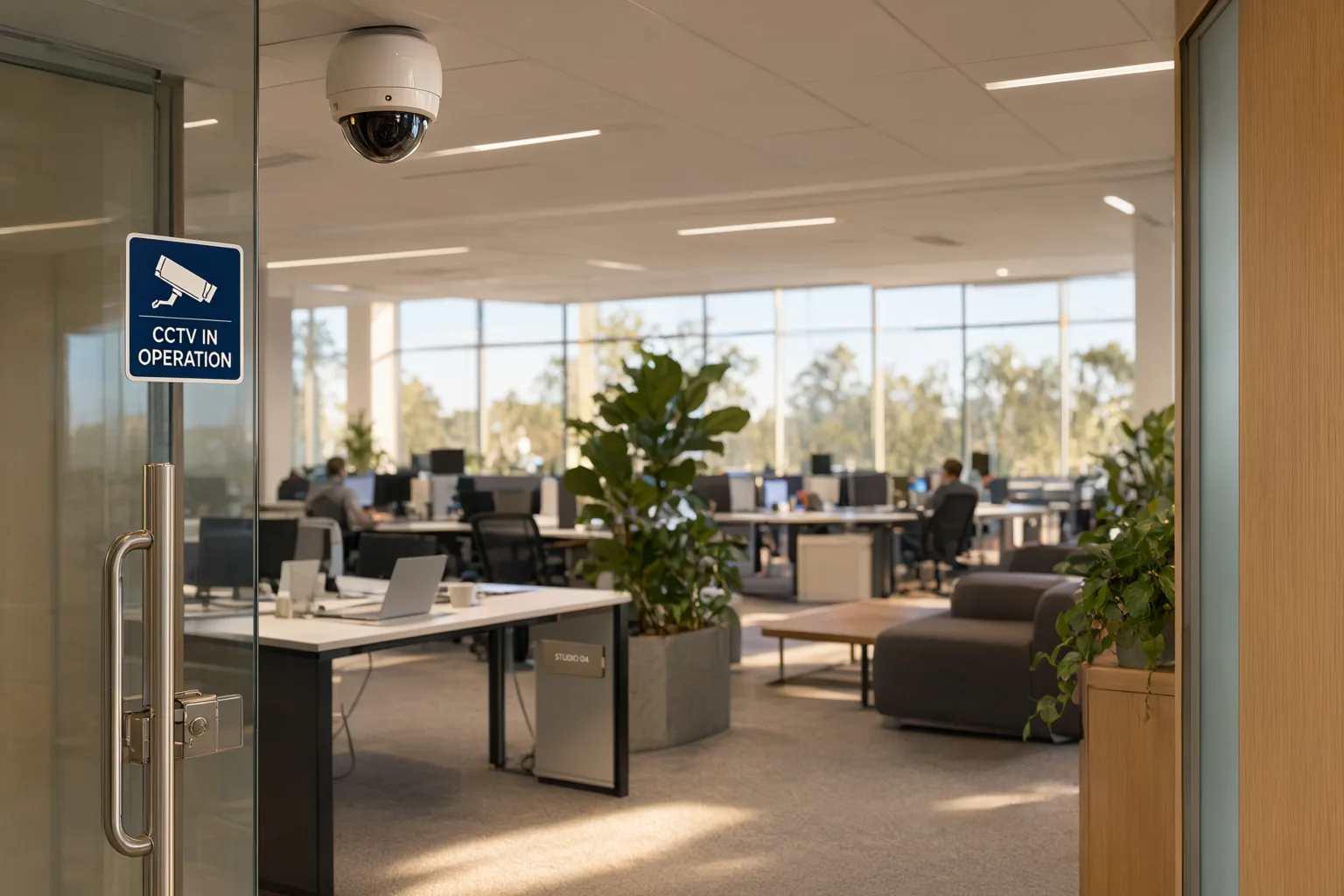
Signage is equally important. Cameras should be clearly visible, and signs should be placed at entrances and throughout monitored areas so that employees, customers, and visitors are aware recording is taking place. This transparency does not weaken your security posture. In fact, visible cameras are a stronger deterrent than hidden ones because potential offenders know they are being watched before they act, rather than discovering it after the damage is done.
Professional-grade systems from Hikvision, Dahua, Uniview, and Axis deliver crystal-clear footage with features like ColorVu full-colour night imaging, AcuSense human and vehicle detection, and ANPR number plate recognition, all while keeping you on the right side of the law. Modern network video recorders also support remote viewing via secure mobile apps, so owners and managers can check on their premises from anywhere without compromising compliance.
Are There Areas Where Workplace Cameras Are Never Appropriate?
Regardless of whether surveillance is overt or covert, there are spaces in every workplace where cameras should never be installed. Toilets, change rooms, shower facilities, and prayer or lactation rooms are strictly off limits. Recording in these areas is a criminal offence in every Australian state and territory, and no amount of employer notification or signage makes it legal.
Break rooms and [[staff-only-areas-and-cctv-lunchrooms-lockers-and-legal-grey-zones|staff-only]] areas occupy a greyer zone. While not automatically illegal, installing cameras in areas where employees eat lunch or take personal calls can damage trust and may still attract scrutiny under privacy principles. Many unions and employee representatives treat cameras in these spaces as a red flag, and Fair Work claims often cite them as evidence of poor workplace culture.
The best practice approach is to focus camera coverage on entry and exit points, stockrooms, cash handling areas, loading docks, car parks, and other locations where security risks are highest and privacy expectations are lowest. A well-designed system protects your assets while leaving genuinely private spaces alone.
Do Penalties Apply If You Break Workplace Surveillance Rules?
The penalties for unlawful workplace surveillance are serious. In NSW, an employer who conducts covert camera surveillance without a magistrate's authority faces fines and potential criminal prosecution under the Workplace Surveillance Act 2005. Employees who discover they have been secretly recorded may bring claims for breach of privacy, breach of contract, or constructive dismissal.
In unfair dismissal proceedings before the Fair Work Commission, evidence obtained through illegal surveillance is routinely excluded, which can destroy an otherwise strong case. An employer who spends thousands of dollars on a covert camera operation only to watch the footage ruled inadmissible has wasted money and created legal liability simultaneously.
Beyond the legal exposure, there is a reputational cost. News of hidden cameras spreads quickly among staff and can devastate workplace culture, morale, and retention. Customers and clients who learn that a business secretly records people may take their business elsewhere. For a fraction of the cost of defending a single legal claim, you can install a professional, fully compliant CCTV system that protects your business, your people, and your reputation.
How Do You Set Up Compliant Workplace CCTV Step by Step?
Setting up a lawful workplace camera system is straightforward when you follow the right process. Start by identifying your security objectives: are you protecting stock, monitoring cash handling, securing the perimeter, or all of the above? Next, map out camera positions that cover high-risk areas without intruding on private spaces. Choose professional-grade hardware suited to Australian conditions, including heat-rated housings for warehouse ceilings where summer temperatures climb well past 40 degrees Celsius, and corrosion-resistant mounts for coastal locations exposed to salt air.
Prepare a written surveillance policy that explains what is being recorded, why, how footage is stored, who can access it, and how long it is retained. Distribute this policy to all employees with at least 14 days notice before the system goes live, and display clear signage at every monitored entry point. Finally, restrict footage access to authorised personnel only and maintain a log of who views recordings and when.
A licensed and insured installer can guide you through every step, from initial consultation and system design to installation, configuration, and handover with staff training, ensuring your system is both effective and fully compliant from day one. Professional installation also ensures cabling, mounting, and recorder placement meet Australian standards and insurer expectations.
Why Do Employers Keep Asking About Hidden Camera Scenarios?
Scenario one: a retail owner suspects a staff member of skimming the till. The temptation is to hide a camera above the register overnight. This is unlawful in NSW without a magistrate's authority. The lawful path is to review existing overt CCTV footage, tighten cash-handling procedures, and if suspicion persists, seek legal advice about applying for covert surveillance authority or engaging a licensed investigator.
Scenario two: a warehouse manager wants to stop after-hours break-ins. Overt cameras covering entry points, roller doors, and the loading dock — combined with signage and alarm integration — achieve this legally and effectively. Motion-activated recording and remote alerts mean incidents are captured even outside business hours.
Scenario three: an office manager wants to check whether staff are working during the day. Productivity monitoring through covert cameras is both unlawful and counterproductive. If performance management is the goal, transparent processes, clear KPIs, and openly disclosed monitoring policies are the correct tools. Hidden cameras aimed at desks invite Fair Work disputes and privacy complaints that dwarf any productivity gain.
Which Approach Actually Protects Your Business: Overt vs Covert?
When weighing overt against covert surveillance, consider deterrence, admissibility, and cost. Visible cameras deter offences before they happen; hidden cameras merely document them after the fact. Lawfully obtained overt footage is generally admissible in court and tribunal proceedings, while covert footage is only usable if the underlying authority was validly obtained. And overt systems avoid the fines, prosecution risk, and reputational damage attached to non-compliant covert operations.
There is also an insurance dimension. Many Australian insurers look favourably on businesses with professionally installed, monitored CCTV, and some offer reduced premiums for premises with verified surveillance coverage. A covert rig discovered by an investigator does nothing for your insurance position — and may complicate claims if footage cannot be produced lawfully.
In short, overt CCTV wins on every measure that matters: legality, deterrence, evidence quality, and total cost of ownership. The only situation where covert surveillance makes sense is a magistrate-approved investigation into suspected serious criminal conduct, conducted with legal guidance.
Under the Workplace Surveillance Act 2005 (NSW), covert camera surveillance of employees is prohibited unless a magistrate issues a covert surveillance authority on application by an employer. The magistrate must be satisfied there are reasonable grounds to suspect unlawful activity is occurring at the workplace, and that covert surveillance is necessary to establish whether it is happening. Even then, the authority lasts a maximum of 30 days and cannot cover change rooms, toilets or bathing facilities. South Australia takes a similar approach through its Surveillance Devices Act framework, which restricts the use of listening and optical devices in private premises without consent.
The Privacy Act 1988 also applies to any business with annual turnover above $3 million that collects footage of identifiable staff. Under Australian Privacy Principles, you must have a clearly expressed privacy policy covering CCTV collection, tell people when their image is being recorded, and store footage securely. Small businesses may be exempt from some provisions, but state-based surveillance legislation applies regardless of turnover, so virtually every employer in [[/newcastle|Newcastle]], [[/adelaide|Adelaide]] and across Australia must comply.
For overt systems, NSW employers must give employees at least 14 days written notice before camera surveillance begins, stating whether it is continuous or intermittent, whether audio is recorded, and how the cameras will operate. New employees starting after installation must be notified before they commence work. Signs must be clearly visible at every entrance to surveilled areas. In South Australia, while there is no identical 14-day rule for video, the Surveillance Devices Act prohibits recording private conversations without consent from all parties, making audio capture especially risky for Adelaide businesses.
Camera placement matters as much as legality. Mount cameras at eaves, rooflines or brick pillars overlooking entries, loading docks, cash handling zones and car parks — never where they can view inside amenities. Coastal installations in Newcastle need marine-grade housings rated for salt air and humidity, while Adelaide's hot summers demand equipment rated to at least 50°C with adequate ventilation to prevent heat-related failures during summer storms and extended sun exposure.
Costs for a compliant four-camera commercial system in Newcastle or Adelaide typically range from $2,500 to $6,000 installed, depending on cabling runs, storage retention and analytics features. Larger warehouse or retail deployments with 16+ cameras commonly run $8,000 to $20,000. Compare that against NSW penalties for unlawful covert surveillance — fines up to $11,000 for individuals and $55,000 for corporations — plus potential civil claims and Fair Work exposure, and overt compliance is clearly the cheaper path. Contact Aussie CCTV Cams for a free site assessment and quote.
Documentation protects you in disputes. Keep signed notices, signage photographs, your privacy policy, and a register of camera locations. If an incident occurs, properly collected overt footage is admissible evidence for police reports, insurance claims and Fair Work proceedings. Covertly obtained footage gathered without authority risks being excluded, exposing you to prosecution rather than supporting your case. A licensed installer will provide compliance documentation as part of the handover package.
Finally, review your system annually. Laws evolve, staff turnover means new notices are needed, and technology changes — modern AI-powered analytics can detect loitering, line-crossing and after-hours movement without any need for hidden devices. An annual audit with your installer keeps your Newcastle or Adelaide business compliant, secure and defensible.
For Newcastle business owners, compliance starts before installation day. Under the Workplace Surveillance Act 2005 (NSW), employees must receive at least 14 days' written notice before overt camera surveillance begins, and signage must be clearly displayed at every entrance. New staff should be told about existing cameras during onboarding, ideally in their employment contract or induction pack. Skipping these steps can render footage unusable and expose you to penalties enforced by NSW Industrial Relations.
Adelaide employers face parallel obligations under South Australia's Surveillance Devices Act 2016 and the Privacy Act 1988 (Cth). While SA does not mandate the same 14-day notice period as NSW, covert recording of private conversations or activities without consent remains an offence carrying significant fines. The Australian Consumer Law also intersects here: misleading staff about monitoring practices can constitute deceptive conduct, so transparency protects you commercially as well as legally.
Installation quality matters as much as legality. Coastal conditions in Newcastle demand weather-rated housings rated for salt air and storm exposure, while Adelaide's hot, dry summers mean cameras need adequate heat dissipation when mounted under eaves or on brick walls. A professional installer will position cameras to cover entries, stockrooms and registers without ever pointing into change rooms, bathrooms or designated break areas where privacy expectations are absolute.
Budget realistically for a compliant system. A four-camera overt setup for a small retail shop typically costs $1,500–$2,500 installed, while a warehouse or commercial site needing 8–16 cameras, night vision and remote monitoring generally runs $3,500–$8,000. These figures include signage, notification documentation and licensing-compliant configuration. Get a quote tailored to your property rather than guessing, because retrofitting non-compliant installs costs far more than doing it right the first time.
Workplace surveillance options compared for Australian businesses
| Option | Legality & Requirements | Typical Cost (AUD) |
|---|---|---|
| Overt CCTV with signage | Fully legal in NSW & SA; 14 days' written notice required in Newcastle NSW | $1,500–$2,500 (4 cameras) |
| Magistrate-approved covert cameras | Legal only with covert surveillance authority; serious suspected crime required | $5,000+ incl. legal fees |
| Audio + video monitoring | High risk; requires all-party consent under state surveillance Acts | Not recommended |
| Monitored alarm + visible cameras | Lawful deterrent; no notice issues beyond standard CCTV rules | $2,000–$4,000 |