
Key Takeaways
- Professional construction site theft prevention typically costs $2,000–$8,000 AUD installed, versus average losses of $10,000+ per break-in.
- Thieves target portable, high-value items first: tools, copper wiring, appliances and fuel.
- Most construction theft happens between 6pm and 6am, peaking Friday and Saturday nights in Newcastle NSW and Adelaide SA growth corridors.
- AI-monitored CCTV with audio deterrents outperforms fences, padlocks and dummy cameras.
- Layered security — lighting, cameras, monitoring and signage — delivers the best return for home builds and commercial projects alike.
What Does Construction Site Theft Really Cost Australian Builders?
The short answer is that construction site theft prevention typically costs between $2,000 and $8,000 for a professionally installed, AI-monitored CCTV system across Australia. For builders in Newcastle NSW and Adelaide SA, that investment protects copper wiring, tools and appliances worth tens of thousands of dollars. You can recover the full cost by preventing just one break-in, making monitored site security one of the smartest line items on any commercial build budget.
The problem has intensified as material prices and copper values have climbed. Quality power tools hold their resale value remarkably well, and stolen goods move quickly through online marketplaces and informal networks, which is why recovery rates often sit below 10 per cent. Once gear leaves your site, chances are you'll never see it again.
For small builders and subcontractors, one bad night can be catastrophic. Losing $10,000 of tools before a critical pour doesn't just dent the budget — it can trigger penalty clauses, blow out schedules and erode a reputation that took years to build.
Which Items Do Thieves Target First on Building Sites?
Thieves work to a simple formula: portable, valuable, easy to sell. Knowing what sits at the top of their shopping list lets you direct your security budget where it matters most.
Power tools lead by a wide margin. Milwaukee, Makita and DeWalt kit commands strong prices second-hand, and an entire ute-load can disappear in under five minutes. Copper comes next — both rolls of cable stored on site and wiring already installed in wall frames. Organised crews have been known to strip a whole stage of a development overnight when copper prices spike.
Fuel theft is rampant across regional and outer suburban areas, with diesel siphoned from excavators, generators and site vehicles. Smaller plant such as plate compactors, concrete saws and laser levels regularly walk off sites, as do appliances, hot water systems and air conditioning units waiting for installation. Even bulk materials — timber, Colorbond roofing, tiles and fixtures — are targeted, particularly at townhouse and duplex projects sitting at lock-up stage.
- Power tools and trade equipment (highest resale value)
- Copper wire, cable and installed electrical fittings
- Diesel fuel from machinery and site vehicles
- Small plant: compactors, saws, generators, laser levels
- Appliances, hot water systems and air conditioning units
- Building materials: timber, roofing iron, tiles and fixtures
Where Are Australia's Construction Theft Hotspots?
[[time-lapse-cameras-on-building-sites-marketing-gold-and-dispute-evidence|Construction]] theft clusters where opportunity is greatest: the fast-growing outer suburban corridors where dozens of homes sit under construction side by side, with little natural surveillance between them.
In New South Wales, the south-west Sydney growth areas around Leppington, Austral and Oran Park, plus the north-west corridor through Box Hill and Marsden Park, consistently report high incident rates. Melbourne's western and northern growth fronts — Wyndham, Melton and Whittlesea — face similar pressure, while south-east Queensland's Logan, Ipswich and Moreton Bay corridors round out the national hotspots.
Regional centres aren't safe either. [[/newcastle|Newcastle]], Wollongong, the Central Coast and Geelong all see regular targeting, partly because thieves bank on slower police response times and lighter security outside the metro core.
When Are Sites Most Vulnerable? Timing Patterns Every Builder Should Know
Location is only half the story — timing matters just as much. The bulk of construction theft happens between 6pm and 6am, with Friday and Saturday nights standing out as the peak windows. Thieves know weekends mean no tradies arriving early, no deliveries, no neighbours watching.
Long weekends amplify the risk, but nothing compares to the Christmas–January shutdown. Sites sit unattended for weeks over the holidays, and organised offenders plan around it. The end-of-year break reliably produces a spike in major plant and copper theft across every state and territory.
The practical takeaway: your security needs to be strongest precisely when nobody is there. Passive measures that depend on someone noticing a problem are useless at 2am on New Year's Day — automated detection and response aren't optional extras.
Why Do Fences, Padlocks and Dummy Cameras Fail?
Plenty of builders still rely on temporary fencing, a padlocked site shed and a 'smile, you're on camera' sign connected to nothing. Determined thieves see straight through it. Standard temp fencing can be lifted or cut in seconds, sheds are routinely jemmied open, and fake cameras are easy to spot for anyone who knows the difference.
Static guards genuinely work, but at $40 to $60 per hour they're hard to justify on smaller projects or long builds — costs balloon into the thousands every week. Meanwhile, consumer-grade wireless cameras from the hardware store routinely fail on real sites: dust, heat, rain and unreliable power knock them out exactly when they're needed most.
The common thread is passivity. A camera that records a theft but alerts nobody simply delivers high-definition footage of your loss. Effective modern site security must detect intruders, deter them in the moment and trigger a response in real time.
How Does AI-Powered Monitored CCTV Change Construction Site Theft Prevention?
Professional CCTV has transformed [[construction-site-cctv-protecting-plant-tools-and-materials-after-hours|construction site]] protection. Today's systems pair rugged hardware with artificial intelligence that actively identifies intruders rather than just filming them.
Deep-learning platforms such as Hikvision AcuSense and Dahua WizSense separate humans and vehicles from animals, weather and swaying vegetation — cutting false alarms dramatically while ensuring genuine intrusions fire instant alerts. Hikvision ColorVu cameras capture full-colour images around the clock, even in near darkness, preserving the faces, clothing and vehicle details that grainy black-and-white infrared footage loses.
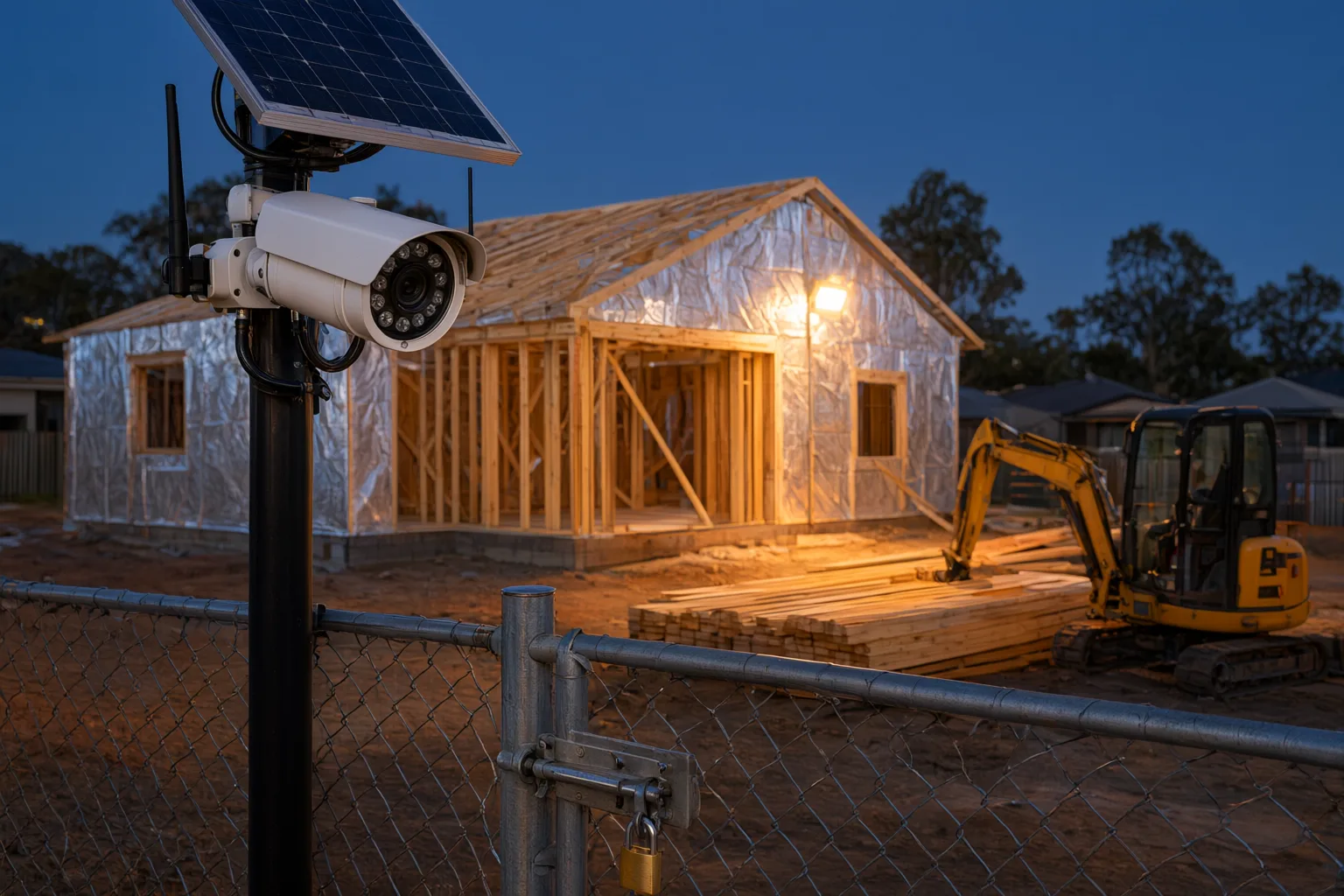
Most early-stage builds lack mains power and fixed internet, so solar-powered camera trailers and pole-mounted units running on 4G deliver full coverage from day one. They stream live video to your phone, fire strobe lights and sirens when an intruder appears, and can be relocated as the site evolves. ANPR cameras at entries log every vehicle coming and going, building a powerful evidentiary trail.
The results are compelling: sites with visible, actively monitored CCTV typically report theft reductions of 50 to 80 per cent, and professional-grade footage is regularly used by police to secure convictions — something consumer camera clips rarely achieve.
Should You Build a Layered Site Security Plan That Actually Works?
No single measure stops determined thieves. The strongest protection stacks layers, each covering the gaps in the others.
Start with the perimeter: quality temporary fencing fitted with anti-lift brackets, locked gates and clear signage advertising 24-hour monitored surveillance. Signage alone deters a meaningful share of opportunistic offenders. Layer two is lighting — motion-activated LED floodlights remove the dark corners thieves depend on and sharpen camera image quality at night.
Layer three is detection: AI-enabled cameras covering entry points, material storage areas and the site office, configured to push instant alerts to your phone or a monitoring centre. Layer four is response — decide in advance whether an alert means you check live footage, a monitoring centre verifies and calls police, or the camera's speaker issues an audible warning.
Finally, shrink the reward. Lock tools in steel containers, engrave or mark equipment, delay delivery of high-value items until they're actually needed, and maintain a current asset register with serial numbers and photos. As licensed and insured NSW security installers, we design systems around your specific layout, build stage and risk profile using professional Hikvision, Dahua and Uniview hardware built to survive dust, storms and rough handling — backed by lifetime support through consultation, design, installation, configuration and handover training.
Can You Choose the Right Security Mix for Your Project Size and Budget?
Not every site needs the same setup. A short renovation behind an occupied home may get by with decent lighting and a couple of quality cameras, while a multi-dwelling development full of copper and appliances demands the full layered treatment.
Match spend to risk. High-value targets — copper stockpiles, plant machinery, appliances at lock-up stage — justify monitored AI CCTV even on modest builds, because a single prevented theft typically pays for months of monitoring. Very short-term, low-value sites may reasonably rely on fencing and signage alone, accepting the residual risk.
Whatever you choose, avoid the false economy of dummy cameras and bargain-bin wireless kits. They create a false sense of security, fail in site conditions, and provide no usable evidence when something does go wrong. Invest once in equipment designed for construction environments, and reposition or scale it as the project moves through its stages.
Is Professional Site Security Worth the Cost Compared to One Break-In?
Under the Privacy Act 1988 and state surveillance legislation such as the Surveillance Devices Act (NSW) and South Australia's Surveillance Devices Act 2016, cameras must not record neighbouring private areas without justification. Positioning units toward your own site boundary keeps you compliant while maximising coverage of entry points, plant storage and the site shed.
Coastal and climate factors matter more than most builders expect. Salt-laden air around Newcastle's coastline corrodes cheap camera housings within months, while [[/adelaide|Adelaide]]'s summer heat regularly exceeds 40°C, cooking under-specified electronics mounted under eaves or on exposed roof lines. Commercial-grade IP66-rated housings with operating ranges to 60°C survive both environments, and solar-battery kits keep cameras running on sites with no mains power connected.
Insurance is another angle worth understanding. Many commercial policies require evidence of reasonable security measures before paying out on stolen tools or materials claims. A documented monitored CCTV system, alarm logs and incident footage often make the difference between an approved claim and a disputed one — and insurers increasingly offer premium discounts for professionally monitored sites.
For retail fit-outs, warehouses, farms and large commercial projects, the calculus shifts again. A warehouse build storing high-value plant may justify static guards plus CCTV, while a residential duplex in outer Adelaide might need only two cameras, motion lighting and signage. Matching spend to risk is where an experienced installer earns their fee — get a quote tailored to your specific site rather than guessing.
For a typical double-storey home build in Newcastle's outer suburbs, expect to pay around $2,500 for a four-camera solar-powered system with 4G connectivity and 24/7 monitoring over the build period. Larger commercial projects in Adelaide's Tonsley or Bowden precincts often need eight to sixteen cameras, motion-activated floodlighting and licence-plate capture at the entry gate, pushing installation costs toward $8,000 or more.
Those figures compare favourably with the alternative. Industry insurers report average losses of $12,000 to $30,000 per serious break-in once tools, copper cabling, appliances and repair of damage are tallied — before factoring in project delays that can add weeks to a schedule and trigger penalty clauses in commercial contracts.
Location shapes both risk and price. Coastal sites along Newcastle's Stockton and Merewether foreshore demand marine-rated housings that resist salt spray and humidity, adding roughly 10–15% to hardware costs. In South Australia, sites on the Adelaide Plains face summer heat above 40°C, so cameras need rated operating ranges and shaded mounting under eaves or temporary scaffolding to avoid thermal shutdowns.
Timing patterns should drive your monitoring configuration. Because most theft occurs after dark, AI systems tuned for night detection deliver their value precisely when static guards are most expensive — overnight rates for licensed security personnel in NSW and South Australia commonly run $45–$70 per hour, meaning two guards across a weekend can cost more than an entire month of professional CCTV monitoring.
Compliance matters as much as coverage. Under the Privacy Act 1988 and state surveillance legislation, signage must notify workers and visitors that recording is in progress, footage storage must be secure, and recordings capturing neighbouring properties or public roads should be minimised. A licensed installer familiar with Newcastle City Council and City of Adelaide requirements will position cameras to stay within the law while covering every approach route.
Finally, budget for the full project lifecycle rather than just install day. Most builders hire systems for the duration of the build — typically six to twelve months — with monthly monitoring plans ranging from $60 to $150 depending on response protocols. When the project wraps, reputable providers like Aussie CCTV Cams decommission the equipment, hand over any incident footage for insurance claims, and redeploy it to your next site, spreading the investment across every job you run.
For a typical residential build in Newcastle's outer suburbs or Adelaide's northern corridors, expect these price ranges: a two-to-four-camera solar-powered monitored system with 4G connectivity runs roughly $2,000–$3,500 installed; a six-to-eight-camera commercial-grade setup with audio deterrence and 24/7 monitoring sits around $4,000–$6,000; and large civil or multi-storey projects needing trailer-mounted towers, thermal detection and guard response can reach $8,000 or more for the initial deployment. Monthly monitoring adds $60–$150 depending on response protocols.
Hardware choice matters on Australian building sites. Cameras mounted under eaves or on temporary scaffolding must survive coastal salt air in Newcastle, 40°C+ summer heat across South Australia, dust storms and driving rain. Cheap consumer cameras fail within months; professional IP67-rated units with infrared night vision and onboard analytics keep recording through storms, humidity and bushfire smoke. Solar panels and lithium battery packs keep systems live where site power hasn't been connected yet.
The legal side is straightforward but non-negotiable. Under the Privacy Act 1988 and the Surveillance Devices Act (NSW) and its South Australian equivalent, you may film your own site, but cameras must not capture neighbouring private areas without consent, and recorded footage of workers touches workplace surveillance obligations. Signage notifying staff and subcontractors that monitoring is in place keeps you compliant and doubles as a deterrent. Fines for unlawful surveillance run into tens of thousands of dollars — far exceeding the cost of doing it properly.
Return on investment is where the maths gets compelling. A builder losing $12,000 in tools and materials to one Friday-night break-in has already paid for a mid-range monitored system three times over. Insurers increasingly require documented security measures before paying out on stolen tools claims, and some offer premium reductions for professionally monitored sites. Add the hidden costs — project delays waiting on replacement equipment, subcontractors refusing to work an unsecured site, and higher excesses after repeated claims — and professional construction site [[the-true-cost-of-shoplifting-in-australia-and-how-cameras-fight-back|theft prevention]] stops being an expense and becomes cheap insurance.
Getting started is simple: request a site assessment and get a quote tailored to your project size, duration and risk profile. A reputable installer will map camera positions covering access points, material storage and plant, confirm compliance with NSW and South Australian surveillance laws, and design a system you can relocate between job sites as projects complete.
Across Australia, stolen tools and building materials cost the construction industry hundreds of millions of dollars each year, and the hit lands hardest on small builders and owner-builders who don't carry the same insurance buffers as major contractors. A single trailer load of cordless tools taken from a Newcastle site on a Friday night can wipe out the profit margin on an entire bathroom renovation. Add the hidden costs — insurance excesses, project delays while you wait on replacement equipment, and higher premiums at renewal — and the true price of doing nothing compounds fast.
The pattern is remarkably consistent between our two service regions. In Newcastle and the Hunter, theft clusters around new estates in Fletcher, Cameron Park and the Port Stephens growth corridors, where entire streets of homes sit at various build stages. In Adelaide, hotspots include Mount Barker, Angle Vale and the northern suburbs along the Gawler line. Coastal exposure adds another wrinkle: salt air and summer heat above 40°C kill cheap cameras within months, which is why we specify marine-grade housings rated for humid, corrosive environments on every coastal install.
Timing data from insurer claims tells a clear story. Roughly 70% of reported construction thefts occur overnight, with a secondary spike during lunch breaks when trades leave sites unattended for an hour. Friday afternoons are the single worst window — thieves know tools will sit unguarded until Monday morning. Smart builders schedule material deliveries for Monday rather than Friday, lock high-value tools in site safes nightly, and rely on monitored CCTV with motion-activated floodlights to cover the hours they can't be there themselves.
So why do traditional measures keep failing? Chain-mesh temporary fencing can be cut or lifted in under two minutes with bolt cutters costing $30. Padlocked containers get crowbarred or cut with angle grinders. And dummy cameras are worse than nothing — they signal you've thought about security without actually having any, telling experienced thieves exactly which sites are soft targets. Police in both NSW and South Australia report organised crews hitting multiple sites per night, working quickly enough that a patrol response after the fact recovers almost nothing.
Modern monitored CCTV flips that equation. AI-powered analytics distinguish people, vehicles and animals from wind-blown debris and shadows, cutting false alarms by over 90% while triggering instant verification. When a human intruder is confirmed at 2am, our monitoring centre can issue live audio warnings through onboard speakers — which stops the majority of incidents before anything is touched — and escalate to security patrols or police with verified footage. Solar-powered 4G units mean even sites without power or NBN connection get full coverage within days of booking an install.
A layered plan works because each layer covers the others' weaknesses. Lighting deters opportunists but not professionals; CCTV documents everything but needs verification to trigger response; fencing slows entry but won't stop a determined crew. Stack them — perimeter fencing, motion floodlighting, AI-monitored cameras covering entries and tool storage, signage referencing surveillance laws, and secure tool storage — and you create a site where the risk-reward simply doesn't stack up for thieves. They move on to the unprotected street around the corner.
Budgeting realistically matters too. A small residential renovation might need one solar camera and good lighting for under $1,500. A full home build in Adelaide's outer growth areas typically suits a 4-camera monitored package around $3,500. Large commercial projects, warehouses or multi-stage developments in Newcastle may justify $8,000–$15,000 systems with thermal detection, licence plate capture and dedicated patrol integration. Most builders recover the outlay the first time a break-in attempt is stopped on camera — and insurers increasingly offer premium discounts for documented monitored security.
Finally, know your legal obligations. Under the Privacy Act 1988, the Surveillance Devices Act 2007 (NSW) and South Australia's Surveillance Devices Act 2016, you must not record private activity beyond your site boundary, and workplace surveillance rules apply if staff are monitored. Cameras should face inward toward your property, signage should be visible at entrances, and any audio recording requires extra care. Done properly, compliant monitored CCTV strengthens both your security and your legal position if an incident ever reaches an insurer or court.
Ready to protect your site before the next long weekend? Aussie CCTV Cams installs and monitors construction site security across Newcastle NSW and Adelaide SA, with solar and mains options sized to your project. Get a quote today and sleep knowing someone is watching your site tonight.
For Newcastle builders working along the Hunter's growth corridors, site security costs scale with project size. A single-storey residential build might need four to six cameras covering access points and the tool shed, landing near the lower end of that range at around $2,500 to $3,500 installed. Larger commercial projects in Adelaide's CBD fringe or the northern suburbs often require 12-plus cameras, solar-powered towers and 24/7 monitoring, pushing costs toward $8,000 or beyond.
Stolen tools Australia-wide cost tradies hundreds of millions of dollars each year, and insurers are increasingly scrutinising claims where no genuine site security measures existed. A documented, professionally monitored system not only deters thieves but strengthens your position under consumer law and insurance policy conditions when you do need to claim.
Weather matters too. Coastal Newcastle sites face salt air and storm exposure, so cameras need marine-grade housings mounted under eaves or on brick pillars rather than exposed rooflines. Adelaide's hot, dry summers demand equipment rated for sustained heat above 40°C, with shaded mounting to prevent lens glare and sensor drift during peak sun hours.
For a standard single-storey home build in Newcastle's outer suburbs, most builders land between $2,500 and $4,500 for a four-camera system with solar panels and cellular back-up. Larger commercial projects in Adelaide's north-south corridor, where multiple storeys, plant equipment and materials storage demand wider coverage, commonly invest $6,000 to $8,000 or more. Either way, the outlay is usually recoverable through reduced insurance premiums alone over a two-to-three-year project lifecycle.
Australian insurers are increasingly scrutinising security measures before paying out on stolen tools claims. Under general insurance principles and consumer law protections, failing to take reasonable steps to secure your property can lead to reduced payouts or rejected claims entirely. Documented monitored CCTV, motion-activated lighting and signed visitor logs demonstrate due diligence and strengthen your position when lodging a claim.
Weather matters too. Coastal Newcastle sites face salt air and storm exposure, demanding marine-grade housings and corrosion-resistant mounts fixed to brick, steel or eaves rather than temporary timber. Adelaide's hot, dry summers push hardware tolerances hard, so quality systems rated for extreme heat and dust are essential. Cheap consumer cameras routinely fail within months under these conditions, leaving sites exposed at the worst possible moment.
Construction site security options compared (AUD, typical Australian pricing)
| Security Option | Typical Cost | Best Suited To |
|---|---|---|
| DIY cameras + lighting | $800 – $2,000 | Low-risk renovations behind occupied homes |
| Professionally installed AI-monitored CCTV | $2,000 – $8,000 + $40–$100/month | Residential builds in Newcastle & Adelaide estates |
| Solar 4G tower CCTV (no mains power) | $4,000 – $9,000 | Remote farm, rural and warehouse constructions |
| Static guard (overnight) | $280 – $440/night | Short-term high-risk phases, material delivery windows |
| Full layered plan (fence, light, CCTV, locks) | $6,000 – $12,000 | Large commercial and multi-stage developments |